
SEO Retainer Agreement Template
Most SEO disputes are not about the work. They are about what the client thought they were buying.
Free to download and edit · No watermark · Add your own branding
One side expected page-one rankings by month three; the other was quietly running a technical cleanup that would not move a single keyword for six months. An SEO retainer agreement is what closes that gap before it becomes a refund request, and the single most important thing it does is set honest expectations in writing.
This page gives you a free, editable SEO Retainer Agreement template built for agencies and freelancers, plus a plain-English breakdown of every clause, including the SEO-specific ones a generic retainer leaves out: the no-guarantee-of-rankings clause, the white-hat commitment, and who is liable when an algorithm update wipes a quarter of your gains. Download it, add your branding, fill in the brackets, and send it before the next engagement starts.
What Is an SEO Retainer Agreement?
An SEO retainer agreement is a contract in which a client pays your agency a recurring fee (usually monthly) for an ongoing program of search engine optimization work, rather than a one-time audit or project.
It defines what SEO work gets done each cycle, what results the client can and cannot expect, who provides which access, and how the relationship is billed and ended.
One definitional mistake agencies make repeatedly: treating a retainer as simply a project with monthly billing. A project has a fixed endpoint and a defined deliverable, such as a technical audit or a site migration. A retainer is an ongoing engagement with no completion date, where scope resets each cycle. Conflating the two is what produces agreements that read "we'll do SEO for six months," leaving both parties arguing in month four about whether the work is done.
How it differs from a one-off project contract
Most experienced agencies enforce a minimum initial term of three to six months precisely because the work and the results run on different clocks. A month of technical fixes, content, and link acquisition might not show up in rankings or traffic until the following quarter. A three-month floor gives the engagement enough runway to produce data worth evaluating, and it protects the agency against a client who cancels the moment early volatility hits.
That same lag is why the agreement has to be unusually clear about expectations. On a web design project, the client can see the deliverable. In SEO, for the first few months, the client often cannot see anything except your invoice and your reports. The agreement is what carries the relationship through that trust gap, which is why the expectation-setting clauses matter here far more than in a general retainer.
Which Pricing Model to Use
Before you fill in the template, it helps to know which pricing model you are selling, because it changes how you write the scope and deliverables clauses.
Fixed monthly deliverables
The client pays a set fee for a defined output each month, such as five on-page optimizations, four content briefs, and one technical check. This is the easiest model to scope and the easiest for a client to hold you to, which cuts both ways.
Tiered packages
You sell "Local", "Growth", and "Scale" tiers, each with a bigger scope and fee. Common for agencies with productized SEO. The template's scope clause becomes the tier definition.
Hours or access retainer
The client buys a block of SEO strategist time, or retained oversight of their in-house effort, rather than a fixed deliverable count. Scope here is defined by responsibility, not output.
Fixed deliverables suits agencies that want predictable production; tiered suits volume and self-serve-style selling; hours-or-access suits consultative and enterprise work. If you are unsure, fixed deliverables is the easiest to defend when a client asks "what did I actually get this month?" Pick the model, then write the scope and deliverables clauses to match it — a mismatch between a fixed-fee sale and a vague "ongoing SEO support" scope is where most SEO retainer disputes begin.
For a rough sense of what each model typically commands in the market, see the FAQ section below.
Why an SEO Retainer Agreement Protects You More Than Most Contracts
SEO carries risks a general retainer never has to think about. A proper agreement neutralizes each one.
It stops ranking expectations from becoming a refund claim
The no-guarantee clause, written plainly and signed, is your single best defense against a client who demands money back because a keyword did not reach position one. Without it, "you said you'd get me ranked" is a conversation you cannot win.
It protects you when Google changes the rules
Core updates can erase months of gains overnight, through no fault of yours. A clause stating you do not control search engines and are not liable for algorithm-driven volatility turns a panicked "what did you do?" into a documented, expected part of the work.
It gets you the access you need in writing
SEO stalls without Analytics, Search Console, and CMS access. Making that a signed client responsibility means a slow or missing handover is the client's documented obligation, not your delay.
It signals you are a white-hat operation
A quality-commitment clause reassures a client who has been burned by a previous SEO's risky tactics, and sets a standard you can point to if they ever ask you to do something that would put their site at risk.
The Risks of a Vague SEO Retainer: Real Scenarios
Because the work and the results sit months apart, a missing SEO clause usually surfaces late, when it is hardest to fix. Here is each gap as it plays out, with the clause that would have held it.
A local roofing client on a $1,500/month retainer demanded a full refund after month four because a competitive head term was still sitting on page two. Without a signed no-guarantee clause and a scope defined by work rather than rankings, the agency was arguing about a promise it never made but could not prove it had not made. That conversation cost two hours and a strained relationship — both avoidable.
A core update drops the client's traffic 30% in a week. They assume you broke something and threaten to leave and dispute the last invoice. A clause disclaiming liability for search engine changes would have made this a strategy conversation instead of a fight over money.
An agency scoped three months of technical work for an e-commerce client, then spent the first six weeks waiting on Search Console access that never fully arrived and a developer who was "too busy" to touch the staging environment. The work stalled, the reports looked thin, and the client questioned what they were paying for — a delay entirely on their side that a client-responsibilities clause would have put on record from day one.
The client leaves and claims they own every article, every backlink outreach template, and your keyword research methodology. Without an IP clause separating paid deliverables from your proprietary process, you lose your own tooling along with the client.
Three months in, you discover the client hired a second SEO freelancer who is building spammy links to the same site, putting it at penalty risk and muddying your reporting. A clause requiring disclosure of concurrent SEO work would have surfaced this before it threatened the site.
Each clause that prevents one of these is in the template below.
The Key Components of an SEO Retainer Agreement
Alongside the usual retainer clauses, the template adds the ones search work demands: the no-guarantee wording, the white-hat commitment, algorithm liability, and the access the engagement cannot start without. Each is explained below, with the SEO-only clauses marked.
Parties Involved
The legal names and addresses of the agency (or freelancer) and the client, establishing exactly which entities the agreement binds.
SEO Scope of ServicesSpecific to this template
The heart of the agreement. List the SEO work included each cycle as concrete categories: technical SEO, on-page optimization, keyword research, content production or briefs, link acquisition, local SEO, and reporting. Just as important, list what is explicitly excluded, such as paid ads, web development, copywriting beyond SEO content, PR, and design. The exclusions clause prevents the single most common SEO scope creep: "it's all marketing, can you just also…"
Monthly DeliverablesSpecific to this template
Where the scope says what categories of work you do, the deliverables clause says how much, in countable terms: "five on-page optimizations, four content briefs of 1,200–1,500 words, one technical audit per quarter, keyword rank tracking for an agreed list, and one monthly report." Measurable deliverables are what protect you when a client asks what they got, and what stop you from being held to work you never agreed to.
No Guarantee of Rankings or ResultsSpecific to this template
The most important clause in the entire document. It states plainly that you make no warranty of specific ranking positions, traffic levels, or revenue, because results depend on competition, search engine algorithms, the client's own site and cooperation, and factors outside anyone's control. Guaranteeing rankings also violates Google's own guidance. This clause is what converts an unrealistic expectation into a documented, agreed understanding.
White-Hat Quality CommitmentSpecific to this template
A statement that your work follows search engine webmaster guidelines and uses only ethical, sustainable techniques — no private blog networks, cloaking, or manipulative tactics that risk a penalty. This reassures the client and sets a standard you can cite if they ever push for shortcuts.
Search Engine and Algorithm LiabilitySpecific to this template
A clause stating you have no control over search engines and cannot be held responsible for ranking or traffic changes caused by algorithm updates, manual actions resulting from the client's own prior history, or changes the client makes to their site outside your control. This is distinct from the no-guarantee clause: one sets expectations, this one limits liability for events after the fact.
Payment Terms
The retainer fee, billing date, accepted methods, and any late fee. State whether the fee is billed in advance (standard for retainers) or in arrears.
Account and Tool AccessSpecific to this template
What the client must provide for work to proceed: CMS or developer access, Google Analytics, Google Search Console, Google Business Profile for local work, hosting access where needed, and any existing SEO tool logins. SEO cannot start without these, so this clause makes timely access the client's documented obligation.
Reporting and Communication
The reporting cadence and format — typically a monthly performance report, an agreed strategy call, and dashboard access — plus which metrics you report against. Setting this in writing stops "I never know what you're doing" from becoming a reason to churn.
Duration, Renewal and Termination
The start date, initial term, how it renews, and the notice period. SEO needs runway, so an initial term of three to six months is common and worth stating, with auto-renewal and a thirty-day notice period after that.
Confidentiality and Non-Disclosure
How each side handles the other's confidential information, including the client's data and your methods, during and after the engagement.
Intellectual Property and OwnershipSpecific to this template
Who owns what after payment. The client owns the content and the site improvements they paid for; the agency retains its proprietary audit templates, processes, and tools. Spell out that ownership transfers on full payment, which protects you if an invoice goes unpaid.
Indemnification and Liability
A cap on the agency's total liability, usually tied to the fees paid, so a single issue can never cost more than the contract was worth.
Dispute Resolution and Signatures
The agreed path for disagreements and the jurisdiction's law, followed by signature blocks and dates that make the agreement binding once both parties sign.
The clause most SEO templates skip
Most SEO retainer templates stop at the no-guarantee clause. The one they leave out is concurrent SEO disclosure: a short clause requiring the client to tell you if another SEO provider is working on the same site. Conflicting link building or on-page changes from a second vendor can trigger penalties and make your reporting meaningless, and without this clause you have no standing to flag it. The free template includes it.
Tips and Best Practices for an SEO Retainer That Holds Up
A signed clause is only half the protection; the other half is how you run the engagement around it. These are the practices that keep an SEO retainer intact through the months before results show.
Define success by work and leading indicators, not just rankings
Report on what you did and on early signals — indexed pages, crawl health, impressions, click-through rate — not only on positions that take months to move. It keeps the client oriented during the lag.
Handle mid-term scope requests without an amendment clause
Clients often ask to add a new service area, a second language, or a product launch campaign once work is underway. Without a formal change-order process, those requests quietly expand scope or quietly breed resentment when you decline. Keep a simple email template that says: "Happy to add this — here's what it replaces or what it costs to add." Acknowledge the request in writing, state the impact, and get a reply confirming the change before you act on it. It protects both sides without requiring a signed amendment every time.
Never let a deliverable read like a promise
"We will build five links from relevant DA30+ sites" is a deliverable you control. "We will get you to page one" is a promise you cannot keep. Write the former, never the latter.
List exclusions as explicitly as inclusions
The excluded-services line is what stops a search retainer from quietly absorbing web development or ad management.
Make access a day-one checklist, not an afterthought
Attach the required access list (Analytics, Search Console, CMS, Business Profile) to the agreement so the handover happens before the clock starts, not three weeks in.
Cap your liability at the fees paid, so one bad month can never dwarf the contract's value
Have a lawyer review it once for your jurisdiction before you rely on it across clients
A template is a strong draft, not a substitute for local advice.
How to Use the Free SEO Retainer Agreement Template
The template is ready to use in four steps.
Make a copy
Download the Word (.docx) file, or upload it to Google Docs, and work on your copy, not the original.
Fill in the brackets
Replace every [bracketed] field with your details, the client's details, the SEO scope and deliverables, the fee, and the term.
Add your branding
Drop in your logo and colours so the document looks like it came from your agency.
Send it to sign
Before you share the document for electronic signature, attach your access checklist (Google Analytics, Google Search Console, Google Business Profile, CMS login, and any other tools you need) as Exhibit A at the end of the agreement.
This makes the client's obligation to grant access part of the signed record, rather than something you chase up separately after the contract is done. Once the exhibit is appended, share the document using a standalone e-signature tool such as DocuSign or PandaDoc.
Managing an SEO Retainer After the Agreement Is Signed
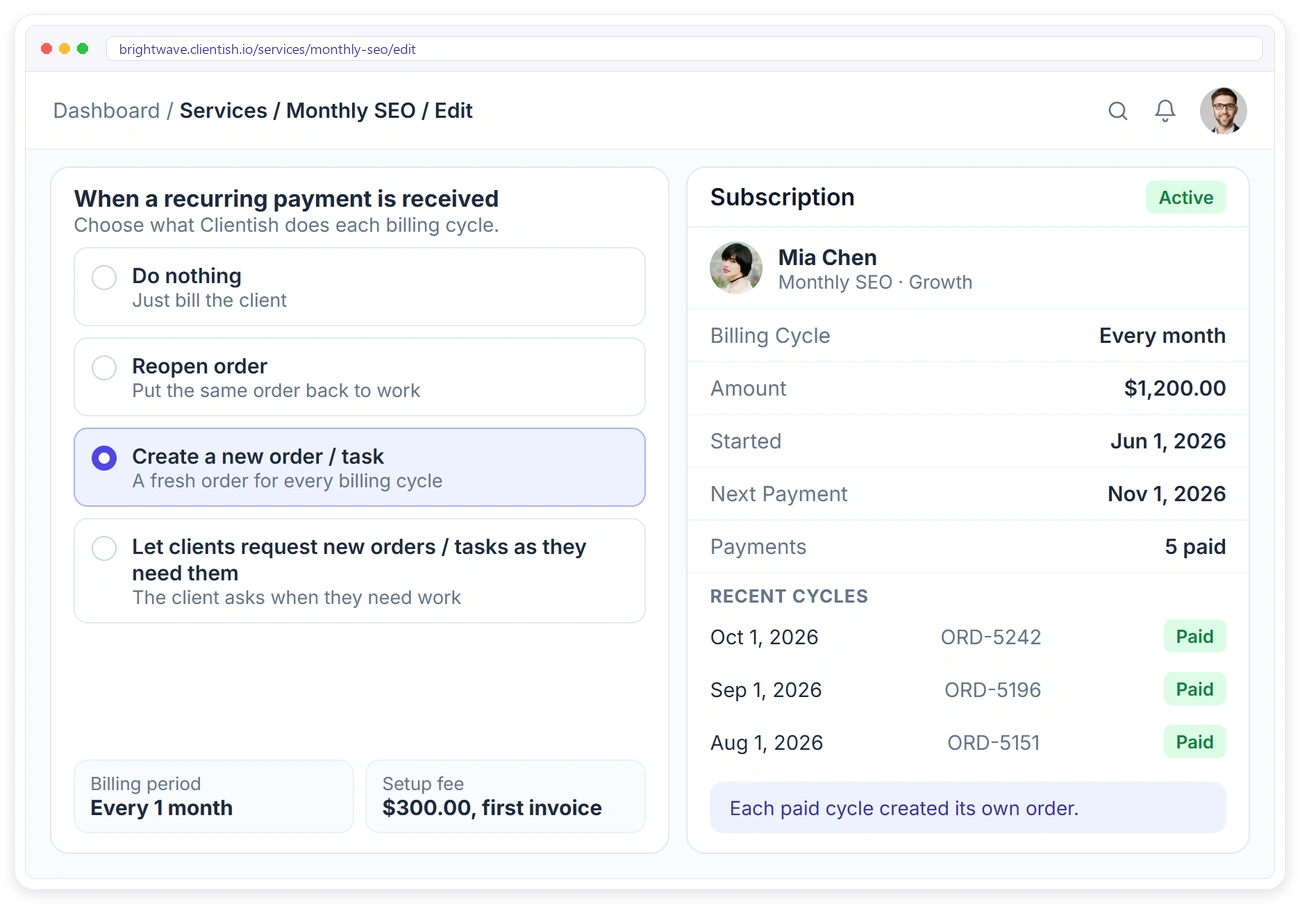
A signed agreement starts the engagement. The ongoing part is the real work: billing the recurring fee on time, tracking what each client has paid, getting the monthly report in front of the client, and fielding questions without a pile of back-and-forth email. The contract defines the deal, but a client portal is what keeps the month-to-month running.
- ✓A recurring subscription raises the retainer invoice every cycle, so you don’t create it by hand
- ✓Clients top up a prepaid balance and pay invoices from it
- ✓A branded client portal on your own subdomain with orders, invoices, subscriptions and balance
- ✓Clients open a support ticket with SLA response times instead of emailing you
- ✓Your own payment gateway, such as Stripe or PayPal, or bank transfer
Download the free SEO retainer template
The editable Word file with all 14 clauses plus signature blocks. Replace the brackets, add your branding and send it.
This template is a free, editable starting point, not legal advice. Laws vary by region, so have a qualified lawyer review it for your jurisdiction before you rely on it.
Frequently asked questions
Is this SEO retainer agreement template free to use?
Yes. It is free to download and edit in Google Docs or Word, with no watermark. Add your branding and use it across all your SEO clients.
Should an SEO contract guarantee rankings?
No. Guaranteeing specific rankings, traffic, or revenue is both unenforceable and against Google's own guidance, and it exposes you to refund claims. The template includes a no-guarantee clause that defines your obligation as the work and process, not a position on a results page.
How long should an SEO retainer last?
Because SEO results lag the work, an initial term of three to six months is common, which gives the strategy time to show results before either side reconsiders. After the initial term, most SEO retainers auto-renew monthly with a thirty-day notice period, which the template supports.
What access does an SEO agency need from the client?
Typically CMS or developer access, Google Analytics, Google Search Console, and Google Business Profile for local work, plus hosting access where technical changes are needed. The template lists these as client responsibilities so the handover is agreed up front.
How much should I charge for an SEO retainer?
That depends on scope, your costs, and your market, so the template leaves the fee as a field. As a rough guide, SEO retainers for SMB clients commonly run around $1,000–$5,000 per month (verify against your own market). For a floor, multiply your hourly rate by the scope's monthly hours and add a 20–30% margin.
Related Templates
If you run SEO alongside other services or want to tighten the rest of your client paperwork, these free templates pair well with this one: More free, editable templates from the Agency Templates Library.
Agency Retainer Agreement
The core retainer contract, ready to brand.
RETAINERPPC Retainer Agreement
Ad management scope, spend handling and reporting.
RETAINERSocial Media Retainer
Posts, reels and reporting defined per cycle.
CHECKLISTClient Onboarding Checklist
The 3-phase onboarding checklist for any agency.
CONTRACTStatement of Work (SOW)
Scope, deliverables, acceptance and milestones per project.
Monthly SEO Report
A clean recurring report clients actually read.
Coming soonCreative Agency Retainer
Design and branding retainers with revision limits.
RETAINERWeb Development Retainer
Maintenance and build hours with change-request terms.