
PPC Management Retainer Agreement Template
The most expensive mistake in a PPC engagement is not a bad campaign. It is a vague contract that blurs the line between your management fee and the client's ad spend, leaves the Google Ads account in the wrong hands, and says nothing about who owns the conversion data when the relationship ends.
Free to download and edit · No watermark · Add your own branding
Any one of those gaps can cost far more than the retainer itself.
This page gives you a free, editable PPC Management Retainer Agreement template built for agencies and freelancers running paid media, plus a plain-English breakdown of every clause, including the PPC-specific ones a generic or SEO retainer leaves out: the fee-versus-ad-spend separation, account ownership and access, performance reporting, and the exit terms that decide who keeps the data. Download it, add your branding, fill in the brackets, and send it before you touch a single campaign.
What Is a PPC Management Retainer Agreement?
Every PPC engagement runs on two separate pools of money, and the agreement that governs it has to keep them apart.
One pool is the management fee your agency earns for planning, running, and optimizing the campaigns. The other is the ad spend the client pours into Google, Meta, or Microsoft to actually buy the clicks. A PPC management retainer agreement is the recurring-fee contract that governs the first pool while making the client's responsibility for the second pool explicit, and it also pins down who controls the ad accounts, what you report, and how either side walks away.
That two-pool structure is the whole reason this agreement looks different from a standard retainer. When the split between fee and spend is left vague, the client cannot tell what reached the agency versus what reached the platform, and that confusion is behind a large share of paid-media disputes. Spelling the split out is the agreement's first job.
How it differs from a one-off project contract
Its second job is to settle ownership of something that quietly accumulates value: the ad account itself. Campaign history, audience lists, and conversion data all live inside that account, and whoever holds it holds years of learning. Unlike search work, where the value sits on the client's own website, a paid-media account can be built in a way that either frees the client or locks them in, so the contract has to say, up front, that the account belongs to the client.
How PPC Management Fees Are Usually Structured
How you price the first pool, the management fee, colours everything else in the relationship: the scope you can afford to deliver, the way you report, and how much the client trusts your budget recommendations. Three models dominate paid media.
Flat monthly fee
The client pays a fixed management fee regardless of ad spend. It is the cleanest model, the easiest for the client to understand, and the one that keeps your incentives aligned with performance rather than budget size.
Percentage of ad spend
Your fee is a percentage of what the client spends on ads — commonly quoted in the 10–20% range depending on account size and market, though the right number depends on your own cost structure and the complexity of the engagement. It scales with the account but carries a known perception problem: it can look like you are incentivized to grow spend rather than improve cost per result. If you use it, the agreement should address that tension directly.
Hybrid (base plus performance)
A base management fee plus a performance bonus tied to an agreed metric such as cost per acquisition or return on ad spend. It aligns incentives but needs a tightly defined bonus trigger to avoid disputes.
Flat fee suits most SMB engagements and is the easiest to defend; percentage suits large, scaling accounts where the work really does grow with spend; hybrid suits mature relationships with clean conversion tracking. Whichever you pick, the template's payment clause must state the model plainly and, critically, confirm that ad spend is separate from and additional to the management fee.
Why a PPC Retainer Agreement Protects You More Than You Think
Spending someone else's advertising budget in public auctions, every day, exposes you to failure modes a general retainer never has to think about. Four of them do the most damage, and the template answers each.
It stops the fee-and-spend confusion before it starts
When the contract states clearly that your fee covers management and ad spend is paid separately by the client to the platforms, you avoid the single most common PPC billing dispute: a client who thinks their $5,000 was all going to you, or all going to ads.
It protects you when results swing
Paid results move with auctions, seasonality, competitor bidding, and the client's own landing pages and offer. A results clause that defines your obligation as management and optimization (not a guaranteed cost per lead) keeps a bad month from becoming a refund fight.
It settles account ownership on your terms and theirs
A clear clause covering accounts under the client's business, client retains admin access, and data and audiences remain the client's on exit is what a serious client looks for and what keeps you from being accused of holding an account hostage.
It gives your exit structure
Paid campaigns do not pause cleanly; pausing mid-month can waste budget or lose momentum. A proper notice period and transition clause protect both the client's spend and your fee during the wind-down.
The Risks of a Vague PPC Retainer: Real Scenarios
Each gap in a PPC contract has a predictable way of blowing up. Here are the five that recur most in paid media, and the clause that would have stopped each one.
A client is billed $6,000 and assumes it was all management work. When they realize $4,500 went to Google and $1,500 to you, they feel misled and dispute the invoice — not because the split was unfair, but because the contract never spelled it out. A clause separating fee from spend would have made this a non-issue.
A client decides to leave and discovers the Google Ads account was created under the agency's manager account, with the agency as owner. Years of conversion history and audience lists are effectively trapped. Without an ownership-and-access clause, the client either starts from zero or pays to pry their own data loose.
On a percentage-of-spend deal, the client's cost per lead creeps up while spend grows. They accuse the agency of inflating budget to inflate its own fee. A contract that either used a flat fee or explicitly addressed the incentive — tying part of the fee to efficiency — would have defused the suspicion.
A client expected a 4x return on ad spend "because that's what the last agency promised" and demands money back when it lands at 2x. Without a clause defining the obligation as management rather than a guaranteed ROAS, the agency is arguing against a promise it never made.
Setup work, creative production, and landing-page changes were billed on top of the management fee, but the contract listed only "PPC management". The client calls it bait-and-switch. A scope clause that lists what the fee does and does not cover would have prevented it.
Every scenario above traces back to a clause the template includes.
The Key Components of a PPC Management Retainer Agreement
Alongside the usual retainer clauses, the template carries a set written specifically for paid media, the ones that deal with the two money pools, the ad account, and platform risk. Each is explained below, with the PPC-specific ones marked.
Parties Involved
The legal names and addresses of the agency (or freelancer) and the client, establishing which entities the agreement binds.
PPC Scope of ServicesSpecific to this template
The management work included each cycle: account setup or restructure, campaign strategy, keyword and audience research, ad creation, bid and budget management, conversion tracking setup, A/B testing, and optimization across the agreed platforms. List the platforms explicitly (Google Ads, Meta, Microsoft Ads) and list what is excluded, such as landing-page development, creative design beyond ad assets, and SEO.
What this looks like in practice: The template includes a line such as: "Services are limited to paid search and paid social campaign management on Google Ads and Meta Ads only. Landing page design, organic SEO, email marketing, and graphic design beyond static ad creatives are excluded from this agreement." The common drafting mistake is writing "manage client's digital advertising" with no platform list, which a client will read as including whatever channel they decide to launch next quarter.
Management Fee and Ad SpendSpecific to this template
The clause that prevents the most disputes. State the management fee and its model (flat, percentage, or hybrid) and state unambiguously that ad spend is separate from the management fee and is paid by the client directly to the advertising platforms (or reimbursed to the agency if the agency fronts it). Spell out who holds the platform billing and what happens if ad spend changes.
What this looks like in practice: If you run ads on a company card and invoice the client later, state the reimbursement window explicitly. For example: "Any ad spend fronted by the Agency will be invoiced to the Client within five business days and is due within seven days of invoice." Skip that sentence and you are effectively offering the client a rolling credit line. A common mistake is writing only "ad spend is billed separately" without defining who holds the card, who is liable if the card is declined, and how quickly the agency is made whole.
Performance Reporting and MetricsSpecific to this template
What you report and how often: typically a monthly report covering spend, impressions, clicks, CPC, conversions, CPA, and ROAS against agreed goals, plus a review call. Defining the metrics in writing turns "I don't know if this is working" into a shared scorecard.
Results Expectations and DisclaimerSpecific to this template
A plain statement that paid-media results depend on auction dynamics, competition, seasonality, the client's offer and landing pages, and platform policies, so the agency does not guarantee a specific cost per acquisition, return on ad spend, or conversion volume. The obligation is professional management and optimization, not a guaranteed number.
Account Ownership and AccessSpecific to this template
The clause serious clients look for first. State that advertising accounts are owned by the client (created under or transferred to the client's business), that the client retains admin access throughout, and that all campaign data, creative assets, and audience lists remain the client's property on termination. This is what stops an account-hostage situation at exit.
What this looks like in practice: The template includes a line such as: "All Google Ads, Meta Ads, and Microsoft Ads accounts shall be created in or transferred into the Client's own Business Manager or Google account. The Agency shall operate as an admin user and shall not hold sole ownership of any advertising account at any time." The edge case agencies routinely miss: audience lists and conversion events built inside a client's pixel or Google tag. If your clause covers "accounts" but not "audience data and tracking assets," a departing client may find their remarketing lists are inaccessible because they were built inside an agency-owned asset.
Platform Policy ComplianceSpecific to this template
A statement that the agency follows the advertising policies of each platform and that accounts can be suspended by the platform for reasons outside the agency's control. It protects you if a platform disapproves an ad or suspends an account for the client's product, offer, or history.
Payment Terms
The billing date, accepted methods, and late fee for the management fee, and whether it is billed in advance (standard) or in arrears.
Client Responsibilities
What the client must provide: timely access to accounts and billing, approvals of ads and budgets, landing pages, product or offer information, and conversion-tracking access. Paid campaigns stall or waste budget when the client is slow here.
Duration, Renewal and Termination
The start date, initial term, renewal, and notice period. PPC needs a learning period, so a short initial term (often one to three months) with a standard thirty-day notice is common. Avoid the lock-in traps clients are warned about (long auto-renewals with short cancellation windows) and include a clean transition clause (see below).
Transition on ExitSpecific to this template
What happens at the end: the agency hands over or confirms the client's ownership of accounts, removes its own access by an agreed date, and the client keeps all data and assets. A defined transition prevents campaigns from being paused abruptly or data being lost in the handover.
What this looks like in practice: The template specifies a handover window: "Within seven business days of the termination date, the Agency will remove its admin access from all advertising accounts and provide the Client with a written confirmation that account ownership has been verified." The edge case most agencies leave out is what happens to campaigns during those seven days. If the agreement is silent, there is no obligation to keep campaigns running or to pause them during the handover, which means a client can lose live traffic with no warning. Naming the transition period and stating whether the agency will maintain or pause campaigns during it closes that gap.
Confidentiality, IP, Liability and Signatures
How each side handles confidential information; ownership of deliverables on full payment (with the agency retaining its own tools and methods); a liability cap tied to the management fees paid; and signature blocks that make the agreement binding.
The clause most PPC templates skip
Most PPC templates cover the fee split but omit a budget-change and approval clause: a short term stating that the agency will not increase monthly ad spend beyond the agreed budget without the client's written approval, and that the client will not slash budget mid-flight without notice. Budget moved without agreement is where trust breaks on both sides. The agency gets blamed for overspend, or has its results wrecked by a surprise cut. The free template includes it.
Tips and Best Practices for a PPC Retainer That Holds Up
A signed template is only as good as the habits behind it. These are the practices that keep a paid-media retainer honest once real budget is flowing through it.
Separate the fee from the spend on every invoice, not just in the contract
A client who sees "$1,500 management + $4,500 ad spend" each month never develops the suspicion that sinks percentage-based relationships.
If you charge a percentage, address the incentive head-on
State in the agreement that recommendations are made on performance, not budget size, and consider tying part of the fee to efficiency so your interests visibly align with the client's.
When a client insists the account stays under your MCC, document what that means for them
Put it in writing that account access, historical data, and billing transfer to the client upon exit, and set a specific handover process. "Staying under our MCC for operational ease" is a reasonable request; it should not silently become "we own your history."
If a platform forces a billing change mid-retainer, treat it as a formal contract event, not an admin footnote
Causes include a card decline, a gateway policy update, or a platform migration. Notify the client in writing, confirm the new billing arrangement, and attach a short written amendment if any fee timing changes. Platforms move faster than retainer cycles; build the habit of documenting it when they do.
Specify what the learning period covers and what it does not
A clause that says "results are not guaranteed during the platform learning period" is reasonable; one with no end date and no minimum activity requirement can be used to delay accountability indefinitely. Name the platform, name the approximate window (typically two to four weeks per campaign), and confirm that the agency's obligations (reporting, communication, optimisation activity) run in full from day one regardless.
Set a concrete first-month deliverable that sits outside performance
A completed account audit, a keyword structure document, a negative keyword list — something the client can evaluate independently of ROAS. It gives the learning period clause a clear boundary: "learning period" explains why conversions are still ramping, not why nothing is happening.
Keep the term short and the exit clean
A short initial term with a fair notice period and a defined transition earns more renewals than a lock-in ever forces. Cap your liability at the management fees paid, and have a lawyer review the agreement once for your jurisdiction.
How to Use the Free PPC Retainer Agreement Template
Getting it client-ready takes four steps.
Work from a copy
Download the Word (.docx) file, or upload it to Google Docs, and work on your copy, not the original.
Complete the brackets
Every [bracketed] field is a placeholder: work through the main categories in order — party names, platforms, fee model, ad-spend handling, and notice period — so nothing gets missed.
Brand it
Add your logo, colours, and footer so it reads as your agency's document, not a stock template — and remove any remaining template branding before sending, since clients who spot unfamiliar wording may Google it and find the source.
Route it for signature
Send the finished agreement through an e-signature tool such as DocuSign or PandaDoc to get both parties signed; once executed, each party should receive a countersigned copy, and store the signed PDF somewhere the client can retrieve it if needed.
Managing a PPC Retainer After the Agreement Is Signed
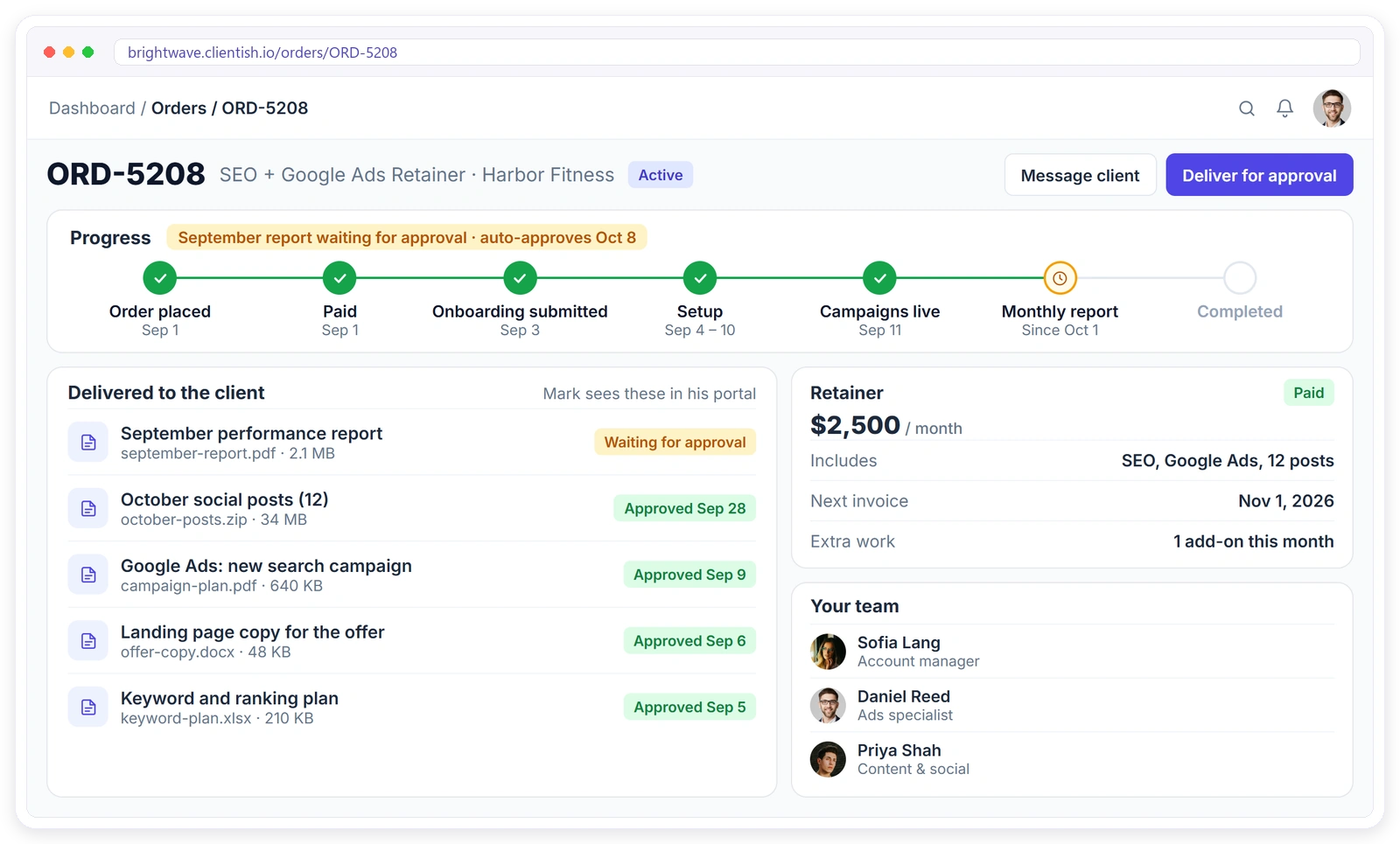
The hard part of a PPC retainer is not the paperwork; it is the monthly rhythm once campaigns are live. Every cycle you invoice the management fee, keep the fee and the ad-spend reimbursements from blurring together, put the performance numbers in front of the client, and field a stream of budget-change and approval requests before they pile up in your inbox. The contract fixes the terms once; keeping that rhythm moving is a tooling problem.
- ✓A recurring subscription raises the retainer invoice every cycle, so you don’t create it by hand
- ✓Clients top up a prepaid balance and pay invoices from it
- ✓A branded client portal on your own subdomain with orders, invoices, subscriptions and balance
- ✓Clients open a support ticket with SLA response times instead of emailing you
- ✓Your own payment gateway, such as Stripe or PayPal, or bank transfer
Download the free PPC management retainer template
The editable Word file with all 12 clauses plus signature blocks. Replace the brackets, add your branding and send it.
This template is a free, editable starting point, not legal advice. Laws vary by region, so have a qualified lawyer review it for your jurisdiction before you rely on it.
Frequently asked questions
Is this PPC retainer agreement template free to use?
Yes — download and edit it in Google Docs or Word, with no watermark. Brand it and reuse it across every paid-media client you take on.
What if the client wants to pay the management fee monthly but ad spend quarterly?
You can structure it that way, but spell it out explicitly in the payment terms section. Define separate billing cycles for each, confirm who holds the ad spend funds in the interim, and clarify what happens if the quarterly ad spend payment is late — does management pause? A single vague "payment" clause covering both creates the ambiguity that leads to disputes.
Can I use this template for a white-label arrangement where I'm the sub-agency?
Yes, with adjustments. If you're operating under a lead agency's brand, you'll want to replace the client-facing party details with the lead agency, add a confidentiality clause that covers their client relationship, and ensure the IP and account-ownership sections reflect that the end client's data doesn't flow to you on exit. The template's structure supports this — you're primarily editing the parties, ownership, and exit clauses.
Do I need a separate agreement for each platform, or can one cover Google, Meta, and Microsoft Ads?
One agreement can and should cover all platforms you're managing. The scope-of-services section is where you list each platform explicitly, along with the specific account IDs where possible. A single agreement reduces admin overhead, but be precise: if you later add a platform mid-retainer, document it as a written amendment rather than a verbal add-on.
Should a PPC contract guarantee a specific ROAS or cost per lead?
No. Paid results depend on auctions, competition, seasonality, and the client's own offer and landing pages, so guaranteeing a number invites refund claims. The template defines the obligation as professional management and optimization, with results reported against agreed goals rather than guaranteed.
Flat fee or percentage of ad spend — which should I use?
A flat fee is cleanest and keeps your incentives on performance rather than budget size, while a percentage fits large, scaling accounts but can look like an incentive to grow spend. A hybrid base-plus-bonus suits mature accounts. The template supports all three.
Related Templates
If you run paid media alongside other services or want to tighten the rest of your client paperwork, these free templates pair well with this one: More free, editable templates from the Agency Templates Library.
Agency Retainer Agreement
The core retainer contract, ready to brand.
RETAINERSEO Retainer Agreement
Scope and deliverables for monthly SEO work.
RETAINERSocial Media Retainer
Posts, reels and reporting defined per cycle.
CHECKLISTClient Onboarding Checklist
The 3-phase onboarding checklist for any agency.
CONTRACTStatement of Work (SOW)
Scope, deliverables, acceptance and milestones per project.
RETAINERPPC Retainer Agreement
Ad management scope, spend handling and reporting.
RETAINERCreative Agency Retainer
Design and branding retainers with revision limits.
RETAINERWeb Development Retainer
Maintenance and build hours with change-request terms.