
Agency Retainer Agreement Template
A retainer is the difference between predictable agency revenue and a feast-or-famine scramble every month. But a retainer only protects you if it is written down.
Free to download and edit · No watermark · Add your own branding
A verbal "we'll do your social for $2,000 a month" has no scope, no payment terms, and no exit, which is exactly how agencies end up doing unpaid work, chasing late invoices, and losing clients with no notice.
This page gives you a free, editable Agency Retainer Agreement template, plus a plain-English breakdown of every clause it contains, why each one matters, and how to use the document once you have it. Download it, add your branding, fill in the brackets, and send it before the next cycle starts.
What Is an Agency Retainer Agreement?
An agency retainer agreement is a contract in which a client pays your agency a set fee on a recurring schedule (usually monthly) in exchange for an agreed scope of ongoing work.
Instead of quoting and signing a new contract for every project, both sides agree once on what gets delivered each cycle, what it costs, and how the relationship runs.
It is different from a one-off project contract in one important way. A project contract ends at delivery. A retainer covers an ongoing relationship with no fixed end point, so it has to answer questions a project contract never does: what happens when the work grows beyond the agreed scope, how either side gives notice to leave, and how the recurring fee is billed and collected.
What a retainer agreement has to settle
Because the relationship has no natural closing date, there is no built-in moment that legally resets the terms, so ambiguities a client might tolerate on a short project can quietly compound into disputes months later. That is the specific gap a retainer agreement is designed to close — which is also why most agencies introduce a retainer after a successful first project, once both sides have enough trust and working history to commit to an ongoing arrangement with confidence.
For the agency, a retainer turns unstable project income into a baseline it can forecast and staff against. For the client, it means guaranteed access to your team without renegotiating every time they need something. The written agreement is what keeps that arrangement fair when the details get tested.
Choose Your Retainer Model First
Before you fill in the template, decide which of the three common retainer models you are selling. The model shapes how you write the scope and payment clauses, and getting it clear up front prevents most mid-contract disputes.
Fixed deliverables
The client pays a set fee for a fixed list of outputs each cycle, such as eight posts and one report a month. It is the easiest model to scope and the easiest for a client to understand.
Bank of hours
The client buys a set number of hours per cycle (say 20 hours a month) and the agency applies them to whatever the client needs. This gives flexibility but needs clear rules on whether unused hours roll over and what happens when the client goes over.
Access and management
The client pays for ongoing availability and oversight, such as managing their ad accounts or acting as their retained strategist, rather than a fixed output count. Scope here is defined by responsibility, not deliverables.
Fixed deliverables suits productized services and clients who want predictability; bank of hours suits strategic or advisory work where output volume varies; access-and-management suits clients buying expertise rather than execution. If you are unsure, choose fixed deliverables — it is the easiest to enforce and closes the most common gap: a mismatch between model and scope that makes clients expect unlimited access when only fixed outputs were sold.
Why Your Agency Needs a Retainer Agreement
A signed retainer agreement is not paperwork for its own sake. It solves several problems that quietly erode agency margins.
A signed agreement changes how clients pay
An agency running a $4,500/mo content retainer on a verbal understanding typically invoices at the end of the month and waits — sometimes 45 days — because the client never technically agreed to a billing date. The moment that same scope goes into a signed agreement with a fixed billing date of the 1st and a 7-day net term, the invoice becomes an expected line item on the client's end rather than a surprise they triage when they get around to it.
It gives you something concrete to hire against
An agency carrying three informal retainers at $3k/mo each can't justify a hire because none are on paper — one email cancellation and the headcount projection collapses. A signed agreement with a 60-day termination clause converts that same $9k/mo into a number a bookkeeper will actually put in a forecast, which is what a lender or staffing agency needs before they'll take you seriously.
It signals that you run a real operation
When a $6k/mo brand strategy client asks to add paid media management mid-retainer, the agency on a handshake deal has no baseline to point to — the client assumes it's included and the conversation gets awkward fast. An agency with a signed scope-of-work attachment can pull up the document in the same meeting, show exactly what's in and out, and table a change-order within 24 hours rather than spending a week trying to reconstruct what was originally agreed over Slack.
The Risks of Not Using a Retainer Agreement: Real Scenarios
Abstract risks are easier to ignore than concrete ones. Here is what each gap in a retainer agreement actually looks like when it goes wrong.
A social media client asks your team to "quickly redo the website copy" in month three. This is the most common month-three conversation for social media agencies because content retainers are the easiest for clients to mentally expand into "digital" work broadly. There is no documented scope, so the conversation turns into a negotiation you were not prepared for — you either absorb twelve hours of unpaid work or risk losing the relationship over a boundary that should have been set on day one.
You deliver a full month of SEO work, then the invoice sits unpaid for 45 days. Without an agreed payment schedule or late-fee clause, your follow-up emails carry no weight and your options narrow to writing it off or ending the relationship.
An e-commerce client decides to move their paid media in-house. They claim the Google Ads account — built on their billing, managed by your team — belongs entirely to them, including the historical data and audience lists your strategist spent months building. Without an IP and asset clause, you have no written position to stand on. Bear in mind that platform terms of service also govern account ownership independently of your contract, so your agreement should also specify who controls account credentials and what access is revoked on termination — your clause and the platform's rules need to work together, not against each other.
A retained PR client calls on the 14th to say they are pausing indefinitely. PR retainers are particularly exposed here because media outreach cycles, journalist relationships, and third-party placement fees are often committed well before the month's midpoint, leaving agencies holding costs the client never sees. You have already committed staff time and a third-party media contact fee for that month. A notice period clause would have given you two to four weeks to backfill; instead, you absorb the loss immediately.
A client blames a delayed email campaign for a failed product launch and cites five figures in lost revenue. Without a liability cap tied to fees paid, that claim has room to grow far beyond what the retainer was ever worth.
Each clause that prevents one of these scenarios is included in the template below.
The Key Components of an Agency Retainer Agreement
These twelve clauses appear in the free template in this order — here is what each one does.
Parties Involved
The legal names and addresses of both the agency and the client. This establishes exactly which entities are bound by the agreement, which matters if either side operates under multiple business names or needs to enforce the contract later.
Scope of Services
The heart of the agreement, and the clause most worth getting right. List exactly what the client receives each cycle as concrete tasks, deliverables, or hours, not vague descriptions. "Social media management" invites arguments. "Eight feed posts, two reels, community management, and a monthly performance report" does not.
Payment Terms
The retainer fee, the billing date, accepted payment methods, and any late-payment fee. State clearly whether the fee is billed in advance of the work or in arrears. Billing in advance is standard for retainers and protects your cash flow.
Scope Adjustments
How out-of-scope requests are handled. The clause should state that any work beyond the agreed scope is quoted and approved in writing before it begins. This single clause is your main defence against scope creep.
Duration, Renewal and Termination
The start date, the length of the initial term, how it renews, and the notice period either party must give to end the agreement. Most retainers auto-renew for successive cycles unless one side gives notice, so the template includes auto-renewal language you can keep or remove. A thirty-day notice period is common and gives both sides time to adjust.
Deliverables and Responsibilities
What the agency is responsible for delivering, and to what standard or turnaround time. Being specific here sets expectations and gives you a reference point if the client ever claims the work fell short.
Client Responsibilities
What the client must provide for the work to proceed, such as account access, timely approvals, brand assets, and feedback. Retainer work often stalls because the client is slow to deliver their part, and this clause makes that responsibility explicit.
Confidentiality and Non-Disclosure
How each party handles the other's confidential information during and after the engagement. Agencies see sensitive client data constantly, and clients want assurance it stays private. This clause protects both sides.
Dispute Resolution
The agreed path for handling disagreements, whether that is mediation, arbitration, or the courts, and which jurisdiction's law applies. Settling this in advance keeps a disagreement from escalating into an expensive, uncertain fight.
Indemnification and Liability
A cap on what the agency is liable for, usually tied to the fees paid under the agreement. This is one of the most important clauses for protecting your business, because it stops a single issue from costing you far more than the contract was worth.
Intellectual Property Rights
Who owns the deliverables, and when ownership transfers. Many agreements assign ownership to the client only on full payment, which protects you if an invoice goes unpaid. Spell out what transfers and what the agency retains.
Signatures and Date
Signature blocks and the date for both parties. The agreement becomes legally binding once both sides have signed, so this section, simple as it is, is what makes the whole document enforceable.
Two clauses most templates skip
The twelve above are the backbone, but two more are where agencies actually get burned around month six, and the free template includes both.
- Unused capacity and over-servicing. If you sell a bank of hours, state whether unused hours roll over and what happens when the client goes over. Without this, you either eat the extra work or face an argument about a backlog you never agreed to clear.
- General provisions. A short block covering independent-contractor status, assignment, force majeure, notices, entire agreement, and severability. These rarely come up, but when they do, their absence is expensive. The template includes them so you do not have to draft them from scratch.
Tips and Best Practices for a Retainer That Holds Up
A template gives you the structure. These practices make the agreement actually work in the real world.
Define scope as a list, not a sentence
The more specific the deliverables, the fewer arguments you will have about what is and is not included.
Keep deliverables measurable
"Monthly report" is weak. "A performance report delivered by the fifth of each month" is something you can be held to and can prove you met.
Create a paper trail when a client verbally okays extra work
Clients often say yes to additional work on a call before you have raised a written quote. That verbal agreement is unenforceable on its own. The moment the call ends, send a follow-up email that captures the approval in writing. A practical formula: "Following our call today — just to confirm, you've given the go-ahead for [brief description of extra work]. I'll have a formal quote with scope and cost to you by [date], and we'll proceed once that's signed off." This creates a dated record of the client's intent, keeps the formal approval step intact, and signals clearly that verbal okays do not replace written sign-off. If the client pushes back on the quote later, you have evidence they already agreed in principle.
Vague scope is where retainers quietly fall apart. Agencies regularly report clients attempting to expand a social media retainer to include web work or broader digital services because "it's all digital marketing, right?" A tight scope list closes that door before it opens.
Bill in advance
Charging at the start of each cycle protects your cash flow and filters out clients who are not serious about committing.
Word your notice clause to match the contract term
For month-to-month retainers, thirty days' written notice is standard — state that notice must be given before the next billing date or that cycle's fee is still owed. For annual retainers, specify that early termination requires either the remaining months' fees or a lump-sum buyout amount. If a client refuses to honour the notice period and simply stops responding, your clause should explicitly state that outstanding fees become immediately due and that you reserve the right to suspend deliverables and pursue recovery. This gives you standing to act rather than chase goodwill.
Review and renew annually
Revisit the scope and fee once a year. Retainers that never get revisited are where agencies quietly underprice themselves as the work grows.
These clauses only work if they are specific enough to act on. A clause that says "reasonable notice" gives you nothing when a client ghosts you after month two.
Cap your liability
Tie your maximum liability to the fees paid, so one issue can never dwarf the value of the contract.
Have a lawyer review it once
Use the template to draft, then get a one-time legal check for your jurisdiction before you rely on it across clients.
How to Use the Free Retainer Agreement Template
The template is ready to use in four steps.
Make a copy
Download the Word (.docx) file, or upload it to Google Docs, and work on your copy, not the original.
Fill in the brackets
Every field in [square brackets] is a placeholder.
Add your branding
Drop in your logo, colours, and footer so the document looks like it came from your agency, not a generic template.
Send it to sign
Share the finished agreement for electronic signature using a standalone e-signature tool such as DocuSign or PandaDoc.
Replace them with your agency details, the client's details, the agreed scope, the fee, and the term.
If a client requests changes, treat the scope and payment clauses as non-negotiable minimums and flag any liability or IP edits to your lawyer before accepting them. Keep a version log so both sides are always working from the same draft.
Managing Retainers After the Agreement Is Signed
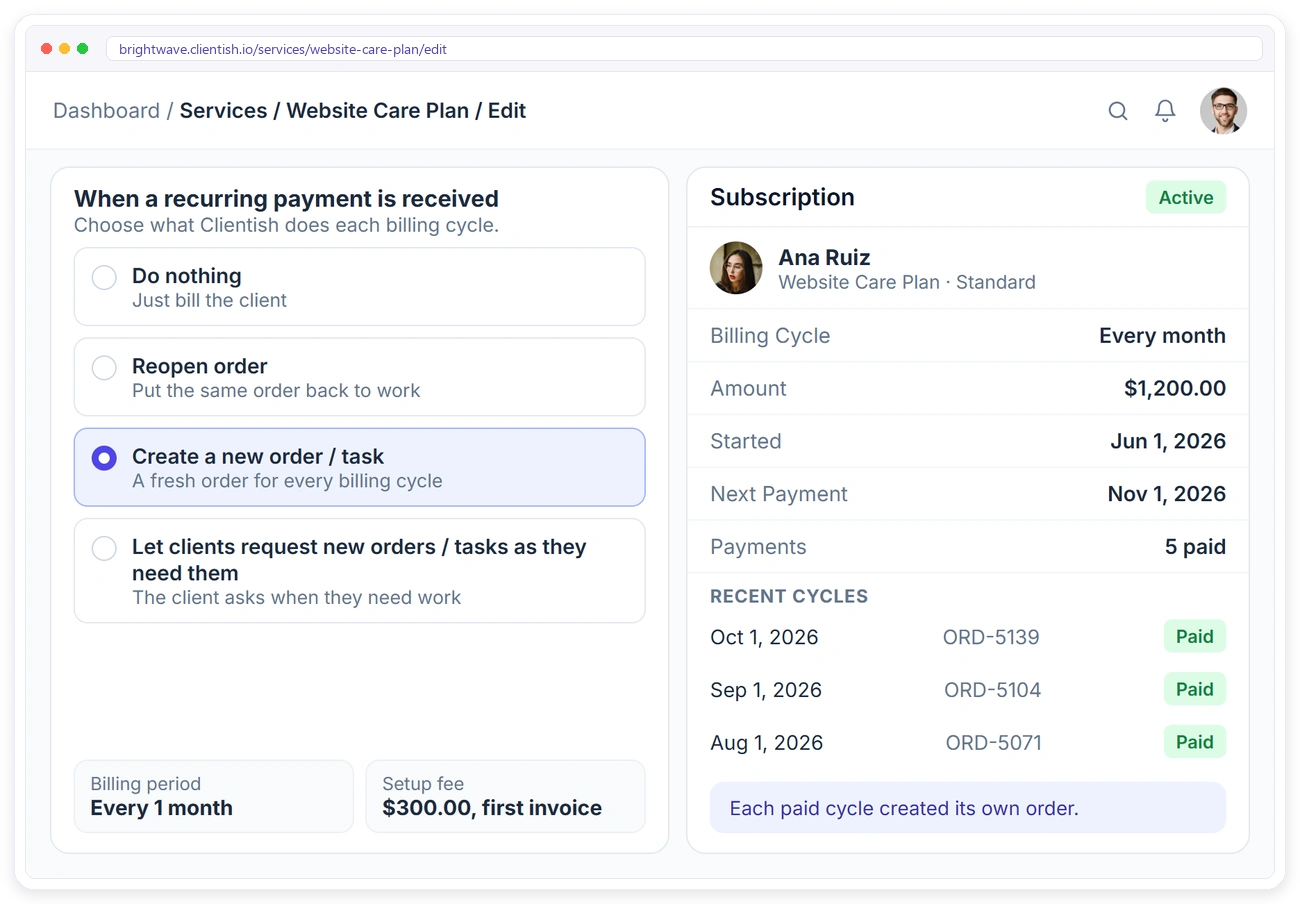
A signed agreement starts the relationship. The harder part is running it month after month: billing the recurring fee on time, tracking what each client has paid, delivering the agreed work, and keeping the client informed without a stream of status emails. That is where a template stops and a tool takes over.
- ✓A recurring subscription raises the retainer invoice every cycle, so you don’t create it by hand
- ✓Clients top up a prepaid balance and pay invoices from it
- ✓A branded client portal on your own subdomain with orders, invoices, subscriptions and balance
- ✓Clients open a support ticket with SLA response times instead of emailing you
- ✓Your own payment gateway, such as Stripe or PayPal, or bank transfer
Download the free retainer template
The editable Word file with all 12 clauses plus signature blocks. Replace the brackets, add your branding and send it.
This template is a free, editable starting point, not legal advice. Laws vary by region, so have a qualified lawyer review it for your jurisdiction before you rely on it.
Frequently asked questions
Is this retainer agreement template free to use?
Yes. The template is free to download and edit in Google Docs or Word, with no watermark. Add your own branding and use it across all your clients.
Is this template legally binding?
The template becomes binding once both parties sign it. It is drafted as a solid starting point, but laws vary by region, so have a lawyer review it once for your jurisdiction before relying on it.
What is the difference between a retainer and a project contract?
A project contract covers a single scoped project and ends at delivery. A retainer covers ongoing work billed on a recurring schedule with no fixed end date, so it adds clauses for scope adjustments, recurring payment, and notice-based termination.
How much should an agency charge for a retainer?
That depends on scope, your costs, and your market, so the template leaves the fee as a field for you to set. As a rough guide for SMB clients, SEO retainers commonly run around $1,000–$5,000/mo, PPC around $1,000–$3,000 (excluding ad spend), social media around $750–$3,000, and content around $2,000–$6,000 (verify against your own market). For a floor check, multiply your hourly rate by the scope's monthly hours, add a 20–30% margin, and make sure it beats your project rate for the same hours.
Can I use this for SEO, PPC, or social media retainers?
Yes. This is the general agency version. The scope section is where you tailor it to your service, and specialised versions for SEO, PPC, web development, and social media retainers are available as separate templates.
Related Templates
If you run more than one kind of retainer or want to tighten the rest of your client paperwork, these free templates pair well with this one: More free, editable templates from the Agency Templates Library.
SEO Retainer Agreement
Scope and deliverables for monthly SEO work.
RETAINERCreative Agency Retainer
Design and branding retainers with revision limits.
RETAINERWeb Development Retainer
Maintenance and build hours with change-request terms.
CHECKLISTClient Onboarding Checklist
The 3-phase onboarding checklist for any agency.
CONTRACTStatement of Work (SOW)
Scope, deliverables, acceptance and milestones per project.
PROJECTChange Request Form
Turn scope creep into a priced, approved decision.
RETAINERPPC Retainer Agreement
Ad management scope, spend handling and reporting.
RETAINERSocial Media Retainer
Posts, reels and reporting defined per cycle.