
Creative Agency Retainer Agreement Template
Creative work breaks down over two things a contract can fix in a sentence each: endless revisions, and who owns the file.
Free to download and edit · No watermark · Add your own branding
The client who expects a fourth and fifth round at no charge, and the one who assumes "I paid for the logo, so I own your working Illustrator file" — both are avoidable, and both are expensive when the agreement stays silent.
This page gives you a free, editable Creative Agency Retainer Agreement template for design, branding, and content studios, plus a plain-English breakdown of every clause, including the creative-specific ones a generic retainer skips: revision limits, usage rights and licensing, source-file ownership, turnaround commitments, and portfolio rights. Download it, add your branding, fill in the brackets, and send it before the next brief lands.
What Is a Creative Agency Retainer Agreement?
What a client buys on a creative retainer is not a thing; it is access to your studio's capacity and taste, applied to whatever they need that month.
A creative agency retainer agreement is the recurring-fee contract that defines that access: how much creative capacity the client gets each cycle, how revisions and turnaround work, who ends up owning the finished work and the editable files, and how the whole arrangement runs and ends. Design, branding, content, illustration, motion, or a blend of all of them can sit under it.
Because you are selling capacity rather than a fixed deliverable, two things have to be nailed down that a project contract never worries about. The first is the unit of that capacity, whether the client is buying hours, a request queue, or a named slice of a designer's time, because without a unit the retainer has no ceiling. The second is the revision boundary, since creative feedback is subjective and will loop indefinitely unless the contract says where a round ends and new work begins.
How it differs from a one-off project contract
Then there is ownership, which in creative work is not one question but three. The final deliverable, the licence to use it, and the layered source file are distinct things, and a careless contract collapses them into a single "you paid, so it's yours." A retainer fee buys the right to use the work; whether it also hands over the editable Figma or Photoshop file, and whether the work can be used anywhere forever, are separate decisions the agreement should make deliberately rather than by accident.
Choose Your Unit of Creative Capacity First
The unit of capacity is the first thing to settle, because the scope, revision, and rollover clauses all hang off it. Three models cover most creative studios.
Hours or allocation
The client buys a block of creative hours per cycle (say 40 hours a month), or a named percentage of a designer's time. Flexible, but needs clear rules on what counts and what rolls over.
Request queue with turnaround
The client submits requests into a queue and you commit to a throughput — "up to two active requests at a time, each turned around in two to three working days." Common for productized design studios.
Fixed deliverables
A set list of creative outputs per cycle, such as "eight social graphics, one email design, and one landing-page mockup." Easiest to scope and price.
Hours suit varied, strategic creative work; a request queue suits high-volume productized design; fixed deliverables suit predictable monthly output. The model you pick decides how you write the scope and revision clauses — a request queue needs a turnaround commitment a fixed-deliverables retainer does not, and an hours model needs a rollover rule the others can skip.
Why a Creative Retainer Agreement Protects You More Than a Project Contract
An open-ended creative relationship builds up pressures a one-off project never lives long enough to feel. Four of them quietly drain a studio's margin, and the template answers each.
It stops revisions from eating your margin
A stated number of rounds, with a clear definition of what a round is and an hourly rate beyond it, is the difference between a profitable retainer and one where every piece quietly spirals into unpaid rework. A per-project contract ends at delivery, so there is no mechanism to bill for the revision cycles that accumulate across a continuous relationship.
It settles the source-file question before it becomes a fight
Making explicit that the fee buys the final deliverable and a usage license, while editable source files are quoted separately, protects your working process and prevents the "I own everything" dispute at exit. A per-project contract typically covers only that project's deliverables, leaving ownership of assets created in later months undefined and contested.
It defines capacity so the client cannot overload it
A named unit — hours, a request limit, a turnaround — gives you something to point to when a client treats an ongoing retainer as unlimited creative on tap. A per-project contract scopes a single brief, so it provides no reference point once that brief is complete and the next wave of requests begins.
It keeps your portfolio rights
A short clause confirming you can show the work in your portfolio, unless the client asks otherwise, protects the marketing value of your best creative. A per-project contract grants no such standing permission, meaning a long-term client could block you from showing months of accumulated work simply because it was never addressed.
The Risks of a Vague Creative Retainer: What Each Failure Actually Costs
Abstract risks are easy to wave off, so here is each one as it actually plays out in a studio, with the clause that would have contained it.
A client sends a sixth round of "small tweaks" on a logo, each reopening earlier decisions. Without a revision cap and a definition of what counts as a round, you either absorb days of unpaid work or become the agency that "won't just make it right." At a blended rate of $100–$150 an hour, three unplanned revision rounds on a single deliverable can erase the margin on an entire month's retainer fee.
The client leaves and demands every layered Figma and Illustrator file, insisting the retainer fee bought them. Without a clause separating the deliverable and license from the editable source, you either surrender files that represent years of reusable work or spend the exit arguing about what was ever included.
You design a campaign for the client's social channels, and a year later it is on billboards and product packaging worldwide. The fee covered a limited use; without a usage-rights clause, you have no contractual basis to charge for the expanded licensing, and retroactive negotiation almost never recovers the full market rate. Agencies that have pursued this route typically settle for a fraction of what a pre-agreed licensing schedule would have earned.
A "design retainer" with no defined unit becomes a firehose, the client queues fifteen requests in a week and treats slow turnaround as a failure. A capacity and turnaround clause would have set the ceiling before resentment, and burnout, built on both sides.
A light month passes with hours unused; the client assumes they bank and demands them all back in a heavy month. The clause clients skim and later resent is the rollover rule, and its absence turns a quiet month into an argument that can sour the whole engagement.
Each of those outcomes is one the template is built to prevent.
The Key Components of a Creative Agency Retainer Agreement
On top of the usual retainer clauses, the template adds the ones a studio actually lives by: capacity, revisions, turnaround, and the three layers of ownership. Each is explained below, with the creative-specific ones marked.
Parties Involved
The legal names and addresses of the studio (or freelancer) and the client, establishing which entities the agreement binds.
One agency-specific detail worth getting right here: name the operating entity, not the trading name. If your studio operates as "Bright Studio Ltd" but trades as "Bright Creative," the agreement should reference the registered legal name, Bright Studio Ltd, with the trading name noted in brackets if helpful. The reverse error (naming only the trading name) means the agreement may not bind the actual legal entity if a dispute reaches a lawyer.
The client side carries its own trap. A common exit-day problem is an agreement signed by a holding company, say "Acme Group Holdings Ltd", while all the day-to-day instructions, briefs, and approvals came from a subsidiary, "Acme Marketing Ltd." If the subsidiary is not named in the agreement, it is not bound by it.
When your client contact works for a subsidiary or operating company rather than the group entity that signs the paperwork, name both: the holding company as the contracting party and the subsidiary as the authorised representative for operational purposes. This one line prevents ambiguity about who owes payment and whose instructions you are contractually entitled to follow.
Creative Scope and CapacitySpecific to this template
The heart of a creative retainer. State the unit of capacity (hours, request queue with a concurrency limit, or fixed deliverables) and what creative services are included — for example brand design, social graphics, content, motion — and what is excluded, such as large projects that need a separate statement of work. This stops a monthly retainer from absorbing a full rebrand at retainer rates.
RevisionsSpecific to this template
The clause that protects your margin. State how many revision rounds are included per deliverable (two is common), define a round as one consolidated set of feedback rather than a trickle of individual notes, and set the hourly rate for work beyond the included rounds. Reopening an approved decision counts as new work, not a revision.
Turnaround and AvailabilitySpecific to this template
For queue or hours models, state response times, working hours, timezone, and holiday coverage. A retainer with no availability clause gives the client a monthly invoice and no claim on when the work actually happens, which is a frequent source of friction.
Intellectual Property and LicensingSpecific to this template
The most nuanced creative clause. State that on full payment the client receives the final deliverables and a defined usage license (typically exclusive, perpetual, and worldwide for the agreed uses). Separate the license from the question of source files (next clause), and state that uses beyond the agreed scope, such as resale or sublicensing, need a separate agreement.
Source FilesSpecific to this template
Whether editable working files (.AI,.PSD,.INDD, Figma) are included. The common position, which the template follows, is that final flattened deliverables are included in the fee and editable source files are available on request for a separate charge or an agreed add-on. Also state who owns licensed fonts and stock used in the work.
Portfolio RightsSpecific to this template
A short clause confirming the studio may display the work in its portfolio and marketing materials unless the client reasonably requests confidentiality. This protects the showcase value of your best creative.
Payment Terms
The retainer fee, billing date, accepted methods, and late fee. State whether the fee is billed in advance (standard) or in arrears.
Rollover and Unused CapacitySpecific to this template
For hours or allocation models, state whether unused capacity rolls over and for how long. One month of carry-forward with expiry after that is common, and no rollover is defensible too — what matters is that the rule is written, not assumed.
Client Responsibilities
What the client must provide: timely briefs, brand assets, consolidated feedback, and approvals. Creative work stalls most often on slow or contradictory client feedback, and this clause makes that responsibility explicit.
Duration, Renewal and Termination
When the retainer begins, its minimum commitment, how it renews, and the notice to end it. One month minimum then month-to-month with thirty days' notice is standard here, and the template confirms that paid-for files and licenses transfer on exit rather than being withheld until some final settlement.
Confidentiality, Liability and Signatures
Three distinct elements that belong in every retainer, each with a specific drafting choice to make.
Confidentiality covers how each side handles sensitive information: your proprietary processes and the client's business data, unreleased campaigns, and pricing. The key decision here is whether the clause should be mutual or one-way. For most creative retainers, mutual confidentiality is the correct choice: the studio shares its workflows, pricing structures, and supplier relationships while the client shares brand strategy, product roadmaps, and financial information that neither side should disclose freely. A one-way clause that only protects the client creates an imbalance. Note also that mutual confidentiality must be reconciled with the portfolio rights clause in Component 7. The cleanest way to handle this is to carve out portfolio use explicitly: confidentiality applies to the client's business information, not to the existence or appearance of the finished creative work, unless the client requests otherwise in writing.
Liability sets the ceiling on what either party can claim from the other if something goes wrong. Capping the studio's liability at the fees paid in the prior three months is a common agency standard — it reflects the actual value in play at any point in the engagement without exposing the studio to claims that dwarf the retainer fee. The clause should also exclude consequential damages (lost profits, lost opportunities, or reputational harm), which can otherwise far exceed the work's direct value.
Signatures make the agreement legally binding once both parties sign. Include a date field alongside each signature block. If the agreement is signed electronically, note the platform used, as this creates a timestamped audit trail that is useful if a dispute arises later.
The clause most creative templates skip
Most creative templates cap revisions but omit a prioritization and approval clause: naming who on each side gives final sign-off and how feedback is collected (a weekly sync or a shared board, not a scatter of emails from five stakeholders). Creative work does not stall because it is hard; it stalls because nobody is named to approve it. The free template includes this.
Tips and Best Practices for a Creative Retainer That Holds Up
Clauses set the boundaries; day-to-day habits are what keep a creative retainer profitable once the briefs start flowing. These are the ones that matter most in a studio.
Send a one-line flag at round two, not round three
"This is your second consolidated round on this deliverable — one remains in scope" is a courteous reminder, not a confrontation. Sending it early resets the expectation without implying the client has done something wrong.
Price overage rounds as a flat add-on, not an hourly rate
Clients who have already committed to a retainer almost never dispute a fixed "additional round: $X" line. They balk at open-ended hourly exposure. Agree on that number before you start the engagement, and reference it in the agreement so invoicing it later is frictionless.
Log approvals in writing, even casually
A Slack "looks good, go ahead" screenshot has settled more disputes than any contract clause. Make it a studio habit to reflect verbal sign-offs back in a short written message.
The most common retainer friction point is not a client who never reads the agreement — it is a client who read it, forgot it, and is now sending a fifth round of notes on a logo you marked approved in month two. Handle it before it becomes a standoff:
Give 60 days' notice, not 30
Thirty days puts the client in crisis mode. Sixty days gives them time to budget for it and you time to have a real conversation rather than a reactive one.
Frame the increase around what the scope now actually contains
If the retainer crept from one brand channel to three over the year, the rate increase is not a surprise — it is documentation of what already happened. Walk the client through the scope in that conversation.
Set a ceiling in the original agreement
A clause that reads "annual rate adjustments will not exceed X% without 60 days' written notice" makes every future increase feel governed rather than arbitrary. Clients accept increases more readily when there is a stated ceiling.
A rate increase is the part of the retainer lifecycle most studios handle badly — usually because they spring it at renewal or, worse, mid-term.
Make brief approval a named gate, not an assumption
The brief goes to the client; the client has a stated window (48 hours is common) to approve or amend; work does not start until written approval comes back. This is worth spelling out in your onboarding process even if the agreement only gestures at it.
Keep the approved brief attached to the deliverable folder, not just the email thread
When a client says "this is not what I asked for," the question is whether you can surface the approved brief in under a minute. If you cannot, the argument is already harder than it needs to be.
Treat a missed approval window as implicit sign-off
State in the agreement that if the client does not respond to a submitted brief within the approval window, work proceeds on the brief as written. This prevents a single unresponsive week from stalling the retainer.
Brief approval is the step most retainer agreements mention in principle and most studios skip in practice. Without it, scope disagreement lands on the deliverable, not the brief — which is the worst possible moment.
How to Use the Free Creative Retainer Agreement Template
Getting it studio-ready takes four steps.
Work from a copy
Download the Word (.docx) file, or upload it to Google Docs, and work on your copy, not the original.
Complete the brackets
Every [bracketed] field is a placeholder: your details, the client's, the unit of capacity, the revision rounds, the licensing terms, and the fee.
Brand it
Add your logo, colours, and footer so it reads as your studio's document.
Get it signed
Share the completed agreement for e-signature (DocuSign, PandaDoc, or similar) so both the studio and the client are on record before work starts.
The revision rounds and source-file clauses are the ones most likely to need real thought for your studio model — don't leave them at the default without reading the clause notes attached to each. How many rounds you specify, and whether layered source files transfer to the client or stay with you, will determine the majority of scope disputes down the line.
While you're here, double-check the licensing and IP-ownership language in context — the clause that grants the client usage rights only upon receipt of cleared payment is easy to overlook once your branding is on the page, and it's one of the highest-value protections in a creative retainer specifically.
Managing a Creative Retainer After the Agreement Is Signed
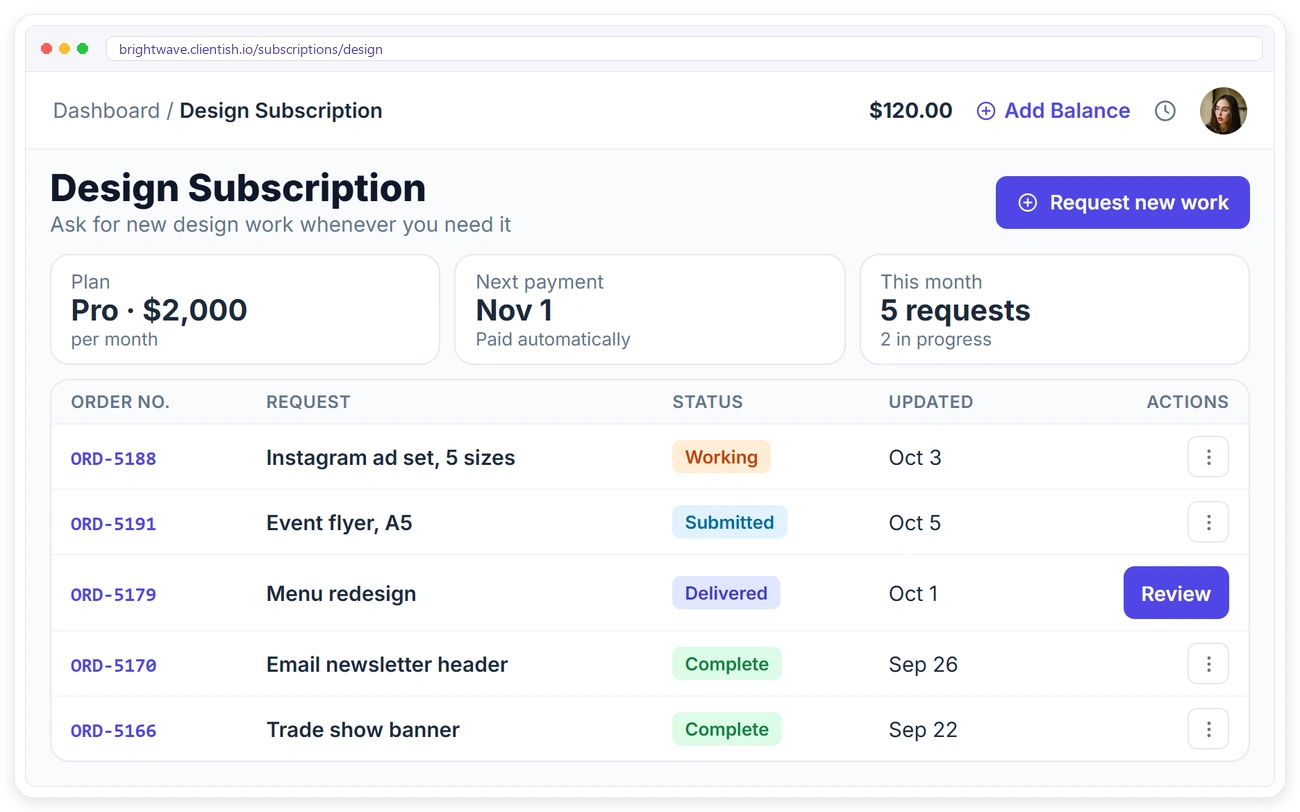
Once the agreement is signed, the real work is the production rhythm it sits on top of: invoicing the fee each cycle, watching how much of each client's capacity is used and how much remains, taking in briefs and revision requests, and keeping sign-offs moving without burying them in email. The contract sets the rules; running the month-to-month is a tooling job.
- ✓A recurring subscription raises the retainer invoice every cycle, so you don’t create it by hand
- ✓Clients top up a prepaid balance and pay invoices from it
- ✓A branded client portal on your own subdomain with orders, invoices, subscriptions and balance
- ✓Clients open a support ticket with SLA response times instead of emailing you
- ✓Your own payment gateway, such as Stripe or PayPal, or bank transfer
Download the free retainer template
The editable Word file with all 12 clauses plus signature blocks. Replace the brackets, add your branding and send it.
This template is a free, editable starting point, not legal advice. Laws vary by region, so have a qualified lawyer review it for your jurisdiction before you rely on it.
Frequently asked questions
Is this creative retainer agreement template free to use?
Yes. Download it and edit it in Word or Google Docs, with no watermark. Brand it and reuse it across your creative clients.
How many revisions should a creative retainer include?
Two rounds per deliverable is a common default, with additional rounds billed at an hourly rate. What matters more than the number is defining a round as one consolidated set of feedback, and stating that reopening an approved element counts as new work rather than a revision.
What if a client disputes that their feedback was consolidated into one round?
Write the process into the agreement: feedback is submitted through one designated channel by a stated deadline, and anything that arrives late or elsewhere is held for the next round rather than absorbed into the current one. Documenting each round with a dated summary the client acknowledges gives you a timestamped record if the dispute escalates.
Does the fee include source files?
Usually not by default. The common position, which the template follows, is that the fee covers the final flattened deliverables and a usage license, while editable source files (.AI,.PSD, Figma) are available for a separate charge or an agreed add-on. State it explicitly so there is no exit-day dispute.
Who owns the creative work — the client or the studio?
On full payment, the client typically receives the final deliverables and an exclusive, perpetual license for the agreed uses, while the studio retains its working process and any pre-existing tools. Uses beyond the agreed scope, such as resale, need a separate agreement. The template sets this out clause by clause.
Can a client renegotiate ownership terms after the agreement is signed?
Only through a written amendment both parties sign; an email concession rarely overrides a signed contract. If a client asks for full IP assignment instead of a license after signing, treat it as a change order with its own fee, and never hand over source files before the amendment is executed.
Do I need a separate IP assignment for work by subcontractors or freelancers?
Yes. Your retainer assigns rights from studio to client, but that only works if the studio actually holds them, and in most jurisdictions a freelancer owns what they create unless they have signed an IP assignment or work-for-hire agreement. Have every subcontractor sign a short assignment before work begins, since the template covers the studio-client relationship, not your subcontractor ones.
Can I show the work in my portfolio?
Yes, if your agreement reserves that right. The template includes a portfolio clause letting the studio display the work in its portfolio and marketing unless the client reasonably requests confidentiality.
Related Templates
If you run a creative studio alongside other services or want to tighten the rest of your client paperwork, these free templates pair well with this one: More free, editable templates from the Agency Templates Library.
Agency Retainer Agreement
The core retainer contract, ready to brand.
RETAINERSEO Retainer Agreement
Scope and deliverables for monthly SEO work.
RETAINERSocial Media Retainer
Posts, reels and reporting defined per cycle.
CHECKLISTClient Onboarding Checklist
The 3-phase onboarding checklist for any agency.
CONTRACTStatement of Work (SOW)
Scope, deliverables, acceptance and milestones per project.
BRIEFCreative Brief
Align the team and the client before work starts.
RETAINERPPC Retainer Agreement
Ad management scope, spend handling and reporting.
RETAINERWeb Development Retainer
Maintenance and build hours with change-request terms.