
Creative Brief Template
Ask a designer what wrecks a project and they rarely say a hard deadline or a small budget.
Free to download and edit · No watermark · Add your own branding
They say the brief that wasn't one — a Slack message reading "we need a landing page, make it modern and clean, go." From that, someone builds a direction, presents it, and hears "hmm, not quite what we pictured."
Three rounds later the real brief finally emerges, assembled from rejections instead of written up front. A creative brief is that missing document: the single page, agreed before anyone designs, that states what the work is for, who it speaks to, the one thing it must say, and who decides when it is right.
This page gives you a free, editable creative brief template for agencies and freelancers — the alignment document you complete before starting any design, campaign, or content work. It pins down the objective, the audience, the single key message, the mandatories, and the one person whose sign-off counts, so the first concept lands close to the mark instead of becoming the first guess in a long series. Download it, fill it in with the client before work begins, and treat it as the agreed brief the creative is measured against.
What Is a Creative Brief?
A creative brief is a short document that defines the direction of a specific creative deliverable — a campaign, a design, a video, a piece of content — before work on it begins.
It captures the objective, the audience, the core message, the tone, the mandatories, and the practical constraints, so everyone producing and approving the work shares one understanding of what it is meant to do and be.
Its purpose is alignment before execution. A creative team can only hit a target they can see, and the brief is how the target gets described in words everyone agrees on first. Without it, the direction is inferred from a conversation, and every person involved infers something slightly different, which is the origin of most revision cycles. The brief replaces that inference with a stated, signed-off intent.
How it differs from the documents around it
It is worth distinguishing from the documents around it — not as a formality, but because each one gets mistaken for the brief in practice, and treating the wrong document as the brief is how misalignment creeps in.
An intake questionnaire collects broad information about a new client or project: goals, budget, timeline, stakeholders. Because it asks many of the same questions that feed into a brief, it is tempting to hand the raw intake answers to the creative team and call it done. The difference is that an intake questionnaire gathers — a creative brief focuses. The brief takes that raw material and distills it into a single, agreed-upon direction for one specific deliverable, resolving any contradictions before production begins rather than during it.
A Statement of Work defines scope, fees, deliverables, and timeline — the commercial shape of the engagement. Agencies sometimes assume that if a SOW describes a deliverable clearly enough, the creative team has what it needs. But a SOW tells the team what they are contracted to produce and when; the creative brief tells them what it needs to do and feel like. Conflating the two leaves the creative substance undefined, even when the commercial terms are airtight.
A marketing brief sets wider strategy — channels, audience segments, campaign objectives, budget allocation across tactics. Because it sits directly above the creative work in the planning hierarchy, it can look like a brief for the assets themselves. The distinction is one of scope: the marketing brief decides where and why; the creative brief decides what the asset says, to whom, and in what tone. One project will often have a single marketing brief driving several creative briefs, one per major deliverable.
Why Your Agency Needs a Creative Brief
For any agency producing creative work, the brief is the cheapest insurance against the most expensive problem: work that has to be redone because it was aimed at the wrong thing.
It cuts revision rounds — and the unpaid hours inside them
Most agencies absorb revision costs silently: a designer rebuilds a concept, the project manager re-coordinates feedback, the deadline slips. A brief that locks in an agreed objective, audience, and message before work starts means the first concept lands close enough to review productively, instead of triggering a restart that nobody bills for.
It forces one message, not five — before a scattered direction wastes a full production cycle
When the single key message isn't written down before creative begins, clients arrive at review wanting the work to say everything at once. Accommodating that mid-stream means reworking copy, layout, and sometimes the concept itself — hours already spent that can't be recovered.
It names the one approver — because late stakeholders are the revision no retainer covers
The brief is where the final decision-maker is identified before work starts. Without it, an executive who was never in the room overturns an approved direction at the eleventh hour, and the agency rebuilds at its own cost to save the relationship.
It captures the mandatories once — instead of discovering them in a round of "oh, and it also needs…"
Logo rules, legal lines, calls to action gathered into the brief are built into the first version. Found after delivery, each missed mandatory is an unplanned revision that pushes the delivery date and quietly erodes the margin on the project.
It turns taste into criteria — so "not quite right" can't become an open-ended bill
"Make it pop" cannot be delivered, invoiced against, or professionally disputed. "A confident, premium tone aimed at finance directors" can. A brief converts vague preference into a measurable direction, giving the agency ground to stand on when a client's mood shifts but the scope hasn't.
The Risks of Starting Creative Work Without a Brief
Beginning a creative project on a loose verbal ask feels fast, right up until the first review. Here is how the gaps surface.
With no written objective or audience, the team builds toward their best guess of the ask, the client sees something they did not picture, and the project restarts from a rejection instead of progressing from a brief.
Without an agreed single message, the client keeps adding things the work should also say, and the result is diluted — technically containing everything asked for and landing none of it.
The work is approved by the contact, then a founder or department head nobody named reviews it and sends it back. The redo is unpaid and the schedule is wrecked, all because no single approver was fixed up front.
Halfway through, it emerges that every asset needs a specific legal line or the new logo, and work already built to the old spec has to be reworked.
When there is no brief to point to, every review is a fresh debate about taste, because there is no agreed intent against which to judge whether the work is right.
Each of these is prevented by a field in the template below.
The Key Sections of a Creative Brief
The template holds each of these as a fillable field. Here is what each one captures and how to fill it so it actually guides the work.
Project Background
A short paragraph on why this work exists — the launch, the campaign, the problem it responds to. It gives the creative team the context to make judgment calls the brief itself cannot spell out.
Objective
What this specific deliverable is meant to achieve, stated as an outcome, not a task. "Drive demo sign-ups from mid-market SaaS buyers," not "design a landing page." The objective is the target everything else serves, and a vague one here undermines the whole brief.
Target Audience
Who the work is for, described beyond demographics. The useful detail is psychographic — what they want, what they worry about, what moves them to act. "Marketing managers at 50-to-200-person firms, time-poor, burned by tools that overpromised" guides creative in a way that "millennials" never will.
The Single Key Message
The one thing the audience should take away. Not a list — one message. Forcing this to a single line is the most valuable discipline in the brief, because work built around one clear message is sharp, and work built around five is noise. Everything else supports this.
Tone and Personality
How the work should feel — confident, playful, premium, plain-spoken. Pin it with adjectives and, where useful, a "like this, not that" pair, so the creative direction is a described quality rather than a matter of taste to be argued later.
Deliverables and Specifications
Exactly what is being produced, with formats, dimensions, lengths, and quantities. A precise deliverables list is what makes "done" a fact rather than an opinion, and it is the line between the agreed work and a later change request.
Mandatories
The non-negotiables every version must include: the logo, the call to action, a tagline, legal or compliance lines, brand colours and fonts. Capturing these in the brief means they are present from the first concept instead of forcing a rebuild when one surfaces late.
References and Inspiration
Examples of work the client likes and dislikes, with a note on why. A few reference pieces communicate a direction faster than a paragraph of adjectives, and the dislikes are often more clarifying than the likes.
Approver and Timeline
Who gives final sign-off — one named person — and the key dates: when concepts are due, when feedback is needed, when the work ships. Naming the single approver here is what prevents the late, expensive reversal by someone who was never involved.
Tips for a Creative Brief That Prevents Revisions
The template supplies the sections. A few disciplines are what make the brief actually reduce redos rather than just document the request.
Insist on one key message
If the brief lists several things the work must say, send it back. The single-message discipline is where a brief earns its keep, and ducking it guarantees diluted work.
Name one approver, not a committee
Agree, before work starts, whose sign-off is final. Conflicting feedback from several stakeholders is the most reliable way to spiral a project, and the brief is where you head it off.
Ban "make it pop" and its relatives
Any instruction that cannot be checked against the finished work is not direction, it is taste. Translate every such phrase into a described, verifiable quality before the brief is signed.
Describe the audience by motivation, not just demographics
What the audience wants and fears guides creative choices; their age bracket does not. Push the audience section past demographics every time.
Have the client sign off on the brief itself
The brief only prevents disputes if both sides agreed to it. A signed brief is the anchor every later review is measured against, which is what turns "I don't like it" into "does it meet the brief?".
Write one brief per deliverable
A single brief stretched across several different assets blurs the direction for each. Keep each brief focused on one deliverable or one tight campaign.
How to Use the Free Creative Brief Template
Turning the template into a working brief takes four steps.
Start from a copy
Download the Word (.docx) file, or upload it to Google Docs, and work on your copy, not the original.
Fill it in with the client
Complete the objective, audience, and single message together, so the brief reflects a shared understanding rather than your assumption of one — in practice, the single key message almost always needs its own dedicated 15-minute conversation, separate from the broader briefing call, before both sides can agree on the wording.
Force the single choices
Hold the line on one key message and one named approver before the brief is finalised — the approver field is the one clients most often try to leave blank, usually because internal sign-off authority is unclear on their end, and that ambiguity must be resolved before work starts or it will resurface at the worst possible moment.
Get it signed, then brief the team
Have the client approve the brief, then hand it to the creative team as the agreed direction the work will be measured against.
Running Creative Approvals Inside a Client Portal
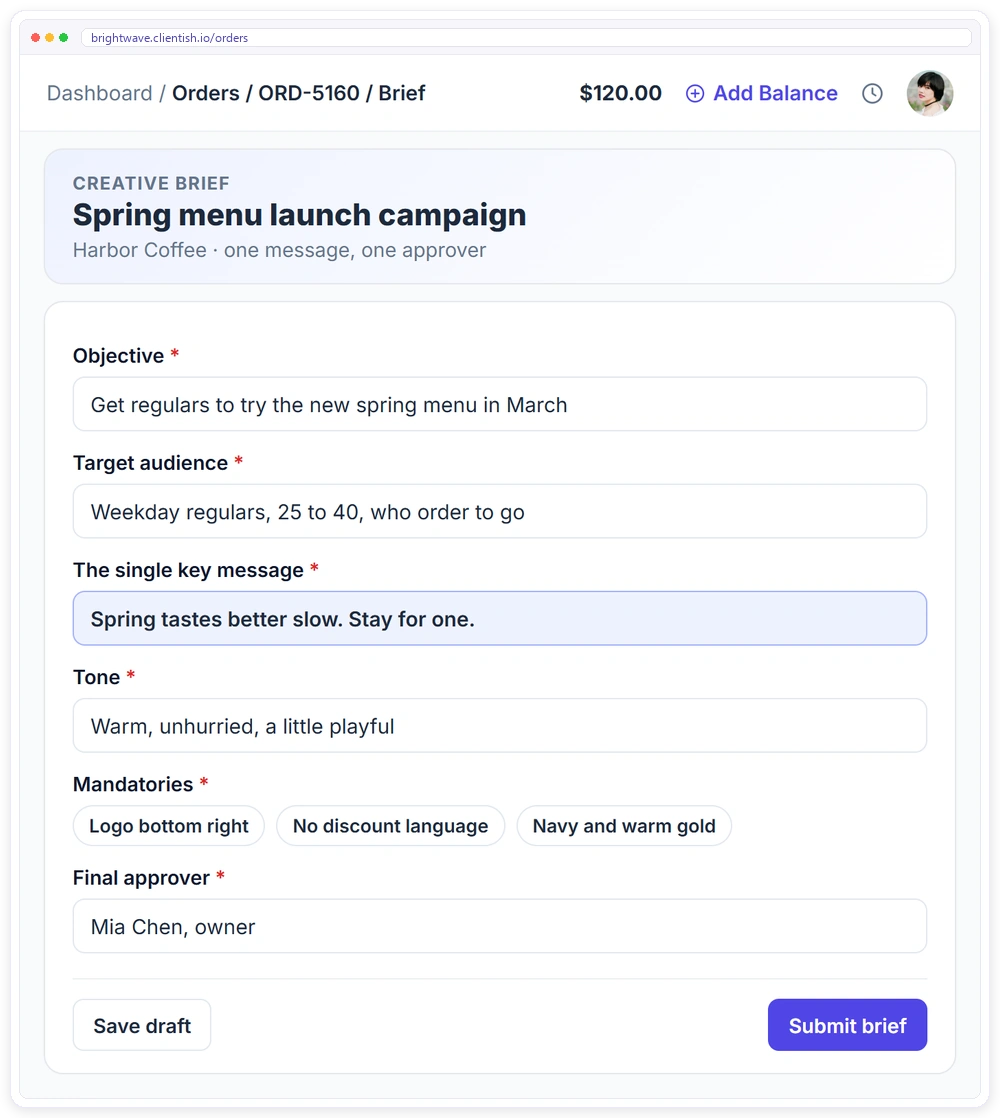
A creative brief sets the direction. The approvals that follow — concepts sent, feedback given, versions signed off — are what a client portal carries, giving the brief a place to live and the sign-offs a clear record.
- ✓The brief as an intake form clients fill in from their portal
- ✓The order waits until the brief is complete
- ✓Concepts delivered for approval, approved or sent back for a revision
- ✓Revisions counted against what the package includes
- ✓All feedback kept on the order, not in email
Download the free creative brief template
The editable Word file with all 9 sections. Replace the brackets, add your branding and use it with every client.
Frequently asked questions
Is this creative brief template free to use?
Yes. There is no watermark and no cost. Open it in Google Docs or Word, adapt the sections to your work, and complete one before every creative project.
What is the difference between a creative brief and a Statement of Work?
A Statement of Work defines the commercial shape of a project: scope, deliverables, fees, and timeline. A creative brief defines its creative substance, the objective, audience, message, and tone the work must hit. The SOW says what you will produce and for how much, while the brief says what it must achieve and feel like, and most projects have both.
How does a creative brief reduce revisions?
It aligns everyone on the objective, audience, single message, and mandatories before any work is produced, so the first concept is built toward an agreed target rather than a guess. Most revision cycles come from misalignment about the ask, which the brief removes up front, and a signed brief gives every later review a fixed intent to judge against.
Why does the brief insist on only one key message?
Because work built around a single message is sharp and work built around several is diluted. A client who wants the piece to say five things at once ends up with a piece that lands none of them, so forcing the message to one line is the brief's most valuable discipline.
What if the client keeps changing the brief after sign-off?
Treat the signed brief as a change-control boundary. Acknowledge the change in writing, note that it falls outside the agreed brief, and issue a short amendment (the field being changed, who requested it, the date) for them to approve before work continues. Unmanaged mid-production changes are the most common cause of unpaid extra rounds, and the amendment record protects both sides.
Who should write the creative brief, the agency or the client?
Usually the agency drafts it and completes it together with the client, because the agency knows which questions matter and the client holds the answers. Filling it in jointly is what makes it a shared, agreed direction rather than one side's assumption. That shared agreement is the whole point of the document.
Related Templates
If you produce creative work for clients, these free templates pair well with the Creative Brief: More free, editable templates from the Agency Templates Library.
Statement of Work (SOW)
Scope, deliverables, acceptance and milestones per project.
ONBOARDINGProject Intake Questionnaire
The discovery questions to ask before you scope.
RETAINERCreative Agency Retainer
Design and branding retainers with revision limits.
CHECKLISTCreative Agency Onboarding Checklist
The full brand kit before the first concept.
PROJECTChange Request Form
Turn scope creep into a priced, approved decision.
CONTRACTClient Service Agreement (MSA)
The legal terms you sign once with every client.