
Client Service Agreement Template
Here is a situation that plays out in agencies more often than anyone admits: the work is delivered, the client uses it, and the final invoice goes unpaid.
Free to download and edit · No watermark · Add your own branding
The agency wants to say "then you don't get to keep the logo," but nothing in writing says the logo belonged to the agency until it was paid for.
In most places, without a written transfer tied to payment, the question of who owns the work is murky at exactly the moment it matters. A Client Service Agreement is where that gets settled in advance, along with the other terms you only miss when something goes wrong: how either side ends the relationship, who is liable for what, and what stays confidential.
This page gives you a free, editable Client Service Agreement template for agencies and freelancers — the master contract that governs your whole relationship with a client, project after project. It covers the legal foundation that a per-project Statement of Work deliberately leaves out: ownership of the work, payment and late terms, termination, confidentiality, liability, and the clause most agencies forget, that intellectual property transfers only once the final invoice is paid. Download it, adapt it to your business, and sign it once with each client before any work begins.
What Is a Client Service Agreement?
A Client Service Agreement (sometimes called a master services agreement) is the contract that sets the standing legal terms between your agency and a client, independent of any single project.
It establishes the rules that apply to everything you do together: how you get paid, who owns the work, what happens if either side wants out, what is kept confidential, and who carries which risks. It is signed once, at the start of the relationship, and then governs every project that follows.
Its defining feature is that it separates the legal terms from the project work. The agreement sets the framework, such as liability, ownership, confidentiality, and termination, and each individual project is scoped in its own Statement of Work that sits underneath it.
How it differs from the documents around it
This is why one signed Client Service Agreement can carry a client relationship for years: a new project needs a new Statement of Work, not a renegotiated contract. The expensive, slow part, the legal terms, is agreed once, which is where the model saves time and cost over a relationship that runs to many projects.
This split is also what keeps it distinct from the documents it is often confused with. A Statement of Work describes a single project's deliverables, timeline, and fees; the service agreement describes the legal relationship those projects happen inside. A set of terms and conditions governs how customers use a product or website, whereas a service agreement governs a direct, negotiated, service relationship between two named parties.
When a service agreement and a Statement of Work disagree, the service agreement is normally written to govern on legal matters, while the Statement of Work governs the specifics of that project's scope.
Why Your Agency Needs a Client Service Agreement
Agencies tend to sign a service agreement only after a relationship goes wrong once. The clauses in it are a list of the specific ways that happens, each one written down before it can.
It settles who owns the work, and when
The agreement states that intellectual property transfers to the client on full payment, not on delivery. Until the final invoice clears, the work is still the agency's. This single clause is the difference between an unpaid invoice you can enforce and one you can only beg for.
It makes payment terms enforceable
Due dates, late-payment interest, and what happens when an invoice is overdue are set in writing, so chasing payment is a matter of pointing to the contract rather than straining the relationship.
It defines how the relationship ends
Notice periods, what is owed for work in progress, and how final deliverables are handled on exit are all agreed up front, so a parting is procedural rather than a dispute.
It protects what is shared
A confidentiality clause covers the client data, strategy, and access you are trusted with, and the agency's own methods and pricing in return.
It caps your liability
A limitation-of-liability clause keeps a dispute proportional to the fees involved, rather than exposing the agency to a claim many times the size of the project.
It establishes you as an independent contractor
Stating the relationship explicitly avoids the client being treated as an employer, with the tax and legal consequences that misclassification can carry.
The Risks of Working Without a Signed Service Agreement
Working on a handshake feels faster until the one project in twenty that goes sideways, at which point there is no document to appeal to. Here is how the gaps tend to surface.
A logo suite is delivered on a Friday so the client can meet a printer deadline; the final $800 invoice goes ignored and disputed. Without an ownership-on-payment clause, the agency has no written basis to reclaim the files already in the client's hands.
A six-week rebrand is cancelled on week four — new CMO, new direction. With no termination clause specifying a kill fee or a rate for work in progress, the agency absorbs five figures of billable hours and a cleared slot it can no longer fill.
Something goes wrong downstream and the client's losses dwarf the project fee. Without a limitation-of-liability clause, the agency's exposure is not capped at the value of the work it was paid for.
Confidential pricing, client lists, or methods change hands, and without a confidentiality clause there is nothing to enforce.
In the absence of a clause establishing independent-contractor status, a long, close engagement can start to look like employment, raising tax and legal questions neither side intended.
Each of these is a clause in the template below.
The Key Clauses of a Client Service Agreement
The template holds each of these as editable sections with plain-English notes. Here is what each clause does and the decision you are making when you fill it in.
Parties and Relationship
Names the two parties and states that the agency acts as an independent contractor, not an employee or partner. This framing clause is short but load-bearing: it sets the tax and legal nature of the relationship for everything that follows.
Services
Describes, at a high level, the kind of services the agency provides, and points to the Statement of Work for the specifics of each project. The agreement does not try to scope the work itself. That is the Statement of Work's job. It says, in effect, "the detailed scope lives in each SOW; this contract governs the terms around it."
Fees and Payment
Sets how and when the agency is paid: rates or how fees are determined, invoicing frequency, the payment window, and the interest or fee that applies to a late payment. Writing the late-payment term in is what turns an overdue invoice from an awkward conversation into an enforceable one.
A common mistake is to skip a defined payment window and invoice with vague language like "due upon receipt," which leaves nothing to enforce when an installment goes unpaid for months. A single line setting a specific payment window and a stated interest rate on overdue balances is what gives the agency contractual footing to charge interest or pause work, instead of simply chasing.
Term and Termination
States how long the agreement runs and how either party ends it: the notice period, what is owed for work completed or in progress at termination, and how final files and access are handled on the way out. A clear termination clause is what stops a parting from becoming a fight over who owes what.
Intellectual Property and Ownership
The clause agencies most often get wrong. It states that ownership of the delivered work transfers to the client on receipt of full payment — not on delivery, not on project completion, but on payment. Until then, the agency retains the rights. This is the mechanism that makes an unpaid invoice enforceable: the client cannot own what they have not paid for. The clause should also reserve the agency's right to its own pre-existing tools, methods, and templates, and its right to show the work in a portfolio unless otherwise agreed.
The wording is where this goes wrong in practice. An agreement that transfers ownership "upon delivery" hands the work over before the final invoice clears, so a client who then disputes the last payment already holds the files and can claim them as theirs. Changing that single phrase to "upon receipt of full payment" is the difference between an enforceable position and none at all.
Confidentiality
Protects information shared in both directions (the client's data, strategy, and access, and the agency's methods and pricing). State how long the obligation lasts, including after the relationship ends, since confidential information does not stop being confidential when the contract does.
Limitation of Liability
Caps the agency's financial exposure, commonly at the total fees paid under the agreement or a defined amount, and excludes indirect or consequential damages. This clause keeps a worst-case dispute proportional to the size of the engagement rather than open-ended.
This matters most when a client's claimed losses dwarf the project fee, which is exactly when an uncapped agency is exposed to a figure many times the value of the work it was paid for. A cap stated explicitly, with consequential damages excluded by name, holds up as a signed clause to point to rather than a position to argue in court. The number you set here is the ceiling on your worst day.
Indemnification
Sets out who covers whom if a third party brings a claim — for example, the client indemnifying the agency for content the client supplied, and the agency indemnifying the client for its own infringing work. It allocates the risk of outside claims between the two parties.
Warranties and Disclaimers
States what the agency does promise (typically that the work will be performed professionally and competently) and what it does not, such as guaranteeing specific business results. Being explicit here prevents an implied promise of outcomes the agency never actually made.
Independent Contractor Status
Confirms in its own clause that the agency is a separate business responsible for its own taxes, tools, and team, and that nothing in the agreement creates an employment or partnership relationship. It reinforces the framing set in the first clause and closes the misclassification risk.
Dispute Resolution and Governing Law
Names the process for resolving a disagreement — negotiation first, then mediation or arbitration before court — and the jurisdiction whose law governs the agreement. Agreeing this in advance means a dispute has a defined path rather than an immediate escalation to litigation.
Tips for a Client Service Agreement That Actually Protects You
The template provides the clauses. A few disciplines decide whether they hold up when you need them.
Bind the IP transfer to full payment, explicitly
The phrase that matters is that ownership passes "upon receipt of full payment." Delivery is not payment, and an ambiguous transfer clause is the same as none when an invoice goes unpaid.
Write the late-payment consequence, not just the due date
A due date with no stated consequence is a suggestion. Name the interest rate or late fee and when it starts.
Let the agreement govern terms and the SOW govern scope
Do not duplicate project detail into the master agreement; point to the Statement of Work for it. Duplication is how the two documents end up contradicting each other.
Know which clauses you can flex on and which you cannot
When a client pushes back on the template, have a clear internal position before the conversation starts. Clauses around payment terms, IP ownership, liability caps, and governing law carry real legal consequence — treat these as non-negotiable or change them only with a lawyer's input. Clauses covering notice periods, revision rounds, or reporting frequency are delivery preferences and can usually be adjusted to fit the client without exposing you to meaningful risk.
Set a liability cap you could actually live with
The common choice is the total fees paid, which keeps exposure tied to the value of the engagement. An uncapped agreement is an open-ended risk.
Have a prepared response when a client strikes your liability cap
It happens: a client redlines the cap during negotiation, either deleting it or replacing it with an uncapped formulation. Know your position before that conversation. A reasonable counter is to offer a modest increase — say, fees paid over the preceding three months — while holding firm on a ceiling. If a client insists on full unlimited liability, that is a commercial decision that should change your pricing, your insurance coverage, or both. Never simply accept the deletion and move on.
Treat performance-guarantee requests as scope, not assurances
If a client wants to add a clause guaranteeing specific outcomes — a traffic figure, a conversion rate, a search ranking — do not absorb it into the agreement as written. Either reframe it as a target documented in the SOW with no contractual remedy attached, or price the guarantee explicitly and back it with a capped remedy you control. An outcome guarantee buried in a service agreement is a liability clause in disguise.
How to Use the Free Client Service Agreement Template
Turning the template into a signed agreement takes five steps.
Start from a copy
Download the Word (.docx) file, or upload it to Google Docs, and work on your copy, not the original.
Fill in your parties, fees, and jurisdiction
Set the names, how fees are determined, the payment window and late term, and the governing law for your location.
Set your ownership and liability positions
Confirm the IP-transfers-on-payment clause reads the way you want, and set a liability cap you are comfortable standing behind.
Have it reviewed if the stakes warrant it
A template is a strong, informed starting point.
Sign once, then scope projects with SOWs
Get both signatures before any work starts, then run each new project under its own Statement of Work without re-opening the contract.
For high-value clients, IP-heavy work, or an unfamiliar jurisdiction, a short review by a lawyer is worth it — this document is not legal advice.
Running the Client Relationship Inside a Portal
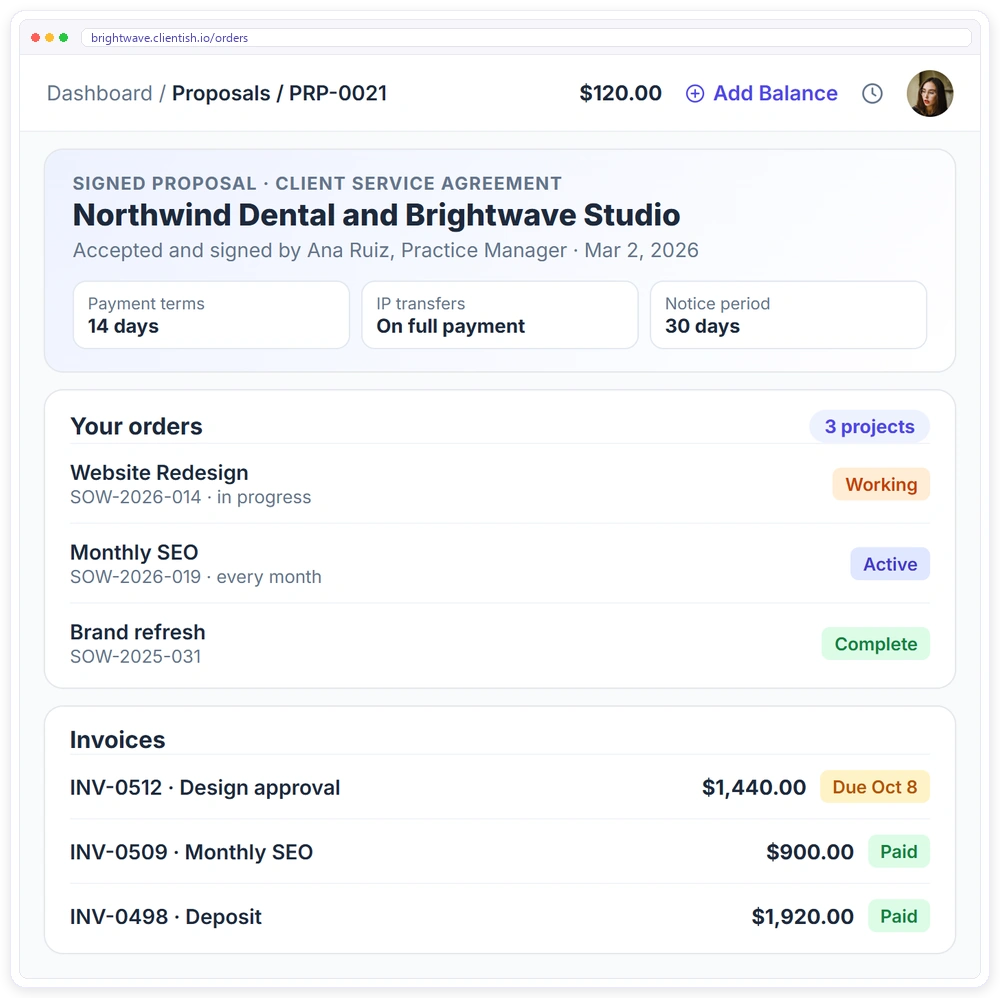
A signed service agreement sets the terms. The day-to-day of the relationship those terms govern, the invoices, their due dates, and the running balance, is what a client portal carries.
- ✓A proposal the client accepts and signs with a typed name, saved with the time
- ✓Every project under the agreement as an order in the client’s portal
- ✓Invoices with your payment terms and reminders until paid
- ✓Your own payment gateway, such as Stripe or PayPal, or bank transfer
- ✓A branded client portal on your own subdomain
Download the free client service agreement template
The editable Word file with all 12 sections. Replace the brackets, add your branding and use it with every client.
This template is a free, editable starting point, not legal advice. Laws vary by region, so have a qualified lawyer review it for your jurisdiction before you rely on it.
Frequently asked questions
Is this client service agreement template free to use?
Yes. There is no watermark and no cost. Open it in Google Docs or Word, adapt the clauses to your business and jurisdiction, and use it with every client you take on.
What is the difference between a client service agreement and a Statement of Work?
The service agreement sets the standing legal terms of the whole relationship: ownership, liability, confidentiality, termination, and payment. The Statement of Work scopes a single project, its deliverables, timeline, and fees, and you run each project under its own SOW after signing the service agreement once. The agreement governs the legal terms; the SOW governs that project's scope.
When does the client actually own the work?
Under the template's intellectual property clause, ownership transfers to the client on receipt of full payment, not on delivery. Until the final invoice is paid, the agency retains the rights to the work. Writing this explicitly is what makes an unpaid invoice enforceable rather than a loss the agency has to absorb.
What if a client refuses to sign before work starts?
Don't start. A client who resists signing a straightforward agreement before any work begins is showing you how disputes will go later. If timing is the reason, a short letter of engagement covering scope, fee, and IP ownership bridges the gap in minutes.
Does this template replace a non-disclosure agreement?
No. It includes a confidentiality clause covering the working relationship, but for sensitive methodology or pricing shared during a pitch or discovery phase, before the service agreement is signed, use a standalone NDA for that stage. The two documents cover different moments in the relationship.
Do I need a lawyer to use this template?
The template is a thorough, informed starting point that covers the clauses an agency agreement needs, but it is not legal advice. For a high-value client, IP-heavy work, or a jurisdiction you are unsure about, a short review by a qualified lawyer is worth the cost, since this is the document you rely on when something goes wrong.
Related Templates
If you contract with clients, these free templates pair well with the Client Service Agreement: More free, editable templates from the Agency Templates Library.
Statement of Work (SOW)
Scope, deliverables, acceptance and milestones per project.
RETAINERAgency Retainer Agreement
The core retainer contract, ready to brand.
ONBOARDINGProject Intake Questionnaire
The discovery questions to ask before you scope.
CHECKLISTClient Onboarding Checklist
The 3-phase onboarding checklist for any agency.
PROJECTChange Request Form
Turn scope creep into a priced, approved decision.
CONTRACTNon-Disclosure Agreement (NDA)
Mutual by default, for pitches and discovery.