
Non-Disclosure Agreement (NDA) Template
The riskiest moment in an agency relationship often comes before any contract is signed. It is the pitch — the discovery call, the strategy session, the proposal where you show a prospective client exactly how you would solve their problem.
Free to download and edit · No watermark · Add your own branding
To win the work, you reveal your methodology, your pricing logic, sometimes a half-built plan, and in return they hand you their traffic numbers, their roadmap, their competitive weak spots.
All of that changes hands with nothing protecting either side, which is precisely what a non-disclosure agreement is for: signed before the sensitive conversation, it lets both parties speak freely because both are bound to keep what they hear private.
This page gives you a free, editable non-disclosure agreement template for agencies and freelancers — the document you sign before a pitch, a discovery session, or any conversation where confidential information is shared in either direction. It is written as a mutual NDA by default, because an agency reveals as much as it receives, and it covers the clauses that make one enforceable: a clear definition of what is confidential, the standard exclusions, how long the obligation lasts, and what a breach triggers. Download it, adapt it, and sign it before the first sensitive word.
What Is a Non-Disclosure Agreement?
You're on a discovery call and the prospect asks you to walk through your SEO audit framework.
You share your screen, step through the proprietary scoring system your team has spent years refining, and reference a couple of anonymised client examples to illustrate the results. Two weeks later they go with another agency — one that pitches a suspiciously familiar audit structure. Without a signed NDA in place before that call, you had no legal footing to protect any of it.
A non-disclosure agreement (NDA), also called a confidentiality agreement, is a contract in which the parties agree to keep certain shared information private and to use it only for an agreed purpose. It defines what counts as confidential, obliges whoever receives it to protect it, and sets out what happens if they do not. For an agency, it is the document that makes it safe to have a candid conversation before a formal engagement exists.
How it differs from the documents around it
An NDA comes in two forms, and the difference matters for agencies. A unilateral NDA protects only one party's information — appropriate when just one side is disclosing, such as a client handing over data to a vendor who shares nothing sensitive back. A mutual NDA protects both parties' information, which is the right default for agency work: in a pitch or discovery session, you are showing your frameworks, your pricing, and your approach at the same time the client is showing you their internal numbers. A one-sided NDA in that situation protects the client and leaves the agency exposed.
It is worth placing against the confidentiality clause you may already have in a service agreement. That clause covers information shared once you are working together, under a signed contract. An NDA covers the stage before that — the pitch and the discovery, when there is no service agreement yet but sensitive information is already changing hands. The two are complementary: the NDA protects the conversation that decides whether you work together, and the service agreement's confidentiality clause protects the work once you do.
Why Your Agency Needs an NDA
An agency trades in information — strategy, methods, pricing, and the client's own private data. An NDA is what lets that trade happen before a contract without either side taking on uncovered risk.
It protects your methodology in the pitch
The frameworks and approaches you reveal to win work are among your most valuable assets. A mutual NDA means a prospect cannot take your strategy to a cheaper agency or run it in-house without consequence.
It gets you the real numbers you need to price correctly
Clients who won't share actual traffic data, revenue figures, or margins without an NDA in place force you to scope on guesswork. A signed NDA before discovery is how you get the information you need to price the engagement accurately — protecting your margin, not just their secrets.
It covers the gap before the contract
The most sensitive exchange often happens before any service agreement exists. The NDA fills exactly that window, protecting both sides from the first call to the signed engagement.
It defines what confidential actually means
Rather than leaving "confidential" to interpretation, the NDA names what is protected and what is not, so there is no later argument about whether something was fair to repeat.
It gives a breach real consequences
With remedies written in — including the right to seek an injunction to stop further disclosure — a leak becomes an enforceable matter rather than a regret.
The Risks of Sharing Without an NDA
Skipping the NDA to keep things moving feels efficient until information you meant to keep private is used against you. Here is how the gaps surface.
You pitch your full approach to win the account, do not get it, and later see your exact framework in use — either in-house or at a competitor who was pitching the same client. With nothing signed, there is nothing to point to. The Confidential Information definition clause is what establishes that your methodology was protected material in the first place.
A prospect comparing three agencies shares your rate card in a group email, and your pricing logic — including how you structure retainers versus project fees — becomes a known quantity across your market before the conversation even ends. The Non-Use and Non-Disclosure clause is the specific provision that prohibits a recipient from passing your information to third parties without authorisation.
A prospect shares customer information or internal figures in discovery, the deal does not proceed, and there is no agreement governing what you may do with what you now hold — an uncomfortable position for both sides.
In the rush, someone signs the client's NDA without reading it, agreeing to a perpetual, one-sided obligation that your use of freelancers technically breaches from day one. The Term and Termination clause sets a defined duration and scope, while the Permitted Disclosures clause ensures your standard subcontractor relationships are not an automatic violation.
"We'll keep it between us" is not enforceable. When it matters, a verbal assurance of confidentiality is worth exactly nothing.
Each of these is addressed by a clause in the template below.
The Key Clauses of an NDA
The template holds each of these as an editable clause. Here is what each one does and the decision you make when you fill it in.
Parties and Purpose
Names the two parties and states why information is being shared: the pitch, the project discussion, the potential partnership. The purpose matters because it limits use — the receiving party may use the information only for that stated reason, and nothing else. Agency decision: Keep the purpose narrow and project-specific. A clause that reads "exploring a potential business relationship" is so vague it could be stretched to cover almost anything; "evaluating a website redesign engagement commencing Q3 2025" is enforceable.
Once the parties and purpose are locked, the next logical question is what, exactly, counts as the information being protected.
Definition of Confidential Information
Describes what is protected. A good definition is specific enough to be clear (business strategies, pricing, customer data, methods, designs) but not so broad it becomes unenforceable. The common approach is to cover information that is marked confidential or that a reasonable person would understand to be confidential from its nature.
Watch out on client-supplied NDAs: they often define confidential information to include your agency's own methodologies and pricing, which could restrain you from using your own processes. Redline any definition that captures information you originated before the engagement.
With confidential information defined, you equally need to spell out what falls outside that protection — otherwise the clause has no practical boundary.
Exclusions
States what is not protected, which is as important as what is. Standard carve-outs are information that is already public, was already known to the receiving party, is independently developed without using the disclosed information, or is received legitimately from a third party. Without these, the definition is overbroad and a court may decline to enforce it.
Some client templates omit the "independently developed" carve-out entirely; insist on it. Without it, your agency could be prevented from pursuing work it developed on its own, using no knowledge gained from the client.
Exclusions define the outer limit; the obligations clause defines what the receiving party must actively do with everything inside that limit.
Obligations and Permitted Disclosure
Sets out how the receiving party must handle the information: hold it in confidence, use it only for the stated purpose, and protect it as carefully as their own. This is also where you permit necessary sharing with employees and, critically for an agency, with subcontractors and freelancers who need it to do the work, provided they are bound by the same obligations. Leaving the subcontractor carve-out out is the mistake that turns ordinary agency work into a technical breach.
Name this carve-out explicitly as covering subcontractors and freelancers, not just "employees." Many client templates use "employees" alone, which leaves your delivery model exposed from the moment you brief an outside developer.
Closely related to obligations is the question of whose information those obligations run in both directions to protect.
Mutual or Unilateral
States whether both parties' information is protected or only one party's. For most agency situations this should be mutual, because you are disclosing as much as you receive. Set it unilateral only when one side alone is sharing and the other is not. Agency decision: Default to mutual in your own template. When a client sends a unilateral NDA that protects only their information, assess whether you will be sharing credentials, internal pricing, or proprietary processes during the engagement — if so, push back and convert it to mutual before signing.
With the scope of protection settled, the next clause determines how long that protection actually runs.
Term and Duration
How long the obligation lasts, covering both the period during which information may be shared and how long it must be kept confidential afterward. A fixed, reasonable term (commonly two to five years for ordinary business information) is more enforceable than a perpetual one. Trade secrets can be protected for as long as they remain secret, but applying "forever" to routine information often makes the whole clause harder to enforce.
Client-supplied NDAs frequently say "perpetual" or "indefinitely." Redline that to a defined term, with five years a reasonable and commonly accepted position, and add a carve-out that trade secrets remain protected for as long as they qualify as such under applicable law.
Once the term ends, there needs to be a mechanism to ensure the information does not simply remain in the other party's files indefinitely.
Return or Destruction of Materials
What happens to the confidential materials when the discussion ends or the relationship concludes. Typically the receiving party returns or destroys them on request, which closes the loop so sensitive information does not simply linger indefinitely. Agency decision: Add a written confirmation requirement — the returning party should confirm destruction in writing within a set period, such as ten business days. Without this, "destroy on request" is unverifiable and essentially unenforceable in practice.
Even with return and destruction obligations in place, you need the agreement to specify what happens when a breach occurs despite those protections.
Remedies
What a breach entitles the wronged party to. Because leaked information often cannot be undone with money alone, this clause usually states that the disclosing party may seek an injunction (a court order to stop further disclosure) in addition to any other legal remedy. It is what gives the agreement real force. Watch out: Some templates limit remedies to damages only and include a clause waiving the right to injunctive relief. That waiver strips the agreement of its most practical enforcement tool. Delete any language that restricts the non-breaching party to monetary remedies alone.
Finally, specifying where those remedies would be pursued is what makes the whole agreement practically actionable.
Governing Law
The jurisdiction whose law applies and where disputes are resolved. Agreeing this up front avoids a fight about venue if the agreement is ever tested. Agency decision: Specify your own jurisdiction as the governing law in your template. When a client's NDA names their jurisdiction instead — particularly a foreign one — factor in the practical cost of litigating there before accepting it unchanged.
Tips for an NDA That Holds Up
The template gives you enforceable clauses. These practices cover the moments the template cannot: how you send it, what happens when it comes back unsigned, and how you keep things moving without friction.
Frame it as routine, not suspicious
When you share the NDA, one sentence is enough: "Before we get into the details of your project, I send a mutual NDA so both sides are protected — here it is." Positioning it as a standard step removes the implication that you distrust the prospect.
Send it before the discovery call, not after
Attaching the NDA to your meeting confirmation means it arrives in a low-pressure context. Sending it mid-conversation, or after you have already shared sensitive information, undermines the protection and creates awkwardness.
Use an e-signature workflow
Emailing a PDF and waiting for it to be printed, signed, scanned, and returned adds days and signals that your agency runs on friction. Send a signable link instead. Clientish lets you attach documents to a client portal so the prospect signs in one click from the same place they will later receive proposals and invoices.
Ask why before deciding
Some prospects refuse on principle; others have legal teams that require their own form. A refusal is not automatically a red flag — it is information. Ask whether they would prefer a mutual version, or whether they have their own NDA they need you to sign instead.
If they will not sign any NDA, limit what you share
You can still run a productive discovery call without revealing your pricing structure, proprietary processes, or existing client names. Save that detail for after a contract is in place.
Make the call consciously
Walking away from a prospect who refuses any confidentiality agreement is a legitimate business decision, especially when the conversation will involve sensitive client data. Document your decision either way.
Never sign a client's NDA unread
Client-supplied NDAs are often unilateral and perpetual. Check that it is mutual where it should be, that the term is reasonable, and that it allows the subcontractor sharing your work requires.
How to Use the Free NDA Template
Turning the template into a signed NDA takes five steps.
Start from a copy
Download the Word (.docx) file, or upload it to Google Docs, and work on your copy, not the original.
Set the parties, purpose, and direction
Fill in the names, state the reason for sharing, and confirm whether it is mutual (usually) or unilateral.
Set the term and governing law
Choose a reasonable confidentiality period and the jurisdiction for your location.
Sign before you share
Get both signatures in place before the sensitive conversation begins — an NDA signed afterward does not protect what was already said.
Sign it properly and file it somewhere you can find it
For e-signatures, DocuSign and HelloSign (now Dropbox Sign) are the most widely accepted options; both produce a certificate of completion that logs timestamps and IP addresses, which matters if you ever need to prove the agreement was executed.
PandaDoc and Adobe Acrobat Sign are solid alternatives. When presenting the NDA to a prospect, frame it as standard practice rather than a sign of suspicion — something like "We send this to everyone before a strategy conversation; it protects both sides" keeps the tone collaborative. Once signed, save the document in a clearly named folder (e.g., `NDAs / [Client Name] / [Year]`) in cloud storage your whole team can access, such as Google Drive or Dropbox. Add the signed date and parties' names to the filename so the document is retrievable in seconds if a dispute arises.
Keeping Documents and the Relationship in One Place
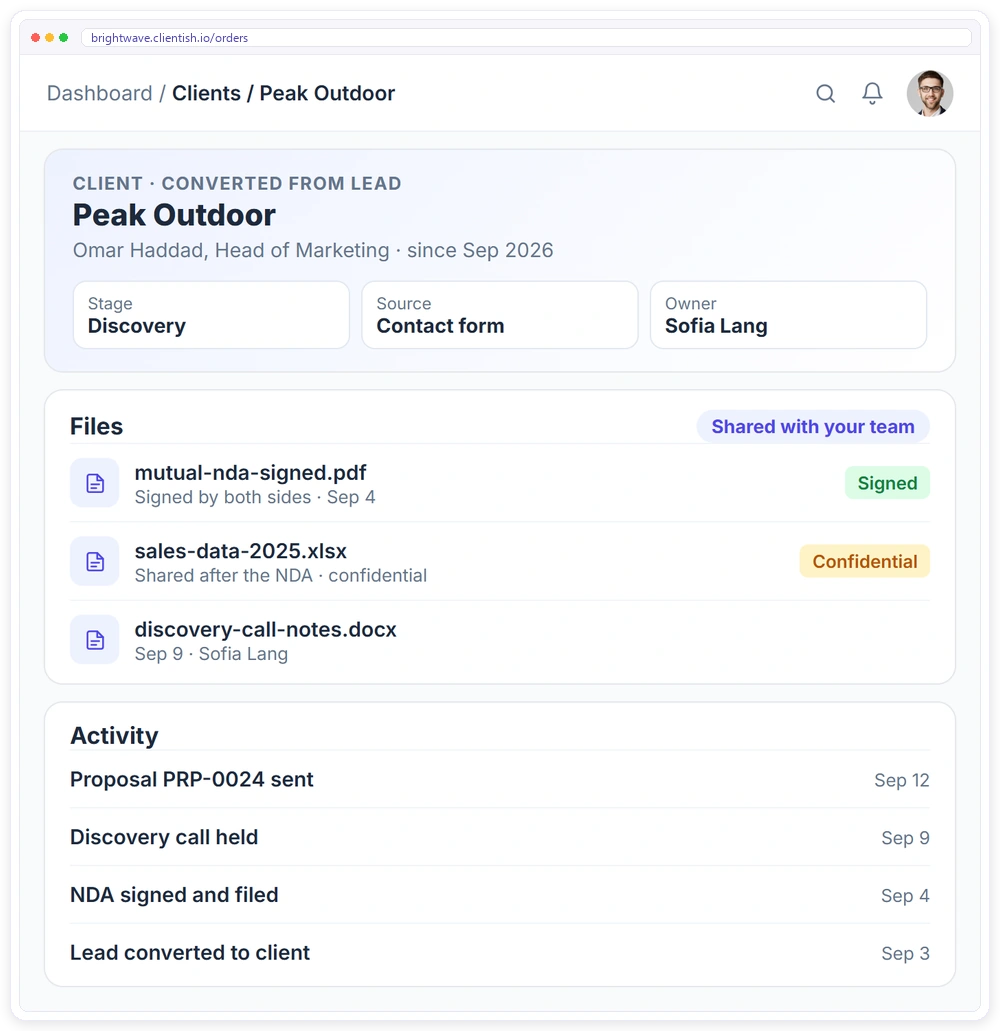
An NDA protects the conversation before the work. Once the work begins, the relationship moves on to invoices, approvals, and a shared place to keep documents — and that is where a client portal takes over from the signed PDF in an email thread.
- ✓Leads become clients in the CRM, with the whole history kept
- ✓The signed NDA and shared files kept on the client record
- ✓A proposal the client signs online once discovery is done
- ✓A branded client portal on your own subdomain
- ✓Clients open a support ticket instead of emailing
Download the free non-disclosure agreement (NDA) template
The editable Word file with all 10 sections. Replace the brackets, add your branding and use it with every client.
This template is a free, editable starting point, not legal advice. Laws vary by region, so have a qualified lawyer review it for your jurisdiction before you rely on it.
Frequently asked questions
Is this NDA template free to use?
Yes. There is no watermark and no cost. Open it in Google Docs or Word, adapt it to your situation and jurisdiction, and use it before any confidential conversation.
Should an agency use a mutual or unilateral NDA?
Usually mutual. In a pitch or discovery session an agency reveals its own methodology and pricing at the same time the client reveals their data, so both sides have information worth protecting, and a unilateral NDA would leave the agency exposed. Use unilateral only when one side alone is disclosing and the other is not.
How long should an NDA last?
For ordinary business information, a fixed term of two to five years is both common and defensible. Genuine trade secrets can be protected for as long as they stay secret, but applying a perpetual obligation to everything tends to make the agreement harder to enforce, so reserve indefinite protection for information that truly warrants it.
What is the difference between an NDA and a confidentiality clause in a contract?
An NDA is a standalone agreement, usually signed before a contract exists, to protect information shared during a pitch or discovery. A confidentiality clause lives inside a service agreement and protects information shared once you are working together. The NDA protects the conversation that decides whether you work together; the clause protects the work once you do.
What if a prospect refuses to sign the NDA?
Treat it as information. Most reasonable prospects understand why an agency protects its methodology and client data, so a brief explanation of what the NDA covers usually settles it. Persistent refusal, especially before you have shared pricing or strategy, is a signal worth weighing before you invest further.
Can I sign an NDA by e-signature?
Yes, in most countries an e-signature is legally valid for an NDA, and a signing tool's timestamped audit trail is often more defensible than a scanned paper signature. Check local rules if your counterparty is in a jurisdiction you are unfamiliar with.
Related Templates
If you share sensitive information with clients and partners, these free templates pair well with the NDA: More free, editable templates from the Agency Templates Library.
Client Service Agreement (MSA)
The legal terms you sign once with every client.
CONTRACTStatement of Work (SOW)
Scope, deliverables, acceptance and milestones per project.
RETAINERAgency Retainer Agreement
The core retainer contract, ready to brand.
ONBOARDINGProject Intake Questionnaire
The discovery questions to ask before you scope.
SALESClient Proposal
Client problem first, value before price, tiered.
PROJECTChange Request Form
Turn scope creep into a priced, approved decision.