
Social Media Retainer Agreement Template
A social media retainer goes wrong in ways no other agency service does. A post goes out that the client never approved. Nobody agreed who answers the angry DM at 9pm.
Free to download and edit · No watermark · Add your own branding
The client leaves and realizes the agency still holds the Instagram password. And when a post lands badly in public, the question of who is responsible has never once been written down. Every one of those is a clause away from being a non-issue.
This page gives you a free, editable Social Media Retainer Agreement template for agencies and freelancers managing social, plus a plain-English breakdown of every clause, including the social-specific ones a generic retainer misses: the content approval workflow, account access and credential handover, community management scope, crisis and post liability, and the honest results disclaimer. Download it, add your branding, fill in the brackets, and send it before you post anything.
What Is a Social Media Retainer Agreement?
Social media work happens in public and in real time, which is exactly what makes the contract behind it unusual.
A social media retainer agreement is the recurring-fee contract under which your agency runs a client's social presence, content, scheduling, posting, community management, and reporting across the agreed platforms.
It has to answer questions no quieter service ever raises: what goes out and how often, how a post is approved before the client's whole audience sees it, who holds the account logins, who replies to the audience, and who carries the blame when something public goes wrong.
Structurally, a social retainer sits in a different category from both a project contract and a general marketing retainer, and the differences matter when you draft one. A project contract closes when a deliverable is accepted: the scope is fixed and completion is measurable. A general marketing retainer often covers strategy, media buying, or analytics work that is largely invisible to the public and can absorb scope drift quietly.
How it differs from a one-off project contract
A social retainer has neither of those properties. The work is continuous with no natural endpoint, and every output is public the moment it goes live. That combination means the agreement cannot rely on the mechanisms those other contract types use to manage risk.
It also cannot rely on what most service retainers assume: that the agency operates at arm's length from the client's assets. A copywriting or SEO retainer delivers work to the client, who then controls what happens to it. In a social retainer, the agency often holds the client's account credentials, posts directly to live accounts, and speaks in the client's voice in real time.
That creates legal exposure around account access, around who authorized a given post, and around liability for public statements, which a standard retainer clause structure is not built to handle. The agreement has to address those questions explicitly, because no template designed for general marketing or creative services will have asked them.
Decide What the Client Is Buying Each Month First
Social scope creep is relentless, and the only real defence is a monthly output stated in numbers. So the first thing to pin down is what the client actually gets each cycle, and in which of three shapes.
Fixed output by platform
The clearest model: a set number of posts, stories, and reels per platform per cycle — for example "12 feed posts, 20 stories, and 4 reels on Instagram, plus 8 posts on LinkedIn." Easy to scope, easy to hold you to.
Content plus community
Fixed content output plus a defined amount of community management — responding to comments and DMs within agreed hours. This is where vague retainers quietly expand, so the community portion needs its own boundary.
Full management
Content, community, strategy, paid boosting oversight, and reporting as an ongoing managed service. Scope is defined by responsibility, so the exclusions clause matters most here.
Fixed output suits content-only engagements; content-plus-community suits most SMB social; full management suits brands handing over the whole channel. Whichever you pick, write the posting output as countable deliverables per platform — "social media management" with no numbers is one of the most common sources of social retainer disputes, because scope creep in community management and ad-hoc content requests is nearly impossible to dispute without a number on record.
Why a Social Media Retainer Agreement Protects the Agency, Not Just the Engagement
Clients are well served by a clear agreement — but the clauses in a social media retainer exist because the agency carries disproportionate exposure. Understanding that asymmetry explains why certain protections are non-negotiable from your side of the contract.
Your reputation is on the line for someone else's brand
Every post published under this agreement is public and permanent. If something goes wrong, the agency is the one who pressed send — regardless of who drafted the brief or approved the copy.
You hold access that isn't yours
Managing client accounts means holding credentials, ad spend authority, and sometimes page admin rights. A contract defines exactly what you are authorised to do with that access, and limits your liability for anything outside that scope.
Scope creep hits agencies harder than clients
A client who adds a platform, a weekly story series, or a "quick" ad campaign loses nothing by asking. An agency that absorbs it loses billable hours. The agreement is what lets you say no — or invoice — without the relationship breaking down.
Termination without a clause leaves you exposed
Without a defined notice period and an offboarding process, a client can demand an immediate handover of all assets while withholding final payment, and you have no written position to stand on.
The Risks section covers what can go wrong inside an engagement. This is about what protects you when the engagement ends badly — or never should have started on those terms.
The Risks of a Vague Social Media Retainer: Real Scenarios
Because social plays out in public, a missing clause rarely stays a private problem. Here is each gap as it surfaces in a live account, with the clause that would have closed it.
The agency schedules a week of content, one post misjudges the client's tone, and it publishes before the client sees it. The client is furious their audience saw something they never approved. A clause defining the approval step — and stating that unreviewed content is not published — would have stopped it cold.
The client decides to leave and discovers the agency created the business's new TikTok under the agency's own email, or changed the Instagram password and never shared it. Without an access-and-handover clause, the client fights to recover their own accounts.
A "social retainer" with no defined community scope turns into the agency being expected to answer every comment and DM within minutes, nights and weekends included. A clause setting response hours and volume would have drawn the line.
A reply the agency posted from the brand account sparks a public backlash. The client demands the agency absorb the fallout and lost business. Without a liability and crisis clause, responsibility for a public moment nobody planned for is argued after the fact instead of agreed before.
The agency manages an Instagram collaboration for a skincare brand — product gifted, caption written, post live — and no one added #ad or #sponsored. A follower flags it, the platform surfaces it for review, and the brand is fielding questions about deceptive advertising before anyone has checked the contract to see whose job disclosure actually was. A clause assigning responsibility for FTC-style disclosures on paid posts, gifted content, and influencer partnerships would have made the obligation clear before the post went up.
For each of those public failures, the template carries a clause that heads it off.
The Key Components of a Social Media Retainer Agreement
Beyond the usual retainer clauses, the template adds the ones that only matter when you are posting in someone else's voice: approval, account access, community scope, and public liability. Each is set out below, with the social-specific ones marked.
Parties Involved
The full legal names and addresses of both the agency (or freelancer) and the client, so it is clear which entities are bound and who is accountable for the brand's public channels.
Social Scope and DeliverablesSpecific to this template
The monthly output stated as countable deliverables per platform — posts, stories, reels, and which networks (Instagram, LinkedIn, TikTok, Facebook, X). List what is included (content creation, scheduling, posting, reporting) and what is excluded, such as paid ad management, influencer sourcing, or video production beyond the agreed format.
Content Approval WorkflowSpecific to this template
The most important mechanic in a social agreement. State how content is submitted for approval, who on the client side approves it, the deadline for approval, and — critically — that content is not published without sign-off, and that if the client misses the approval window the schedule shifts rather than the agency guessing. This single clause prevents the unapproved-post disaster.
Account Access and CredentialsSpecific to this template
How account access is handled. Best practice, which the template follows, is that accounts are owned by the client, the agency is granted access (through a business-manager tool or shared access rather than the client's raw password where possible), credentials are kept confidential, and all access and ownership transfer cleanly to the client on exit.
Community ManagementSpecific to this template
What the agency does with comments, messages, and mentions, and within what hours and volume. Define whether community management is included, the response window (for example, within business hours), and what escalates to the client. Without this, community work expands without limit.
Posting Schedule and Reporting
The cadence of posting and the reporting rhythm — typically a monthly report covering reach, engagement, follower change, and top content, plus a review call. Agreeing the metrics up front keeps "I can't tell if this is working" from becoming a reason to churn.
Results Expectations and DisclaimerSpecific to this template
A plain statement that reach, engagement, and follower growth depend on platform algorithms, audience behaviour, and content resonance outside the agency's full control, so the agency does not guarantee specific follower counts, engagement rates, or viral outcomes. The obligation is professional management, not a guaranteed number.
Liability and Crisis ResponsibilitySpecific to this template
Who is responsible for published content, replies, and public incidents. State that the agency acts on the approved brand voice and guidelines, that the client is responsible for content it approves, and how a public crisis is handled and escalated. This allocates a risk unique to social before it materializes.
Advertising Disclosure ComplianceSpecific to this template
A clause assigning responsibility for required advertising and sponsorship disclosures (such as FTC-style #ad labelling on paid or influencer content), so a compliance obligation does not fall through the gap between the parties.
Payment, Confidentiality and IP
The retainer fee, billing date, and late fee; confidentiality covering the client's data and login credentials; and ownership of the created content, which transfers to the client on full payment while the agency retains its own tools and templates.
Duration, Renewal and Termination
When the retainer starts, its minimum commitment, how it renews, and the notice to end it. Month-to-month with thirty days' notice is standard for social, and the template confirms that account access, created content, and any scheduled posts hand back to the client cleanly on exit.
The clause most social templates skip
Most social templates cover posting and approval but omit a brand safety and guidelines clause: a short term confirming the agency works to an agreed set of brand guidelines and a do-not-post list (topics, competitors, claims to avoid), and that the client supplies them. Social mistakes are rarely malice; they are an agency guessing at a boundary nobody wrote down. The free template includes it.
Tips and Best Practices for a Social Media Retainer That Holds Up
The clauses draw the lines; what keeps a social retainer safe once posts are going live is a set of working habits. These are the ones that matter most.
When a client goes silent mid-approval cycle
The most common retainer breakdown is not a dispute; it is radio silence during a scheduled approval window. Decide before the first month what happens when a client does not respond by the approval deadline. A workable default: one chase at the 24-hour mark, a second at 48 hours, then move the content to the next cycle and note the slip in writing.
Do not improvise a live post to fill the gap, and do not absorb the lost week as unpaid overtime. Document the missed cycle in your monthly report so the pattern is visible if it recurs; clients who see it logged tend to respond faster the following month.
When a platform outage delays scheduled posts
Schedulers go down and platforms throttle APIs without warning. Have a one-paragraph protocol ready before it happens: who checks the scheduler first, how quickly you notify the client, and whether you post manually or hold.
If a time-sensitive post misses its window because of a platform-side failure, log it and offer a make-good slot, but make clear in the retainer that platform outages are outside your control and are not a deliverable failure on your part. A clause covering force majeure or third-party platform failure is worth adding once you have confirmed the language with a lawyer.
What a healthy monthly retainer check-in call actually covers
A check-in that only recaps last month's numbers is a wasted call. A tighter agenda: open with any scope or deadline issues from the current cycle before they compound, walk the metrics with one clear "what changed and why" per platform, flag the content themes or formats you want to test next month, confirm the approval schedule and any client-side events or blackout dates, and close on any outstanding decisions the client owes you.
Keep it to 30 minutes, and send a three-line summary immediately after so nothing is lost between the call and the next brief. Clients who get a consistent agenda show up prepared, and calls on a reliable format are far easier to reschedule when conflicts arise.
Handling a retainer pause or mid-month scope shift
Clients request pauses and budgets get reviewed. When a client asks to pause mid-month, refer to your agreement's pause clause rather than negotiating it fresh each time. If you do not have one, add it to your next version: the minimum notice to pause, whether paused months roll over or lapse, and the notice to resume.
For mid-month scope shifts, such as a client who wants to add a platform or double the posting frequency without a formal change order, confirm in writing before you absorb the extra work, even if the confirmation is a single reply-to email restating what was agreed. A retainer without a pause-and-change-order habit will eventually absorb work it was never paid to do.
How to Use the Free Social Media Retainer Agreement Template
Four steps get the template ready to send to a social client.
Copy it first
Download the Word (.docx) file, or upload it to Google Docs, and work on your copy, not the original.
Fill every bracket
Each [bracketed] placeholder needs your input: your details, the client's, the platforms and monthly post counts, the approval workflow, the community-management hours, and the fee.
Make it yours
Drop in your logo, colours, and footer so the agreement looks like it came from your agency.
Send for signature
Before you route the finished document through an e-signature service (DocuSign, PandaDoc, or similar), check that the approval-window deadline stated in the agreement actually matches your client's internal review process — if their legal or brand team needs five business days to review content but the agreement says two, you'll be in breach of your own turnaround commitments from day one.
When deciding which platforms to list, only include channels the client is actively using or launching at the start of the retainer — adding speculative platforms creates scope ambiguity. For post counts, anchor each number to what you scoped during discovery, not what sounds impressive. On community management: include it only if you discussed it explicitly at the scoping stage and agreed on a monthly hour cap; if it was never scoped, leave that clause out entirely rather than leaving the bracket blank or adding a vague estimate.
Confirm that timeline with the client before both sides sign, and get signatures before the first post goes out.
Managing a Social Media Retainer After the Agreement Is Signed
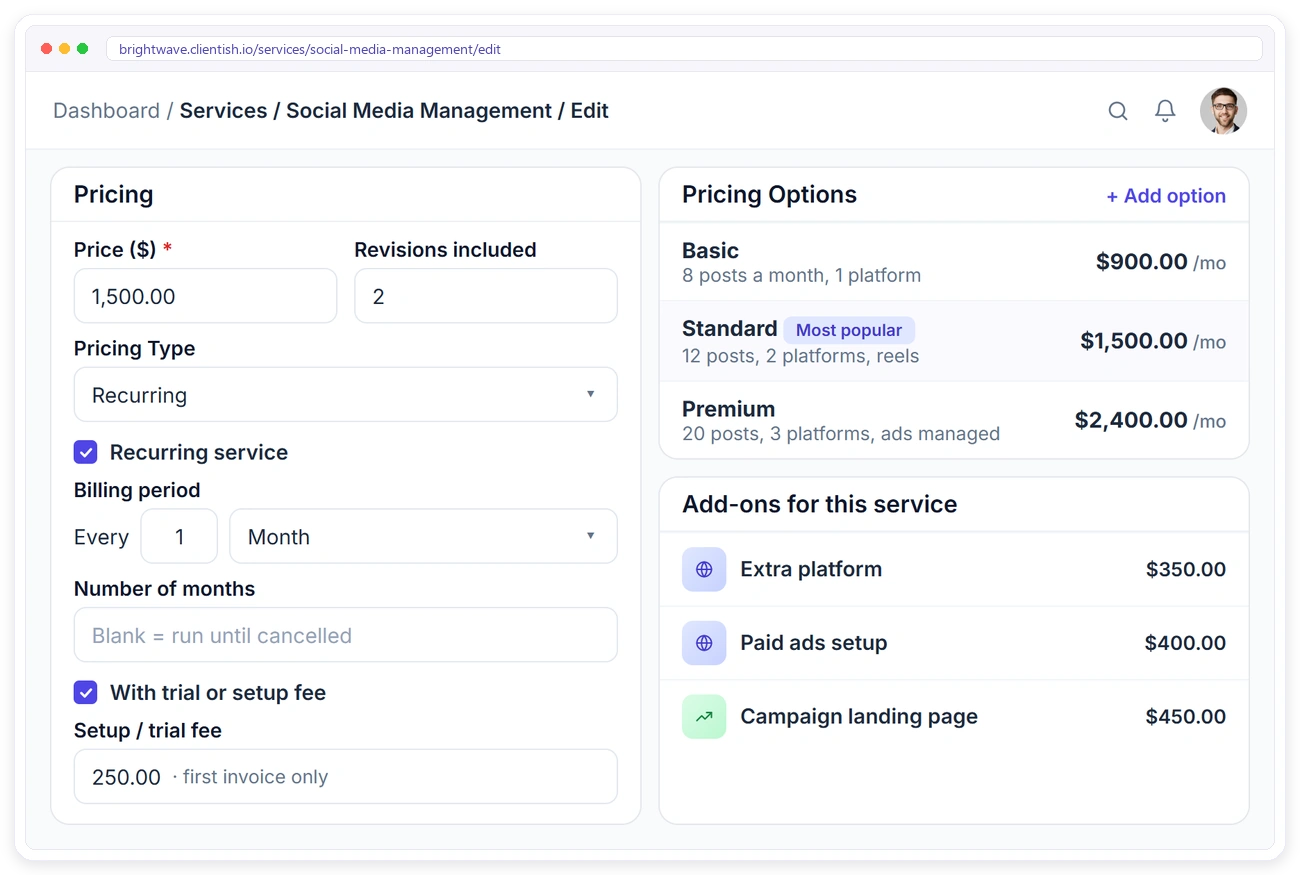
Social is a daily-rhythm service, and once the agreement is signed that rhythm is where the work lives: invoicing the fee each cycle, tracking each client's content output and community hours, keeping approvals moving, and making the reporting visible without an endless email chain. The contract sets the rules; sustaining that daily rhythm is a tooling job.
- ✓A recurring subscription raises the retainer invoice every cycle, so you don’t create it by hand
- ✓Clients top up a prepaid balance and pay invoices from it
- ✓A branded client portal on your own subdomain with orders, invoices, subscriptions and balance
- ✓Clients open a support ticket with SLA response times instead of emailing you
- ✓Your own payment gateway, such as Stripe or PayPal, or bank transfer
Download the free social media retainer template
The editable Word file with all 11 clauses plus signature blocks. Replace the brackets, add your branding and send it.
This template is a free, editable starting point, not legal advice. Laws vary by region, so have a qualified lawyer review it for your jurisdiction before you rely on it.
Frequently asked questions
Is this social media retainer agreement template free to use?
Yes — it is free to download and edit in Google Docs or Word, with no watermark. Add your branding and use it with every social client you take on.
How should content approval work in a social contract?
The agreement should state who on the client side approves content, the deadline for approval, and that nothing publishes without sign-off. The template also specifies that if the client misses the approval window, the posting schedule shifts rather than the agency publishing unreviewed content — which prevents the most common social dispute.
Who should own the social media accounts and passwords?
The client. Best practice, which the template follows, is that accounts are owned by the client, the agency is granted access through business tools rather than raw passwords where possible, credentials stay confidential, and all access transfers to the client on exit so there is no lockout.
Should a social media contract guarantee follower growth?
No. Reach, engagement, and follower growth depend on platform algorithms and audience behaviour outside the agency's full control, so guaranteeing numbers invites refund claims. The template defines the obligation as professional management, with results reported rather than guaranteed.
Who is responsible if a post causes a problem?
The template includes a liability and crisis clause: the agency works to the approved brand voice and guidelines, the client is responsible for content it approves, and the clause sets out how a public incident is escalated and handled. It also assigns responsibility for advertising disclosure compliance.
Related Templates
If you run social alongside other services or want to tighten the rest of your client paperwork, these free templates pair well with this one: More free, editable templates from the Agency Templates Library.
Agency Retainer Agreement
The core retainer contract, ready to brand.
RETAINERSEO Retainer Agreement
Scope and deliverables for monthly SEO work.
RETAINERPPC Retainer Agreement
Ad management scope, spend handling and reporting.
CHECKLISTClient Onboarding Checklist
The 3-phase onboarding checklist for any agency.
CONTRACTStatement of Work (SOW)
Scope, deliverables, acceptance and milestones per project.
CONTRACTNon-Disclosure Agreement (NDA)
Mutual by default, for pitches and discovery.
RETAINERCreative Agency Retainer
Design and branding retainers with revision limits.
RETAINERWeb Development Retainer
Maintenance and build hours with change-request terms.