
Service Level Agreement (SLA) Template
"We'll get back to you quickly" is not a commitment — it is a hope, and the gap between the client's idea of quickly and the agency's is where support relationships sour. The client expects a reply within the hour; the agency, juggling a dozen accounts, gets to it the next afternoon.
Free to download and edit · No watermark · Add your own branding
Neither is wrong, because nothing was ever agreed.
A service level agreement replaces that vague promise with a number: a stated time to respond, a stated time to resolve, the hours those apply, and what happens if the agency misses them. It is what turns "quickly" into something the client can rely on and the agency can actually staff for.
This page gives you a free, editable service level agreement template for agencies offering ongoing support, maintenance, or hosting — the document that defines the response and resolution times you commit to, the priority levels they vary by, the uptime you guarantee, and the remedy if you fall short. Download it, set targets you can realistically hit, and attach it to your retainer or support agreement so "what happens when something breaks" is answered before anything does.
What Is a Service Level Agreement?
A service level agreement (SLA) is a document that defines the measurable standards of an ongoing service — how fast the provider responds, how fast it resolves issues, how much uptime it guarantees — and the remedy the client receives if those standards are not met.
It converts service quality from a matter of goodwill into a set of specific, trackable commitments that both sides agree to in advance.
Its defining feature is measurability. Where a general promise of "good support" cannot be enforced or even checked, an SLA states that a priority-one issue will be acknowledged within one hour and resolved within four, that the service will be available 99.9% of the time, and that a missed target earns the client a service credit. Each of those is a number you can measure against, which is what makes the agreement meaningful rather than decorative.
How it differs from the documents around it
It belongs to a specific kind of work and pairs with documents you may already use. An SLA is for ongoing services — support, maintenance, hosting, a managed retainer — not one-off projects, which a Statement of Work scopes instead. It typically attaches to a retainer or service agreement: the service agreement sets the legal terms, the retainer sets the recurring fee, and the SLA sets the service standards that fee buys. Together they answer what you do, for how much, and to what measurable standard.
Why Your Agency Needs an SLA
For any agency selling ongoing support or hosting, the SLA is what makes the service sellable and deliverable at once — it sets the client's expectations and the agency's own operating targets in the same document.
It replaces "quickly" with a number
The single most common support dispute is a mismatch of expectations about speed. Stating response and resolution times removes it: the client knows exactly what to expect, and the agency knows exactly what it has to meet.
It lets you charge for responsiveness
Faster response is a product you can price. An SLA with tiered targets lets you sell a premium support level to clients who need it, instead of giving everyone your fastest response and hoping the fees cover it.
It sets the agency's own operating bar
The targets are not just promises to the client; they are the standard your team staffs and plans around. An SLA turns "we should probably reply faster" into a defined, measurable goal.
It makes a miss a defined event, not a crisis
When the remedy for a missed target is written down — usually a service credit — a lapse becomes a known, bounded consequence rather than an open argument about what the agency owes.
It protects you with exclusions
A well-written SLA states what it does not cover — client-caused issues, third-party outages, scheduled maintenance — so you are measured only against what you actually control.
The Risks of Offering Support Without an SLA
Selling ongoing support on vague terms works until the first serious incident, at which point the absence of agreed standards becomes the problem. Here is how the gaps surface.
The client believes support means near-instant replies; the agency believes it means same-week attention. Both operate in good faith and the relationship still erodes, because the standard was never named.
Without stated hours and priority levels, every request implicitly becomes urgent and every hour becomes support hours. The agency ends up on call indefinitely for a fee that never assumed it.
Something goes down, the fix takes longer than the client thinks reasonable, and because no resolution target and no remedy were ever agreed, the fallout is an open-ended dispute instead of a defined service credit.
In the absence of a realistic SLA, agencies promise "24/7 support" or "100% uptime" verbally to win the work, then cannot deliver it, which is worse than having set an honest target in writing.
Without exclusions, the agency gets held to its response and uptime targets even when the cause was the client's own change, a third-party provider, or planned maintenance.
Each of these is addressed by a section in the template below.
The Key Sections of an SLA
The template holds each of these as a fillable section. Here is what each one defines and how to set it without over-committing.
Parties and Services Covered
Who the agreement is between and exactly which services it applies to — the website, the application, the hosting, the support channel. Being specific here matters: the SLA should cover the services you can measure and control, and name anything it deliberately excludes.
Priority Levels
How issues are classified by severity, because a down site and a cosmetic bug do not deserve the same response. A common three-tier scheme is critical (service down or unusable), high (major feature broken), and normal (minor issue or request). Each level gets its own response and resolution targets, so your fastest commitments are reserved for the problems that actually warrant them.
Response and Resolution Times
The two numbers at the heart of the SLA, and they are not the same. Response time is how quickly you acknowledge an issue and begin work; resolution time is how long until it is fixed. State both, per priority level — for example, a critical issue acknowledged within one hour and resolved within four, a normal request acknowledged within one business day. Keeping them separate is what stops a client expecting an instant fix when what you committed to was an instant reply.
Support Hours
When the SLA's clock runs — business hours in a stated time zone, extended hours, or 24/7. This is where you decide, and the client agrees, whether a Saturday-night outage falls under the agreement or waits until Monday. Defining it protects you from an unbounded on-call expectation you never priced.
Availability and Uptime
For hosting or an application, the percentage of time the service is guaranteed available, measured over a stated period. Set this realistically: 99.9% is a strong, achievable commitment, while 100% is a promise no one can keep and should never be made. State how uptime is measured and what counts as downtime.
Remedies and Service Credits
What the client gets when a target is missed — typically a service credit against the next invoice, scaled to the severity or duration of the miss. This is the clause that gives the SLA teeth. It also caps the consequence: a defined credit is a known, bounded remedy, which is far better for the agency than an open claim for damages.
Exclusions
What the SLA does not cover: issues caused by the client's own changes, failures of third-party services, scheduled maintenance announced in advance, and force-majeure events. This section is what ensures you are measured only against what you control, and it is as important to the agency as the targets themselves.
Client Responsibilities
What the client must do for the SLA to hold — report issues through the agreed channel, provide access, respond to requests for information. A resolution target cannot run while the agency is waiting on the client, and this section makes that explicit.
Monitoring and Review
How performance is tracked and how often the SLA is reviewed, commonly quarterly. A review period lets both sides adjust targets that proved unrealistic and keeps the agreement matched to the service as it evolves.
Tips for an SLA You Can Actually Meet
An SLA that looks impressive but cannot be met is worse than none, because every miss is now a breach. A few disciplines keep it honest and enforceable.
Commit to numbers you can meet when short-staffed, not on your best day
The SLA is a floor you are promising never to go below, so set it against your realistic capacity, not your ideal one. A target you miss routinely is a liability, not a selling point.
Never promise 100% uptime or instant resolution
Realistic, specific commitments — 99.9% uptime, a one-hour response — build more trust than round-number promises you cannot keep.
State both times, and make the difference clear to the client
The most common SLA misunderstanding is a client who hears "one-hour SLA" and expects the problem fixed in an hour, when you committed to replying in one. Spell out that response and resolution are different clocks.
Tie the tightest targets to the highest priority only
Reserve your fastest response and resolution for genuine emergencies, and set calmer targets for routine requests, so you are not sprinting for a cosmetic tweak.
Write the exclusions as carefully as the targets
Client-caused issues, third-party failures, and scheduled maintenance must be out of scope, or you will be held to your numbers for things you never controlled.
Make the client's reporting duties a condition
The resolution clock should start when the issue is reported through the right channel with the information you need, not before.
How to Use the Free SLA Template
Turning the template into a working SLA takes five steps.
Start from a copy
Download the Word (.docx) file, or upload it to Google Docs, and work on your copy, not the original.
Set your priority levels and targets
Define your tiers and assign a realistic response and resolution time to each, based on what you can meet consistently.
Set uptime, hours, and the remedy
Choose an achievable uptime figure, define your support hours and time zone, and set the service credit for a missed target.
Write your exclusions and the client's responsibilities
List what is outside the SLA and what the client must do for it to apply.
Attach it to the retainer and review it
Pair the SLA with your support retainer or service agreement, and set a review date to adjust targets as the service matures.
Running Support and SLAs Inside a Client Portal
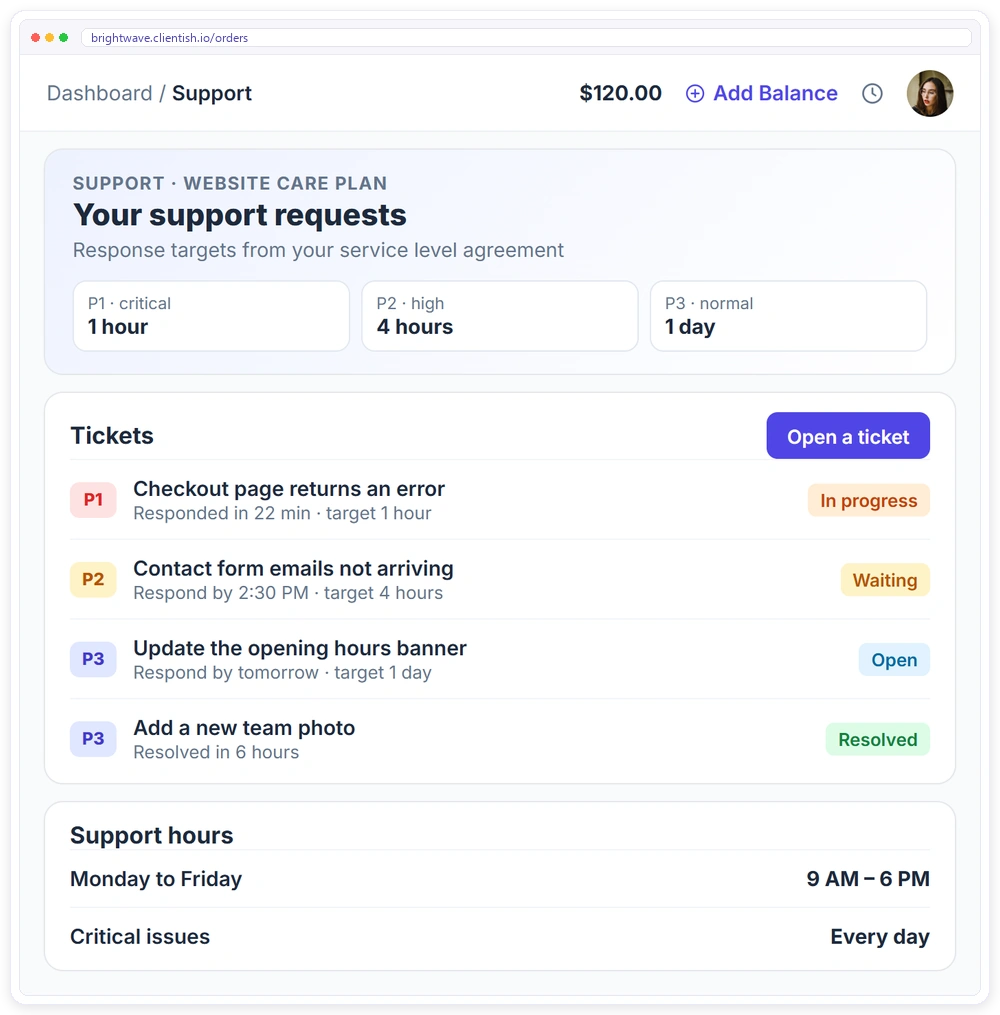
An SLA sets the standards. The day-to-day of the service — the client reporting an issue, tracking it, and seeing it handled — is what a client portal carries, giving the response clock a clear start and a visible record.
- ✓Clients open a support ticket from their portal instead of emailing
- ✓Priorities with the response times you set
- ✓Tickets assigned to the right person on your team
- ✓Clients get an email when you reply and see every ticket’s history
- ✓Support plans billed as a recurring service
Download the free service level agreement (SLA) template
The editable Word file with all 9 sections. Replace the brackets, add your branding and use it with every client.
This template is a free, editable starting point, not legal advice. Laws vary by region, so have a qualified lawyer review it for your jurisdiction before you rely on it.
Frequently asked questions
Is this SLA template free to use?
Yes. There is no watermark and no cost. Open it in Google Docs or Word, set the targets to what your agency can realistically meet, and attach it to your support or hosting agreement.
What is the difference between response time and resolution time?
Response time is how quickly you acknowledge an issue and begin working on it; resolution time is how long until it is fully fixed. They are different commitments, and stating both separately prevents the common misunderstanding where a client hears a one-hour SLA and expects the problem solved in an hour rather than acknowledged in one.
What uptime percentage should I promise?
A realistic, specific figure such as 99.9%, measured over a stated period. Never promise 100% — it is impossible to guarantee and sets you up to breach the SLA on the first unavoidable outage. A believable commitment you can meet builds more trust than a round number you cannot.
How is an SLA different from a service agreement or SOW?
A Statement of Work scopes a one-off project. A service or retainer agreement sets the legal terms and the recurring fee of an ongoing relationship. An SLA sets the measurable service standards — response, resolution, uptime — of that ongoing service, and usually attaches to the retainer or service agreement rather than standing alone.
What are service credits?
A service credit is the remedy a client receives when the agency misses an SLA target — usually a credit against the next invoice, scaled to how badly or how long the target was missed. It gives the SLA teeth while also capping the consequence to a known amount, which protects the agency from an open-ended claim.
Related Templates
If you offer ongoing support, maintenance, or hosting, these free templates pair well with the SLA: More free, editable templates from the Agency Templates Library.
Agency Retainer Agreement
The core retainer contract, ready to brand.
CONTRACTClient Service Agreement (MSA)
The legal terms you sign once with every client.
CONTRACTStatement of Work (SOW)
Scope, deliverables, acceptance and milestones per project.
RETAINERWeb Development Retainer
Maintenance and build hours with change-request terms.
PROJECTChange Request Form
Turn scope creep into a priced, approved decision.
CHECKLISTClient Onboarding Checklist
The 3-phase onboarding checklist for any agency.