
Client Proposal Template
There is a predictable way to lose a pitch, and most proposals follow it exactly. They open with the agency — who we are, when we were founded, the logos of clients you may recognise — and only reach the prospect's actual problem on page four, if at all.
Free to download and edit · No watermark · Add your own branding
By then the reader, who came to find out whether you understand their situation, has learned mostly about yours. The proposals that win do the opposite: they open with the client's problem, lay out the outcome before the price, and make the next step effortless. The difference is not polish. It is sequence.
This page gives you a free, editable client proposal template for agencies and freelancers — the persuasive document you send to win the work, before any contract or Statement of Work exists. It is ordered the way winning proposals are: the client's situation first, your proposed approach and the outcome it produces next, the investment after the value is clear, and a frictionless next step at the end. Download it, tailor it to each prospect, and send proposals that read as being about the client rather than about you.
What Is a Client Proposal?
A client proposal is a persuasive document an agency sends to a prospective client to win a specific piece of work.
It sets out your understanding of their problem, the approach you recommend, what you will deliver, and what it will cost — framed to make the case that you are the right choice. Unlike the documents that follow it, its job is not to record agreed terms but to persuade someone to agree in the first place.
That persuasive purpose is what separates it from a Statement of Work. A proposal comes before the decision: it is a sales document, weighted toward value, outcomes, and why you. A Statement of Work comes after the yes: it is an operational document that records the exact scope, deliverables, and fees you will be held to. The proposal wins the work; the SOW defines it. Many agencies carry the agreed shape of a proposal straight into the SOW once it is accepted.
How it differs from the documents around it
It also sits at a specific point in the sales process. Discovery or an intake questionnaire gathers what you need to know about the prospect; the proposal is where you turn that understanding into a recommendation and an ask. A strong proposal is visibly built on discovery — it reflects the client's own words and situation back to them, which is exactly what signals that you were listening and that the proposal is for them, not a template with their name pasted in.
Why Your Agency Needs a Strong Proposal
The proposal is often the only thing a decision-maker reads closely before choosing between you and a competitor. Getting its structure right is a direct lever on win rate.
It wins on understanding, not features
Prospects choose the agency that most clearly grasps their problem. A proposal that opens with their situation, in their language, beats one that opens with your credentials, however impressive those are.
It frames price against value
Presenting the outcome and its worth before the fee is what makes the fee feel proportionate. A number that arrives before the value has been established reads as expensive; the same number after it reads as reasonable.
It gives the client a choice, not an ultimatum
A proposal with tiered options turns the decision from "yes or no" into "which one," which keeps a hesitant prospect in the conversation rather than forcing a binary they may answer with "no." A prospect who balks at a single large package will often say yes to a smaller entry tier, keeping the client and the door open for future work.
It separates you from the competitor
When several agencies pitch the same work, the proposal that names the client's specific problem and shows relevant proof stands out against the generic ones, which is most of them. An e-commerce client who sees their exact abandoned-cart problem called out by name will read past the first page; one receiving a generic "digital marketing proposal" often won't.
It makes saying yes easy
A clear next step — a call to book, a simple sign-off, a defined start — removes the friction that lets a warm prospect cool. A proposal that ends vaguely invites "let me think about it."
The Risks of a Weak or Generic Proposal
Most proposals do not fail with a rejection — they fail silently, disappearing into an inbox while the agency waits for a reply that never comes. Here is how each common weakness sets off a chain that costs the work.
The proposal leads with your story and reaches the client's problem late → the reader, looking for evidence you understand them, finds a brochure about you → they quietly move on to an agency that opened with their situation, and yours never gets a second read.
The fee appears before the outcome has been made concrete → it lands as a raw cost rather than an investment against a result → the prospect anchors on the number, the conversation becomes about discount, and margin shrinks before the project has started.
One option forces a yes-or-no decision → a prospect who might have said yes to a smaller tier, or stretched to a larger one, has nowhere to go → they say no to the only option offered, and a winnable deal is lost entirely.
The proposal promises "a comprehensive strategy" and "ongoing support" without specifics → the prospect cannot tell what they are buying, but accepts anyway → the ambiguity becomes the contract, and scope creep erodes margin across the life of the project.
The proposal finishes with no clear next step → the momentum from a strong pitch dissipates while the prospect wonders what happens now → a proposal that does not ask for the decision rarely gets it.
Each of these is addressed by a section in the template below.
The Key Sections of a Winning Proposal
The template holds each of these as an editable section, in the order that wins. Here is what each one does and how to write it.
Executive Summary
Write this last, then paste it first. Use this two-sentence formula: "[Client name] needs to [specific outcome] so that [business result]. We recommend [approach] — and this proposal shows exactly how we will get you there." Every other word in the proposal should be able to trace back to those two sentences.
The Client's Situation
Your understanding of their problem, in their own terms. This section, placed early and deliberately, is what signals that the proposal was built on discovery and is for this client specifically. Reflecting their situation back accurately does more to win trust than any claim about your capabilities.
Proposed Approach
How you will solve the problem — the strategy and the reasoning behind it, framed around the outcome rather than the mechanics. Prospects buy a result, not a process, so lead with what the approach achieves and keep the step-by-step detail proportionate.
Scope and Deliverables
Exactly what the client will receive, specifically enough that "done" is unambiguous. Name the deliverables, and name what is out of scope. Precise deliverables here are both what differentiates you from vaguer competitors and what prevents scope creep if the proposal is accepted and carried into a SOW.
Goals and Success Metrics
How success will be measured — the specific, trackable outcomes the work is aimed at. This turns the proposal from a promise of activity into a promise of results, and it gives both sides an agreed definition of what a win looks like.
Timeline
The phases and key dates, so the prospect can see how the work unfolds and when they will see results. A clear timeline makes the engagement feel real and manageable rather than open-ended.
Investment
Present tiers by outcome, not by hour count. For example: Growth (core deliverables, one revision round), Accelerate (adds conversion audit and monthly reporting), Partner (adds dedicated Slack access and quarterly strategy session). Naming tiers after what the client gains — rather than Bronze/Silver/Gold — keeps the framing anchored to value rather than cost.
Proof
Relevant case studies, results, and testimonials that show you have done similar work successfully. Proof placed near the decision reassures a prospect who is about to commit. Keep it relevant to their situation rather than a generic highlight reel.
About the Agency
Who you are and why you are the right fit — kept short and placed late, because by this point the client's problem and your solution have already made the case. This section supports the decision; it does not lead it.
Next Steps
Exactly what happens if they say yes: the call to book, the sign-off to give, the start date. A single, frictionless next step is what converts a strong proposal into a signed engagement, so make the path to yes obvious and easy.
Tips for a Proposal That Converts
The template gives you the winning structure. A few disciplines are what make a proposal actually convert rather than just look professional.
Open with the client's problem, not your agency
The first thing the reader should meet is evidence you understand their situation. Save your story for late in the document, after the case is already made.
Never show the price before the value
Establish the outcome and what it is worth first, so the fee reads as proportionate. Order matters more than the number itself here.
Offer tiered options where you can
A good/better/best structure turns a yes-or-no into a which-one and keeps a hesitant prospect choosing rather than declining. Match the tiers to how you actually deliver.
End with one clear next step
A single, specific action (book this call, sign here, start on this date) is what converts momentum into a signature. A vague ending loses warm prospects.
Personalise the email subject line that delivers the proposal
"Proposal for [Agency]" is easy to ignore. "[Client name] — the plan for [their specific goal]" signals immediately that what's inside is worth opening. The subject line is the first conversion point, before the document is even seen.
Set a follow-up cadence before you hit send
Decide in advance: a light-touch check-in at 48 hours, a value-add nudge at five days, a closing question at ten. Prospects rarely chase you, and if you leave follow-up to instinct, it usually doesn't happen.
Handle a verbal yes before the document is signed
When a client says yes on a call, send the proposal within the hour and name the moment explicitly in your covering note — "As we agreed just now, here's the document to make it official." Momentum stalls fast; capturing it in writing while the energy is live dramatically reduces the gap between intention and signature.
How to Use the Free Proposal Template
Turning the template into a winning proposal takes four steps.
Start from a copy
Download the Word (.docx) file, or upload it to Google Docs, and work on your copy, not the original.
Fill the Client's Situation field from your discovery notes
In the Client's Situation section, paste two to three phrases directly from your intake or discovery call notes — use the client's own words where possible so the proposal is visibly built for them, not recycled.
Keep the value sequence before the Investment section
The template runs situation → approach → outcomes → investment for a reason; resist moving the Investment block earlier, and use the tiered-pricing rows already in that section if you're offering more than one package.
Complete the Next Step field, then follow up
In the Next Step section at the close, name one single action (a call, a sign-off, a portal invite) and set a follow-up date for yourself — don't leave that field blank and wait in silence.
Onboarding a Won Client Inside a Portal
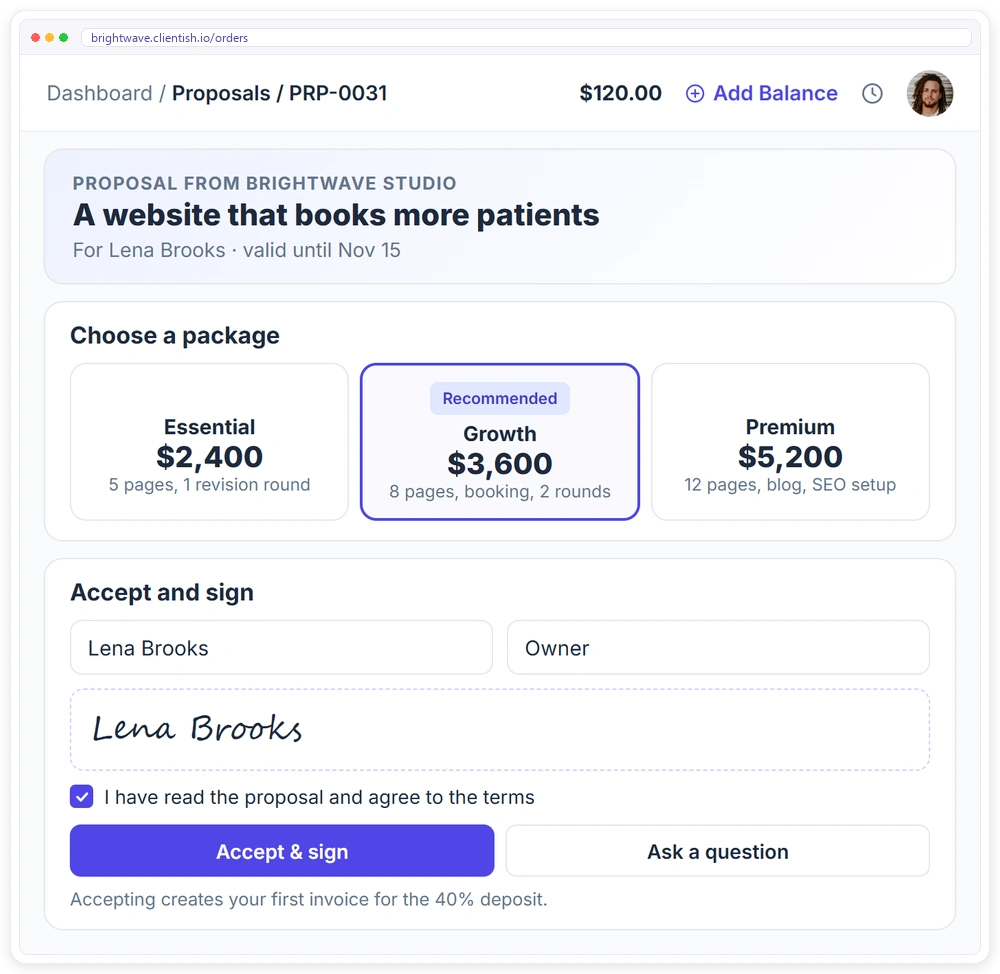
A proposal wins the work. The moment it is accepted, the relationship becomes real — invoices, onboarding, and a shared place to work — and that is where a client portal takes over from the proposal in an inbox.
- ✓Proposals built from sections and templates in Clientish
- ✓Packages the client chooses between
- ✓Accept and sign online with a typed name
- ✓Accepting creates the client, the deposit invoice and the order
- ✓One reminder after 3 days without an answer
Download the free client proposal template
The editable Word file with all 10 sections. Replace the brackets, add your branding and use it with every client.
Frequently asked questions
Is this proposal template free to use?
Yes. There is no watermark and no cost. Open it in Google Docs or Word, tailor it to each prospect, and use it to pitch your work.
What is the difference between a proposal and a Statement of Work?
A proposal is a persuasive sales document sent to win the work: it emphasises the client's problem, your approach, and the value, to make the case for choosing you. A Statement of Work is the operational document that comes after the yes, recording the exact scope, deliverables, and fees you will be held to. The proposal wins the work; the SOW defines it, and the agreed shape usually carries straight into the SOW.
Where should pricing go in a proposal?
After the value, not before it. Presenting the outcome and what it is worth first makes the fee read as a proportionate investment rather than a raw cost, because the reader has something to weigh it against. A price that appears before the value invites the prospect to anchor on the number and negotiate down.
Should I offer one price or several options?
Several, where your work allows it. A tiered good/better/best structure turns the decision from a yes-or-no into a which-one, which keeps a hesitant prospect engaged and lets a keen one spend more. A single price forces a binary that a wavering prospect may answer with no.
When should I follow up after sending a proposal?
Three to five business days after sending is the window: long enough to read it, short enough that momentum has not died. Keep the follow-up brief, confirming they received it and offering a short call, and after one more nudge a week later, send a final check-in rather than chasing indefinitely.
Can I use this template for retainer pitches, not just project work?
Yes. Replace the one-off deliverables section with your ongoing scope (monthly outputs, cadence, and exclusions), and show the monthly fee alongside an estimated annual value so the commitment feels proportionate rather than open-ended.
Related Templates
If you pitch and win client work, these free templates pair well with the Proposal: More free, editable templates from the Agency Templates Library.
Statement of Work (SOW)
Scope, deliverables, acceptance and milestones per project.
ONBOARDINGProject Intake Questionnaire
The discovery questions to ask before you scope.
CONTRACTClient Service Agreement (MSA)
The legal terms you sign once with every client.
RETAINERAgency Retainer Agreement
The core retainer contract, ready to brand.
SALESInvoice
Itemised, with a real due date and a deposit option.
CHECKLISTClient Onboarding Checklist
The 3-phase onboarding checklist for any agency.