
Case Study Release Form Template
A verbal "sure, you can use that" is where a lot of agency case studies begin, and it is not where they are safe. The client who said it on a call may have forgotten; the person who said it may have left; the results you published may be more specific than they are now comfortable sharing.
Free to download and edit · No watermark · Add your own branding
Months later, a request to take the case study down arrives, or worse, a dispute about using their logo and numbers without documented permission. A case study release form turns that casual yes into written, scoped permission — exactly what you are allowed to publish, where, and for how long — so your best proof of work is also your safest.
This page gives you a free, editable case study and testimonial release form for agencies and freelancers — the one-page permission you get signed before publishing a client's name, logo, quote, or results. It covers the grant of permission, where and how you may use the material, the client's right to review it before it goes live, and how they can withdraw consent, so your marketing rests on documented agreement rather than a half-remembered conversation. Download it, get it signed before you publish, and keep the record.
What Is a Case Study Release Form?
A case study release form is a short agreement in which a client gives your agency written permission to use their name, logo, quote, and project results in your marketing.
It defines what you may publish, where you may publish it, and for how long, and it records that the client agreed — so that a published case study or testimonial rests on documented consent rather than an informal say-so.
Why Your Agency Needs a Release Form
Case studies win work, but only if you can actually use them. A signed release is what converts a client result into a usable, defensible marketing asset.
It makes the case study safe to publish
Using a client's name, logo, and numbers without written permission is a risk you take every time you publish on a handshake. A signed release removes it, so your best work can be shown without a worry hanging over it.
It defines exactly what you may use
The form pins down the specifics — the quote, the logo, the results, the channels — so there is no later disagreement about what was permitted. If a client later says "I never agreed to you showing our revenue figures," a signed form with those figures listed is your answer.
It gives the client a say, which protects the relationship
Building in a review-before-publish step means the client sees how they are represented before it is public. That courtesy is what keeps a case study from becoming a grievance, and it makes clients far more willing to say yes.
It creates a durable record
People move on and memories fade. When the contact who gave you verbal approval leaves the business and their replacement questions why their brand is on your website, a signed form is the permission that survives — not someone's recollection of a conversation from a year ago.
It supports honest, compliant marketing
If an auditor or a prospective enterprise client asks to see your social proof documentation, a signed release — with the client confirming their statements are accurate — is the record you hand them, demonstrating that your testimonials meet the basic standard of being genuine and not misleading.
The Risks of Publishing Without a Release
Publishing a client's story on an informal yes feels harmless until it is not. Here is how the gaps surface in real agency situations.
Mid-pitch cycle, your client's incoming marketing lead discovers the case study and demands removal. The original contact who approved it has moved on. With nothing signed, you have no legal standing to keep the asset live — and the centrepiece of your proposal disappears days before a critical presentation.
You published a specific growth or revenue number the client was proud of at signing. Six months later, due-diligence review by their acquirer flags it as a disclosure problem. Without a signed scope defining exactly which metrics were approved, you are negotiating a retraction under pressure rather than following an agreed revocation procedure.
The client contact who said yes had no authority to licence brand assets. Their legal team raises a formal objection weeks after publication. A release that explicitly grants permission for name and logo use converts that dispute into a documented non-issue.
The person who gave you the verbal go-ahead leaves the company. Their replacement has no file, no email thread, and no obligation to honour an agreement they never saw. An informal yes does not survive a personnel change; a countersigned document does.
A testimonial or supporting statistic accurately reflected what the client shared, but references a product line, partnership, or internal initiative they later needed to keep confidential. Without a clause confirming the client reviewed and approved the final published content, the dispute over what was authorised has no anchor.
Each of these is addressed by a clause in the template below.
The Key Clauses of a Release Form
The template holds each of these as an editable clause. Here is what each one does and the decision you make when you fill it in.
Parties
Names the agency and the client, and the specific client representative authorised to grant permission. The most common mistake here: any employee signs, rather than someone with actual authority to bind the company. Before you send the form, confirm who has that authority — a director, owner, or someone with a documented mandate to sign on the client's behalf. A signature from the wrong person can make the permission unenforceable.
Grant of Permission
The core clause: the client authorises the agency to use specified material (their name, logo, quote, likeness, and project results) in marketing. State exactly what is covered, because the permission extends only to what the form names. The decision to make: are you asking for broad permission across all assets, or limiting it to a specific quote and logo? Defaulting to broad language feels easier but can create resistance; defaulting to narrow language can leave you needing a second signature when you want to use the case study in a new way.
Scope of Use
Where and how the material may be used: your website, social media, proposals and pitch decks, advertising, printed materials. Naming the channels is what keeps "we agreed to a case study" from turning into a dispute when it appears somewhere the client did not expect. The decision to make: list only the channels you intend to use. A common mistake is copying a maximalist scope from another template and presenting it to a cautious client — the length of the list can stall sign-off. Match the scope to your actual distribution plan, and it becomes easier to justify every item.
Content and Materials
What forms the material takes: written quote, logo, screenshots, data, photos, video. If a particular asset is included or excluded, say so here, so there is no ambiguity about whether, for example, a recorded video testimonial is covered. The decision to make: if you plan to use video footage or specific financial results, name them explicitly. Leaving the asset list vague is the most common source of post-publication disputes. A client who thought they approved a short quote may object when they see their revenue figures published.
Review and Approval
The client's right to review the case study or testimonial before it is published. This is both a courtesy and a safeguard: it lets the client correct anything inaccurate or sensitive before it is public, which protects the relationship and the accuracy of the piece. Many clients will only agree to a release that includes it. The decision to make: set a concrete review window — five or ten business days is typical — and specify what happens if no response is received. Leaving the review period open-ended is a common mistake that lets approval stall indefinitely.
Term and Revocation
How long the permission lasts and how the client can withdraw it. A clear term and a written revocation process mean that if the client's situation changes, removing the material is a defined procedure rather than a dispute.
The decision to make is whether the permission is perpetual or time-limited; perpetual is simpler and common for case studies, but some clients will only agree to a fixed term. Decide too whether revocation takes effect immediately or after a reasonable wind-down period, since without that detail a removal request can become a source of conflict.
Compensation
Whether anything is given in exchange. Usually a case study release is granted at no cost, and the form states that no compensation is due. The decision to make: if you are offering anything in return (a discount on future work, a free add-on, or a gift card), you must name it here. An undisclosed exchange of value in a testimonial or endorsement is a compliance problem under FTC guidelines and equivalent rules in other markets — the compensation clause is where you make that exchange transparent. Gifting a benefit and leaving this clause blank is the mistake to avoid.
Accuracy and Truthfulness
The client's confirmation that the statements and results in the material are true and reflect their experience. This supports honest marketing and the standard that testimonials must be genuine, and it protects the agency if the accuracy of a published result is ever questioned.
If the case study includes specific metrics, confirm before signing that they are figures the client is comfortable attesting to. A common mistake is inserting results the agency calculated internally without the client's explicit sign-off, which then leaves this clause unsigned or creates a dispute after publication.
Signature
The signature, name, title, and date that make the permission binding. A signed and dated form is the record that stands if the permission is ever questioned. The decision to make: collect title as well as name, so the record shows that the signer held a role consistent with the authority claimed in the Parties clause — and make the date field required, since an undated signature is a common oversight that weakens the record.
Tips for a Release Process That Works
The template gives you a sound form. A few habits make it actually protect you and strengthen the relationship.
Diagnose the delay before you chase
Stalls usually fall into one of three buckets: they haven't read it, they're waiting on someone above them, or they're quietly nervous about something in the content. Reply with a single low-pressure message that names the specific case study and gives a clear deadline tied to a real reason ("We're aiming to publish the week of the 14th, so happy to answer any questions before then"). Vague nudges get ignored; a concrete date moves things.
Give them a graceful off-ramp if they need one
If a client repeatedly goes quiet, offer to narrow the scope rather than lose the release entirely. A logo and one anonymised quote beats nothing, and it often wins a "yes" where a full release did not.
Ask the question before you send the form, not after
A quick "Are you the right person to approve this, or should I copy anyone else?" in your initial email surfaces the real decision-maker without embarrassment. If you discover post-signature that the signer lacked authority (a common issue with large clients where legal or comms teams hold approval rights), treat the existing signature as provisional, contact the correct person, and get a countersignature or a fresh form. Do not publish on a provisional release.
File by client, not by date or project name
Inside your shared drive, keep a top-level folder per client. Inside each client folder, maintain a `_releases` subfolder. Name each file with the format `ClientName_CaseStudyTitle_Signed_YYYY-MM-DD.pdf`. When you publish the case study, drop a note in your project management tool linking to the release path so anyone pulling the asset in future knows where to look.
Log the status in your CRM or client record
A signed release that only lives in someone's email is invisible to the rest of the team. A simple one-line field ("Release signed: Yes / Location: [path]") on the client record means you can confirm permission in thirty seconds if a client ever queries it.
Wait, then re-personalise, not re-paste
If a follow-up deadline passes, don't forward the original email chain. Send a fresh, short message that references something specific to the client (a recent result, a piece of news about their business) before returning to the ask. It signals that you're still paying attention to them, not just processing paperwork.
Never imply they owe you the signature
Frame every follow-up around what the case study does for them (peer recognition, a usable reference piece you'll share back) rather than what you need from them. The moment a client feels cornered, the relationship takes a hit that outlasts the form.
Only publish what is true, and have a lawyer review the form for your jurisdiction
Keep results accurate and endorsements genuine. This template is a starting point, not legal advice, and a qualified lawyer should review it before you rely on it commercially.
How to Use the Free Release Form Template
Turning the template into a signed release takes four steps.
Start from a copy
Download the Word (.docx) file, or upload it to Google Docs, and work on your copy, not the original.
Fill in the specifics
Name the material, the scope of use, the term, and the revocation process for this particular case study.
Get it signed, then share the draft for review
Have someone with authority sign the release — ideally alongside the testimonial — then share the draft case study for the client's review and approval before publication.
File it with the asset
Store the signed release with the case study it covers, so the permission is always findable.
Keeping Client Relationships Strong Enough to Say Yes
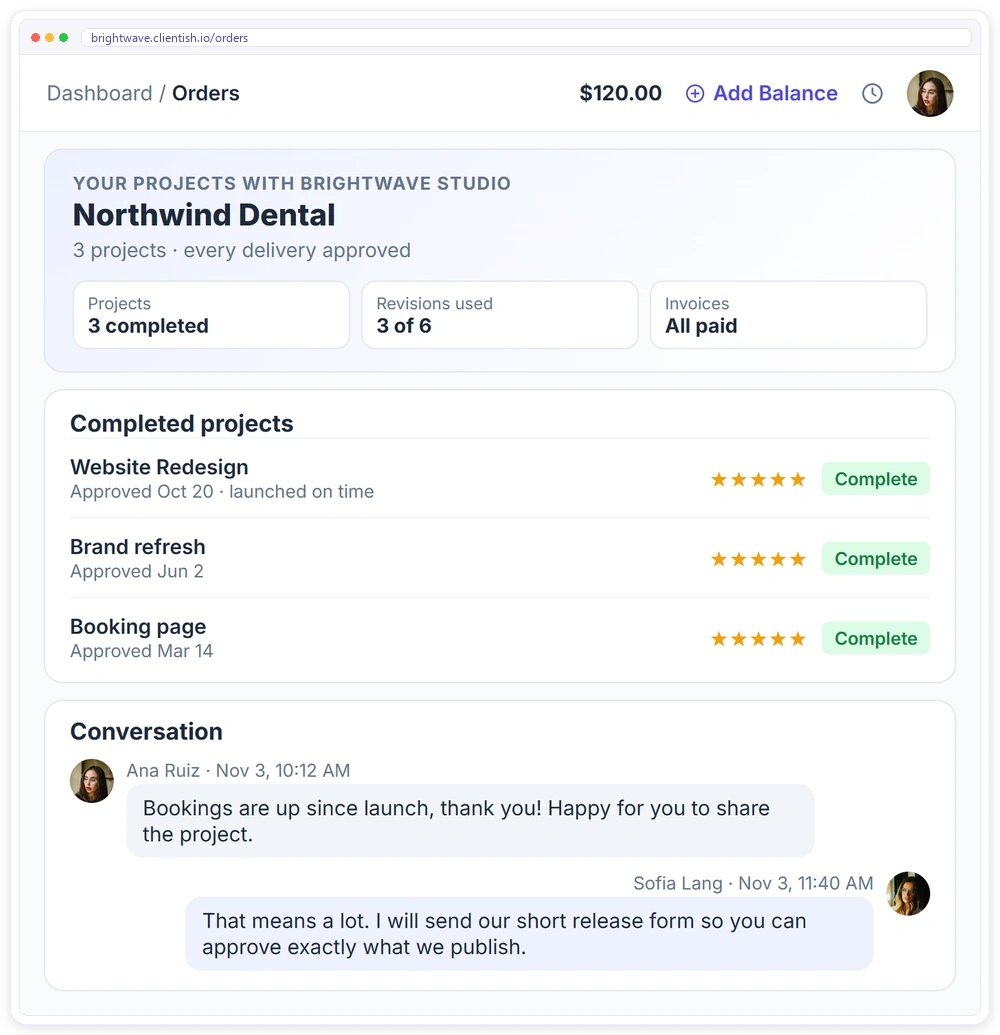
A release form captures permission. What makes a client happy to grant it in the first place is a relationship that ran smoothly from start to finish — and that experience is what a client portal supports throughout.
- ✓Every delivery approved by the client in their client portal
- ✓Clients rate the work when they approve it
- ✓Feedback, files and invoices kept together on each project
- ✓A progress timeline the client can follow from start to finish
- ✓Clients open a support ticket instead of emailing
Download the free case study release form template
The editable Word file with all 7 sections. Replace the brackets, add your branding and use it with every client.
This template is a free, editable starting point, not legal advice. Laws vary by region, so have a qualified lawyer review it for your jurisdiction before you rely on it.
Frequently asked questions
Is this case study release form template free to use?
Yes, there is no watermark and no cost. Open it in Google Docs or Word, adapt it to your situation and jurisdiction, and get it signed before publishing a client's case study. It is a starting point, not legal advice.
Do I really need a signed release to publish a case study?
It is strongly advisable. Publishing a client's name, logo, or results without documented permission exposes you to a takedown request or a publicity-rights complaint, and a verbal yes does not survive the departure of the person who gave it. A signed release is the record that you were authorised, which protects both sides and keeps your best marketing safe to use.
What should the release let me do?
List every intended use explicitly rather than relying on a broad phrase like "marketing purposes." A practical scope list might include: the client's company name and logo on your website's case study page; a pull quote in your LinkedIn and Instagram posts; the project's headline results (e.g. "42 % revenue increase") in paid ads; the full case study PDF attached to pitch decks; and a video testimonial clip on your YouTube channel. If a use is not named, you do not have permission for it — so draft the list against your actual distribution plan, not a generic one.
Can a client withdraw permission after signing?
If the form includes a revocation clause, yes, through the written process it defines. A clear term and revocation process is good practice: it means that if the client's situation changes, removing the material is a defined procedure rather than a dispute. Build it in, and state what happens when a revocation request is received, including a realistic removal window.
Should I let the client review the case study before publishing?
Yes. Offering a review before the piece goes live lets the client correct anything inaccurate or sensitive, which protects both the accuracy of the case study and the relationship. It also makes clients considerably more willing to grant the release, since they keep a say in how they are represented.
Related Templates
If you turn client results into marketing, these free templates pair well with the Release Form: More free, editable templates from the Agency Templates Library.
Client Offboarding Checklist
End an engagement cleanly, with nothing missed.
CONTRACTClient Service Agreement (MSA)
The legal terms you sign once with every client.
CONTRACTNon-Disclosure Agreement (NDA)
Mutual by default, for pitches and discovery.
CHECKLISTClient Onboarding Checklist
The 3-phase onboarding checklist for any agency.
CONTRACTStatement of Work (SOW)
Scope, deliverables, acceptance and milestones per project.
SALESClient Proposal
Client problem first, value before price, tiered.