
Client Offboarding Checklist Template
How a client relationship ends is what the client remembers about the whole of it.
Free to download and edit · No watermark · Add your own branding
A project can go beautifully for six months and still leave a sour final impression if the exit is messy — a final invoice that surprises them, access that lingers awkwardly, files they have to chase, a relationship that just trails off without a proper goodbye.
And the ending is not only about memory: the clean exit is what produces the testimonial, the referral, and the returning client a year later, while the sloppy one produces a quiet non-recommendation. A client offboarding checklist is how you make every exit the clean kind, on purpose, rather than leaving the most reputation-sensitive moment of the engagement to improvise.
This page gives you a free, editable client offboarding checklist template for agencies and freelancers — the structured exit you run when an engagement ends, whether the client is pausing, leaving, or simply finished. It covers the handoff of final work and access, the security step of revoking access, the clean close of billing, and the exit conversation where a testimonial is asked for while the wins are fresh, followed by the referral ask once the dust has settled. Download it, assign an owner, and run it every time a client leaves.
What Is Client Offboarding?
Client offboarding is the structured process an agency runs to end a client engagement cleanly — handing over final deliverables and client-owned credentials, revoking tool and platform access, closing out billing, gathering feedback, and leaving the relationship on terms that invite a return or a referral.
It is the deliberate counterpart to onboarding: where onboarding sets a relationship up well, offboarding closes it well, and both are too important to improvise.
Its purpose is to protect what the engagement built. By the time a client leaves, you have earned goodwill, produced results, and learned their business. A structured exit captures the value of all of that — the testimonial, the referral, the door left open for future work — while an unstructured one lets it evaporate, and sometimes turns a satisfied client into a dissatisfied ex-client over a billing surprise or a file they could not get back.
What the checklist covers besides the phases
It applies whenever an engagement ends, for any reason. A project finishing, a retainer winding down, a client pausing, even a relationship ending badly — each deserves a clean exit, and the badly-ending ones most of all, because that is where a professional offboarding does the most to protect your reputation. Churn is a normal part of agency work, not a failure to rush past; treating every exit as a process rather than an awkward loose end is what separates agencies clients recommend from ones they merely leave.
Why Your Agency Needs an Offboarding Checklist
The exit is a high-stakes, high-risk moment, and running it from a checklist is what turns the risk into an opportunity.
It protects your reputation at the most fragile moment
The ending disproportionately shapes how a client remembers you. A smooth, organised exit leaves a strong final impression; a messy one undoes months of good work in the client's memory.
It captures the testimonial while the wins are fresh
The exit conversation is the natural moment to ask for feedback and a testimonial, when the results are top of mind. A checklist makes sure that ask actually happens rather than being forgotten in the rush to close.
It generates referrals
A well-run exit, followed by a check-in once the client has settled, is one of the highest-return touchpoints in the whole relationship, because a referral from a happy former client costs a fraction of winning a new one cold.
It closes the security gap
Revoking the access the client had, and collecting the access you had, is a step agencies routinely forget, leaving credentials and permissions live long after the relationship ends. The checklist makes revocation a step, not an afterthought.
It ends billing cleanly
A final invoice settled and subscriptions cancelled means the relationship ends on goodwill, not on an automatic renewal the client has to dispute or a pending invoice that sours the goodbye.
The Risks of an Unstructured Exit
An exit left to improvisation fails quietly, and the cost shows up later as a lost referral or a reputation ding. Here is how the gaps surface.
A project manager assumed the account lead would handle the close-out; the account lead assumed the PM had it covered. The client received a final file and silence.
A client spent three weeks after the engagement ended emailing their old agency asking for assets — a brand font here, a login credential there — because the final delivery had pulled from four different tools with no single handover document.
Six months after a client relationship ended, an agency discovered it still had admin access to the client's live website — and the client, now with a different agency, had not noticed either.
A retainer client received an auto-renewal charge the month after their contract ended because no one had flagged the subscription for cancellation, and a clean ending turned into a refund request and a chilly exchange.
A client wrapped a successful rebrand project pleased with the work. No one followed up. Eight months later the agency pitched that client's close contact and lost the job to a competitor the contact had already recommended.
Each of these is prevented by a step in the checklist below.
How to Structure Offboarding: Three Phases
Offboarding works best as a timeline running from the decision to end through the weeks after the client has gone. Structuring it in three phases — pre-exit preparation, the active exit, and post-exit follow-up — ensures the handover is complete, access is closed, and the testimonial and referral are asked for at their most effective moments rather than missed. The timing of each phase matters: the testimonial lands in the exit itself, while the referral works best weeks later, once the client has settled.
Pre-Exit
Final Two Weeks7 tasks
The Exit
Final Week7 tasks
Post-Exit
30 to 90 Days5 tasks
The Offboarding Checklist, Phase by Phase
The template holds this full checklist as checkboxes with owner and due-date columns, plus the handoff packet outline, the access-revocation list, and the exit-conversation prompts. Here is what each phase covers.
Pre-Exit
Agree and record when the engagement formally ends, so both sides are working to the same date.
Name who runs the exit, so it does not fall through the gaps between people.
List what is finished, what is in progress, and what will not be completed, so nothing is left ambiguous.
Check for outstanding invoices and upcoming renewals, and plan the final invoice and any cancellations.
Begin assembling the final deliverables, documentation, and access details into one organised handover.
The Exit
Hand over all deliverables with clear access instructions, a summary of what was delivered, and operating notes for anything you built.
Hand back any accounts, assets, and logins that belong to the client, with instructions.
Issue the final invoice and cancel any subscriptions or recurring charges, so billing ends cleanly.
A proper close: recap what was achieved, gather honest feedback, and — while the wins are fresh — ask for a testimonial.
Remove your team's access to the client's tools and systems, and revoke the client's access to yours, once the handover is confirmed.
Post-Exit
A genuine note of thanks that closes the relationship warmly rather than letting it trail off.
A friendly, non-salesy message once the client has settled into the transition, which keeps the door open.
Once the relationship has stabilised, make the referral ask, separately from the testimonial, when the client can recommend you from a settled vantage point.
File the project, document what was delivered, and record notes on the relationship for your own future reference.
The step most agencies skip
The step that most often gets missed is revoking access — both directions. Agencies hand over the final work and move on, leaving the client's logins to project tools live and their own logins to the client's systems active, sometimes for years. It is a security exposure and a sign of a process that was never finished. The free template makes revocation an explicit, checked step for both sides, so no engagement ends with a door left open.
Tips for an Offboarding Process That Protects Your Reputation
Having the steps is half of it. A few disciplines are what make offboarding actually produce referrals and protect your standing rather than just tidy up.
Assign one owner to every offboarding
The single most common offboarding failure is that no one was responsible for it. Name an owner the moment an exit is decided, the same as you would for a project.
Assemble the handoff in one place
A complete packet — deliverables, open items, credentials, operating instructions, contacts — handed over once beats a trickle of files the client has to chase for weeks.
Ask for the testimonial at the exit, the referral later
Feedback and a testimonial belong in the exit conversation, while the results are vivid. The referral ask lands better 30 to 60 days on, once the client has settled and can recommend you from a calm vantage point.
Keep the follow-up human, not a pitch
The post-exit check-in works because it is a genuine, low-pressure touch. The moment it reads as a sales email, it stops opening doors and starts closing them.
Revoke access, both directions, as a checked step
Do not let it be the thing you meant to get to. Removing their access and yours is a security step, not housekeeping.
End billing before it ends the goodwill
Cancel renewals and settle the final invoice proactively, so the last financial touch is clean rather than a surprise the client has to contest.
How to Use the Free Offboarding Checklist Template
Getting the checklist ready for a departing client takes four steps.
Start from a copy
Download the Word (.docx) file, or upload it to Google Docs, and work on your copy, not the original.
Assign the owner and dates
Name who runs the exit and fill the owner and due-date columns, so every step has a name and a deadline.
Brand it
Add your logo and make it part of your standard process, the same as your onboarding.
Run it for every exit
Duplicate it for each departing client and work through the phases, treating the handoff, the access revocation, and the testimonial ask as the steps that matter most.
Running Offboarding Inside a Client Portal
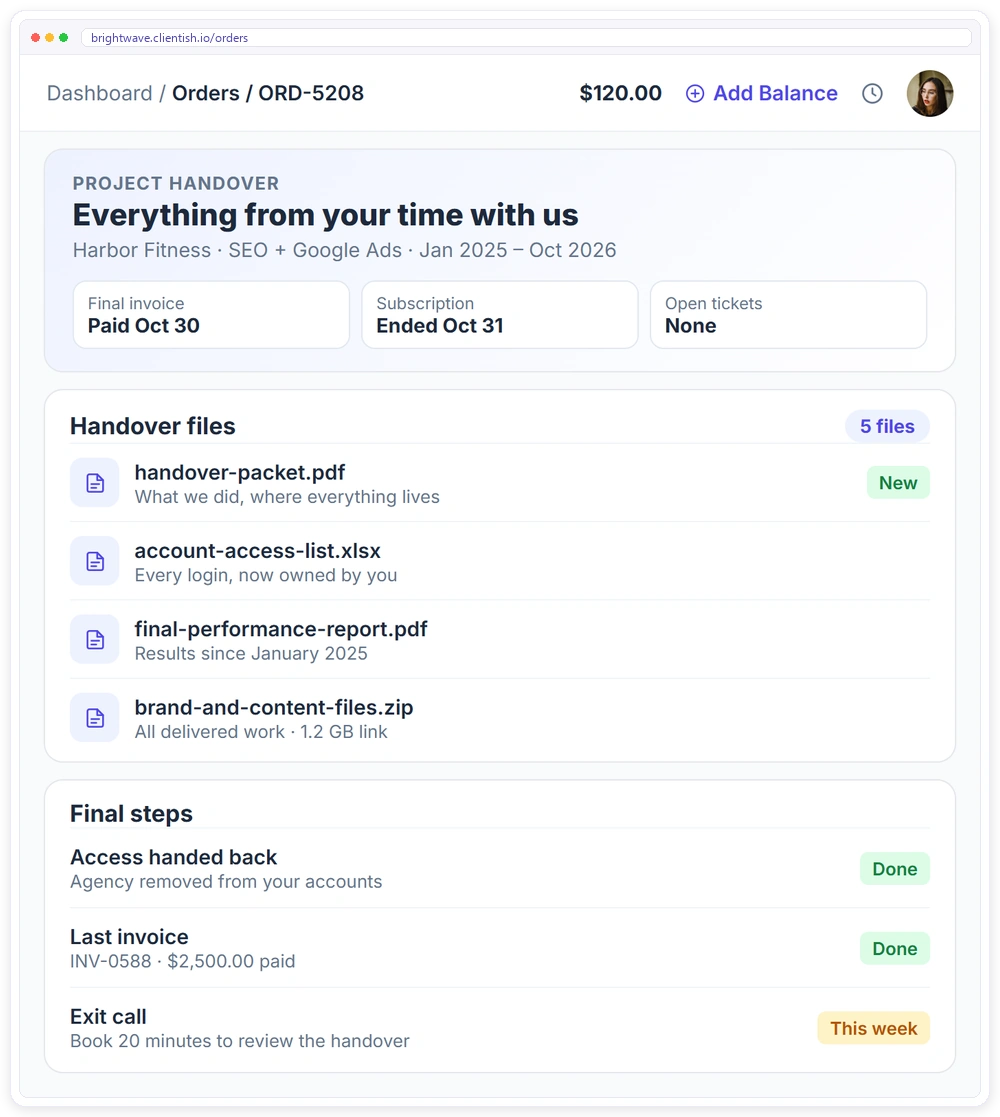
A checklist keeps your side of the exit organised. What the client experiences — the final handover, the last invoice, the closing of their account — is what a client portal carries, making even the ending feel professional.
- ✓The final invoice and every receipt in the client’s client portal
- ✓Handover files and messages kept on the project
- ✓Recurring billing stopped in one place when the engagement ends
- ✓The full order and ticket history stays on record
- ✓Clients open a support ticket for anything after the exit
Download the free client offboarding checklist template
The editable Word checklist with 19 tasks across three phases, plus handoff packet — what to include, access revocation — both directions, exit conversation — prompts. Add your branding and run it for every client who leaves.
Frequently asked questions
Is this client offboarding checklist template free to use?
Yes — download it, add your branding, and use it immediately with no cost or watermark. It works in Google Docs, Google Sheets, or Word.
What if a client leaves mid-project rather than at a natural end point?
Pause and document the exact completion status of every deliverable before anything else — mid-project exits create disputes most often because scope progress is ambiguous. Note what's done, what's partially done, and what's out of scope for handover, then get sign-off on that record before closing out.
What if a client refuses to give a testimonial?
Don't push — a reluctant testimonial rarely reads well anyway. Instead, ask if you can stay in touch and revisit it in a few months once they've had time to see the results of the work in practice.
What if offboarding is rushed because the client is unresponsive?
Send the handoff packet and a deadline in writing, then document that you did. If they don't engage, your paper trail protects you from later claims that assets weren't delivered or access wasn't transferred.
What if the client disputes final deliverables right at the end?
Go back to the agreed scope document rather than relitigating the whole engagement verbally. A clean scope record is the fastest way to resolve a last-minute dispute without damaging the relationship or delaying closure.
What is the most commonly missed offboarding step?
Revoking access in both directions — removing the client from your tools and yourself from theirs. Credentials left live after a relationship ends are a security risk, not just an oversight.
Related Templates
If you take clients on and see them out, these free templates pair well with the Offboarding Checklist: More free, editable templates from the Agency Templates Library.
Client Onboarding Checklist
The 3-phase onboarding checklist for any agency.
RETAINERAgency Retainer Agreement
The core retainer contract, ready to brand.
CONTRACTClient Service Agreement (MSA)
The legal terms you sign once with every client.
CONTRACTStatement of Work (SOW)
Scope, deliverables, acceptance and milestones per project.
SALESInvoice
Itemised, with a real due date and a deposit option.
CONTRACTCase Study Release Form
Written permission to publish client results.