
SEO Client Onboarding Checklist Template
In SEO, the clock starts the day you get access, not the day the contract is signed. Every week spent waiting on Search Console, Analytics, or CMS logins is a week of rankings data you will never recover and a week closer to the client wondering what they are paying for.
Free to download and edit · No watermark · Add your own branding
A structured SEO onboarding checklist is what turns that fragile first month into a measured, confident start, and it does one thing a generic onboarding checklist cannot: it captures a baseline you can prove progress against later.
This page gives you a free, editable SEO Client Onboarding Checklist template, built for SEO and digital agencies, plus a walkthrough of every phase from signed contract to the first 30 days. It is organized as a timeline and includes the SEO-specific steps a general checklist leaves out: the exact access to collect, the technical and on-page audit, the baseline snapshot, and an optional local-SEO block. Download it, add your branding, assign owners, and run it for every new SEO client.
What Is SEO Client Onboarding?
SEO client onboarding is the structured process an agency runs between a signed SEO contract and the start of active optimization work.
It covers collecting the right access, auditing the client's current search presence, recording a performance baseline, aligning on keyword and competitor targets, and setting expectations for a channel whose results arrive on a delay.
It differs from general client onboarding in two ways that matter. First, SEO depends on specific technical access, Search Console, Analytics, the CMS, that a non-SEO engagement never needs, and the handover of that access is the single most common place SEO onboarding stalls. Second, SEO results lag the work by months, so onboarding has to set that expectation explicitly and capture a baseline now, while the numbers still reflect the "before" state, so there is something to measure against later.
What the checklist covers besides the phases
That baseline is the part agencies most often skip and most regret skipping. If you do not record current rankings, organic traffic, indexed pages, and backlink profile at the start, you have no honest way to show the client what your work changed. A good SEO onboarding checklist makes the baseline a required step, not an afterthought.
How to Structure SEO Onboarding: Three Phases
Like any onboarding, SEO onboarding works best as a timeline rather than a flat list, because the sequence protects the engagement. This template uses three phases.
Before you start
The first 48 hoursInternal handoff, welcome email, workspace setup, and team assignment. This prevents the post-signing silence.
The first week
The SEO questionnaire, access collection, the technical and on-page audit, the keyword and competitor baseline, and the all-important performance baseline snapshot. This is the phase that makes or breaks an SEO engagement.
The first 30 days
Strategy roadmap, the first quick win, the first report against baseline, and a 30-day check-in. This is where the client starts to trust that the delayed payoff is coming.
Phase 2 carries more weight in SEO than in any other service, because access, audit, and baseline all have to happen before real work can start, and all three are easy to rush or skip under pressure to "just get going."
Why Your Agency Needs an SEO Onboarding Checklist
A repeatable SEO onboarding checklist solves problems that are specific to search work and directly cost agencies clients.
It captures a baseline you can prove progress against
Without a recorded starting point for rankings, traffic, and backlinks, you cannot demonstrate your impact, and "trust me, it's working" is not a renewal argument. The baseline is your evidence.
It gets technical access collected before it stalls the work
Search Console and Analytics access is the most common SEO onboarding bottleneck, and every week of delay is unrecoverable data and a client losing patience. A checklist makes access a named, dated task.
It sets the results-lag expectation on day one
SEO's delayed payoff is the source of most early-client anxiety. Onboarding is where you state the realistic timeline, before the client expects page-one rankings by week three.
It makes every SEO client's start consistent and auditable
The same access, the same audit, the same baseline, every time, regardless of who runs the onboarding.
The Risks of Skipping Structured SEO Onboarding
Here is what each missing piece looks like when an SEO engagement starts badly.
Three months in, the client asks what has improved. You have rankings data from last week but nothing from the start, so you cannot show the change you drove. The work was good; the lack of a baseline makes it unprovable.
Two weeks pass with no Search Console or Analytics access because it was never formally requested, so the audit cannot start. The first invoice is due with no work done, and the client's patience is already thin.
No one set the results timeline, so the client expects first-page rankings within a month. When month two shows mostly technical groundwork, they conclude the agency is not delivering, over a timeline a single onboarding conversation would have set.
Work starts without a technical or on-page audit, so a crawl issue or a manual penalty surfaces in month three, after you have built content on a broken foundation. The audit would have caught it in week one.
Keyword and competitor research never happened at onboarding, so the first month's work targets terms the client cannot realistically rank for. A baseline of where they stand versus competitors would have aimed the strategy correctly.
Each of these failures maps to a specific step in the checklist that follows.
The SEO Onboarding Checklist, Phase by Phase
The downloadable template holds this full checklist as checkboxes with owner and due-date columns, plus the SEO access list, the questionnaire, and the baseline snapshot table. Here is what each phase covers.
Before You Start
Brief the SEO team on what was sold, the client's goals, and anything promised during the sale, so strategy starts from the real agreement.
Confirm the client is in, name their main contact, and preview what the first week looks like. Momentum sets the tone.
A single home for the engagement: scope, access, audit findings, reporting, and communication.
Decide the day-to-day contact, the SEO lead, and who the client escalates to.
The First Week
Goals, target locations and audience, priority services or products, known competitors, past SEO work (and any penalties), brand guidelines, and target keywords the client has in mind.
The step that stalls SEO onboarding most often. Request, in one organized list: Google Search Console, Google Analytics (GA4), Google Business Profile (for local), the CMS and any developer access, hosting, and any existing SEO tools (Ahrefs, Semrush, and similar).
Crawl the site for indexation, crawl errors, site speed and Core Web Vitals, mobile usability, broken links, and redirect issues. This surfaces anything that would undermine content work built on top of it.
Review titles, meta, headings, internal links, and existing content performance to find both problems and quick wins.
Record, with the date, the current state: keyword rankings for the target set, organic sessions, indexed pages, Core Web Vitals, domain and backlink metrics, and conversions where tracked. This is your "before," and it is the step most templates skip.
Document the client's current keyword positions and benchmark them against two or three real competitors, so strategy targets realistic, winnable terms.
The First 30 Days
Segment the plan into quick wins, incremental gains, and longer-term initiatives, aligned to the baseline and the client's goals.
A visible early result, such as fixing a high-impact technical issue, optimizing a page already ranking on page two, or delivering the audit itself as a deliverable. Early proof matters more in SEO than anywhere, because the big results are months away.
Show what was done and the starting numbers you will track from here. Early visibility replaces the client's lag-driven anxiety with confidence.
Review progress against the baseline, confirm the keyword and content plan for the next 60 days, surface blockers (usually access or approvals), and collect feedback while there is time to adjust.
The optional local-SEO block
If the client is a local business, add three steps to Phase 2: a Google Business Profile audit (claim, verify, and optimize each location), a NAP and citation audit (confirm name, address, and phone are consistent across directories and listings), and a review audit (assess rating and volume across Google and other platforms for red flags and quick wins). Local rankings move on signals a standard SEO audit does not check, so this block is what makes the template fit a local agency as well as a national one.
Tips and Best Practices for SEO Onboarding That Retains Clients
The checklist gives you the sequence. These habits are what carry an SEO client through the results lag without losing confidence.
Request all access as one clear list, immediately
Drip-fed access requests are what drag SEO onboarding past the client's patience. Ask once, in the first days, and make it the client's named task.
Never skip the baseline, even under time pressure
Five minutes recording the starting numbers is what lets you prove your impact three months later. It is the cheapest insurance in the engagement.
State the results lag out loud at onboarding
Tell the client meaningful movement typically takes three to six months. Setting it now prevents the month-two "why am I not ranking?" conversation.
Report on leading indicators early
Indexed pages, crawl health, impressions, and click-through rate move before rankings do, and they keep the client oriented while the big numbers catch up.
Engineer a quick win in the first ten days
A technical fix or a page-two page nudged up gives the client something real before the strategy matures.
Ask for feedback at 30 days, against the baseline
A check-in anchored to the starting numbers is far more convincing than a survey, and it catches problems before renewal.
How to Use the Free SEO Onboarding Checklist Template
The template is ready to run in four steps.
Copy it first
Download the Word (.docx) file, or upload it to Google Docs, and work on your copy, not the original.
Put names and dates on it
Fill the owner and due-date column so every access request, audit, and baseline step is owned by someone, not left floating.
Brand it
Add your logo and colours so the checklist reads as part of your agency's SEO process.
Run it per client
Duplicate it for each new SEO client, switch on the local block when relevant, and work through the phases in order.
Running SEO Onboarding Inside a Client Portal
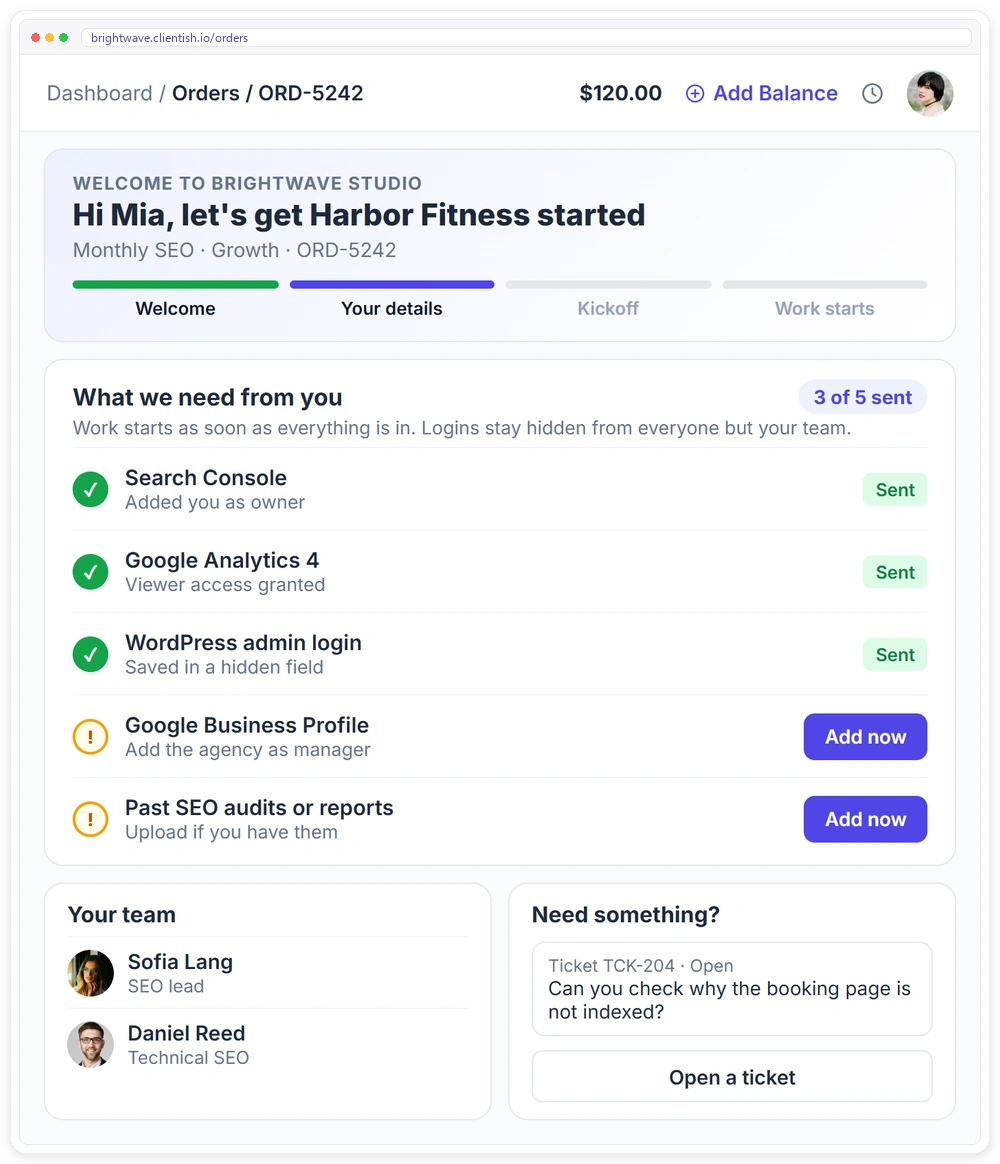
The checklist keeps your SEO team moving through access, audits, and baseline. The client's side of it, though, the welcome, the access requests, the first report, and knowing who to reach, is what a client portal is built to carry.
- ✓A branded client portal on your own subdomain from day one, with orders, invoices and subscriptions
- ✓An onboarding form attached to the service, so the order waits until the client sends what you need
- ✓Logins collected in hidden fields that only your team sees
- ✓Clients open a support ticket with SLA response times instead of chasing you by email
- ✓A task template creates the onboarding tasks with owners and due dates for every new client
Download the free SEO client onboarding checklist template
The editable Word checklist with 26 tasks across three phases, plus access checklist, performance baseline snapshot, SEO onboarding questionnaire — core questions. Add your branding and run it for every new client.
Frequently asked questions
Is this SEO onboarding checklist template free to use?
Yes. It is free to download and edit in Google Docs, Google Sheets, or Word, with no watermark. Add your branding and run it for every new SEO client.
What access do I need to collect when onboarding an SEO client?
Typically Google Search Console, Google Analytics (GA4), the CMS and any developer access, hosting, Google Business Profile for local work, and any existing SEO tools. The template lists these as a single first-week task so nothing is requested piecemeal.
Why is a baseline snapshot so important in SEO onboarding?
Because SEO results lag the work by months, you need a dated record of the starting rankings, traffic, indexed pages, and backlinks to prove what your work changed later. Without it, you cannot demonstrate impact, which is the step most templates skip and the one this template makes required.
How long does SEO onboarding take?
The active setup, access, audits, and baseline, fits in the first week, while the full onboarding, including the strategy roadmap, first quick win, and 30-day check-in, runs across the first 30 days. The template is organized on that timeline.
Does this work for local SEO onboarding?
Yes. The template includes an optional local-SEO block adding a Google Business Profile audit, a NAP and citation audit, and a review audit to Phase 2, so it fits a local agency as well as a national one.
Related Templates
If you run SEO alongside onboarding other services, these free templates pair well with this one: More free, editable templates from the Agency Templates Library.
Client Onboarding Checklist
The 3-phase onboarding checklist for any agency.
CHECKLISTSocial Media Onboarding Checklist
Voice, content pillars and the approval workflow.
RETAINERSEO Retainer Agreement
Scope and deliverables for monthly SEO work.
CONTRACTStatement of Work (SOW)
Scope, deliverables, acceptance and milestones per project.
ONBOARDINGProject Intake Questionnaire
The discovery questions to ask before you scope.
Monthly SEO Report
A clean recurring report clients actually read.
Coming soonSocial Media Onboarding Checklist
Voice, content pillars and the approval workflow.
CHECKLISTPPC Client Onboarding Checklist
Conversion tracking, MCC access and billing ownership.
CHECKLISTWeb Design Onboarding Checklist
Content owners, assets, brief and sitemap.
CHECKLISTCreative Agency Onboarding Checklist
The full brand kit before the first concept.