

The polite way to remind a client to pay you is a short message that names the invoice number, the amount and the due date, gives a link or the details to pay, and ends with one easy next step. Start before the due date, and get firmer only as the invoice gets later.
Chasing money feels awkward, so many service businesses put it off until the invoice is weeks old and the message comes out sharper than they meant. A fixed schedule and ready wording remove both problems. This guide is for agencies, freelancers, consultants and service businesses that invoice clients, and it gives you the schedule, sixteen templates for email, text, WhatsApp and the phone, and what to do when reminders stop working.
Key takeaways
- Every reminder names the invoice, the amount, the due date and how to pay, and asks one simple question.
- Send one reminder before the due date, one on it, then at 1 to 3, 7, 14 and 30 days late.
- Keep the words about the invoice, not the person; get firmer with each stage, never ruder.
- Pick up the phone at about two weeks, and confirm any promise in writing the same day.
- Late fees and pausing work hold up only if your terms said so before the work started; some countries, such as the UK and the EU, also give a legal right to interest.
How Do You Politely Remind a Client to Pay You?
You politely remind a client to pay by treating the late invoice as a small admin slip rather than a broken promise: mention the invoice, the amount and the date it was due, make paying one click away, and ask a simple question the client can answer in a line.
A late invoice is often not a statement about you. It may sit in the wrong inbox, wait for an approval, or miss a payment run. Writing as if that is what happened keeps the tone light and gives the client an easy way out. As one commenter in an r/etiquette thread on reminding people about money put it, “awkwardness is a feeling, not a fact.”
Keep it short. A reminder that needs scrolling reads like a complaint. The formula is the same at every stage: invoice, amount, date, how to pay, one question. Only the tone and the next step change as the invoice gets older.
What should a payment reminder include?
A payment reminder should include the invoice number, the amount still owed, the original due date, a payment link or bank details, the invoice itself attached or linked, and an invitation to say if anything is wrong, so the client can pay or reply without searching their inbox.
Each item removes one reason to put the email aside. Check every reminder against this list before you send it:
- Invoice number: it is what the accounts team searches for.
- Amount, and one line on what it was for: “[amount] for the March SEO retainer” is easier to approve than a bare number.
- Due date or days overdue: a date the client can check against their own records.
- How to pay: a payment link, or bank details if they pay by transfer.
- The invoice: attached again or linked, so nobody has to dig for it.
- Their reference: a purchase order number or client reference, if their accounts team uses one.
- One question: “Is anything holding this up?” invites a reply instead of silence.
How to ask for payment without sounding rude
You ask for payment without sounding rude by describing the invoice instead of the person, replacing blame words like “you failed” or “you still haven’t” with neutral facts such as “this invoice is still open”, and closing with a question or a clear date rather than a demand.
Small wording changes do most of the work. Each swap below keeps the message firm without making it personal:
- “You still haven’t paid” becomes “Invoice [INV-number] is still showing as open on my side.”
- “As per my last email…” becomes “Following up on my note from [date].”
- “I need this paid now” becomes “When is this scheduled to be paid?”
- “Sorry to bother you again” goes; start with the invoice instead.
- “Why is this late?” becomes “Is anything on the invoice holding it up?”
- “Friendly reminder!!!” becomes “Quick reminder: [INV-number], due [date].”
There is no need to apologise for asking. Someone in a small-business thread on Reddit made the point bluntly: “they are being rude by not paying you on time already.”
How do you keep the client relationship while chasing payment?
You keep the relationship by being consistent rather than emotional: send reminders on a fixed schedule, keep the wording about the invoice, thank the client quickly when payment arrives, and fix the cause for next time, such as a deposit, shorter terms or invoices sent straight to their accounts team.
A schedule takes the mood out of it. One commenter in an r/smallbusiness thread described the shift as “reframing it as a process, not a conversation.” When the money lands, reply with a one-line thank-you and no lecture. Watch the pattern, though: another commenter warned that a “steadily increasing time to pay bills is a red flag”, and a client who is late every month needs new terms, not more reminders.
How do you remind a client who is also a friend?
Remind a friend who is also a client the same way you would remind any client: send the invoice through your normal system with the amount, due date and payment link, add one warm line of your own, and keep the conversation about the work rather than the friendship.
In an r/artbusiness thread about a commission for a friend, one reply was simple: “Business is business, send them a professional invoice.” A short, friendly message keeps it light:
“Hey [Name], loved working on [project] with you. Sending the invoice over properly so it’s all in one place: [INV-number], [amount], link here: [pay link]. Just keeping my books tidy!”
When Should You Send a Payment Reminder?
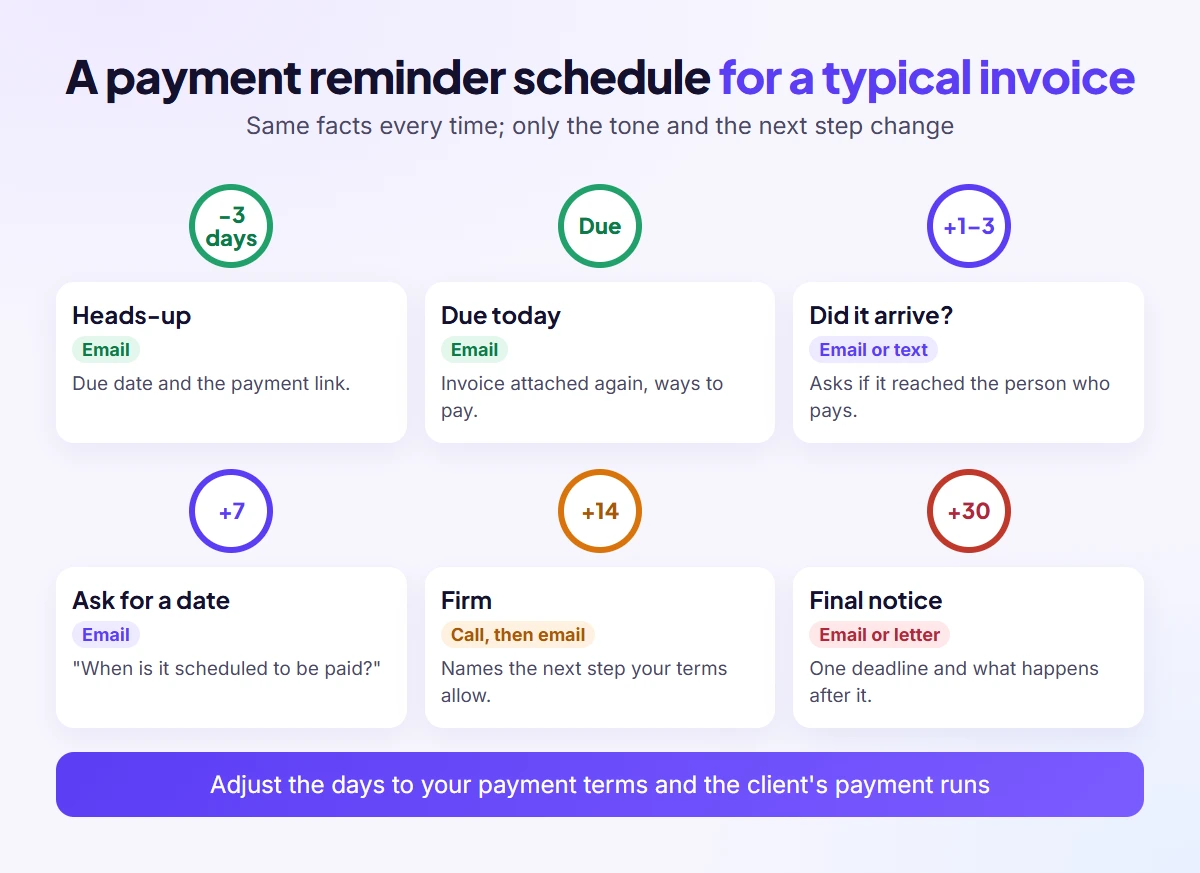
Send the first reminder about three days before the invoice is due, a second on the due date, then follow up one to three days after, at one week, at two weeks with a phone call, and send a final notice at about thirty days if nothing has arrived.
The guides and forum threads differ by a few days, but most follow the same shape: one note before, one on the day, and a few after that each get a little firmer. This schedule fits a typical 14 or 30 day invoice:
| When | Channel | Tone | What this message adds |
| 3 days before due | Friendly | The due date and the payment link | |
| Due date | Neutral | “Due today” and the invoice attached again | |
| 1 to 3 days late | Email or text | Light | Asks whether it reached the person who pays |
| 7 days late | Clear | Asks for a payment date | |
| 14 days late | Call, then email | Firm | Names the next step your terms allow |
| 30 days late | Email or letter | Formal | A final deadline and what happens after it |
Adjust it to your terms and your clients. Some large companies pay in batches on set days, so ask when their payment run is and time a reminder just before it. Holiday periods can slow payments down too, and a two-person studio and a 500-person company will not move at the same speed.
How many reminders should you send before taking action?
Send three reminders after the due date, make one phone call and then send a final notice before you take formal action, which usually means about five contacts across thirty days; fewer looks impatient, and many more without a consequence teaches the client that waiting costs nothing.
Many clients pay before the end of that list. In another Reddit discussion of overdue invoices, one commenter said “most people pay after the second nudge.” The later steps exist for the few who do not, and for your records if the invoice goes further.
Should you remind a client before the invoice is due?
Yes, one short reminder a few days before the due date is the easiest way to avoid chasing later, because it catches a lost invoice or a missing purchase order while there is still time to fix it, but one reminder is enough; repeated messages before the due date feel like pressure.
Use the days before the due date to check three things: that the invoice reached the person who pays, not only your contact; whether their accounts team needs a purchase order number or has a fixed payment run; and that your payment terms and any late fee are written on the invoice itself.
Payment Reminder Email Templates for Every Stage
The six payment reminder email templates below cover a whole invoice cycle, from a friendly note before the due date to a final notice at thirty days, and each one is short, names the invoice and amount, and adds one new thing the earlier message did not say.
Replace the words in square brackets with your own details. Keep the invoice number in every subject line, so the whole thread stays together in the client’s inbox.
Friendly payment reminder before the due date
A friendly reminder before the due date should read like a calendar note, not a request: mention the invoice and the date it falls due, put the payment link where the client can see it, and offer to fix anything on the invoice before it is due.
Subject: [INV-number] for [project] is due on [due date]
Hi [Name],
A quick heads-up that invoice [INV-number] for [amount] is due on [due date]. You can pay it here in a minute: [pay link].
If your accounts team needs a PO number or a different billing name on it, tell me now and I’ll send a corrected copy before the due date.
Thanks,
[Your name]
Payment reminder on the due date
On the due date, send a short, neutral message that says the invoice is due today, attaches the invoice again, and repeats the ways to pay, without any apology and without mentioning fees yet, because an invoice still open on this day is often just sitting in a queue.
Subject: Due today: [INV-number] ([amount])
Hi [Name],
Invoice [INV-number] for [project] is due today. I’ve attached it again so it’s easy to forward to whoever handles payments.
Pay online: [pay link]
Bank transfer: [bank details]
Thank you,
[Your name]
Polite reminder when the invoice is one day late
When an invoice is one to three days late, write as if it went to the wrong place, because sometimes it did: ask whether it reached the person who pays, offer to resend it, and say you will check your own records if it has already been paid.
Subject: [INV-number]: did it reach your accounts team?
Hi [Name],
I haven’t seen payment for [INV-number] ([amount], due [due date]) come through yet, so I wanted to check it landed with the right person.
If it’s already been sent, ignore this and I’ll check with my bank. If it’s stuck somewhere, who should I send it to?
Pay link, in case it helps: [pay link]
Thanks,
[Your name]
Overdue invoice email: one week late
A week after the due date, your email should stop guessing why the invoice is late and ask the client directly for a payment date, while still offering help in case something on the invoice, such as the amount or the billing details, is the reason it has not been paid.
Subject: [INV-number] is now 7 days overdue
Hi [Name],
Invoice [INV-number] for [amount] was due on [due date] and is still open. I’ve attached it again.
Could you reply with the date it’s scheduled to be paid? If something on the invoice is holding it up, tell me what and I’ll sort it today.
[pay link]
Thanks,
[Your name]
Firm payment reminder: two weeks late
At two weeks overdue, a firm reminder states the facts, refers to the payment terms the client agreed to, and names the next step that your terms allow, such as pausing new work or adding the agreed late fee, with a specific date by which payment avoids it.
Send it after your phone call if you can, so it confirms what you discussed. Only name a consequence your contract or invoice terms already include; a threat you cannot back up weakens every reminder after it.
Subject: [INV-number]: 14 days overdue, payment needed by [date]
Hi [Name],
Invoice [INV-number] for [amount] is now 14 days past its due date of [due date], and I haven’t had a reply to my last two emails.
Under our agreed terms, [new work pauses / a late fee of (agreed fee) applies] when an invoice is more than [X] days overdue. I’d rather not do that, so please arrange payment by [date]: [pay link].
If there’s a problem with the invoice or the timing, call me on [phone] and we’ll agree a plan.
[Your name]
Final notice payment email: thirty days late
A final notice at thirty days overdue should say plainly that it is the last reminder, list the invoice, amount and every date you followed up, give one deadline, usually seven to fourteen days away, and state the single next step you will take if the deadline passes.
Do not bluff here. Name only the step you will take, keep a copy, and print the same text as a letter if you want a paper record.
Subject: Final notice: [INV-number] ([amount]), [X] days overdue
Hi [Name],
This is my final reminder about invoice [INV-number] for [amount], due on [due date]. I followed up on [date], [date] and [date], and by phone on [date].
Please pay the full amount by [deadline]: [pay link]. If payment hasn’t arrived by then, I will [send a formal letter before claim / pass the invoice to a collection agency].
If you want to agree a payment plan instead, reply before [deadline] and I’ll put it in writing.
[Your name]
[Agency]
What subject line should a payment reminder email have?
A good payment reminder subject line names the invoice number and its status, such as due soon, due today or seven days overdue, so the client and their accounts team can find and act on it from the inbox without opening the email.
Two options for each stage, so you are never sending the same subject twice in one thread:
| Stage | Option A | Option B |
| Before due | [INV-number] for [project] is due on [date] | Heads-up: [INV-number] due [day] |
| Due date | Due today: [INV-number] ([amount]) | [INV-number] is due today, pay link inside |
| 1 to 3 days late | Quick check on [INV-number] | Checking on [INV-number] (due [date]) |
| 7 days late | [INV-number] is now 7 days overdue | Payment date for [INV-number]? |
| 14 days late | [INV-number] overdue: please pay by [date] | Action needed: [INV-number] past terms |
| 30 days late | Final notice: [INV-number] ([amount]) | Final reminder before next steps: [INV-number] |
Avoid capital letters, exclamation marks and words like “urgent” or “last chance”. They look like spam, and spam is the easiest excuse a client has for not seeing your email.
How to Remind a Client to Pay by Text or WhatsApp
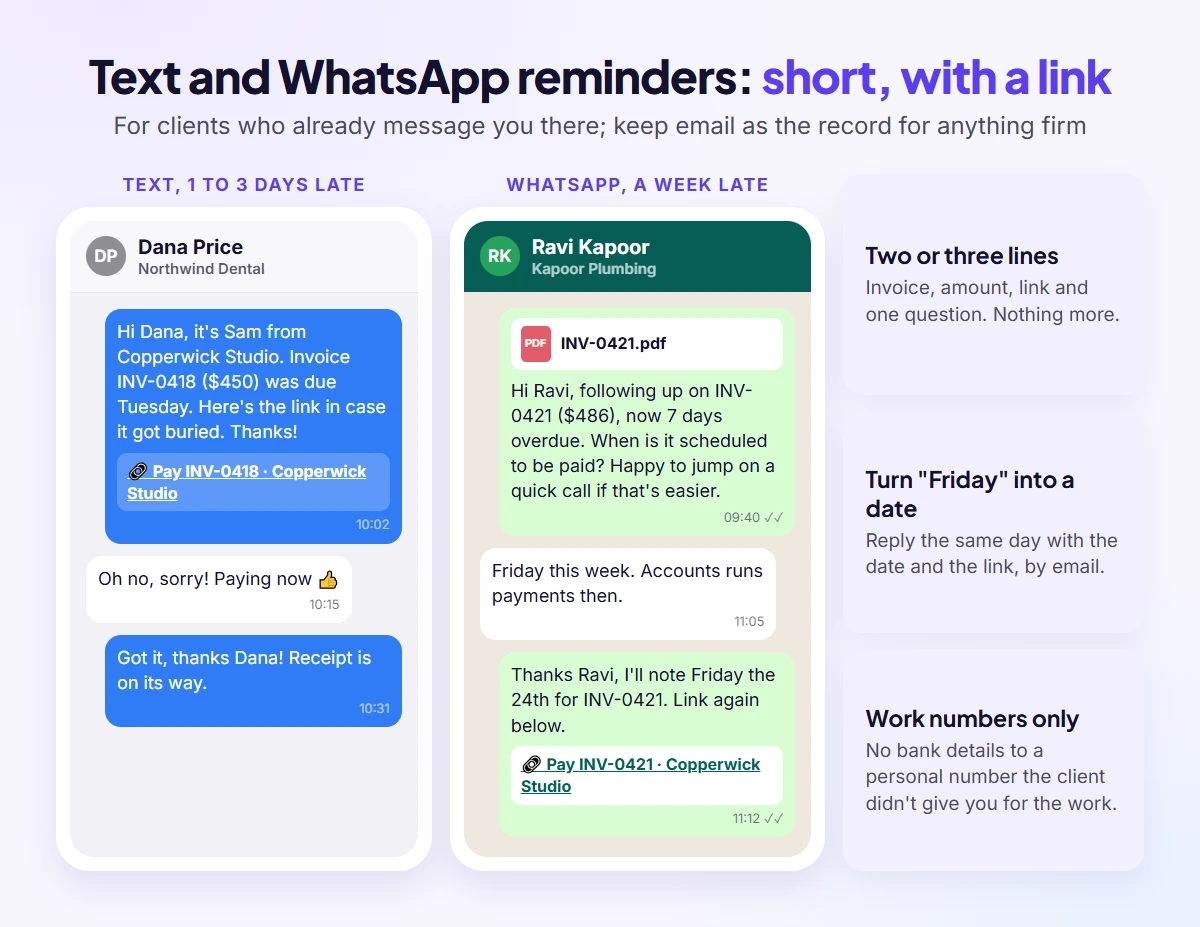
A text or WhatsApp payment reminder should be two or three short lines that name the invoice and amount, include a payment link, and ask one question; use it only with clients who already message you there, and keep email as the record for anything firm or formal.
A text is short and shows up on the client’s phone, which makes it a good first nudge. It also feels more personal, so keep it short and friendly, and move back to email when the reminder needs to carry terms, fees or deadlines.
Payment reminder text message examples
These payment reminder text messages are written for clients who already text you, and each fits on one screen: a light nudge for a day or two late, a clearer one that asks for a date at a week, and a firm one that points to an email with the details.
Text 1, one to three days late: “Hi [Name], it’s [Your name] from [Agency]. Invoice [INV-number] ([amount]) was due [day]. Here’s the link in case it got buried: [pay link]. Thanks!”
Text 2, about a week late: “Hi [Name], [INV-number] for [amount] is a week overdue now. Which day is it scheduled for?”
Text 3, two weeks or more: “Hi [Name], I’ve just emailed about [INV-number], which is now [X] days overdue. Could you take a look today and call me if there’s a problem?”
Payment reminder message on WhatsApp
On WhatsApp, a payment reminder works best as a short message with the payment link and a PDF of the invoice attached, sent to a business number or a chat the client already uses for the project, so it looks like part of the work rather than a personal chase.
WhatsApp 1, due date or just late: “Hi [Name], just a note that invoice [INV-number] for [amount] was due [day]. PDF attached, and you can pay here: [pay link]. Let me know if anything’s off.”
WhatsApp 2, a week or more: “Hi [Name], following up on [INV-number] ([amount]), now [X] days overdue. When is it scheduled to be paid? Happy to jump on a quick call if that’s easier.”
Do not send bank details or other sensitive information to a personal number the client did not give you for the work.
Should you remind a client by email, text, WhatsApp or phone?
Use email for every reminder that needs a record, text or WhatsApp for a quick nudge to clients who already message you there, and a phone call once an invoice is about two weeks late or emails go unanswered, because a call gets an answer an email can ignore.
Each channel has a job, and the record each one leaves matters if the invoice ever goes further:
| Channel | Best for | When | Leaves a record? | Watch out |
| Every stage, attachments, firm and final notices | Always | Yes, the strongest | Can be ignored or land in spam | |
| Text (SMS) | A quick nudge to clients you already text | 1 to 7 days late | Partly, as a screenshot | Feels personal, so keep it short |
| Clients who run the project on WhatsApp | Due date to about 14 days | Yes, in the chat | Use a work number and no sensitive data | |
| Phone call | Silence after two or three emails, large invoices | About 14 days late | No, so follow up by email | Call the person who pays, with the invoice open |
| Letter | A final notice or letter before claim | 30 days or more | Yes | Send it only when you are ready for the next step |
What Do You Say When You Call a Client About a Late Payment?
On a late-payment call, say who you are and which invoice you are calling about, ask whether it has reached accounts and when it is due to be paid, listen for the real blocker, agree a specific date, and confirm that date in an email straight after the call.
A call cuts through silence. In an r/agency thread about a client 30 days past due, one reply put it plainly: “Pick up the phone man!” Have the invoice open, call the person who pays if it is not your usual contact, and do not ask “why are you late?”. Ask where the invoice is instead. This script keeps the call short:
“Hi [Name], it’s [Your name] from [Agency]. Have you got two minutes? I’m calling about invoice [INV-number] for [amount], which was due on [due date].”
“I wanted to check it reached the right person, and see where it is on your side.”
Listen. If there is a problem, solve it on the call: wrong details means you resend today; a missing approval means you ask who approves.
“So I can plan, what date will it be paid?” Wait for a date, and let the silence do the work.
“Great, [date] works. I’ll send a quick email now so we both have it. Thanks, [Name].”
Voicemail: “Hi [Name], [Your name] from [Agency] about invoice [INV-number], due [due date]. Please call me back on [phone] today or tomorrow. I’ll also send the details by email. Thanks.”
How Do You Reply When a Client Says They’ll Pay Later?
When a client says they will pay later, thank them, turn the vague promise into a specific date or a written plan, and confirm it back in writing the same day, because “next week” with no date usually becomes another reminder you will have to send.
Replies like these are good news: the client is talking to you. The three below cover answers that come up again and again in forum threads on late payment.
What to say when a client says “I’ll pay next week”
When a client says they will pay next week, reply the same day with thanks and a named day, such as Thursday the 14th, plus the payment link, so the promise becomes a date you can both see and you know exactly when a follow-up is fair.
“Thanks, [Name], that’s helpful. I’ll note [day, date] for [INV-number] ([amount]). Here’s the link so it’s ready: [pay link]. If anything changes, just let me know before then.”
What to say when a client can’t pay the full amount
If a client cannot pay the full amount, offer a short written payment plan with two to four fixed instalments, dates and amounts, ask for the first payment now, and make clear that new work waits until the plan is complete, so the balance shrinks instead of growing.
“Thanks for being upfront, [Name]. We can split the [amount] into three payments: [amount] today, [amount] on [date] and [amount] on [date]. Reply ‘agreed’ and I’ll send the first link. New work can start once the last payment lands.”
What to say when a client wants new work before paying
When a client asks you to start new work while an invoice is still unpaid, say yes to the work and no to the timing: you are glad to start as soon as the open invoice is paid, and you can schedule the new project for the day after it clears.
When someone in an r/smallbusiness thread described exactly this situation, one reply asked the obvious question: “where are they going to get the money to pay for the additional work?” Keep the reply friendly and specific:
“Happy to take this on, [Name]. I can start as soon as [INV-number] ([amount]) is settled. If it’s paid by [date], I’ll have the kick-off on [date]. Here’s the link: [pay link].”
What Should You Do If a Client Still Hasn’t Paid?
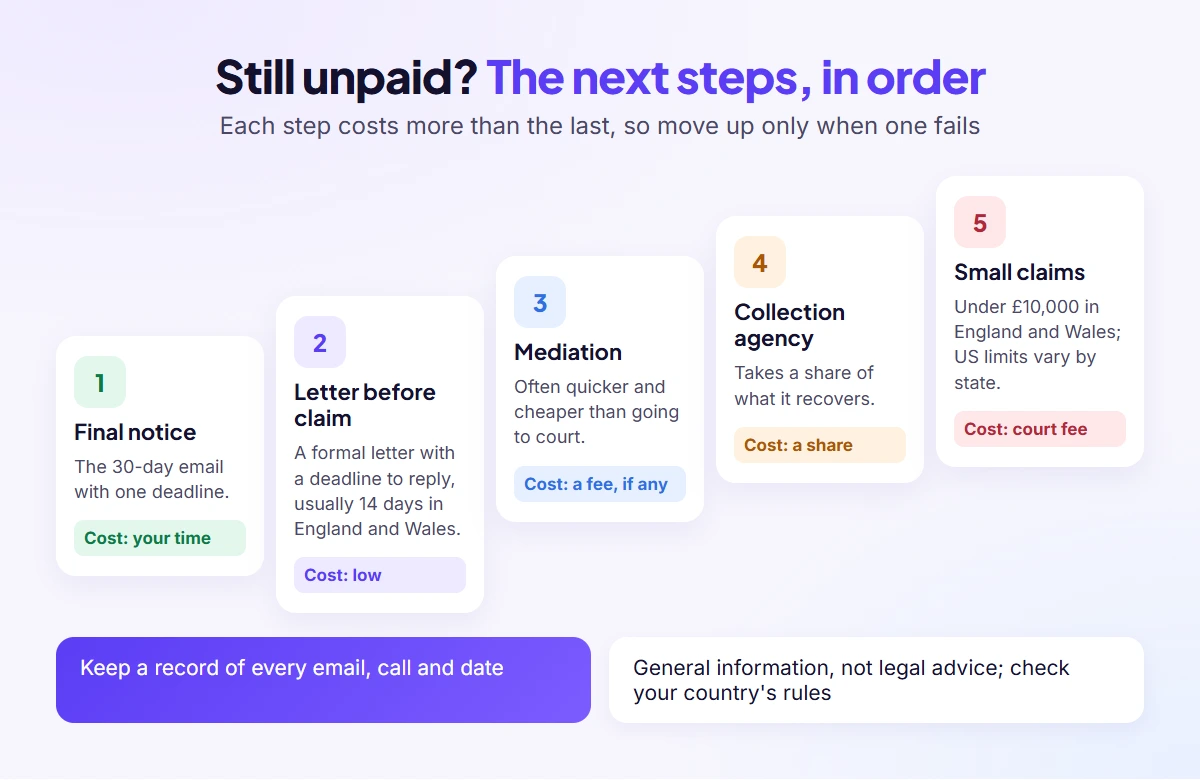
If a client still has not paid after your reminders, a call and a final notice, send a formal letter before claim with a deadline, then choose between a collection agency, mediation or a small claims court, based on the amount owed, the cost of each route and whether you want to keep the client.
Each step costs more time or money than the one before, so move up only when the last one has failed, and keep a record of every message, call and date. The usual order looks like this:
- Final notice: the thirty-day email above, with one deadline.
- Letter before claim or letter of demand: a formal letter that gives a deadline to reply, usually 14 days in England and Wales.
- Mediation: Citizens Advice notes it “could be quicker and cheaper than going to court”.
- Collection agency: it takes a share of what it recovers, so compare that with the amount owed.
- Small claims: in England and Wales for claims under £10,000; in the US the limits and rules vary by state.
When should you stop work for a client who hasn’t paid?
Stop new work for a client when an invoice passes the point your agreement names, for example fourteen days overdue, and tell them before you pause rather than going quiet; if your agreement says nothing, give written notice with a date and let ongoing deliverables wait until the invoice clears.
Not everyone agrees on hardball. One commenter in an r/freelance thread said they “would never withhold work or hardball unless it was an absolute last resort”. For a long, valuable relationship, a call usually comes first; for a client with a pattern of lateness, a pause written into your terms is fair to both sides.
Can you charge a late fee or interest on an unpaid invoice?
You can usually charge a late fee or interest only if it was agreed before the work, in your contract or on the invoice, while some countries add a legal right on top, such as statutory interest on business invoices in the UK and the European Union, and fixed recovery costs.
As a commenter in an r/freelance thread put it, “You can’t add a late fee retroactively.” The rules below come from official government sources for each country, as of October 2026:
| Country | When an invoice is late | Interest and fees | Source |
| UK | If no date was agreed, 30 days after the client gets the invoice; agreed business terms are usually within 60 days | Statutory interest of 8% plus the Bank of England base rate between businesses, unless your contract sets a rate; fixed recovery costs of £40, £70 or £100 by debt size | gov.uk |
| EU | Businesses pay within 60 days unless they expressly agree otherwise and it is not grossly unfair | Interest of at least 8 points above the European Central Bank reference rate, and €40 minimum for recovery costs | European Commission |
| New York City | By the contract date or, if none, within 30 days of finishing the work; contracts of $800 or more must be in writing | An unpaid freelancer can collect double the amount not paid, plus fees (Freelance Isn’t Free Act) | NYC Consumer and Worker Protection |
| Rest of the US | Set by your contract | Late-fee and small-claims rules vary by state; check your state court website | State courts |
| India | The agreed date, up to 45 days; for registered micro and small suppliers | Compound interest at three times the RBI bank rate, with monthly rests (MSMED Act) | Ministry of MSME |
| Australia | Set by your contract | Recovery steps: reminder, letter of demand, dispute help, debt collection, then a tribunal or court | business.gov.au |
This is general information, not legal advice, and rules change, so check the current position in your country before you rely on it. If you do charge a fee, bring it in at the two-week email and give the day it starts, so the client has a fair chance to avoid it.
How long can you chase an unpaid invoice?
In England and Wales you generally have six years to take legal action over an unpaid invoice, the limitation period for simple contract debts, and other countries set their own limits, but there is no reason to wait: escalate within weeks rather than years, while the work and the paper trail are fresh for both sides.
Scotland and other countries have different periods, so check locally. Whatever the limit, a reminder schedule that runs in the first thirty days keeps the record clear and the conversation current.
How Do You Avoid Chasing Client Payments Next Time?
You avoid most payment chasing by agreeing the terms before the work starts: take a deposit, bill large projects in milestones, use shorter payment terms, write any late fee on the invoice, send invoices to the person who pays, and schedule a reminder before each due date.
Commenters in the Reddit threads keep landing on the same few rules: “no final files until the invoice is paid”, “net 14, not net 30”, and, from one commenter in r/agency, “We started charging in advance each month”. A clear proposal helps too; our guide on how long a quote should be valid covers putting dates and terms in writing before the client says yes, and proposals with a deposit on the first invoice make the upfront payment part of signing.
How to ask a client to pay upfront
Ask a client to pay upfront by presenting it as how you schedule work rather than a judgment of them: explain that projects are booked once the deposit or first month is paid, give the exact amount and date, and offer milestones for larger projects so the commitment feels fair.
In an r/smallbusiness thread with more than 300 comments, a small graphic design business asked how to word exactly this to a client who always paid late; the client agreed to pay in full 30 days before the project started. A neutral email does the job:
Subject: How we’ll schedule [project]
Hi [Name],
Looking forward to [project]. From this month, we book work once the first payment is in, so the team can block the time for you.
For this project that’s [deposit] by [date], then [amount] at [milestone] and the balance on delivery. The invoice is here: [pay link].
Once it’s paid, we’ll confirm the start date the same day.
[Your name]
Can You Send Payment Reminders Automatically?
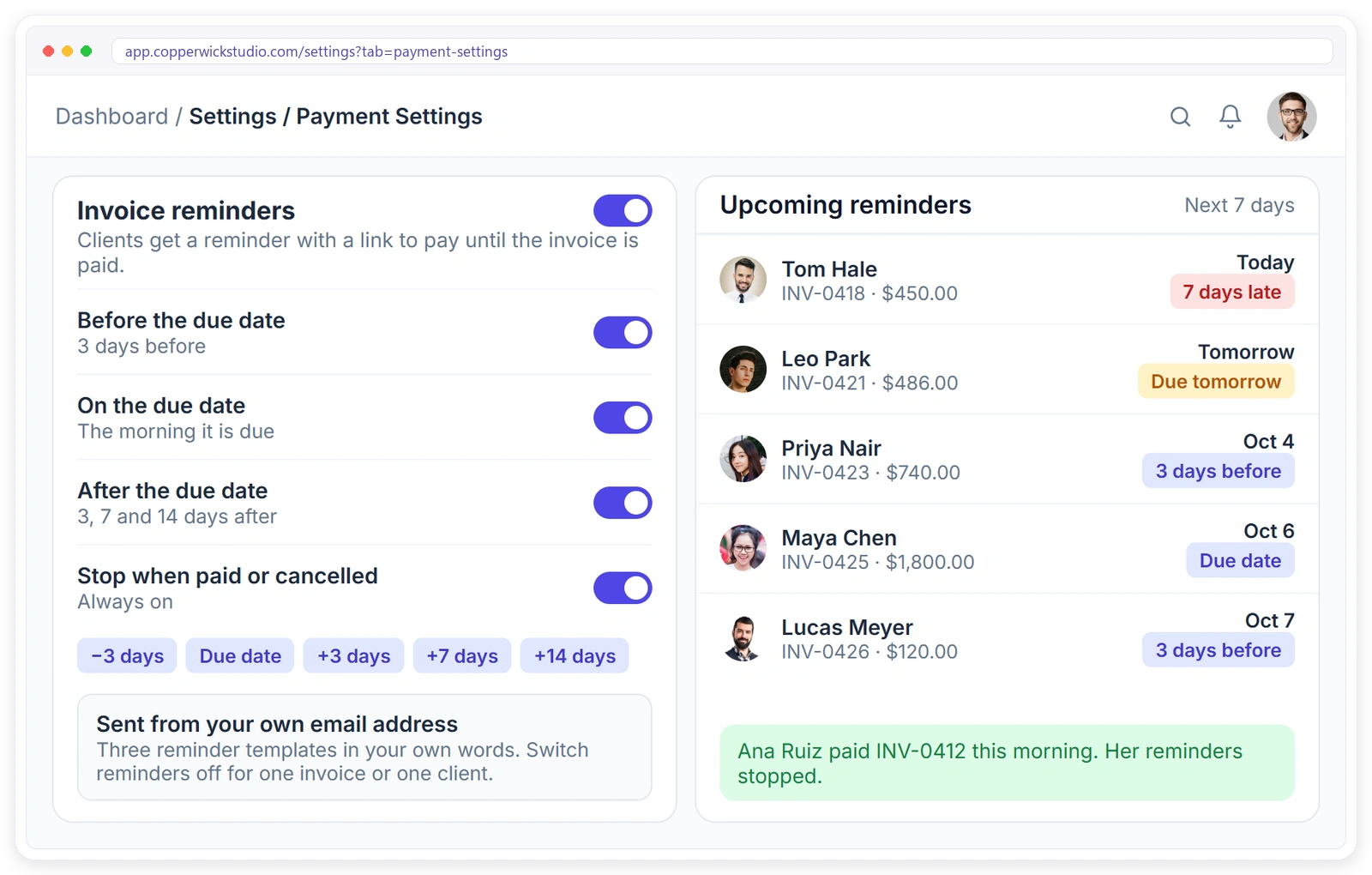
Yes, invoicing software can send payment reminders for you on a schedule, before the due date, on it and after it, and stop once the invoice is paid. That keeps every client on the same polite rhythm and saves you from deciding, invoice by invoice, whether it is too soon to ask.
Clientish is an all-in-one client management portal for agencies, freelancers, consultants and service-based businesses: leads, proposals, a branded client portal, orders, invoices and subscriptions, support tickets and live chat in one place. In its invoicing and billing, the schedule in this guide becomes a setting:
- Your schedule: a reminder before the invoice is due (you choose 1 to 30 days ahead), one on the due date and up to five after it.
- A link to pay in every reminder: the same payment link as the invoice, and the reminders stop as soon as it is paid or cancelled.
- Your words, your address: reminders go from your own email server using three reminder templates you can edit, and you can switch them off for one invoice or one client.
- Proof it arrived: invoice emails show when the client opened them, which answers “I never got it”.
The automated client emails page shows the other letters that go out by themselves, and the Docs walk through setting up invoice reminders. Reminders are on every plan, and you can try it free for 14 days.
Frequently Asked Questions
These are the questions agencies, freelancers and service businesses ask once payment reminders become a routine, from the wording itself to who should receive them.
Is it rude to remind a client to pay you?
No, reminding a client to pay is not rude: a reminder is a normal part of invoicing, and clients expect it. What feels rude is blame, sarcasm or pressure before the due date. A short, factual note that names the invoice and makes paying easy is simply professional, and many clients are glad of it when an invoice has slipped.
Is “friendly reminder” passive-aggressive?
“Friendly reminder” can read as passive-aggressive when it opens a second or third chase, so use it once, before or on the due date. After that, start with the invoice number and the facts instead, such as “[INV-number] is now 7 days overdue”, which is clearer and harder to take personally.
How long does a client legally have to pay an invoice?
A client legally has as long as your contract says to pay an invoice, within limits some places set. In the UK an invoice with no agreed date is late 30 days after the client receives it; EU businesses must pay within 60 days unless agreed otherwise; New York City freelancers must be paid within 30 days of finishing the work if no date is set.
Should you mention the late fee in the first reminder?
Leave the late fee out of the first reminder and mention an agreed fee from the two-week reminder, as a date (“the agreed fee applies from Friday”) rather than a threat, and decide in advance whether you would waive it for a good long-term client who pays once reminded.
Who should get the reminder: your contact or their accounts team?
Once an invoice is late, send the reminder to both your contact and their accounts team. Your contact can push the approval, and the accounts team releases the money. Ask at the start of the project who pays invoices and whether they need a purchase order number, and you will avoid many “it never reached us” delays.
What if the client says they never received the invoice?
When a client says they never received the invoice, resend it the same day with the payment link, ask them to confirm it arrived, and note the date. If it happens again, send invoices to two addresses and use a system that shows when the email was opened, so the question does not come up a third time.
What if the client disputes the work instead of paying?
When a client disputes the work instead of paying, ask them to put the issue in writing, fix any genuine problem quickly, and ask for the part of the invoice nobody disputes to be paid now. For future projects, a clause saying work is accepted unless problems are raised within a set number of days prevents the same standoff.
Should you offer a discount to get paid faster?
An early-payment discount helps only when it is written into your terms before the work starts. A discount offered to a client who is already late usually teaches them that waiting pays. For an overdue invoice, a short payment plan is the better offer.
Do automated payment reminders annoy clients?
Automated payment reminders can annoy clients when the wording is generic or they keep arriving after the money has been sent. Keep them short and in your own words, set them to stop the moment the invoice is paid, and they read as part of good invoicing rather than nagging.
Final Thoughts
Pick the schedule above, save the six emails as templates, and send the next reminder on the day it is due rather than the day you feel brave enough. A polite reminder sent on time is easier to write and easier to read than an angry one sent a month late.
Then fix the cause: put your terms and any late fee on the invoice, ask for a deposit on new projects, and let reminders run on their own. To send invoices with a payment link and reminders that stop when the client pays, Signup & Try Demo.
Sources
Clientish publishes this guide. It reflects the author’s 15 years of client work as a consultant and founder of Giant Marketers and experience building client management software for agencies, plus official guidance from gov.uk, Citizens Advice, National Debtline, the European Commission, New York City’s Department of Consumer and Worker Protection, India’s Ministry of MSME and business.gov.au, payment reminder guides, threads on Reddit (r/etiquette, r/freelance, r/smallbusiness, r/agency, r/graphic_design and r/artbusiness), Quora, ChatGPT answers and Google’s “People also ask”, reviewed as of October 2026. Quotes attributed to Reddit users are real; all templates were written for this guide. This guide is general information, not legal advice. The Clientish section describes the product as of October 2026.

