

The usual recommendation for a service quote is a 30-day window: time for the client to get sign-off while your rates and calendar still hold. Use 14 days when the price includes costs you do not control, such as software, ad budgets, subcontractors or exchange rates, and treat 7 days as the floor. Write the exact end date on the quote.
Across fifteen years of client work at Giant Marketers, the quote that caused the most trouble was never the expensive one. It was the one with no end date, which came back months later with a “yes” at a price we had long since outgrown and a start date we could no longer give. A validity date is a small line, but it protects your margin and your calendar at the same time.
Key takeaways
- 30 days suits most service quotes; 14 days suits prices with outside costs or currency risk; 7 days is the floor.
- Print an end date on every quote instead of a count of days.
- A validity date holds the price, not your start date; book the start when the client accepts and pays.
- An accepted quote is usually binding, and an expired one is a new conversation.
- Remind the client a few days before the date, by name and with the date in the message.
How Long Should a Quote Be Valid?
Most service quotes and proposals should stay valid for 30 days, or 14 days when part of the price depends on costs or capacity that can change within a month. No law sets a period in most countries, so the choice is yours, and three questions decide it: how fast your costs change, how long the client needs to decide, and how long you can keep the work slot open.
That also answers “how long does a quote last” and “how many days is a quote valid for”: until the date printed on it. If there is no date, it may stay open for an undefined “reasonable time”, which is exactly the situation you want to avoid.
These four periods are a good starting point for most service quotes, and the right one depends on what could change before the client says yes: your own fee, outside costs, your calendar or the client’s approval process.
| Validity | Use it when | Typical work |
| 30 days | The price is mostly your own time | Website builds, branding, audits, retainers |
| 14 days | Outside costs, another currency or a tight calendar | Software licences, subcontracted work, quotes in the client’s currency |
| 7 days | A small job or your last free slot | Quick fixes, rush jobs, a block of hours |
| 45 to 60 days | The client needs a formal approval process | Larger companies with procurement or several people signing off (a tender may set its own period) |
Why do most quotes say “valid for 30 days”?
Thirty days is mostly habit: it matches monthly billing, supplier price lists and the default in common invoicing software, not any legal rule. One tradesperson on Reddit admitted they simply leave the software’s 30-day default because it saves typing in a date. That is fine, as long as you pick the number on purpose; another commenter summed up why the date exists at all: “It’s always the same price until it isn’t.”
Is a Quotation Valid for 30 Days?
A quotation is valid for 30 days only if it says so; 30 days is the most common choice, not a legal default. It suits service work well because most of the price is your own time, which does not change from week to week, and it lines up with the monthly cycle of retainers and invoices.
For a website build, a brand identity project, a content package or an audit, 30 days gives the client time to compare options and get approval without leaving you exposed to old rates for months. If your quote carries no date at all, the rules depend on the country, which the legal section below covers.
Is a Quotation Valid for 7 Days?
A quotation is valid for 7 days only when it states 7 days, and that short window suits small jobs or prices you cannot hold longer, not large projects that need sign-off. Seven days is the practical floor; a shorter window tends to read as pressure, and a client who needs a manager’s approval simply cannot meet it.
Use 7 days for a quick one-off task, a rush job or a price tied to a slot that will fill soon, and say why: “This quote is valid for 7 days because these hours are the last free slot this month.” A reason turns a short deadline from a sales trick into useful information.
When should a quote be valid for 14 days?
Use 14 days when your price includes third-party costs, foreign-currency amounts or a start date you can only hold for a couple of weeks. Software licences, stock assets, subcontracted specialists and exchange rates can all move within a month, so the shorter window keeps the price accurate without rushing the client unduly.
How Long Should a Quote Be Valid for Different Types of Service Work?
Match the validity to what can change in the price: fee-only project work can hold for 30 days, while anything with ad budgets, software costs or currency exposure needs 14 days or a separate line for those costs. The table below gives a starting point for the most common kinds of agency and freelance work.
| Type of service work | Suggested validity | What can change | Add to the quote |
| One-off project, fee only (website, brand identity, content package, audit) | 30 days | Your rates, your calendar | Start date confirmed on acceptance and deposit |
| Small task or block of hours (fixes, a landing page, support hours) | 7 to 14 days | Your free slots | “Booked in order of acceptance” |
| Monthly retainer (SEO, social media, care plan) | 30 days to accept | Your rate at renewal | The period the monthly price stays fixed |
| Ad-spend work (PPC, paid social) | 30 days for your fee | Platform costs, the client’s budget | Ad budget shown as the client’s cost, paid at actual |
| Work with outside costs (licences, plugins, print, subcontractors) | 14 days, or 30 with costs listed separately | Supplier prices, subcontractor availability | Outside costs “at current price, confirmed before purchase” |
| International client, other currency | 14 days in their currency, 30 in yours | Exchange rate, transfer fees | The currency and the exact end date and time zone |
| Procurement or multi-stakeholder clients | 45 to 60 days | Your calendar, most of all | Price held to a date; team and start confirmed at signing |
How long should a retainer proposal be valid?
A retainer proposal can stay open for 30 days, but the more important date is how long the monthly fee is held once the retainer starts. Write both: the date by which the client can accept, and the period during which the monthly price stays fixed, such as the first six months. That second date stops a price review from becoming an awkward surprise later; an agency retainer agreement is the natural place to put it.
How long should a quote with ad spend or software costs be valid?
Keep your own fee valid for 30 days and list ad budgets, software licences and other outside costs separately at their current price, so a change in those costs does not force a whole new quote. A tradesperson on MyBuilder described the same split for labour and materials, holding labour prices far longer than material prices. For agencies, the equivalent is your fee versus the costs you pass through.
What validity should an international client’s quote have?
Give international clients the same window as local ones, but shorten it to about 14 days if you quote in their currency, and state the currency and the exact end date. Add a time zone to the end date, such as “5 pm UK time”, so there is no argument about which day the quote ended on the other side of the world.
How Do You Know If a Quote’s Validity Period Is Too Long?
Your quote validity is too long if a client could accept on the last day and you would be losing money or could not start on time. Ask yourself one question before you send: if this client says yes on the final day, would I still do this exact work, at this price, on the date I promised?
Warning signs that your window is too long:
- You keep honouring old prices after you have raised your rates.
- Clients accept when your calendar is already full, and you have to push their start date.
- Outside costs, such as software or subcontractor rates, change before the quote ends.
- Proposals sit undecided for weeks and then several clients say yes at once.
Signs it is too short are the opposite: clients ask for an extension on most proposals, or larger clients cannot get approval in time. If that happens often, lengthen the window rather than extending every proposal by hand.
Does a Quote’s Validity Date Reserve Your Start Date?
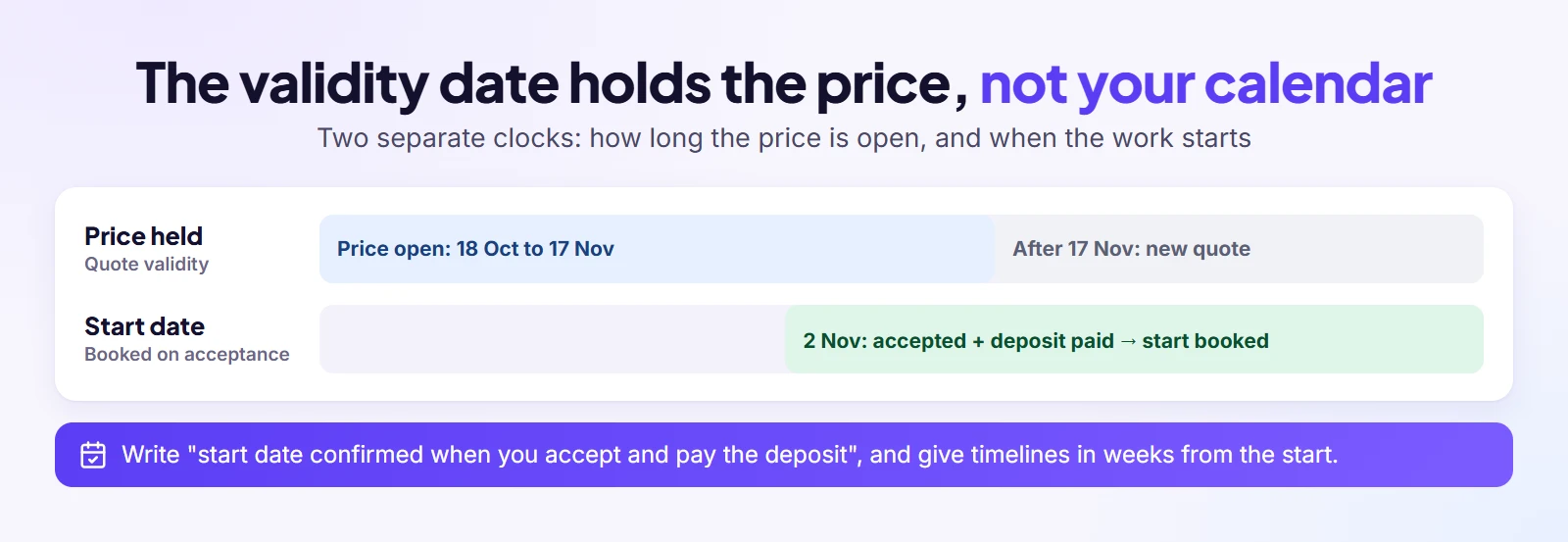
No: a validity date holds the price until that day, but your start date should be confirmed only when the client accepts and pays any deposit. Keeping the two separate is one of the most useful changes you can make to a quote, because for agencies capacity, not cost, is often what runs out first.
An SEO agency owner on Reddit described the clause they use: the quote is valid for 30 days, and the project joins the work queue only on formal acceptance. A freelancer in another thread put it more bluntly: “My time isn’t theirs unless they lock in a deposit.” Write timelines as weeks from the official start, not as calendar dates, so a slow approval does not leave you promising dates you cannot keep. Once the client accepts, a clear first week matters too; our guide on onboarding clients without email covers it.
What Should a Quote Validity Clause Say?
A quote validity clause should state the exact last day the price can be accepted, what happens after that day, and, for service work, that the start date is confirmed on acceptance. Put it next to the total and the accept button, and mention the date in your email too, because many clients never read the small print. If the scope changes after acceptance, a change request form keeps the new price separate from the original quote.
Should you write a date or a number of days?
Write a date: “Valid until 17 November 2026” leaves no question about when the clock started, while “30 days” does. A number of days invites the argument of whether it counts from the day you sent it, the day the client opened it or the day of your last call. A date ends that argument before it starts.
Quote validity wording examples (copy and adapt)
Quote validity wording should be short, dated and specific to your situation, as in these examples for common kinds of service work. Change the dates, currency and periods to match your own quote.
- Project, fee only: “This proposal can be accepted until 17 November 2026. After that date we’ll review the price and timeline and send you an updated proposal.”
- Price and start date kept apart: “The prices in this proposal are held until 17 November 2026. Your start date is booked when you accept and the deposit is paid.”
- Retainer: “This retainer proposal is open until 17 November 2026. Once you start, the monthly fee stays the same for the first six months.”
- Ad spend: “Our management fee is valid until 17 November 2026. Your ad budget is paid to the ad platforms at actual cost and is not part of this price.”
- Outside costs: “Software licences and stock images are listed at today’s price. If any of them changes before we buy it, we’ll show you the new figure first.”
- International: “All prices are in GBP and valid until 5 pm UK time on 17 November 2026.”
- Procurement: “This price is held until 31 January 2027 to allow for your approval process. The team and start date are confirmed when the contract is signed.”
- Estimate, not quote: “This is an estimate based on what we know today, not a fixed price. We’ll send a fixed quote after the discovery call.”
How Legally Binding Is a Quote?
A quote is usually an offer: it becomes legally binding when the client accepts it within its validity period, and from then on neither side can change the price alone, which is how official consumer advice in several countries describes it. Acceptance can be a signature, a reply email, a deposit or an online acceptance, depending on what your quote says. This section is general information, not legal advice; rules differ by country and between consumer and business clients.
If you do not want the quote itself to bind you, say so: wording such as “subject to contract” signals that a separate agreement will follow. And if a client changes the terms when replying, that is usually a new offer from them, not an acceptance of yours.
Is a quote the same as an estimate?
No: a quote is a fixed price for defined work, while an estimate is your best guess and the final bill can differ. Consumer guidance in the UK, Australia and New Zealand draws the same line. One freelancer on Reddit had a client come back a year later expecting an old estimate to hold, even though the estimate said it was not a contract, so label the document clearly as one or the other and give it an end date as well.
The difference shows up on the final invoice: an accepted quote binds you to the price, while an estimate mainly sets expectations, so pick the label that matches how sure you are of the scope.
| Compare | Quote | Estimate |
| Price | Fixed for the agreed scope | A best guess that can change |
| When to send it | Scope is clear and agreed | Scope is still being worked out |
| If the work grows | New quote or change request | Final bill can differ |
| Needs an end date? | Yes | Yes, plus the word “estimate” |
Our guide to sending proposals clients can sign shows how a fixed quote turns into an invoice and order on acceptance.
What happens if a quote has no expiry date?
Without an expiry date, a quote generally stays open for a “reasonable time”, which no one can define in advance, so a client may try to accept an old price months later. In common-law countries an offer lapses after a reasonable time if no date is given, and some countries set their own rule; in France, for example, an unsigned quote with no expiry date is generally treated as valid for three months.
How long is a quote valid in the UK, Australia, New Zealand and South Africa?
None of these countries sets a standard validity period for service quotes; a quote lasts until the date written on it, and 14 to 30 days is the usual choice. In the UK, an accepted quote is a binding agreement. Australian government guidance lists a quote expiry date among the things a written quote should include. In New Zealand, an accepted quote is generally treated as a maximum price unless extra work is agreed. South Africa has no prescribed period for agency quotes. In the US, offers lapse at the stated time or after a reasonable time.
In these countries the pattern is similar: no law sets a period for service quotes, and an accepted quote generally counts as a deal. In the UK and US an undated quote stays open for an unclear “reasonable time”; France is different, because an undated quote there is generally treated as valid for about three months.
| Country | Fixed validity by law? | Once accepted | If no end date |
| UK | No | A binding agreement | Generally a “reasonable time” |
| Australia | No | A binding contract | No set rule; official guidance says to include an expiry date |
| New Zealand | No | Generally a maximum price | No set rule; date the quote to avoid doubt |
| South Africa | No, for agency quotes | Generally a contract under ordinary contract rules | No set rule; quotes usually state 14 to 30 days |
| US | No | A contract | Generally a “reasonable time” |
| France | No, but three months by custom if no date | A contract | Generally treated as about three months |
What Happens When a Quote Expires?
When a quote expires, its price and terms stop being an open offer, so you can re-price, change the timeline or decline before agreeing to the work. Do not quietly revive the old document; send a fresh version with a new date, and apply the same policy to every client so nobody feels singled out.
Can a client accept an expired quote?
A client cannot hold you to an expired quote, but their late “yes” can be treated as a new request that you are free to accept, change or turn down. If you are happy to keep the old price, say so in writing with a new end date. For high-value work or consumer clients, check local rules before relying on an expired date.
What should you do when a client comes back months after the quote expired?
Thank them, check whether the scope, your rates and your calendar are still the same, and send a new proposal with a new date rather than reopening the old one. Someone at a web agency described on Reddit a client returning after a year to a quote that had been valid for only 30 days; a commenter replied that no reasonable person would expect a proposal to stay valid “for more than 30-90 days max.”
Three replies cover most cases:
- Re-quote at current rates: “Good to hear from you. Our rates and calendar have changed since March, so I’ve attached an updated proposal valid until [date].”
- Re-quote with a smaller option: “The full project is now [price]. If the budget is fixed, a smaller package covers [scope] for close to the original amount.”
- Cannot fit it now: “We’d love to help, but our calendar is full until [month]. I can hold a start in [month] if you accept the attached proposal.”
Can you raise your price if a client accepts after your rates went up?
If they accept before the validity date, honour the old price; if the date has passed, you can send a new proposal at your current rates. A freelancer on Reddit who raised their rates while a proposal sat unanswered for a month was told by most commenters to honour it this time and add an expiry date to the next proposal, which is the fairest way to handle it.
When Should You Follow Up Before a Quote Expires?
Follow up a few days before the validity date, usually two to four days, with a short message that names the date and makes it easy to say yes, no or “need more time”. Check first whether the client has opened the proposal: a client who opened it and went quiet needs a different message from one who never opened it.
Opened, no reply: “Hi [Name], a quick note that the proposal for [project] is open until [date]. Happy to answer any question or jump on a ten-minute call before then.”
Not opened: “Hi [Name], just checking the proposal reached you; it’s here: [link]. It’s valid until [date], so there’s still time to look it over.”
When a client needs longer, agree a single written extension. If most clients need extensions, your window is too short; if deals keep stalling after extensions, the problem is the deal, not the date.
How Do You Make Proposals Expire Automatically?
A proposal tool with a valid-until date on each proposal is the simplest answer: the quote stops accepting a “yes” by itself once the date passes. That removes the awkward conversation about an old price, because the client simply cannot accept it.
Clientish is an all-in-one client management portal for agencies, freelancers, consultants and service-based businesses: leads, proposals, a branded client portal, orders, invoices and subscriptions, support tickets and live chat in one place. When you send proposals to clients from it, the validity rules in this guide become settings:
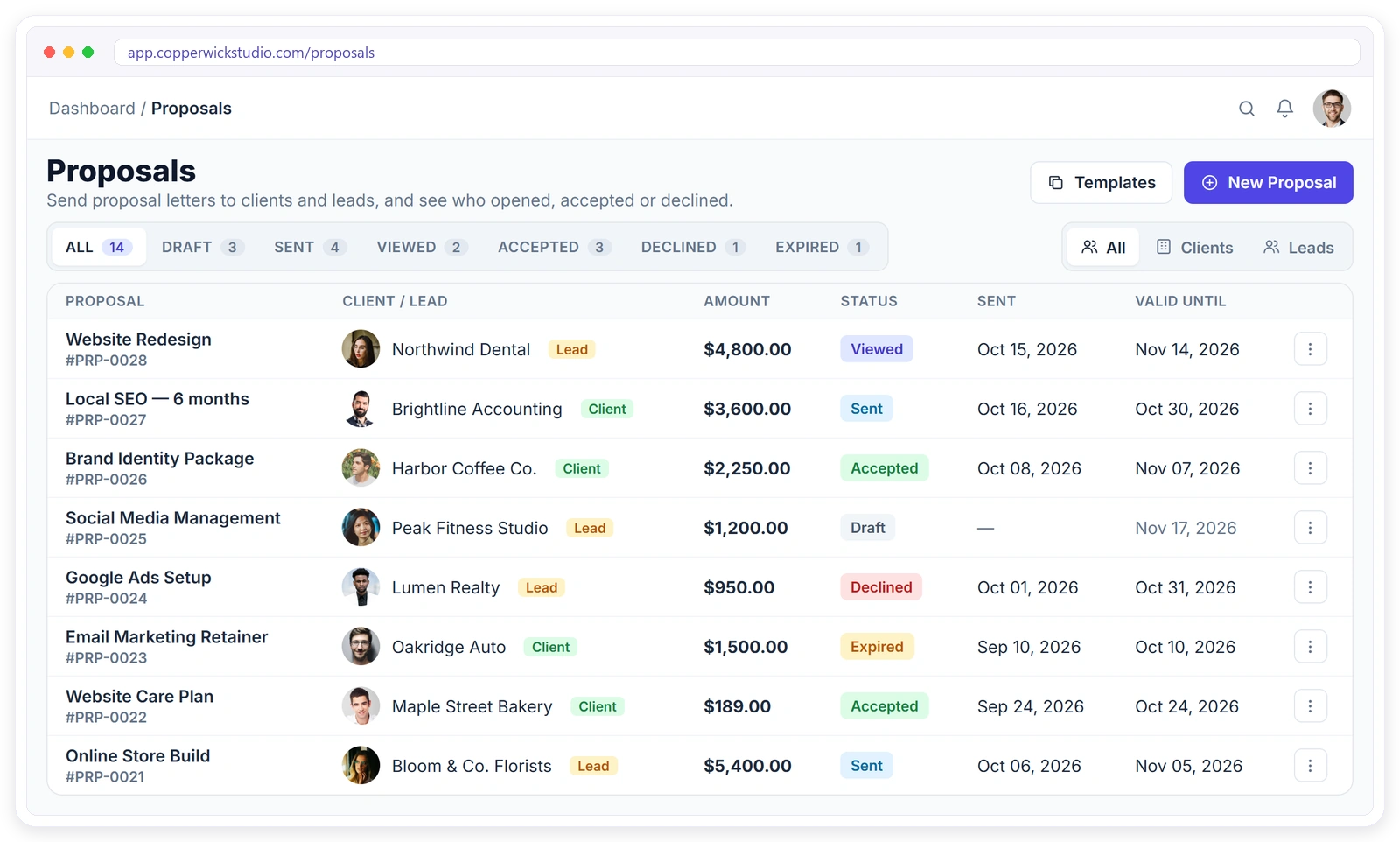
- Valid-until date: you set the date on each proposal, and it moves to Expired by itself when the date passes. Each proposal shows whether it is Draft, Sent, Viewed, Accepted, Declined or Expired.
- Reminders: one reminder goes to the client automatically three days after sending if there is no answer, and another reminds them before the proposal expires.
- Price and start kept apart: when the client accepts with an e-signature, the client record, invoice and order are created, with an optional deposit on the invoice, so you can confirm the start date once that deposit is paid.
- Clear price changes: if you change the price on a proposal that is still open, it is marked as updated and the client is told.
You can try it free for 14 days and send your next quote with a real end date.
Frequently Asked Questions
Here are the questions service businesses ask once they start putting real end dates on their quotes and proposals, from extensions to verbal quotes.
Does the validity period start when I send the quote or when the client opens it?
It starts from whatever your quote says, which is why an exact end date is better than a number of days. If you must use days, count from the date the quote is issued and print that date on it. Then it does not matter when the client happens to open the email.
Can I extend a quote before it expires?
Yes. Check that your costs and calendar still allow it, then confirm the extension in writing with a new end date. One extension is a courtesy; if you extend most quotes, your standard window is probably too short for the clients you serve.
Can I withdraw a quote before its expiry date?
In many common-law countries, an offer can generally be withdrawn before the client accepts it, as long as you tell them. Rules vary by country and for consumers, so treat this as general information. Once the client has accepted, the quote is usually binding on both sides.
Does an accepted quote still expire?
No. Once the client accepts within the validity period, the validity date has done its job, and the delivery timeline and payment terms take over. That is why the quote should say when the work starts after acceptance, not just when the offer ends.
Should a proposal and a quote have the same validity?
Usually yes. A proposal is a quote with more context, such as your approach, timeline and case studies, so the same logic applies: 30 days for fee-only work, 14 days when outside costs are involved, and an exact end date either way.
Do I need a validity date on an estimate?
Yes. An estimate is not a fixed price, but it is still based on today’s rates and calendar. A date and a clear “estimate, not a quote” label stop a client from treating a year-old guess as a promise when they finally come back.
Should I offer a discount for signing before the expiry date?
Only if the reason is real and you say what it is, such as a free slot that will be gone next month. Invented urgency damages trust, and clients who sign under pressure tend to be harder to work with. A clear date and a helpful reminder usually do more.
What if a client asks for more time?
Give one extension in writing with a new date, after checking your costs and calendar. Ask what is holding the decision up; often it is an approval you can help with. If they ask again, the deal has stalled, and a short call works better than another extension.
Is a verbal or WhatsApp quote valid?
It can be, since an agreement does not always need to be on paper, but it is hard to prove what was promised. Follow any spoken or chat quote with a written version that includes the price, the scope and the end date, and ask the client to accept that version.
Final Thoughts
Open the last three quotes you sent and check one thing: does each have an exact end date? If not, add one to your template today, using 30 days for fee-only work and 14 days when outside costs or currency are in the price.
Then separate price from start date in your wording, and set a reminder a few days before each date. To send proposals that expire by themselves and turn into an invoice and order on acceptance, Signup & Try Demo. If you are still working out the price itself, our guide on how to price a productized service covers the maths.
Sources
Clientish publishes this guide. It reflects the author’s 15 years of client work at Giant Marketers and experience building client management software for agencies, plus quote and proposal guides, consumer guidance from government and advice sites in the UK, Australia, New Zealand and France, discussions on Reddit, MyBuilder and a Facebook trade group, and Google’s “People also ask” answers reviewed as of October 2026. Quotes attributed to Reddit and MyBuilder users are real; wording examples and message templates were written for this guide. This guide is general information, not legal advice. The Clientish section describes the product as of October 2026.

