

The right way to price a productized service is a three-step calculation: work out what one delivery costs you in real hours, add the margin your business needs, and then check that number against what the result is worth to the buyer and what similar offers charge. Publish one price with written limits on revisions, turnaround and scope, and adjust it after real sales.
In fifteen years of client work at Giant Marketers, I have learned that a fixed price is only as safe as the limits written under it. A package at $1,500 a month is fine until “four posts” quietly becomes six, every post goes through three rounds of edits, and the client expects a call every week. The price was never the problem; the missing hour budget was. This guide shows the maths, the limits and the tests that keep a published price profitable.
Key takeaways
- Price from your loaded hourly cost, using the hours you can really bill in a year, not 2,080.
- Turn every monthly fee into an hour budget, and fit the deliverables to that budget.
- Write down revisions, turnaround, the size of one unit and what is not included; without them the price does not hold.
- Test a new price on a few real buyers and watch hours per delivery as well as sales.
- Raise prices for new buyers first, then give existing clients clear notice and a reason.
How Do You Price a Productized Service?
One freelancer in a pricing thread asked whether they should just pull a number out of thin air. The answer is no: a price that holds comes from three numbers, in order: what the work costs you, the margin you need, and what the buyer will happily pay.
The pricing formula in one line
Minimum price = cost of one delivery ÷ (1 − target margin). Say one delivery costs you $600 in time and tools and you want a 40% margin: the minimum price is $600 ÷ 0.6 = $1,000. That number is your lower limit, not your price. From there you look at the value of the outcome and at the market, and you move up when both allow it. Moving below it means every sale makes you poorer.
Why a published price is set differently from a quote
When you quote a custom project, you talk to the buyer first and price that one deal. A productized service has one price for everyone, often seen before any conversation, so it has to work for the average buyer of that package, not the best one. In practice, buyers at higher price points still want a short call before they pay. The call just gets shorter, because the scope and the price are already settled.
What Is a Productized Service, and What Does It Usually Cost?
A client who buys “a logo” from you and a client who buys “the Logo Package” are buying different things: the first is a conversation, the second is a product. A productized service is the work you already deliver, packaged so every buyer gets the same thing, at the same price, in the same time.
Fixed scope, fixed price, fixed delivery time
Think of a monthly website care plan, a four-post blog bundle or a logo package with two rounds of changes. The scope is written down, the price is public or close to it, and the delivery time is known before the client pays. It is still a service: a person does the work. What changes is that you stop reinventing the offer for every client, which is exactly what lets you price it once and sell it many times.
What public offers show about price ranges
Published prices vary widely by service and market. Monthly design and website plans from small studios start in the low hundreds of dollars and climb past a few thousand. Monthly SEO packages from agencies that publish their prices often sit in tiers of a few hundred to around a thousand dollars. Content and copywriting retainers commonly land between a few hundred and a few thousand a month. Treat these ranges as a sense check, never as your price; your costs and your buyers decide that.
Work that should stay custom-quoted
Some work does not fit a fixed price. If two buyers of the same package would need very different hours, the package is not ready. Large SEO projects on sites with very different problems, complex web builds and anything that depends on the client’s own team moving fast all carry too many variables. Keep those as proposals, and productize only the parts that repeat, such as an audit or a monthly reporting pack.
Which Billing Model Fits: One-Time, Monthly or Per Unit?
A $1,500 audit and a $1,500-a-month content plan look alike on a price list, but one is paid once and the other has to stay profitable every month. Choose the billing model before the number, because it changes all the maths that follow.
One-time packages
One-time pricing fits work that ends with a clear deliverable: an audit, a landing page, a logo, a 90-day content plan. The client pays once, you deliver once, and the job is closed. This is the easiest model to price, because you can count the steps and their hours. It is also the easiest to sell as a first purchase, which makes a good one-time package a natural door into a monthly plan.
Monthly subscriptions
A monthly price fits work that has to keep happening for the result to last: content, social media, website care, ongoing SEO, ad management. Revenue becomes steadier, and planning your team gets easier. The catch is that a monthly fee hides the hours inside it. If you do not turn the fee into an hour budget, a monthly client can drift from profitable to loss-making without anyone noticing. The section on hour budgets below deals with that.
A base package plus paid extras
Many productized services work best as a small, clear base package with extras the client can add: an extra article, a rush delivery, a landing page on top of the monthly plan. The base stays simple to explain and to deliver, and buyers who want more pay for more. Spell out exactly what the base includes, and price each extra with the same cost method you use for the base.
Per unit, per request or per hour inside a package
Pricing per unit, such as per article, per slide or per post, works when every unit is about the same size. When units vary, per-unit prices feel mechanical and miss the real work: a 600-word post and a 3,000-word guide are not the same unit. Hourly pricing inside a package brings the old problem back, because it punishes you for getting faster. As a rule, price per unit only when the unit is stable; otherwise price the month and limit the volume.
How Do You Calculate What One Delivery Really Costs?
A price can look healthy on paper and still lose money, because the cost under it was a guess. The cost of a delivery is the real hours, at your real cost per hour, plus the costs you forget.
Your real hourly cost, not your billing rate
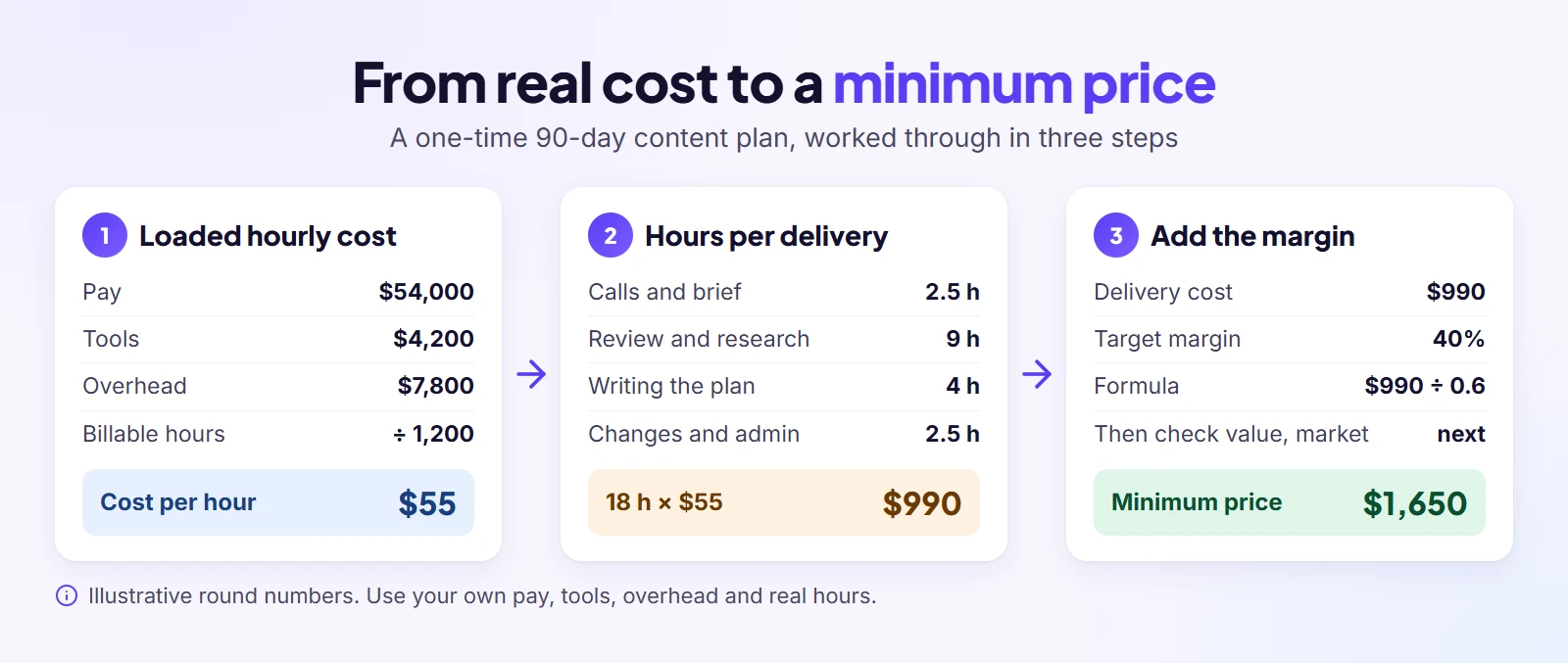
Add up what the business needs in a year: your pay or your team’s salaries, tools and software, and overhead such as rent, insurance and accounting. Then divide by the hours you can bill, not by the hours you work. A full-time year is about 2,080 hours, but sales, admin, learning and gaps between projects eat a large share; one freelancer in a pricing discussion said they always plan with 1,600 billable hours, and a business that spends more time selling may bill fewer. As an example: $54,000 pay + $4,200 tools + $7,800 overhead = $66,000 ÷ 1,200 billable hours = $55 an hour. That $55 is your loaded cost.
| Item | Amount |
| Pay | $54,000 |
| Tools | $4,200 |
| Overhead | $7,800 |
| Total a year | $66,000 |
| ÷ Billable hours | 1,200 |
| Loaded cost per hour | $55 |
Hours per delivery, from the steps you do
List every step of one delivery and give each its hours: the kickoff call, research, the work itself, internal review, revisions, the delivery call and the admin around it. Use real hours from your last few projects, not the ones you wish they took. Never tracked them? Track the next two deliveries before you publish a price. One freelancer in a pricing discussion spent 50% more time on a job than expected, and calls and revisions are the hours most often left out of an estimate.
Costs people forget
Payment gateway fees come off every invoice. Freelancers and subcontractors carry their own margin. Some tools are paid per client, such as a reporting seat or a stock image plan. Tax has to be set aside before the money is yours to spend. None of these is large on its own, but together they can turn a healthy-looking margin into a thin one. Add them to the cost of each delivery rather than hoping the margin will absorb them.
From cost to a minimum price
Now put the pieces together. Here is a one-time 90-day content plan, priced the way we would work it out at Giant Marketers. The hours and the $55 rate are illustrative round numbers, not our real rates, so swap in your own.
| Step | Hours |
| Discovery call and brief | 1.5 |
| Review of existing content | 4 |
| Topic and keyword research | 5 |
| Writing the 90-day plan | 4 |
| Presentation call | 1 |
| One round of changes | 1.5 |
| Admin and invoicing | 1 |
| Total | 18 hours × $55 = $990 |
At a 40% target margin, the minimum price is $990 ÷ 0.6 = $1,650. Many service businesses aim somewhere between 30% and 50%; pick the figure that covers growth, slow months and the occasional delivery that runs over. If $1,650 feels too high for your buyers, the answer is to cut steps or hours, not the margin.
How Many Hours Can a Monthly Package Pay For?
Picture a client on your $1,500 plan who sends “one quick thing” every week. By the end of the month, has the fee paid for the work, or have you? One line of maths answers it: the hours the fee can buy.
Turn the monthly fee into an hour budget
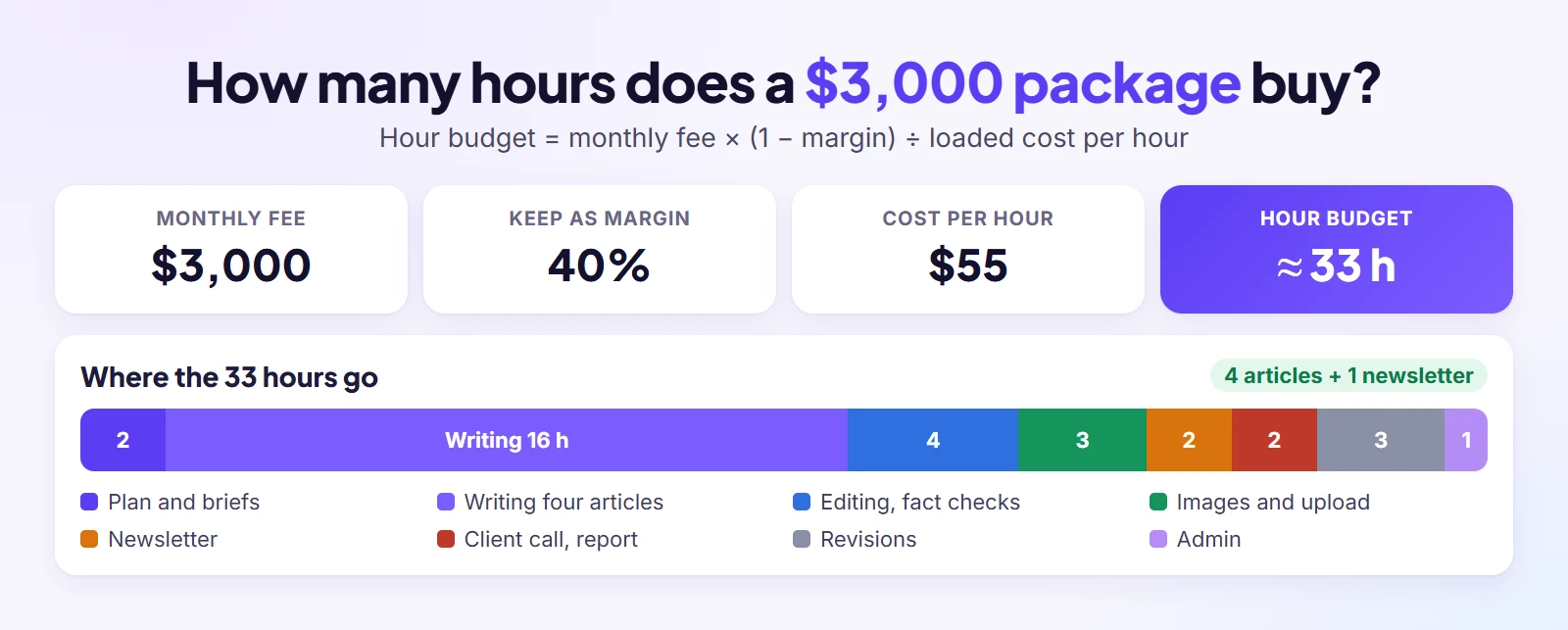
Hour budget = monthly fee × (1 − target margin) ÷ loaded hourly cost. A $3,000 content package at a 40% margin and $55 an hour gives $3,000 × 0.6 ÷ 55 = about 33 hours a month. A $1,500 package gives about 16. Write that number next to the package name in your own notes. It is the real product you are selling, and every deliverable, call and revision has to fit inside it.
| Monthly fee | × (1 − 40% margin) | ÷ $55 an hour | Hour budget |
| $1,500 | $900 | ÷ 55 | about 16 h |
| $3,000 | $1,800 | ÷ 55 | about 33 h |
Fit the deliverables to the budget, not the other way round
With the budget known, build the package from it. If one long blog post takes you four hours with research and editing, a 16-hour package cannot hold four posts plus a newsletter, calls and revisions. Either the package holds two posts, or it costs more. This is where monthly packages often go wrong: the deliverables are chosen to look generous, and the hours are hoped for. Choose the hours first, then the deliverables.
Our monthly content package, worked through
At Giant Marketers, this is how we would build a monthly content marketing package of four articles and one newsletter. As before, the hours and the rate are illustrative.
| Monthly task | Hours |
| Monthly plan and briefs | 2 |
| Writing four articles (4 hours each) | 16 |
| Editing and fact checks | 4 |
| Images, formatting and upload | 3 |
| One newsletter | 2 |
| Client call and short report | 2 |
| Revisions (one round per article) | 3 |
| Admin | 1 |
| Total | 33 hours × $55 = $1,815 |
At a 40% margin the minimum is $1,815 ÷ 0.6 = $3,025. Rounding down to $3,000 leaves a margin just under 40%, which is fine for a package delivered every month; rounding to $2,500 to look cheaper would not be. The point is not the exact figure. It is that the price and the hour budget were set together, so the team knows the package has about 33 hours and no more.
What to do when a client keeps going over
One month over budget is noise. Three months over is a pattern, and the fixes are few: talk to the client about what they are asking for, fix something inside your own process, or move them to a bigger package. Check the actual hours per client every month. If part of the work is done by contractors who log time, their hours per client make the check easy.
Why “unlimited” plans break the maths
“Unlimited requests for one monthly fee” sounds generous, and it is how many design subscriptions are sold. In practice those plans work only because they limit something else: one request at a time, a 48-hour turnaround per request, and a narrow list of request types. Without those limits, the hour budget has no ceiling, and a single busy client can wipe out the margin on the whole plan. Selling “unlimited” anyway? Put the real limits in writing next to the word.
How Do You Set the Price Above Cost: Value, Market and Buyer?
Two buyers can look at the same $3,000 package and see different things: one sees a cost, the other sees a month of leads. Cost sets the floor; three checks decide how far above it you go: the value of the outcome, what similar offers charge and what the buyer can afford.
Price on the outcome where you can measure it
If your package produces something the buyer can count, such as more booked calls, lower ad costs or hours saved, price against that outcome as well as your costs. A package that brings a client $20,000 of new work a quarter can carry a higher price than one whose value is hard to see. The limit is that value pricing usually needs a conversation, and a published price often sells without one. Use value to justify moving up from your floor, not to invent a number.
Check the market without copying it
Look at what five to ten similar offers charge and what they include. If you are far below them, buyers may doubt the quality; if you are far above, you need a clear reason, such as speed, specialism or results. Do not copy a competitor’s price. Their costs, buyers and margins are not yours, and copying a number ties your pricing to a business you know nothing about.
Check it against what the buyer can afford
A monthly fee also has to fit the buyer’s budget. A small local business may spend a few hundred dollars a month on marketing, while a larger company may spend several thousand. If your price takes a large share of a buyer’s monthly revenue, they are likely to cancel at the first slow month. When your buyers fall into clear groups, such as small businesses and larger companies, a separate package for each usually works better than one price stretched across both.
The 5 C’s and the 7 pricing strategies, applied
The “5 C’s of pricing” appear in different versions; a common one is cost, customers, competition, channels and compatibility with your goals. Most of them are covered above: cost is your loaded hourly cost, customers is the buyer check, competition is the market check, channels is where you sell (your site, your portal, a proposal), and compatibility asks whether the price fits the business you want to build. The seven pricing strategies usually listed in marketing courses fit productized services unevenly:
| Strategy | Fits a productized service? | When |
| Cost-plus | Yes, as the starting point | Always; it sets your minimum |
| Value-based | Partly | When the outcome is measurable |
| Competitive | As a check | To test whether you are far off the market |
| Penetration (low launch price) | Only with an end date | For a new package, as a time-limited offer |
| Premium or skimming | Sometimes | With a clear specialism or faster delivery |
| Economy | Rarely | Only if delivery is very lean |
| Dynamic | No | Changing prices per buyer breaks the idea of a published price |
How Should You Build Packages and Tiers?
The day the first package sells, it is tempting to build five more. Hold off for a while: fewer, clearer packages are easier to choose from and easier to deliver, so add tiers only when buyers keep asking for more.
How many packages to offer
Start with one package and sell it until the delivery feels routine. Then add a second level for the buyers who keep asking for more, and perhaps a third. Two or three levels give buyers a choice without making them study a menu. Five tiers plus a page of extras takes you back to custom quoting with extra steps. More levels make sense only when your buyers fall into very different groups.
What should change between packages
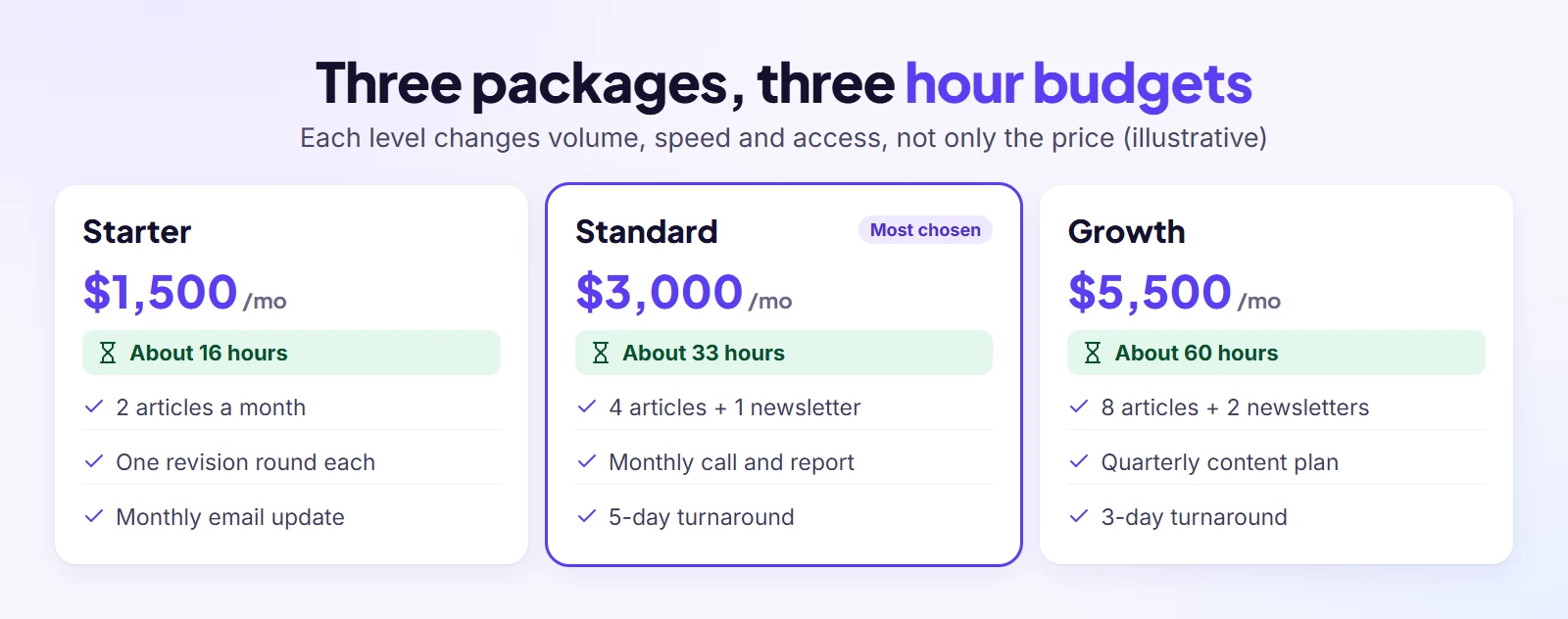
The difference between levels should be something the buyer can feel, not only a bigger number. Volume is the obvious one: two articles, four articles, eight. Speed is another: a five-day turnaround against two days. Access matters too, such as a monthly call versus a weekly one. In hour terms, each level is a bigger hour budget, with deliverables chosen to fit it. The three packages below are illustrative.
| Package | Includes | Hour budget | Price a month |
| Starter | 2 articles, one revision round each, monthly email update | about 16 h | $1,500 |
| Standard | 4 articles, 1 newsletter, monthly call and report | about 33 h | $3,000 |
| Growth | 8 articles, 2 newsletters, quarterly content plan, 3-day turnaround | about 60 h | $5,500 |
Entry offers that lead to the main package
A small one-time package is often the easiest way into a monthly plan. An audit, a content plan or a single landing page lets a new client see how you work at low risk, and a good result makes the monthly package an easy next step. Price the entry offer properly with the same cost method. It can be smaller, but it should not lose money; a loss-making first purchase attracts buyers who only want the cheap thing.
Showing packages next to custom work
Many agencies sell both fixed packages and custom projects. Keep them visibly separate: packages with prices in one place, and custom work described with “starting from” figures or a request for a proposal in another. Buyers who want a quick start pick a package; buyers with bigger needs ask for a call. Mixing the two on one list confuses both groups.
What Limits Must Every Package Spell Out?
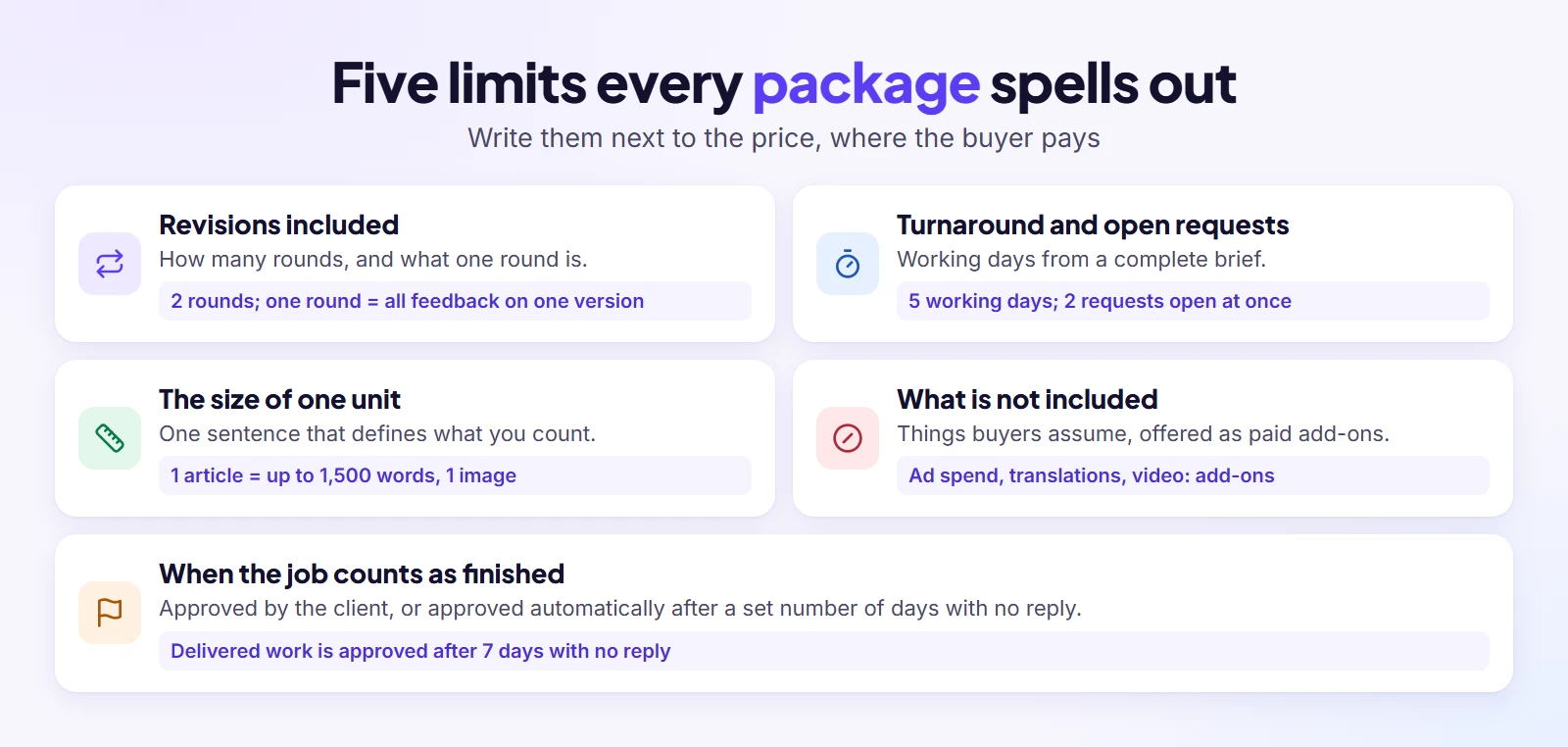
“Four posts a month” sounds clear until the client asks whether a carousel counts as one post or five. A price without written limits is a promise you cannot keep, and these five limits protect the hour budget behind every package.
Revisions included, and what counts as one
Say how many rounds of changes are included, and say what one round is: all the client’s feedback on one version, sent at once. Without that definition, a client can send five small notes on five days and call it one round. Extra rounds are fine, but they are paid. Two rounds is a common choice, and it is usually enough when the first version is good.
Turnaround and requests in progress at once
State the delivery time in working days, and when the clock starts: usually when the brief is complete, not when the order is paid. For monthly packages, also say how many requests can be in progress at once. One or two at a time keeps your team’s week predictable and stops a client from dropping a whole quarter’s work on one Monday.
Define the unit
Every package counts something: articles, posts, pages, videos. Write one sentence that defines that unit. “One article = up to 1,500 words, one featured image, one internal review” leaves no room for a 4,000-word guide counted as one article. For social media, “one post = one image and caption in one size” does the same job. The definition takes a minute to write and saves an argument every month.
What’s not included
List the things buyers commonly assume are included but are not: ad spend, stock photos beyond a set number, translations, video editing, extra platforms. A short “not included” list is more useful than a long “included” list, because it answers the questions that cause disputes. Point each excluded item to a paid add-on where you can, so the answer is “yes, for $X” rather than “no”.
When the job counts as finished
Decide when a delivery is complete: when the client approves it, or after a set number of days with no reply. Without this rule, a delivery can stay open for weeks while the client “has a look”, and the next month’s work piles on top. A quiet approval after a set number of days protects your schedule without rushing a client who is actively reviewing.
How Do You Price Add-Ons, Rush Work and Extras?
The client who loves your package will ask for “just one more” sooner or later. That is good news when the extra has a price, worked out with the same method as the base, so it adds margin instead of eating it.
Add-ons that keep the base package simple
Good add-ons are things some buyers want and others do not: an extra article, a landing page, a translated version, an extra platform. Price each one as hours × loaded cost ÷ (1 − margin), then round up. Offering them at checkout keeps the base package small and easy to compare, while buyers who need more can build what they need without a custom quote.
Rush fees
Faster delivery is worth paying for, and buyers know it. Price a rush by what it costs you: overtime, or other clients’ work moving back a few days. A flat percentage picked from thin air either undercharges for real disruption or scares off buyers for a small favour. If a rush means a weekend, price the weekend; if it only means reordering the week, the fee can be modest.
Extra revisions and out-of-scope requests
When a client asks for more than the package includes, a paid option is kinder than a flat no. Offer an extra revision round at a set price, or quote the extra piece of work as an add-on. If the extra requests come every month, the client has outgrown the package, and the right step is a conversation about the next level up.
Setup fees
A setup fee on the first invoice covers the one-time work at the start of a monthly package: onboarding, access, a first audit, templates. It also filters out buyers who plan to try one month and leave. Some agencies skip it to lower the barrier and recover the cost over a minimum term instead. Either works, as long as the first month’s onboarding hours are paid for somewhere.
When Should You Discount, and What Payment Terms Protect the Price?
Sooner or later a buyer asks, “Can you do a bit better on the price?” A discount is fine when it has a reason and an end date; without both, it becomes the real price and the published one stops meaning anything.
Launch and test offers with an end date
A new package is a fair reason for a lower opening price, as long as buyers know when it ends. Run it for a set number of buyers or a set number of weeks, then move to the full price as promised. Using a coupon code with an expiry date, rather than lowering the listed price, keeps the published price stable and makes the offer easy to switch off.
Discounts for paying ahead or committing longer
Paying a quarter or a year in advance gives you cash and certainty, and a modest discount for that is a fair trade. The same goes for a longer minimum term. Keep the terms simple: one discount for paying ahead, written down, with no extra side deals.
Discounts that cost more than they earn
Every special price is something your team has to remember. One client on 10% off, another on a grandfathered rate, a third with a free extra article: within a year, nobody knows who pays what. Limit discounts to a few named reasons, give each a limit and an end date, and say no to the rest.
Get paid before the work starts
Productized services are usually paid upfront: the first month before work begins, then each month before that month’s work. For larger one-time packages, a deposit with the balance on delivery works well. Upfront payment also makes cancelling simple: a client who stops paying the next invoice has stopped the service, without awkward emails.
How Do You Test a New Price Before You Commit to It?
Your first price is a guess, even after all the maths above, and that is fine. What matters is checking it on real buyers before you put it everywhere, and planning that check before you publish.
Test with a few real buyers first
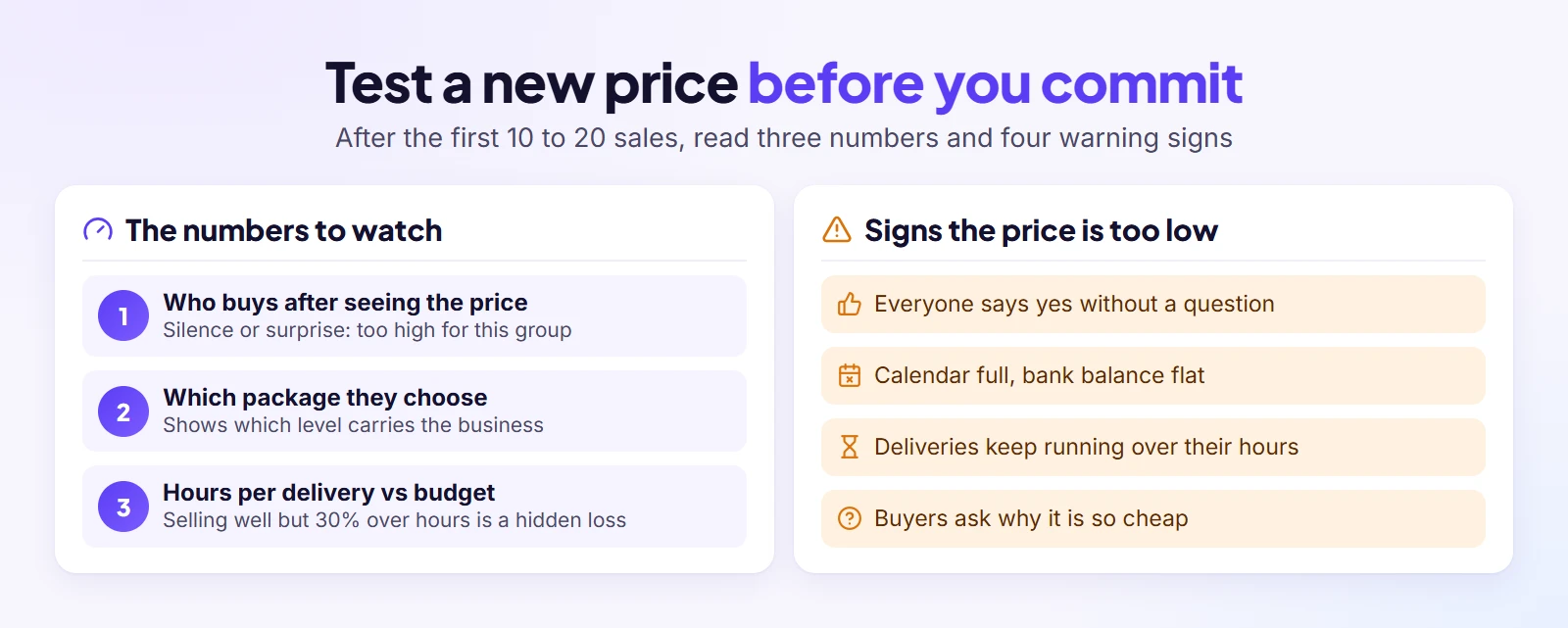
Offer the package to a small group of past clients or warm contacts, at the real price, and watch the reaction. Surprise or silence suggests the price is too high for that group; an instant yes from everyone suggests it is too low. A simple page describing the package, shared with a few people you trust, gives you this reaction before you build anything else.
The numbers to watch
After the first ten to twenty sales, look at three things: how many people who see the price go on to buy, which package they choose, and how many hours each delivery took against its budget. The last one matters as much as sales. A package that sells well and runs 30% over its hours is a loss you have not noticed yet.
Signs the price is too low
Everyone says yes without asking a question. Your calendar is full, but the bank balance does not move. Deliveries regularly run over their hour budget. Buyers ask whether something is wrong because the price looks cheap next to similar offers. Any one of these is a reason to test a higher price on the next few buyers.
How and When Should You Raise Prices for Existing Clients?
“Increasing prices is always scary,” one founder wrote in a thread about selling services on subscription. Yet it is one of the most direct ways to grow revenue without more clients, and it goes well when the new price comes with notice, a reason and work that already justifies it.
New price for new buyers first
The easiest increase is the one existing clients never feel: put the new price on the page for new buyers, and let current clients stay at their rate for a while. Once the new price has sold a few times, you know it holds, and the conversation with existing clients is easier because the price is already public.
Notice, timing and how much
Give existing clients clear notice in writing, with the date and the new amount; the agency owner in the case below gave 60 days. Large jumps can be split into two smaller steps a few months apart. Expect some clients to leave; one agency owner on Reddit described a 30% increase that lost about a fifth of clients and still grew yearly revenue, which suggests the old rate was too low.
Grandfathering or a yearly increase in the agreement
Some agencies keep long-standing clients on their old rate as a thank-you. Others write a small yearly increase into the agreement from day one, so no single rise feels like a surprise. The second is easier to manage, because it turns a hard conversation into a clause both sides already signed. If you use a written agreement, an agency retainer agreement template is a good place to add that clause.
Earn the increase first
A price rise lands well when the client already sees the value: results reported clearly, deadlines met, problems fixed before they had to ask. If quality has slipped, fix that first. Asking for more money while the work is getting worse invites a client to start comparing you with others.
Putting Your Prices Live in Your Client Portal
You have done the maths, set the tiers and written the limits. Now buyers need to see the price, pick a package and pay without a week of emails, and the tool you sell from either keeps those limits in place or quietly lets them slip.
Clientish is an all-in-one client management portal for agencies, freelancers, consultants and service-based businesses: leads, proposals, a branded client portal, orders, invoices and subscriptions, support tickets and live chat in one place. When you sell productized services from it, the pricing decisions in this guide become settings on each service:
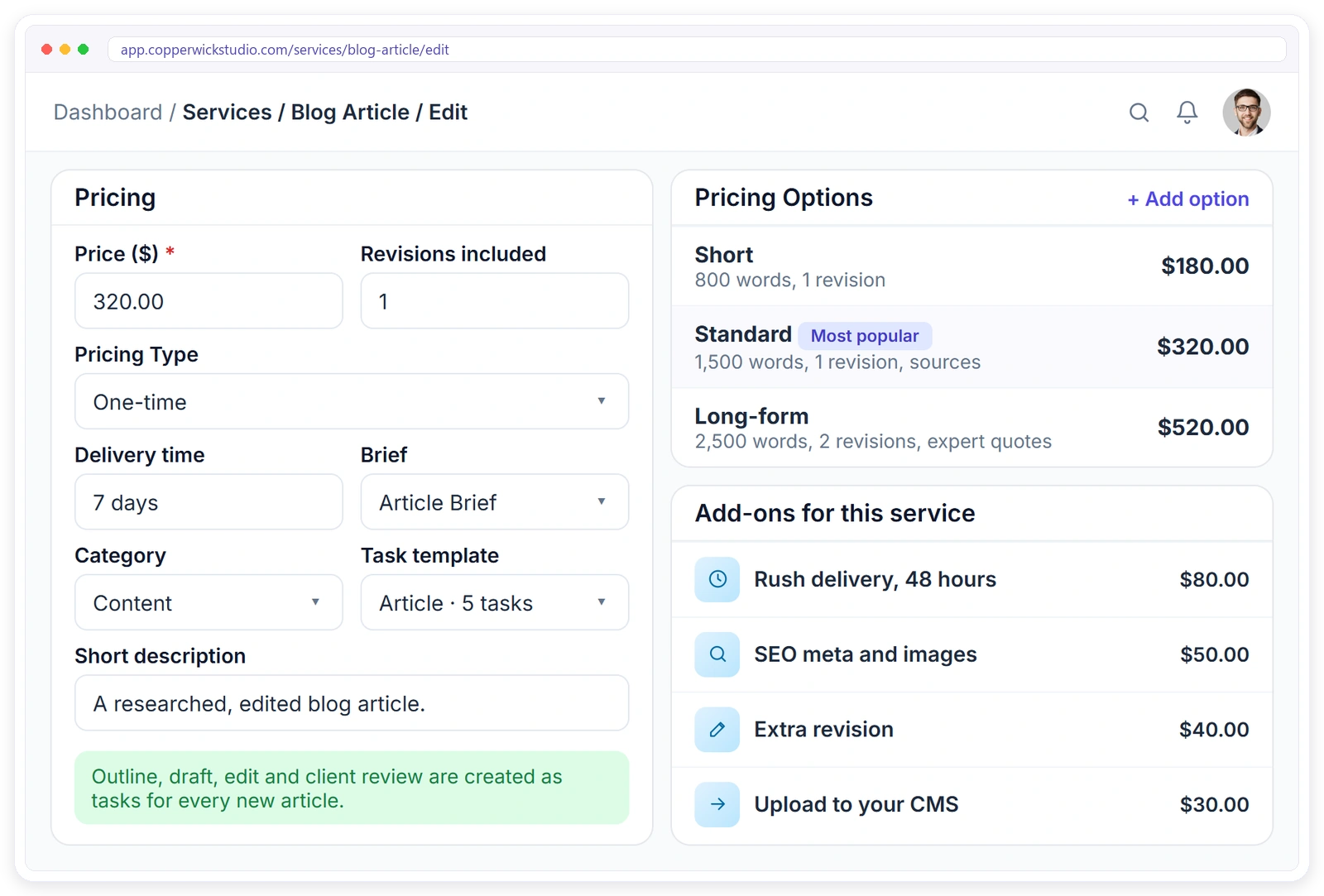
- Packages and extras: give a service packages such as Basic, Standard and Premium, each with its own price and description, and attach paid add-ons clients pick on the order form. A setup fee can go on the first invoice.
- Limits in the setup: set the revisions included per service and a delivery time in days or hours, so every new order gets its due date. Delivered orders are approved automatically after 7 days by default, and you can choose anywhere from 1 to 60.
- The steps on every order: a service can carry a task list of up to 30 tasks, each with a due day and an owner, so the steps you priced are the steps your team follows.
- Monthly billing: make a service recurring, billed every week, month or year. Each cycle reopens the same subscription invoice, and clients can switch on auto-pay with a saved card through Stripe or pay each renewal invoice themselves; recurring billing and subscriptions covers the details.
- Offers with an end date: coupons can be a percentage or a fixed amount, set per service, with an expiry date, a use limit, a minimum order or once per client.
For buyers who still want a call, a proposal can offer packages to choose from, take a deposit and create the client, invoice and order when it is accepted. The Services report shows revenue by service for any date range, which tells you which package to push and which to rethink. Clientish starts at $9.99 a month, with no fee per service or order; try it free for 14 days and build your first package, limits included.
Frequently Asked Questions
These are the questions agency owners, freelancers and consultants ask once the first package is live and real buyers start pushing on it.
Should you publish your prices on your website?
For productized services, yes in most cases. A visible price saves both sides a sales call that was never going to work, and it brings in buyers who already accept the number. Keep custom work separate with “starting from” figures. Publishing works best when the limits sit right next to the price.
Is “unlimited requests for one monthly fee” a sustainable model?
Only with firm limits behind the word. Successful unlimited plans restrict how many requests are open at once, how fast each is delivered and which types of request count. Without those rules, one busy client can use more hours than the fee pays for, and the margin on the whole plan disappears.
What is the difference between a productized service and a retainer?
A retainer usually buys access to your time or team for a month, with the work agreed as it comes. A productized service sells a defined result, such as four articles a month, at a fixed price with written limits. Retainers flex more; productized services are easier to sell, deliver and scale.
Do you still need sales calls if your prices are fixed?
Often, especially above a few hundred dollars. The difference is the length and purpose of the call: instead of building a scope and price from nothing, you confirm the buyer fits the package and answer a few questions. Many buyers of smaller packages will buy without any call at all.
How do you handle a client who keeps asking for more than the package includes?
Treat the first request as a chance to explain the limit kindly and offer the extra as a paid add-on. If the requests keep coming, the client has outgrown the package. Show them their package and the next one up side by side, so the upgrade becomes a simple choice rather than an argument.
How do you price a productized service for clients in other countries?
Start from the same cost floor, because your costs do not change with the buyer’s country. Then decide whether to keep one global price or set regional packages for very different markets. Invoicing in the buyer’s currency makes the price easier for them to read, as long as the converted price still clears your minimum.
Should a productized service price end in 7 or 9?
It matters far less than the scope and limits. Some sellers end prices in 7, such as $1,497, and others use round numbers such as $1,500. Pick one style, use it across all packages, and spend your energy on the hour budget instead.
How often should you review your prices?
Look at sales and hours every month, and review the prices themselves once or twice a year. A review does not mean a rise every time; it means checking that costs, hours and demand still support the current number. Change one package at a time so you can see what each change does.
Can you sell productized services to clients who also buy custom work?
Yes, and many agencies do. A package can be the starting point for a client who later needs a custom project, and a custom client can add a package for repeat work. Keep the two clearly separate in your offers and invoices, so the package price is never quietly bent for custom clients.
What should you do if nobody buys at your new price?
First check that enough people saw it; ten views is not a test. Then ask the few who said no what stopped them: the price, the scope or the timing. If price is the reason, adjust the scope before cutting the number, because a smaller package at a fair price beats the same package sold at a loss.
Final Thoughts
Pick the service you sell most often and work out two numbers this week: your loaded hourly cost and the hours one delivery takes. Those two alone will tell you whether your current price is safe, and they take an afternoon with your last few invoices and your calendar.
Then write down the limits under that price before you change the price itself. If you want each step of a delivery written down for the team as well, my guide on how to create agency SOPs shows how, and onboarding clients without email covers the first week after a buyer pays. To put your packages, limits and payments in one branded portal, Signup & Try Demo.
Sources
Clientish publishes this guide. It reflects the author’s 15 years of client work at Giant Marketers and experience building client management software for agencies, plus common practice described in pricing guides, agency forum discussions on Reddit and Google’s “People also ask” answers reviewed as of October 2026. The 1,600 billable hours comes from one freelancer in a Reddit pricing discussion; the 1,200 hours in the cost example is an illustrative round number. The 5 C’s and seven pricing strategies follow common marketing course versions, which differ by source. All costs, hours and package prices for Giant Marketers in this guide are illustrative round numbers, not real rates, and Copperwick Studio in the product screenshot is a fictional demo agency. The Clientish section describes the product as documented on clientish.co in October 2026.

