

Offering white label services is a simple arrangement: your agency sells a service under its own name, and a partner does the work behind you. To do it well, pick a service clients already ask for, test a partner on one paid job, sign a contract covering poaching, deadlines and account ownership, price it to cover your own hours, and check every file before the client sees it.
In fifteen years of client work at Giant Marketers, I have learned that clients judge an agency by what arrives in their inbox, not by who made it. That cuts both ways with white label work. A good partner lets a small agency sell SEO, ads or development it could never staff on its own. A weak one puts your name on a late report with someone else’s logo in the footer. This guide covers the decisions that separate the two: when to white label, what to charge, what to sign and how to keep quality in your hands.
Key takeaways
- White label only services you can judge, even if you cannot deliver them yourself.
- A 50% markup is a 33% margin, and your own hours come out of that margin.
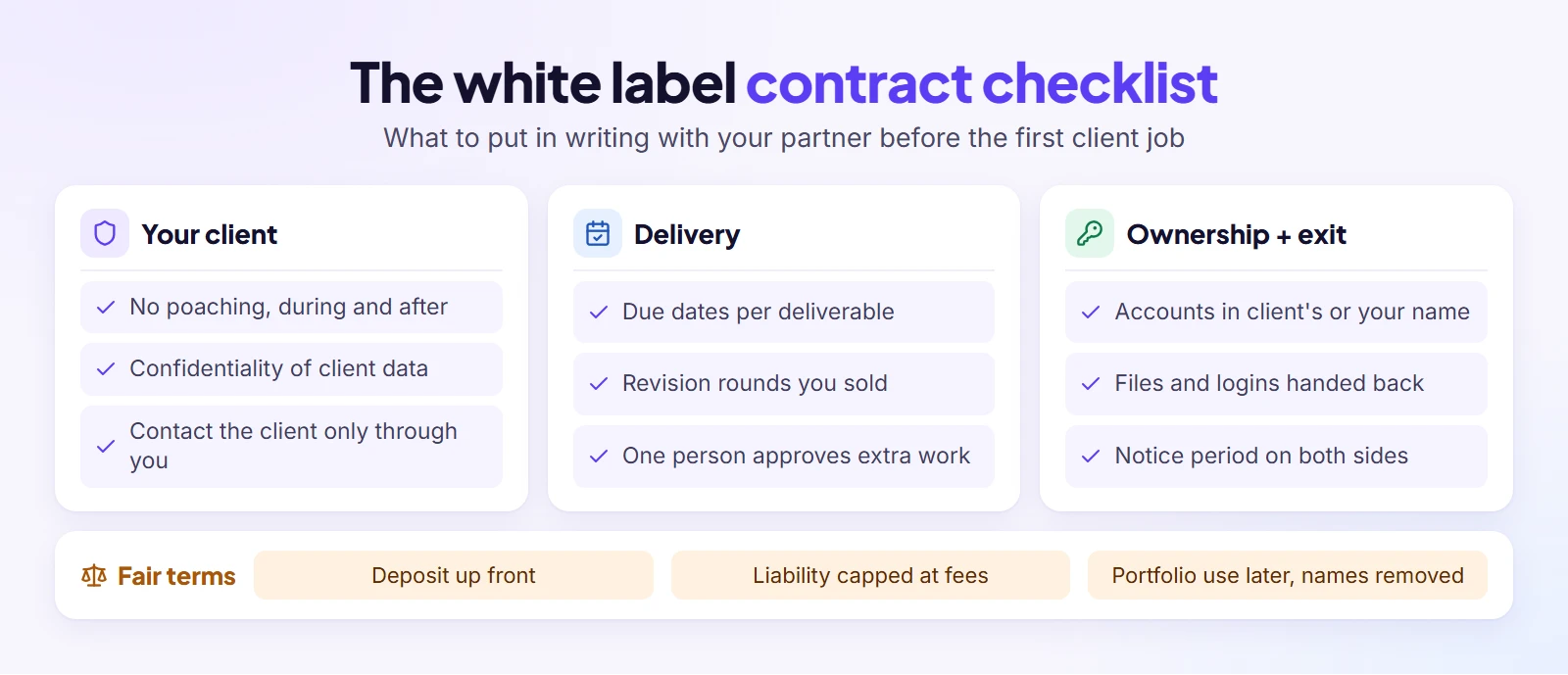
- Put no-poaching, deadlines, revision rounds, account ownership and an exit plan in the partner contract.
- Every deliverable passes an agency review before the client sees it.
- Give the partner an earlier due date than the client, so a missed deadline does not become your missed deadline.
What Are White Label Services for Agencies?
A client asks your web design studio, “Can you also do our SEO?” You say yes, the client pays you, and a specialist partner does the work under your name. That is white labeling: you sell, manage and stand behind the service, and the partner delivers it for you, not for the client.
A simple example
Say your agency builds websites and three clients a month ask about SEO. Instead of hiring an SEO specialist, you agree a wholesale price with an SEO partner, add your margin, and sell a monthly SEO package under your brand. The client signs with you, gets reports in your design and talks to your account manager. The partner sees the brief, does the work and reports to you. Your client relationship stays with you, and the partner never becomes a second supplier the client has to manage.
What is a white label agency?
A white label agency is the partner side of the arrangement: a company that delivers services for other agencies to resell. Some only work this way; others mix white label work with their own clients. You will also hear “SEO reselling” or “private label SEO”, which mean the same thing for one service. If you want to be the partner rather than the reseller, the contract and quality sections below still apply; you are simply reading them from the other chair.
White label vs referral vs subcontracting
In a referral, you introduce the client to another company, the client pays them directly, and you may get a fee. In white labeling, the client knows only you, pays only you, and you pay the partner. Subcontracting is the same money flow as white labeling, but usually open: the client knows a specialist is involved. The deal shapes differ in who owns the relationship, and that decides how much control and how much risk you carry.
Should Your Agency White Label at All? When It Works and When It Doesn’t
“When you’re an agency, your fulfillment is your product,” as one agency owner put it on Reddit. That line is the whole test: white label work is fine only when you can stand behind the result as if your own team made it.
Good reasons to white label
The best reason is demand you already have: clients asking for a service you do not offer, who will otherwise take that work, and possibly the rest of their budget, to another agency. A second good reason is a spike you cannot hire for in time, such as a run of website builds in one quarter. A third is testing a new service before you commit to a hire. In each case, the service sits next to your core work and makes the client relationship stronger.
When not to white label
Do not white label your core service; if clients hire you for strategy or design, that work has to be yours. Be careful with work you cannot review: if nobody in the agency can tell good SEO from bad, you cannot check the partner either. Fast-revision creative such as video can spiral, because every change goes through two companies. And avoid accounts whose budget cannot produce results; no partner can make a tiny ad budget work for an expensive market.
Run it as a bridge, not forever
White labeling works well as a bridge. When a service grows to steady monthly volume and the partner bill starts to look like a salary, compare the two. Bringing the service in-house gives you more margin and control; staying with a partner keeps you flexible. Decide on numbers you track, not on habit, and review the choice once or twice a year.
Is White Labeling Legal, and Do You Have to Tell Clients?
“Is white labeling illegal?” is one of the first questions people search, and in general the answer is no: reselling work under your brand is not illegal in itself. It is a normal business arrangement; the trouble starts with what you claim, not with the arrangement itself.
Where white labeling goes wrong
The risk sits in misrepresentation and contracts. Showing a partner’s portfolio as your own, inventing team members, or claiming certifications you do not hold can mislead clients. Breaking your client contract, for example one that bans subcontracting or limits who handles their data, is another problem. Regulated work, such as legal, medical or financial content, may carry its own rules. This is not legal advice: read your client contracts and check local rules before you resell anything sensitive.
Three disclosure stances agencies take
Some agencies are fully open: “We work with a specialist SEO partner, and we manage and check everything.” One reseller on Reddit is open about the partner and says “nobody seems to mind”. Others stay quiet but answer truthfully if asked. A third group hides the partner completely. The open approach costs nothing when the work is good. The hidden approach works until a client finds out, and some clients feel misled when they do; one wrote that they would be “furious” to learn an agency they hired was outsourcing without telling them.
What to say when a client asks “Do you outsource?”
Tell the truth, briefly, and put the weight on what you control: “For SEO we work with a specialist team we have tested and trust. We set the strategy, check every deliverable and stay your single point of contact.” Clients rarely mind who types the work; they mind being misled and being passed around. If your hours reports list who did each entry, decide your stance before the first report goes out.
Which Services Do Agencies White Label Most?
Picture a client’s yearly marketing plan: SEO, ads, content, a website refresh, social media. Those five are the services agencies white label most, because each one has clear deliverables and a report you can check before it reaches the client.
White label SEO for agencies
SEO is one of the most common white label services: local SEO, technical audits, content optimisation and link building. Ask for a monthly report you can brand, with rankings, traffic and the work done that month. Ask how links are built, and refuse anything that breaks search engine guidelines. One complaint resellers share on Reddit is a strong first month followed by thin reports, so judge the partner on month three, not month one.
White label paid ads
Google and Meta ads are easy to resell and easy to get wrong. Agree up front who approves budget changes and who supplies creatives and landing pages, and keep the ad account in the client’s or your agency’s name. Ads partners need clear inputs on time; when the agency’s own client handling is messy, the partner ends up blamed for delays they did not cause.
White label content and social media
Content writing and social media management work well as white label services when the brand voice is written down. Give the partner a short voice brief, examples of approved posts and the approval flow: who reviews, how many rounds, and how long the client has to reply. Without that, every post becomes a new negotiation.
White label web design and development
Website builds, landing pages and maintenance plans suit white labeling because the scope can be fixed: number of pages, features, rounds of changes and a launch date. Keep design direction and client meetings in-house if they are your strength, and hand the build to the partner. For maintenance, agree the monthly hours and what counts as an emergency.
How Much Should You Charge for White Label Services?
“How much to charge for white labeling?” sounds like a markup question, and that framing is where the trouble starts. The price has to cover the partner, your own hours and a profit, in that order.
Markup vs margin, with a worked example
Agency owners on Reddit report adding 30% to 50% on top of the partner’s price. A markup is not a margin, though. If the partner charges $1,000 and you add 50%, the client pays $1,500; your $500 is 33% of the sale, not 50%. Then your own time comes out of it: briefing, reviewing, client calls and revisions. The example below uses round numbers.
| Line | Amount |
| Partner’s monthly price | $1,000 |
| Your 50% markup | + $500 |
| Client pays | $1,500 |
| Gross margin | $500 (33%) |
| Your hours: 5 × $55 loaded cost | − $275 |
| What is left | $225 (15% of the sale) |
Fifteen percent may be fine for a service that keeps a client with you; it is thin if refunds or extra revisions hit. Work out your own loaded hourly cost first; our guide on how to price a productized service shows the method.
Wholesale price, revenue split or referral fee?
A wholesale price, where the partner charges you a fixed amount and you set the client price, gives you the most control and the clearest margin. A revenue split ties the partner’s pay to what you charge; it can work early on, but a 50/50 split is generous when the partner does all the delivery and you still carry the client. A referral fee is the lightest option: little money and no control. One agency owner on Reddit summed it up as “wholesale pricing beats revenue splits”.
Is white labeling profitable?
It can be, when the service repeats every month and you track your own hours against it. It stops being profitable when your review time grows, when the partner needs heavy correction, or when price pressure pushes your markup down. One advisor on Reddit described clients who white-labelled and “barely broke even” once they did the maths. Do the maths before the first sale, not after the tenth.
Costs people forget
Extra revision rounds you promised the client but the partner charges for. The partner’s tool or reporting fees. Refunds or free months when the partner misses a deadline. Payment gateway fees on the client’s invoice. Extra support, because a resold service still generates questions, and those come to you. Add each one to the price before you publish it.
How to Choose a White Label Partner (and Test Them First)
Every partner looks good on a sales call. The ones worth keeping are the ones whose third report is as good as their first, so choose on proof and test on one real client before you sell the service widely.
Questions to ask before you sign
- Who does the work: Ask for named people and their experience, not a team page.
- Reporting and frequency: Ask for a sample report you could brand as your own.
- Reply times: Agree response times for normal questions and for urgent ones.
- What they will not do: For SEO, ask how links are built; for ads, who touches the budget.
- Other agencies they serve: Ask for references from other agencies, and call them.
Run a paid pilot on one client
Before you add the service to your price list, run one paid job with one client for one full cycle: a month of SEO or ads, or one website build. Judge three things: did they meet every deadline, was the report clear enough to send without rewriting, and how did they handle a revision request? A pilot costs a little margin and saves you from selling a service you cannot deliver.
Red flags
A strong first month followed by silence; one reseller described a partner who was “good during Month 1 and onboarding but then I get crickets”. Reports full of activity but no results. A partner whose only selling point is price. A partner who asks to talk to your client directly in the first week. Any one of these is a reason to slow down; two are a reason to walk away.
What to Put in the Contract With Your White Label Partner
One provider on Reddit described an agency that “took all the white label clients from me over night”, and resellers on the other side put no-poach terms in their contracts for the same reason. A written contract is what keeps both of you from that story.
Clauses that protect your client relationship
Start with a no-poach clause: the partner may not approach, pitch or take on your clients directly, during the contract and for a set period after it. Add confidentiality, so client data and results stay private. State that the partner contacts the client only through you, or only under your agency’s name when you allow it. These three clauses are the reason white labeling can be safe at all.
Clauses that protect delivery
Write delivery dates for each deliverable, the number of revision rounds included (matching what you sold the client), response times, and who on your side may approve extra work. That last one matters: when only one named person can approve extra scope in writing, surprise invoices stop. Also say that delays caused by missing client input count as the client’s, not the partner’s.
Ownership and exit
Every account the work depends on, from the ad account and Analytics to the website login and Search Console, should be owned by the client or your agency, with the partner added as a user. The contract should say the partner hands back files, logins and work in progress within a set number of days when the arrangement ends, and how much notice each side gives. Without this, switching partners means rebuilding the client’s accounts.
Terms a good partner will push back on
Good partners reject unfair terms, and you want good partners. Paying them only after your client pays you shifts your risk onto them. Unlimited liability for any problem is not workable for a small partner. A permanent ban on mentioning the work anywhere may cost you the best partners. Fair terms, such as a deposit, liability capped at the fees for that work and portfolio use after a set period with client names removed, keep the partnership healthy.
The client side needs its own agreement too; an agency retainer agreement template covers scope, payment and notice with your client.
Who Talks to the Client: You or the Partner?
“Who negotiates with the client and everything?” is a question resellers ask once the first deal is signed. The answer shapes your workload, so decide it before the kickoff call.
Model 1: you are the only contact
The partner talks only to you; you talk to the client. You get the most control and the most work: every question passes through you, and every answer goes back the same way. This model suits the start of a partnership, high-value clients and any client who would be upset to learn someone else is involved.
Model 2: partner people work under your brand
Partner staff join calls as part of your team, use an email address on your domain, and log in to your tools under your agency’s name. You still own the relationship, but the specialist answers technical questions directly. It saves time and works well once you trust the partner, as long as everyone uses your brand consistently and you see every message.
Set an escalation path
Agree who answers when the client is unhappy (always your agency), how fast you promise to reply to the client, and how fast the partner must reply to you; the second number has to be shorter. Write it down for the partner and your own team. When something goes wrong, the client should hear from you first, before they hear anything from the partner.
How to Keep Your Partner’s Name Off Everything the Client Sees
One small-business owner on Reddit noticed another company’s website name showing up in his SEO reports, and guessed that his agency was reselling someone else’s service. Leaks like that rarely come from a big mistake; they come from a footer, a file name or an email sender nobody checked.
The leak points
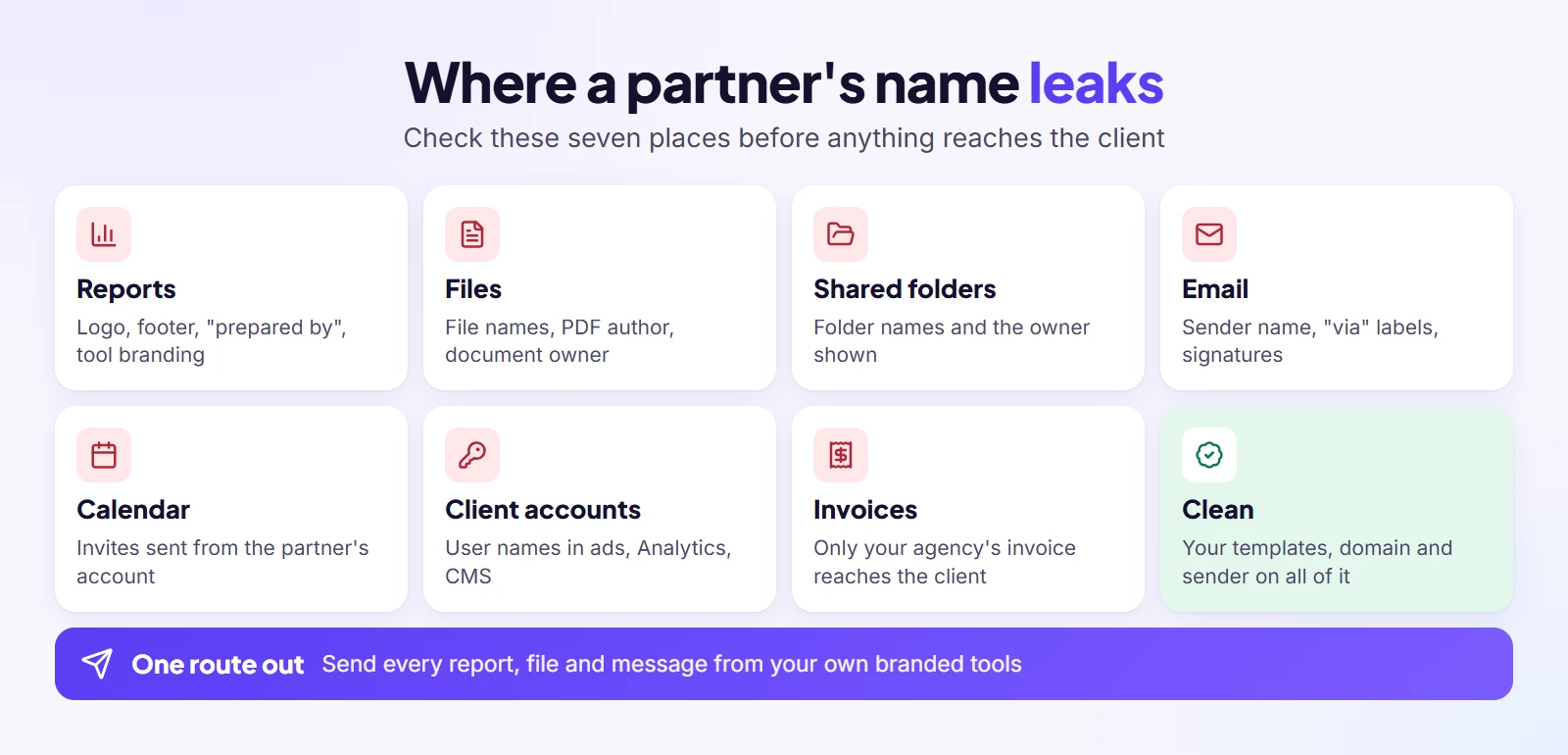
Check every place the partner’s name can appear before anything reaches the client:
| Leak point | What to check |
| Reports | Logo, footer, “prepared by” line, report tool branding |
| Files | File names, PDF author field, document owner name |
| Shared folders | Folder names and the owner shown on shared drives |
| Sender name, “via” labels, signatures, reply-to address | |
| Calendar | Invites sent from the partner’s account |
| Client accounts | User names in ad accounts, Analytics, Search Console, CMS |
| Invoices | Only your agency’s invoice ever reaches the client |
Accounts the client can see
Clients can see user lists in their ad accounts, Analytics, Search Console and website admin. Add partner people under neutral names or your agency’s email addresses, or give access through your agency’s own manager account where the platform allows it. Remove partner users when the work ends. Account ownership stays with the client or your agency, as the contract says.
Send everything through your own branded tools
The simplest fix is to make your own tools the only route to the client: your report template, your email domain, your file names, your client portal. When every delivery and message goes out from one place in your branding, there are far fewer corners for a partner’s name to hide in. A white label client portal does this for the whole client relationship: your logo, colours, domain and email sender on everything the client sees.
Quality Control Before Work Reaches the Client
“If you’re not auditing or understanding the strategy, you’re basically flying blind,” as one reseller put it. The rule that follows is simple: nothing the partner sends goes straight to the client.
A 10-minute review checklist
- Brief match: does the deliverable answer the brief the client signed off?
- Brand voice: does it sound like your agency and the client’s brand?
- Facts and links: are numbers, names and links correct?
- Clean files: no partner names in file names, metadata or footers.
- Report sense check: do the numbers match last month’s, and is any big change explained?
Write the checklist once as a short procedure your team follows every time; our guide on how to create agency SOPs shows how.
Revision rounds: promise what the partner owes you
If the partner includes two rounds of changes, sell the client two rounds, not three. Every round you promise beyond the partner’s terms comes out of your own hours or your margin. When a client needs more, sell the extra round as a paid add-on and agree the partner’s price for it in advance.
Client approval as the finish line
A delivery is finished when the client approves it in writing, or after a set number of days with no reply. That rule protects the partner’s schedule and yours. Without it, work stays “almost done” for weeks, and the next month’s tasks pile on top of the last.
What to Do When the Partner Misses a Deadline
Sooner or later a partner will be late, and the client will not care whose fault it is. Plan for that day before it comes, so a missed partner deadline does not turn into a missed client deadline.
Build a buffer
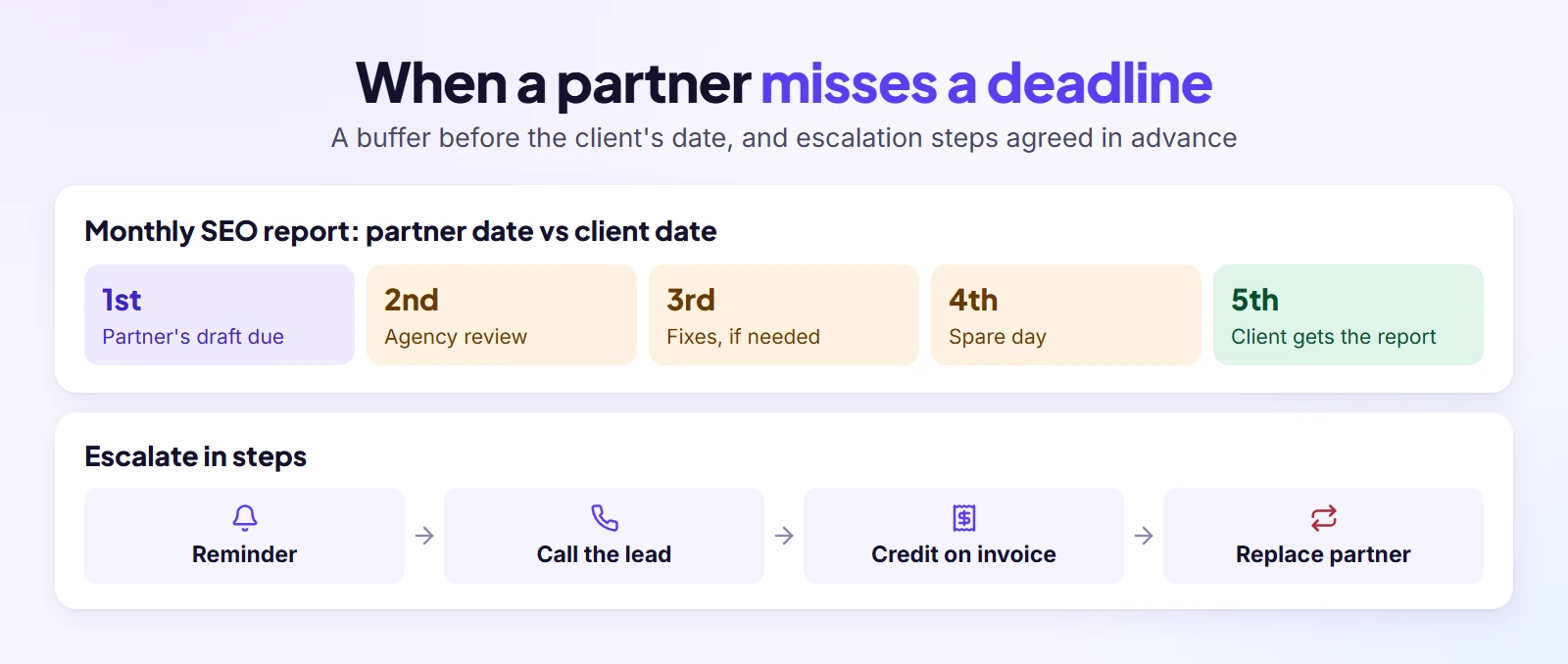
Give the partner a due date a few working days before the client’s. If the client expects the monthly report on the 5th, the partner’s draft is due on the 1st. The buffer gives you time to review, fix small problems and still deliver on time. It also tells you early when something is going wrong.
Escalate in steps
Agree the steps in the contract: a reminder, then a call with the partner’s lead, then a credit on that month’s invoice, and finally replacing the partner for that client. Steps written in advance turn an awkward argument into a process both sides already accepted.
What to tell the client
Tell the client early, own it as the agency, and give a new date with what you are doing to keep it. “The report is delayed; you will have it on Thursday, and we have added a check so it does not happen again” keeps trust. Blaming a partner the client has never heard of does not.
Switching partners without losing the client
Switching is only painless if the client’s accounts are in the client’s or your agency’s name, the files are in your storage, and the contract requires a handover. Keep a second partner in mind for each service you resell, even before you need one. Then a bad month with one partner is a problem you fix, not a crisis.
Running White Label Work Day to Day
You have a partner, a contract and a price. The last step is making the work run the same way every week, with the partner inside your process instead of in a separate inbox.
Package the service before you sell it
Turn the resold service into a package with a fixed scope, delivery time, revision rounds and price. Buyers understand it faster, the partner knows exactly what to deliver, and your margin is visible. If you sell productized services, the white label service becomes one more item in your catalogue.
An example setup in Clientish
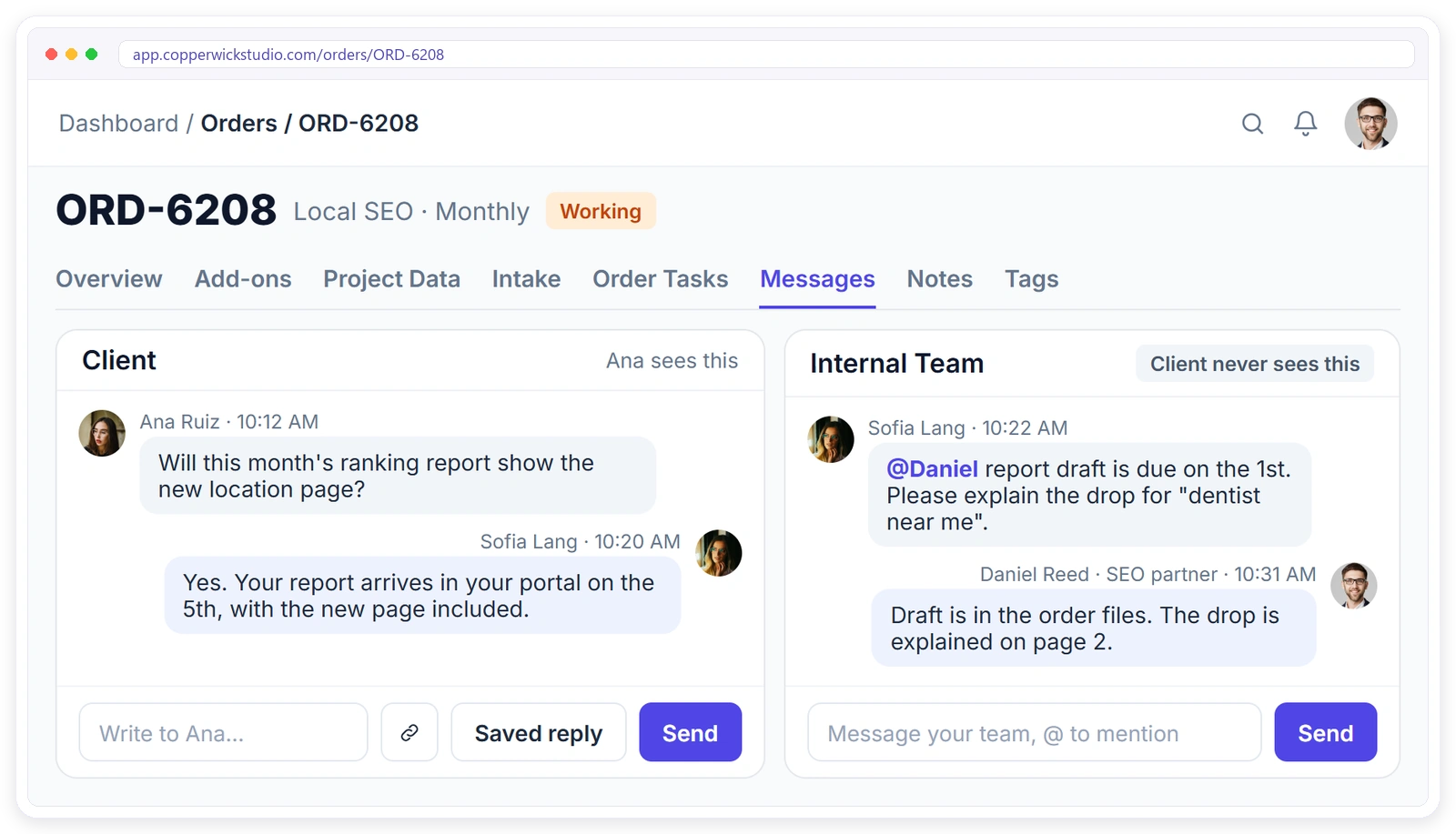
Clientish is an all-in-one client management portal for agencies, freelancers, consultants and service-based businesses: leads, proposals, a branded client portal, orders, invoices and subscriptions, support tickets and live chat in one place. Here is how Copperwick Studio, a fictional demo agency, runs a resold SEO service in it:
- The partner’s specialists as remote members: they sign in on the agency’s own address and branding, and their remote role decides what they can see. Remote members are available from the Growth plan.
- One SEO service: packages with their own prices, three revisions included and a delivery time that sets the due date of each order.
- Two threads per order: a client thread, and an internal team thread hidden from the client, where the agency briefs the partner and reviews drafts.
- Delivery and approval: the agency sends the checked delivery; the client approves it or asks for changes, and delivered orders are approved automatically after seven days by default.
- Hours, if billed hourly: remote members log time per client, and the client approves the hours report before it is invoiced. The report shows who did each entry, so this suits agencies that are open about their partners.
Emails go out from your own sender address and domain on every plan, so the client sees one agency from first message to last invoice. You can try it free for 14 days with one resold service and one partner.
Signs it is time to bring the service in-house
Steady monthly volume, a partner bill close to a salary, and a large share of your revenue depending on one partner are the three signs. If all three are true, price out a hire and compare. Keeping the partner for overflow work while your own specialist handles the core accounts is often the best of both.
Frequently Asked Questions
Here are the questions agency owners ask once their first white label service is live and the practical details start to matter.
Can I run an agency where all the work is white labeled?
You can, but then your real products are sales, account management and quality control, and your price has to pay for them. Agencies that do this well know each service deeply enough to judge it, keep every client account in their own or the client’s name, and have a second partner ready for each service.
Should the partner be allowed to show my clients’ work in their portfolio?
Decide it in the contract. A fair middle ground is portfolio use only after a set period, with client names and identifying details removed, and only with your written approval. A permanent ban is your right, but expect strong partners to push back or charge more for it.
Who should own the client’s ad account, Analytics and website logins?
The client or your agency, never the partner. Add the partner as a user with the access the work needs, and remove it when the work ends. Ownership in the wrong hands turns a partner change into a rebuild of the client’s accounts, and gives the partner leverage you do not want.
Do I pay the partner before or after my client pays me?
Ideally, collect from your client before the work starts, then pay the partner on the terms you agreed, often a deposit and the balance on delivery. Making the partner wait until your client pays shifts your risk onto them, and good partners will refuse or price that risk in.
What if my client wants to meet the person doing the work?
Bring the specialist to the call as part of your team, with your agency’s name on the invite and you leading the meeting. Brief the specialist beforehand on what you have promised the client. Many clients only want to know an expert is involved; they rarely ask which company employs them.
How long should a test project with a new partner run?
One full cycle of the service: a month for SEO, ads or social media, one complete build for a website. That is long enough to see a deadline, a report and a revision request. Short tests only show you the partner’s best behaviour, which is not what your clients will get in month four.
Can I white label a service for just one client?
Yes, and it is a good way to start. One client gives you a real pilot with real money and a real deadline, without promising the service to your whole client list. If it works for two or three months, package it and offer it to similar clients.
Is “private label” the same as “white label”?
For services, people use the terms the same way: a partner delivers the work and you sell it under your brand. “SEO reselling” is the same idea for one service. In physical products, private label sometimes means a product made only for one seller, but that difference rarely matters for agency work.
What happens to my clients if the partner shuts down or raises prices?
That depends on what you agreed. A notice period gives you time to move; a handover clause gets you the files and logins; client accounts in the right names make the move quick. A second partner you have already tested turns a forced switch into a short delay instead of a lost client.
Final Thoughts
Start small: pick the one service clients ask you for most and run a paid pilot with one partner on one client this month. Write the contract before the pilot, not after, and do the margin maths with your own hours in it.
If the pilot works, package the service and bring it into the same process as the rest of your work. To see how a branded portal, remote partners and client approvals fit together, Signup & Try Demo.
Sources
Clientish publishes this guide. It reflects the author’s 15 years of client work at Giant Marketers and experience building client management software for agencies, plus common practice described in white label guides, agency forum discussions on Reddit and Quora, and Google’s “People also ask” answers reviewed as of October 2026. Quotes are from agency owners, resellers and clients on Reddit; the 30% to 50% markup figure is what resellers report there, not a survey. The pricing example uses illustrative round numbers. This guide is not legal advice. Copperwick Studio in the product screenshot is a fictional demo agency, and the Clientish section describes the product as documented on clientish.co in October 2026.

