

HoneyBook is built around the solo service business: one link that holds a proposal, a contract and an invoice, paid by card without the client creating an account. Agencies hit its limits in a different place. A growing studio needs logins for staff, a place where clients come back month after month, repeat sales of the same packages, and somewhere to file the questions that arrive after delivery.
Quick answer: For agencies, the strongest HoneyBook alternative is Clientish: the entry plan covers five staff at $29, and clients sign in under your name to buy, pay, approve work and ask for help, and payments land in your own Stripe, PayPal, Paddle or SSLCommerz account. Dubsado and Bonsai suit freelancers who want HoneyBook’s booking-style flow with different pricing; SuiteDash and Agiled suit teams that want a broad suite; Wayfront, ManyRequests and Zendo suit productized agencies; Clinked, Moxo and Accelo serve specialised needs.
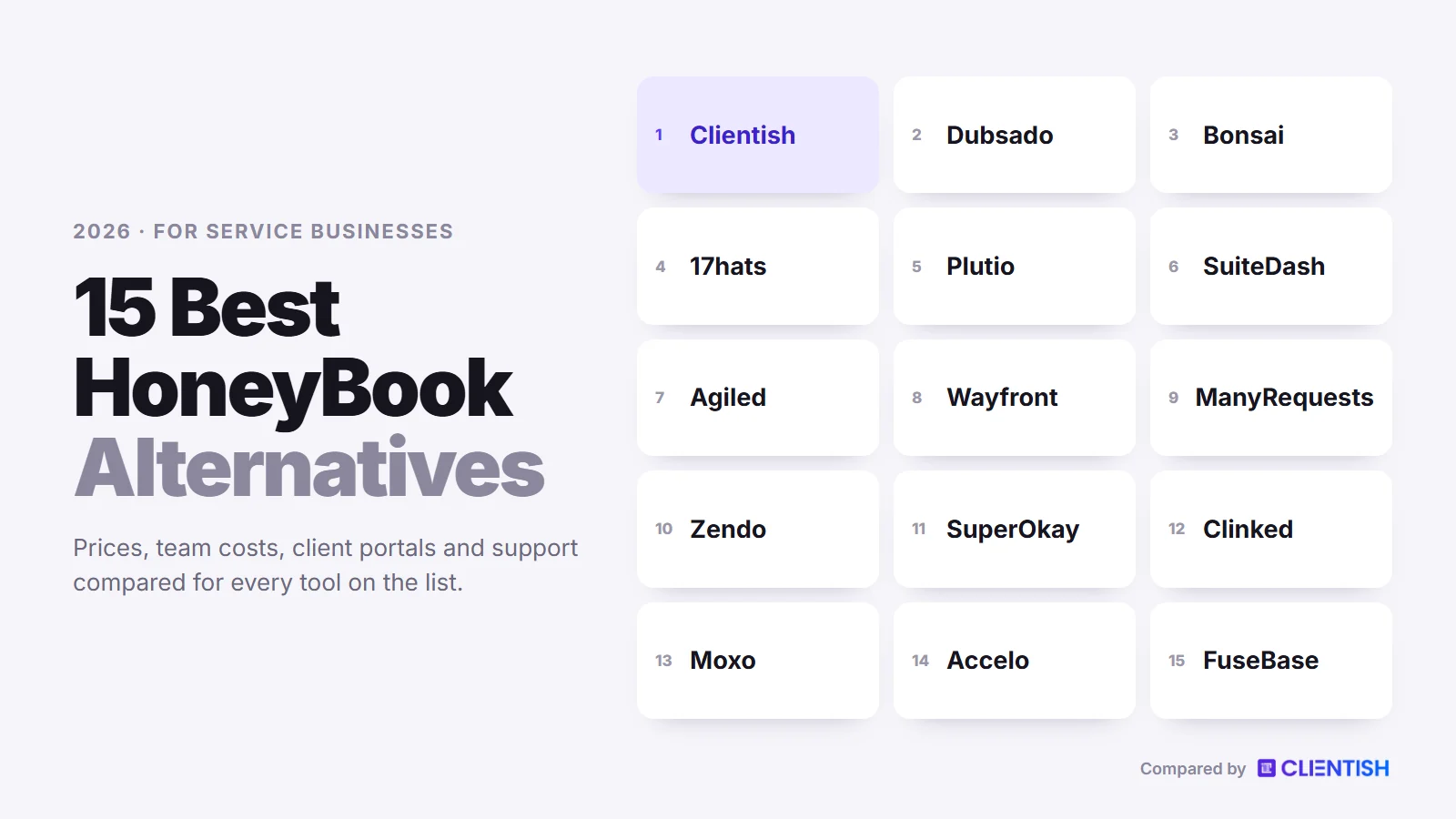
This guide explains why agencies move off HoneyBook, how we picked 15 tools, what each one costs as of early October 2026, where each beats or trails HoneyBook, and how to switch without losing active clients.
Key Takeaways
HoneyBook changed more in 2025 and 2026 than most lists show, so older “HoneyBook alternatives” pages often argue against a product that no longer exists. These are the points that matter now.
- The price rose in 2025. Its three yearly plans now cost $29, $49 and $109 a month, up from $16, $32 and $66 in December 2024.
- Seats are the agency problem. HoneyBook Starter has no team members, Essentials allows two, and anything bigger needs the $109 Premium plan. Clientish seats five to fifty people depending on the plan.
- HoneyBook is the only processor you can use, and only businesses in the US, Canada, the UK and Australia may sign up. Most alternatives here let you connect your own processor (SuperOkay, Clinked and FuseBase have no billing at all).
- HoneyBook has no ticket queue for client questions, and the time tracker it used to include went offline in September 2026. A ticket desk with response targets comes with every Clientish plan, and from Growth up clients approve remote members’ hours before anyone is billed.
- Pick by how you sell. Booking-led solo businesses fit Dubsado, Bonsai or 17hats; agencies selling repeat services to many clients fit Clientish.
Why Agencies Outgrow HoneyBook
HoneyBook’s original job is getting one owner from inquiry to signed contract to paid deposit. The friction appears when an agency adds people, retainers and clients who need ongoing help. These are the eight reasons we see most often, each checked against HoneyBook’s own pages or labelled as a review theme.
The 2025 Price Increase
Between December 2024 and March 2025, HoneyBook’s yearly plans moved from $16, $32 and $66 a month to $29, $49 and $109. Monthly billing now costs $36, $59 or $129. One Capterra reviewer’s yearly bill went from about $250 to $500, and a Trustpilot reviewer reports $200 to over $600.
Team Members Need the Top Plan
Starter allows no team members and Essentials allows two. A third colleague means Premium at $109 a month billed yearly, or $1,308 a year. Team members also can’t be added during the trial, so a team can’t test HoneyBook together before paying.
HoneyBook Processes the Payments Itself
You can’t connect your own Stripe or PayPal account; HoneyBook is the processor, at 2.9% + 25¢ for an online card payment. Because HoneyBook holds the merchant account, its terms let it keep a reserve against your balance, and payout holds come up in a share of its one-star reviews.
Four Countries Only
Since May 21, 2026, businesses in the UK and Australia can join alongside the US and Canada. An agency based anywhere else can’t sign up at all, even if its clients are American.
No Help Desk for Client Questions
Client conversation lives in project messages and, since August 2026, an optional business phone line with texting. There are no tickets, priorities, reply targets or client ratings, which is where agencies with many retainers feel the gap first.
Branding Stops at the Subdomain
Every HoneyBook plan can point a subdomain you own at the portal and smart files, and Essentials hides the “Powered by HoneyBook” credit. Emails show your address only when Gmail or Outlook is connected, and automatic messages such as payment reminders still arrive from HoneyBook.
Reporting Draws Complaints
HoneyBook offers basic, standard and advanced reports by plan, yet reporting is a recurring theme in reviews. One Capterra reviewer wrote that “reporting wasn’t great”, and a Trustpilot reviewer could not pull a report on outstanding balances.
Features Removed or Missing
HoneyBook’s Time Tracker was retired after September 7, 2026, leaving teams that bill by time to find another app. Accounting sync covers QuickBooks Online from Essentials up; Xero isn’t among its integrations, so Xero shops rely on Zapier.
How We Chose These Alternatives
Our shortlist began with the names that appear again and again beside HoneyBook in search results and buyer reviews, and each was then judged on an agency’s working month instead of one wedding or shoot. A tool made the list if it covers proposals, contracts or invoices and has some form of client access. For each one we checked, on its own pricing and help pages on October 4 and 5, 2026:
- Team cost: how many people are included and what extra seats cost.
- Payments: whether you can use your own processor, and in which countries.
- The client side: the client’s view after login, including how a client asks for help.
- Repeat work: how retainers and subscriptions are billed.
- Branding: your logo, your domain and your email sender.
Clientish publishes this guide, and we put it first because it is built for the agency use case this article is about. Every other tool is described from its own documentation, with the gaps that matter for an agency stated plainly.
HoneyBook Alternatives at a Glance
The table compares entry prices and the points that separate these tools for a team. Prices are the lowest paid plan, monthly and billed yearly, as listed on each vendor’s site on October 4 and 5, 2026.
| Tool | From (monthly / yearly) | Team included | Your own payment processor | Client tickets | Trial |
| Clientish | $29 / $23 | 5, 15, 30 or 50 people | Stripe, PayPal, Paddle, SSLCommerz, manual | Every plan | 14 days |
| HoneyBook | $36 / $29 | 0, 2 or unlimited | No, HoneyBook only | No | 30 days |
| Dubsado | $35 / $335 a year | Owner + 3 free users | Dubsado Payments, Square, PayPal | Not found | 21 days |
| Bonsai | $15 / $9 per user | Billed per user | Bonsai Payments, Stripe, PayPal | Not found | 7 days |
| 17hats | $60 / $600 a year | A few users; extra $5 each | Stripe or Square | Not found | 7 days |
| Plutio | $19 / ~$15 | Solo on Core; 30 on Pro | Stripe, PayPal, Square | No ticket module | 7 days |
| SuiteDash | $19 / $180 a year | Unlimited | Stripe, Braintree, PayPal, Authorize.Net | Top plan | 14 days |
| Agiled | $29 / $24 | 1, 3, 7 or 15 seats | Stripe Connect, PayPal, Mollie | Pro and up | 14 days |
| Wayfront | $129 / $99 | 5 seats; extra $20 | Stripe, PayPal, manual | Yes | 14 days |
| ManyRequests | $59 / $39 | 1 seat; extra $20 | Stripe, manual | Requests used as tickets | 14 days |
| Zendo | Free; then $29 / $25 | 1 user; extra $8+ | Stripe, bank transfer | Request types | 14 days |
| SuperOkay | Free; then $9 or $12 | 0, 3 or unlimited | None built in (pay link) | No | Free plan |
| Clinked | $11 per user | Per user, or 100+ members | None listed | No | 14 days |
| Moxo | $5,000 a year | Unlimited seats | Payment step in flows | Workflow requests | On request |
| Accelo | Quote only | By quote | Stripe, Authorize.net, PayPal | Yes | Demo |
| FuseBase | Free; then $32 or $39 | 1, 5 or 50 members | None built in | Not found | 14 days |
Bonsai’s per-user prices apply to each person on the team; the cheapest plan with invoicing, contracts and a client portal is Essentials at $25 a month, or $19 billed yearly.
What a Five- or Ten-Person Agency Pays
Entry prices hide the real difference, because most of these tools charge for people. The table shows the yearly cost of the cheapest plan that covers the whole team with a client portal (and invoicing, where the tool has it), using list prices on October 4 and 5, 2026.
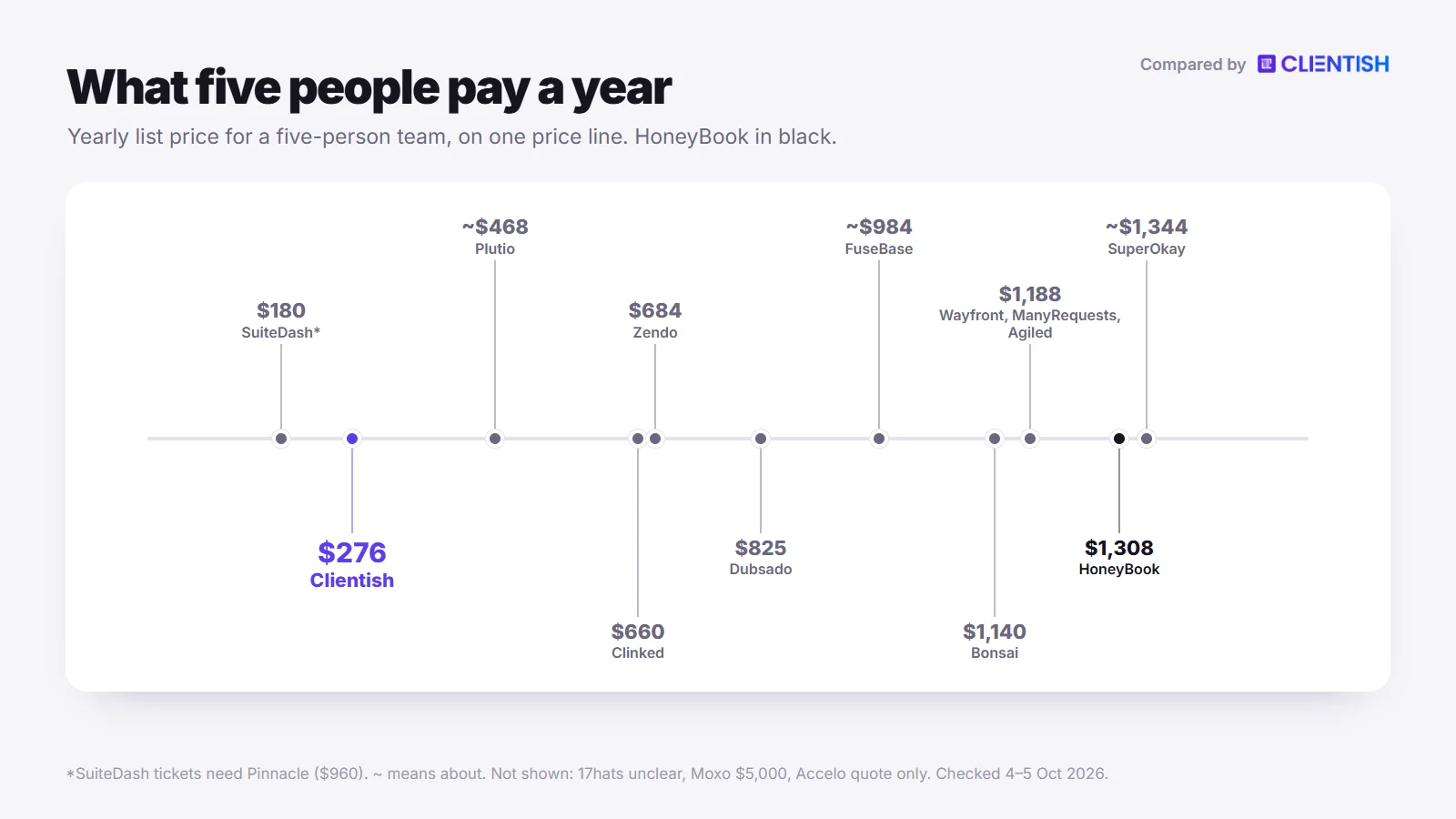
| Tool | 5 people, per year | 10 people, per year |
| Clientish | Starter: $276 | Growth: $468 |
| HoneyBook | Premium: $1,308 | Premium: $1,308 |
| Dubsado | Premier + 4–10 user tier: $825 | Premier + 4–10 user tier: $825 |
| Bonsai | Essentials × 5: $1,140 | Essentials × 10: $2,280 |
| 17hats | From $600 a year plus $5 a month per extra user; which billing option includes the client portal is unclear on 17hats’ pages | |
| Plutio | Pro: about $468 | Pro: about $468 |
| SuiteDash | Start: $180 (tickets need Pinnacle, $960) | Start: $180 (tickets need Pinnacle, $960) |
| Wayfront | Base: $1,188 | Base + 5 seats: $2,268 |
| ManyRequests | Core + 4 seats: $1,188 | Core + 9 seats: $2,088 |
| Zendo | Core + 4 users: $684 | Core + 9 users: $1,164 |
| SuperOkay | Business: about $1,344 | Business: about $1,344 |
| Clinked | Start Up × 5: $660 | Start Up × 10: $1,320 |
| Moxo | Team: $5,000 | Team: $5,000 |
| Accelo | Quote only | Quote only |
| FuseBase | Essentials: about $984 | Advanced: about $3,192 |
| Agiled | Business: $1,188 | Business + 3 seats: $1,908 |
Dubsado’s Starter plan stops at three extra users, so a five-person team needs Premier plus the $25-a-month user tier. Agiled’s Business plan covers seven seats; ten people need Scale or Business with three $20 seats ($1,908). HoneyBook’s $1,308 is Premium, the only plan with more than two team members. Wayfront, ManyRequests and Zendo figures use yearly billing with extra seats at $18, $15 and $8 a month; Clinked’s Start Up is $11 per user a month on monthly billing, and the SuperOkay and FuseBase figures use the lower prices on their pages, which appear to be yearly rates.
The 15 Best HoneyBook Alternatives for Agencies
We grouped the list loosely: tools 2 to 7 are general client-management suites that HoneyBook users often compare, 8 to 10 serve productized and request-based agencies, and 11 to 15 are portal, workflow and PSA tools for more specialised needs. Each entry below starts with how the tool differs from HoneyBook, then lists what it includes, its limits for an agency, and its price.
1. Clientish: Best for Agencies Selling Repeat Services to Many Clients
Clientish replaces HoneyBook’s one-link-per-booking model with a client portal and an order for every purchase. It was built for service agencies (marketing, design, SEO, web and content teams) where the same clients buy, pay and ask questions every month, and the work is shared across a team.
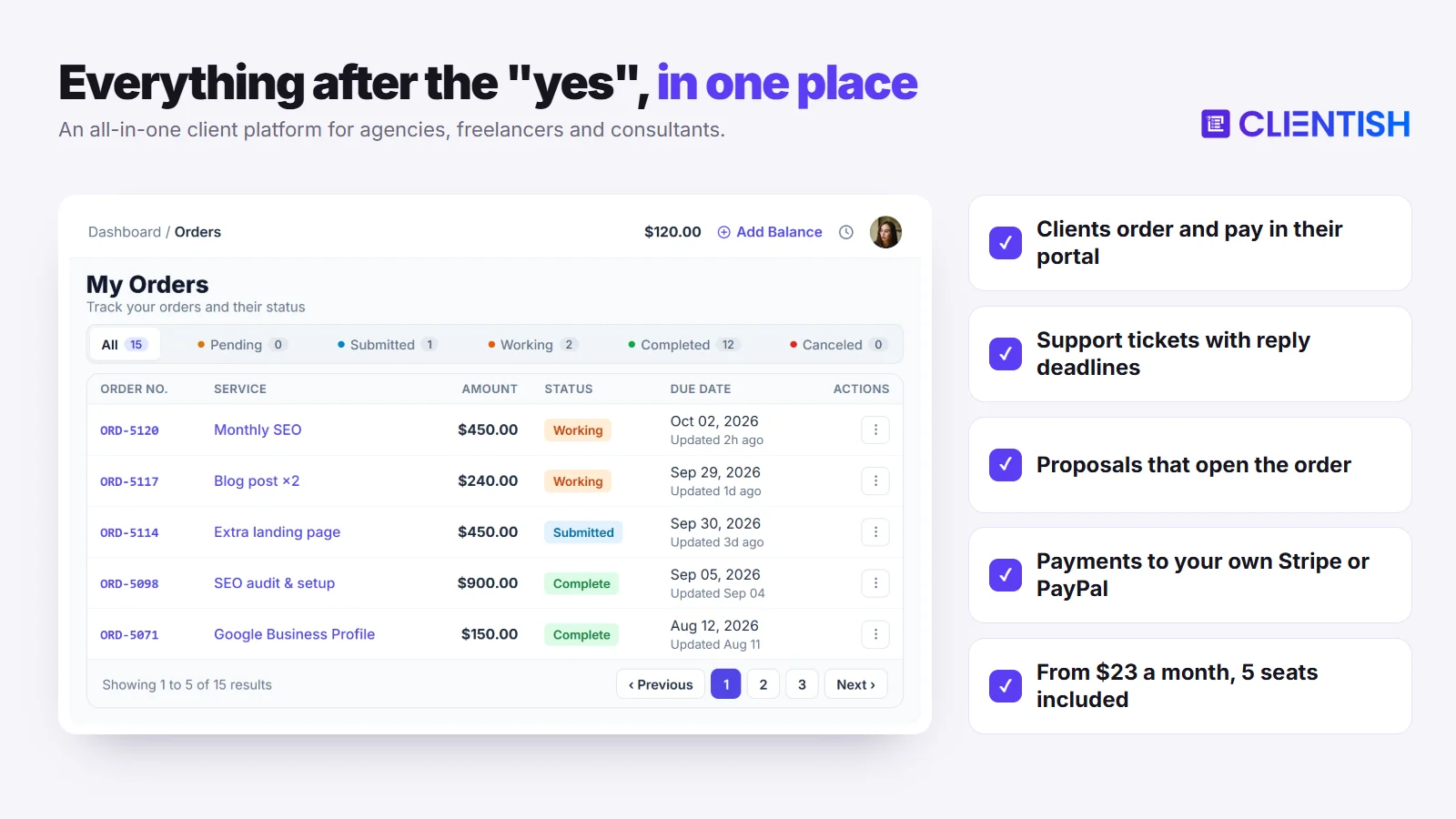
Key features (where it goes further than HoneyBook):
- A team on the first plan: Staff seats scale from 5 on Starter to 50 on Enterprise, each person gets a role you design, and more seats can be added. In HoneyBook a third colleague already means the $109 plan.
- A portal clients come back to: after logging in, a client finds what is in progress, what is due and what renews next, and can reorder, sign off work, adjust subscriptions or ask for help from the same screen.
- A catalogue with a cart: services carry prices, coupon codes and an intake form, so clients can order without a sales call.
- Orders with revision limits: every sale becomes a job with its own brief, delivered files and remaining edit rounds, and silent clients are treated as approving after a week unless you set another delay.
- A help desk on every plan: tickets have a priority, a first-reply deadline, saved replies, internal notes and a client rating at the end.
- Your own payment accounts: card and wallet payments go to the Stripe, PayPal, Paddle or SSLCommerz account you connect, while bank, Wise or mobile-wallet transfers are recorded by your team. Clientish takes no percentage, and the countries you can sell in are set by your gateway.
- Proposals that start the job: pick from eleven layouts, and once the client types their signature Clientish sets up their account, raises a single invoice with the deposit (half, unless you change it) due first, and opens the job.
- Hours the client approves: on Growth and above, contractors record hours against a client, and that client approves the timesheet before billing.
- QuickBooks and Xero: both connect directly, plus webhooks and an API.
- Your brand in the inbox: logo and colours in the portal and every client email sent from your own SMTP, on every plan.
- Leads and live chat from the Growth plan.
Compared with HoneyBook: a team of five costs $276 a year instead of $1,308, clients order from a catalogue in their portal instead of receiving a smart file per sale, questions become tickets, and you choose the payment processor.
Limits for agencies: Renewals are not auto-charged: when a subscription comes due, its invoice opens again and the client settles it by card, transfer or stored credit. You also won’t find a booking calendar, a mobile app or other interface languages, and the portal address is a clientish.io subdomain.
| Pros | Cons |
| Team members included from the $29 plan | Renewals are paid by the client, not auto-charged |
| Ticket desk with reply targets on every plan | No booking calendar or phone app |
| Catalogue, orders and revision limits | English interface only |
| Your own gateways, including Paddle and SSLCommerz | clientish.io subdomain, no custom domain |
Price: $29, $49, $99 or $149 a month for Starter, Growth, Pro and Enterprise; on yearly billing those become $23, $39, $79 and $119. Every plan includes the portal, invoices, tickets and proposals; leads, live chat and remote members start on Growth. Start a 14-day free trial, no card needed.
2. Dubsado: The Closest Like-for-Like Switch
Dubsado is the tool most often compared with HoneyBook, and the closest in spirit: proposals, contracts, invoices, forms and a scheduler for one business owner. Its differences from HoneyBook are choice of processor and three free extra users; its limits for agencies are on the client side.
Compared with HoneyBook: you choose Dubsado Payments, Square or PayPal instead of one built-in processor, three extra users cost nothing, and the 21-day trial is shorter than HoneyBook’s 30 days.
Key features: Dubsado 3.0 brought Flows, a node-based automation builder, along with Kanban and table views and a global time tracker. Clients see invoices, forms, proposals, contracts and appointments in a portal with your logo and colours, and a custom URL can hide Dubsado’s name. Payments run through Dubsado Payments (built on Stripe), Square or PayPal, with no extra Dubsado fee, and recurring invoices can require autopay.
Limits for agencies: The owner gets three extra users free, then 4–10 users cost $25 a month more. Scheduler, Flows, QuickBooks and Xero sit on the Premier plan. Neither support tickets nor a revision allowance appear in its help centre, and prices for new customers rose on December 1, 2025.
| Pros | Cons |
| Choice of Dubsado Payments, Square or PayPal | Price rise for new customers in December 2025 |
| Three extra users free | Scheduler, Flows and accounting sync on Premier only |
| Flows automation builder | No ticket desk or revision allowance found |
Price: Starter $35 a month ($335 a year), Premier $55 ($525 a year). 21-day free trial with Premier features.
3. Bonsai: For Consultants Who Track Projects and Time
Bonsai sells contracts, invoicing and project tools to freelancers and now markets itself to agencies and consultancies too; Zoom bought it in December 2025 and says it will keep running as its own brand. Compared with HoneyBook, it adds Gantt charts, workload views and time tracking, and lets you use Stripe outside its own processor’s countries.
Compared with HoneyBook: Bonsai Payments covers the same four countries as HoneyBook, but Stripe works in many more; every person is a paid seat, while HoneyBook includes two team members on Essentials.
Key features: Proposals, contracts, invoices, forms, scheduling and a client portal from Essentials, where clients view invoices and upload files through an email link rather than an account; client messaging is listed on Premium. Subscription invoices charge a saved card automatically. Premium removes Bonsai branding and adds automations, QuickBooks and Zapier.
Limits for agencies: Every team member is billed at the plan’s per-user rate, so a five-person team on Premium pays $1,740 a year. Custom domains are listed as expected in 2026. Its help centre shows no client ticket queue or revision-request feature.
| Pros | Cons |
| Gantt, workload and time tracking | Every user is a paid seat |
| Stripe available outside its own processor countries | Clients use email links, not accounts |
| Subscription invoices charge cards automatically | Custom domain not yet released |
Price: charged for each person: Basic $15 a month, Essentials $25, Premium $39 and Elite $59 (three users at least), or $9, $19, $29 and $49 when paid yearly. 7-day trial.
4. 17hats: Bookkeeping Built Into the Client Flow
17hats puts bookkeeping next to quotes, contracts and invoices, which is the main thing it adds over HoneyBook. It covers quotes, contracts with e-signature, questionnaires, invoices, a booking page and bookkeeping, and sells every plan as “all features” paid monthly, yearly or every two years.
Compared with HoneyBook: it adds bookkeeping and a bank feed, syncs to QuickBooks one way only, and like HoneyBook has no direct Xero connection.
Key features: Clients use a portal to accept quotes, sign contracts, fill in questionnaires, pay invoices and see event details, though they can’t upload files there. Payments go through Stripe or Square, and recurring invoices with autopay work only with those two. QuickBooks Online receives data one way, in the US, Canada and the UK, and there is no Xero connection. Free iOS and Android apps are available.
Limits for agencies: 17hats is thin: its pages describe a small number of included users with extra users at $5 a month each, and its own pages disagree on the exact count. No custom-domain option is documented (links use a 17hats subdomain), and there is no sign of a ticket desk or revision tracking.
| Pros | Cons |
| Bookkeeping and bank feed in the same app | Few users included; team size unclear on its pages |
| Questionnaires, contracts and invoices in one flow | No custom domain documented |
| Mobile apps on iOS and Android | QuickBooks sync one-way, no Xero |
Price: $60 a month, $600 a year or $800 for two years (a first-year discount was running on October 5, 2026). There is a limited free plan capped at four invoices a quarter, and a 7-day trial.
5. Plutio: A Freelancer Suite in 34 Languages
Plutio gives every plan the same toolset (projects, proposals, contracts, billing, booking pages and a portal) and limits only people, clients and usage. Against HoneyBook it offers its own choice of processors, apps for phone and desktop, and an interface in 34 languages.
Compared with HoneyBook: you connect Stripe, PayPal or Square yourself instead of using a built-in processor, and the interface comes in 34 languages.
Key features: Clients get their own login to shared projects, tasks, files, conversations and linked invoices. Payments run through Stripe, PayPal or Square, and auto billing charges a saved card each cycle. A $9 white-label add-on brings your own domain and SMTP, and the REST API and webhooks are open on every plan.
Limits for agencies: Core is a one-person plan capped at nine active clients; Pro includes 30 contributors and Plutio describes it as the plan for agencies of 2–10 people. Support queues are built from task boards rather than a ticket module, and accounting tools connect through an automation platform.
| Pros | Cons |
| Same features on every plan | Core is for one person and nine active clients |
| 34 interface languages and native apps | No ticket module |
| White-label with your domain for $9 a month | Accounting sync through an automation tool |
Price: Core $19 a month (about $15 billed yearly), Pro $49 (about $39), Max $199 (about $159). 7-day free trial.
6. SuiteDash: Unlimited Users at One Price
SuiteDash takes the opposite pricing approach to HoneyBook: one price per account with unlimited clients and staff, and white-label branding with your own domain on every plan. It is a wide suite (CRM, projects, invoices, portals, email marketing, courses and AI tools) that you configure to your own process.
Compared with HoneyBook: one price covers unlimited staff, where HoneyBook needs Premium beyond two team members, and white-label with your own domain comes on every plan.
Key features: Per-client portal dashboards, magic-link logins, subscription billing that charges automatically, estimates and invoices, and gateways including Stripe, Braintree, PayPal and Authorize.Net. Support tickets, the full automation toolkit and onboarding flows sit on the Pinnacle plan, and QuickBooks Online connects natively.
Limits for agencies: The breadth takes setup time, and SuiteDash sells $50 guided setup sessions and a $299 kickstart service. Xero is on its roadmap rather than live, and we found no ticket reply targets or client ratings.
| Pros | Cons |
| Unlimited clients and staff on every plan | Setup takes time; paid onboarding sessions are sold |
| White-label and custom domain from Start | Tickets and automations on the top plan |
| Native QuickBooks Online sync | Xero not yet live |
Price: Start $19 a month ($180 a year), Thrive $49 ($480), Pinnacle $99 ($960). 14-day trial on Pinnacle, no card.
7. Agiled: Best for Small Companies That Want HR and CRM Alongside Client Work
Agiled is an all-round small-business suite, rebuilt on a new platform during 2026, that adds staff management and a sales pipeline to client work. Next to HoneyBook it adds HR records, expenses and a wider app directory, with Stripe Connect, PayPal or Mollie for payments.
Compared with HoneyBook: you get HR records and a ticket module (from Pro) that HoneyBook lacks, but each plan includes a fixed number of seats (1, 3, 7 or 15) and extra seats cost $20 a month.
Key features: A client portal with invoice payments, tickets (from Pro), chat and booking; recurring invoices that send themselves or bill through a gateway subscription; multi-party e-signing; iOS, Android and desktop apps.
Limits for agencies: Seat counts are 1, 3, 7 and 15 by plan, and each additional seat on Pro or above is $20 a month. The branded portal, custom domain, QuickBooks or Xero and subscriptions need Business ($99 a month billed yearly) or a $19 add-on for branding.
| Pros | Cons |
| HR, expenses and CRM in one suite | $20 a month for each extra seat |
| Mobile and desktop apps | Branding and accounting sync on Business |
| Recurring invoices that send themselves | One-time import from the old platform skips proposals and forms |
Price: Starter $29 a month ($24 billed yearly), Pro $69 ($59), Business $129 ($99), Scale $249 ($199). 14-day trial with Business features.
8. Wayfront: Cart-Based Selling for Productized Agencies
Wayfront, known as Service Provider Pro until February 2026, is built for agencies that sell fixed packages and subscriptions through a white-label portal. Where HoneyBook sells through a smart file per client, Wayfront sells through a cart.
Compared with HoneyBook: clients buy from a cart and subscriptions renew through Stripe, but we found no proposals or contracts, which HoneyBook combines with the invoice in one smart file.
Key features: Services with variants and add-ons, a cart with coupon codes, Stripe or PayPal checkout, intake forms after payment, orders with statuses and task templates, a helpdesk with ticket tags and staff-only notes, request limits per period, credits and an account balance. Stripe subscriptions charge automatically, with dunning emails on failed payments. The portal runs on your own domain and ships in seven languages.
Limits for agencies: Base includes five seats and extra seats are $20 a month ($18 yearly). Proposals and contracts are absent from its help index, and client coworkers, custom templates and the API sit on Pro ($249 a month billed yearly) or as add-ons.
| Pros | Cons |
| Cart, coupons and subscriptions that auto-charge | Starts at $99 a month billed yearly |
| Own domain and seven portal languages | No proposals or contracts found |
| Helpdesk and request limits | Client teams and API on Pro or add-on |
Price: Base $129 a month ($99 billed yearly), Pro $299 ($249); Plus by call. 14-day trial, no card.
9. ManyRequests: Best for Design and Video Teams Working on Requests
ManyRequests is a client portal for request-based creative work, such as unlimited design or video subscriptions. Next to HoneyBook, it adds design and video proofing, a request queue and a catalogue, but every person after the first is a paid seat.
Compared with HoneyBook: it adds image and video proofing and a request queue, and money goes through your own Stripe account rather than a built-in processor.
Key features: Clients buy from a catalogue or custom order form, submit requests through forms with conditional rules or by email, annotate images, PDFs and videos, chat with the team and rate completed requests. Billing runs through Stripe with auto-charging subscriptions, plus manual payments marked as paid. Every plan includes a custom domain and unlimited clients; removing “Powered by” needs Pro.
Limits for agencies: One seat is included, and each extra seat costs $20 a month on Core or $30 on Pro ($15 or $25 billed yearly). There is no ticket module with reply targets; requests are used as tickets. Webhooks and the API are on Pro.
| Pros | Cons |
| Image, PDF and video proofing | One seat included; every extra seat is paid |
| Requests by form or email | No SLA or first-reply targets found |
| Custom domain on every plan | Webhooks and API on Pro |
Price: Core $59 a month ($39 billed yearly), Pro $99 ($79). 14-day free trial, no card.
10. Zendo: A Free Starting Point for Productized Teams
Zendo is a productized-service portal with a free plan, which makes it the lowest-cost way on this list to try a catalogue and checkout. Next to HoneyBook it adds a storefront, subscriptions with trials and pauses, and a portal in 12 languages.
Compared with HoneyBook: it starts free and sells from a storefront, while HoneyBook starts at $36 a month; each Zendo plan includes one internal user.
Key features: A service catalogue for visitors, multi-step checkout, one-off, subscription and custom services, quotes and invoices, real-time chat and file sharing. Payments run through Stripe, with bank transfer as a manual method. Request Types (two on Free, five on Core, unlimited above) let you model support tickets and onboarding.
Limits for agencies: Each plan includes one internal user, with extra users at $8, $12.50 or $17 a month by plan. Custom domains need Pro, QuickBooks and Xero are not listed, and the public API is marked “coming soon”.
| Pros | Cons |
| Free plan for three clients | One internal user per plan |
| Storefront and subscriptions | Custom domain from Pro |
| 12 portal languages | No accounting integrations listed |
Price: Essential free; Core $29 a month ($25 billed yearly), Pro $59 ($49), Agency $99 ($79). 14-day trial of Pro, no card.
11. SuperOkay: A Branded File and Approval Hub
SuperOkay is a client portal for sharing files, documents, tasks and approvals in a branded space per project. It is not a billing tool, which is the biggest difference from HoneyBook: there are no invoices or payments built in.
Compared with HoneyBook: it handles files and approvals but has no invoices or payments, the part HoneyBook is built around.
Key features: Client login by magic link or password, interactive documents with approvals, tasks, embedded apps such as Figma, Miro or Google Data Studio, and Packaged Services pages with a buy button that links to your own payment provider. Each project portal can carry the client’s logo, colours and fonts.
Limits for agencies: Team members start on Solo+ (three people) and are unlimited only on Business ($112 or $146 a month). Custom domain and full white-label need Solo+ or Business. Invoices, recurring billing, tickets and accounting integrations are all missing from its pages.
| Pros | Cons |
| Free plan for one project | No invoices or payments |
| Interactive documents with approvals | Teams need Solo+ or Business |
| Embed almost any web app | No support tickets |
Price: Free; Solo $9 or $12 a month, Solo+ $29 or $38, Business $112 or $146 (the lower figure appears to be the yearly rate).
12. Clinked: Best for Firms That Need Secure File Sharing
Clinked is a secure client portal for files, tasks and conversations, used by firms that care about compliance. It covers ground HoneyBook doesn’t (file versioning, approvals, audit trails, ISO 27001) and leaves out HoneyBook’s core: there is no invoicing or payment collection.
Compared with HoneyBook: it trades billing for compliance: secure file sharing and audit trails, but no invoicing or payment collection.
Key features: Secure logins with 2FA (SSO on Enterprise), file sharing up to 5 GB per file, file requests, approvals, comments and annotations, an online document editor, chat, tasks and calendars, plus iOS and Android apps on every plan. A custom domain comes with Standard, and white-label email notifications with Premium.
Limits for agencies: No invoices, catalogue or tickets are listed. Start Up costs $11 per user a month for up to 25 users; larger plans jump to $239 a month (100 members) and $599 (250 members).
| Pros | Cons |
| Strong security and compliance list | No invoicing or payments |
| File approvals and version control | No catalogue or tickets |
| Mobile apps on every plan | Big price step after Start Up |
Price: Start Up $11 per user a month, Standard $239 a month, Premium $599 ($479 billed yearly), Enterprise by quote. 14-day trial.
13. Moxo: Guided Workflows for Approval-Heavy Work
Moxo is a process platform where clients and staff complete steps (approvals, forms, file requests, e-signatures and payments) inside guided flows, often with AI agents doing preparation work. Unlike HoneyBook, it is built for complex, multi-party processes rather than bookings.
Compared with HoneyBook: it is priced for larger firms ($5,000 a year) and runs guided multi-step processes rather than one booking at a time.
Key features: You design flows with role assignment, and Scale adds branching, loops and an audit log; clients open a magic link or a branded portal. Moxo states SOC 2 Type II certification, and portals with a custom domain sit on the Scale plan.
Limits for agencies: Entry pricing is $5,000 a year for 100 flows, and a trial has to be requested from Moxo. Invoices and payments run as steps inside a flow, we found no recurring-billing module, and Moxo itself notes overhead for very simple engagements.
| Pros | Cons |
| Unlimited seats on every plan | $5,000 a year minimum |
| SOC 2 Type II and audit trails | No subscription billing found |
| Approvals, e-signatures and file requests in one flow | Processes must be designed up front |
Price: Team $5,000 a year; Scale and Enterprise by quote. Trial on request.
14. Accelo: Best for Established Firms Billing Time and Retainers
Accelo is professional services automation (PSA) software for firms that run projects, retainers and tickets with detailed time and budget tracking. It is far heavier than HoneyBook and sold through demos and custom quotes.
Compared with HoneyBook: it handles retainers, tickets and time in depth, but has no public price or self-serve trial, where HoneyBook offers 30 days free.
Key features: Sales quotes that launch projects, project and retainer management, tickets and issue tracking, time tracking, automated invoicing from project activity, payment links through Stripe, Authorize.net or PayPal, and a client portal where clients make requests, approve sign-offs and view invoices. It integrates with QuickBooks, Xero and many business tools.
Limits for agencies: No public pricing, no trial and implementation measured in weeks. There is no client-facing catalogue or checkout.
| Pros | Cons |
| Retainers, tickets and time in one system | No public pricing or trial |
| Invoices generated from project activity | Setup takes weeks |
| Wide integration list | No catalogue or checkout |
Price: by custom quote based on team size. Demo on request.
15. FuseBase: Portals Plus a Shared Workspace
FuseBase (formerly Nimbus) combines client portals with a shared workspace of documents, tasks and AI agents. Set beside HoneyBook, it centres on collaboration and knowledge sharing and has no billing of its own.
Compared with HoneyBook: it adds a shared document workspace and AI agents, but has no invoices or payments.
Key features: Client portals opened by secure magic link, file sharing, task lists and mutual action plans, live chat, forms and surveys, built-in e-signatures, meeting notes and videos, plus AI agents and automation runs by plan. White-label with your own domain and email is on Advanced and Unlimited.
Limits for agencies: There are no invoices or payments built in, and no service catalogue or ticket desk was found. Essentials includes five members and 100 clients; more members are “contact us”, and extra portals cost $20 a month each.
| Pros | Cons |
| Portals plus a document workspace | No invoicing or payments |
| Built-in e-signatures and forms | White-label only from the Advanced plan |
| Free plan and 14-day trial | Extra members priced on request |
Price: Free; Solo $32 or $39 a month, Essentials $82 or $99, Advanced $266 or $399 (lower figures look like yearly billing), Unlimited by quote. 14-day trial.
Cheapest HoneyBook Alternatives
If price is the reason you are leaving, compare what each tool costs for your real team, not the headline. These are the lowest-cost options by situation, using yearly billing where offered.
| Situation | Lowest-cost option | Cost |
| One person testing a portal | Zendo Essential or SuperOkay Free | $0 (with tight limits) |
| One person with invoices and a portal | Plutio Core or SuiteDash Start | $180 a year |
| A team of five with tickets and a portal | Clientish Starter | $276 a year |
| A team of ten with tickets and a portal | Clientish Growth | $468 a year |
| Unlimited users without tickets | SuiteDash Start | $180 a year |
Free plans are useful for trying a workflow, but none of them covers a working agency team: Zendo’s free plan stops at three clients and one user, and SuperOkay’s at one project.
What Your Clients See in Each Tool
The client’s experience decides how many emails your team answers each week. This table shows how clients get in and what they can do once they arrive.
| Tool | How clients get in | Pay invoices | Buy services | Raise tickets |
| Clientish | Own login to a branded portal | Yes | Catalogue and cart | Yes, with reply targets |
| HoneyBook | Magic link, password or code | Yes | Through smart files | No |
| Dubsado | Client portal | Yes | Proposals | Not found |
| Bonsai | Email link, no account | Yes | Proposals | Not found |
| 17hats | Client portal | Yes | Quotes | Not found |
| Plutio | Own login | Yes | Proposals | No ticket module |
| SuiteDash | Login or magic link | Yes | Checkout forms | Top plan |
| Agiled | Client portal | Yes | Checkout link (Business) | Pro and up |
| Wayfront | Passwordless login | Yes | Cart | Yes |
| ManyRequests | Client portal | Yes | Catalogue | Requests |
| Zendo | Password or social login | Yes | Storefront | Request types |
| SuperOkay | Magic link or password | Pay link only | Packaged service pages | No |
| Clinked | Secure login, 2FA | No | No | No |
| Moxo | Magic link or portal | Payment steps | Flow catalogue (Scale) | Flow requests |
| Accelo | Email link | Yes | No | Yes |
| FuseBase | Magic link | No | No | Not found |
Why Agencies Choose Clientish Over HoneyBook
The list above shows many good fits for specific needs. For an agency that has outgrown HoneyBook because of its team, its repeat clients and its support load, this side-by-side sums up the switch.
| HoneyBook | Clientish | |
| Five-person team, per year | Premium: $1,308 | Starter: $276 |
| Payment processor | HoneyBook only | Your Stripe, PayPal, Paddle or SSLCommerz, plus manual methods |
| Countries | US, Canada, UK, Australia | Set by your gateway |
| Client support | Project messages | Tickets with reply targets and ratings |
| Selling repeat services | A smart file each time | Catalogue, cart and coupons |
| Delivery | Projects | Orders with revision limits and approval |
| Contractor hours | Time tracker retired in 2026 | Client-approved hours (Growth) |
| Accounting | QuickBooks Online | QuickBooks and Xero |
| Automatic card renewals | Yes | No; the client pays each renewal |
| Phone app | Yes | No |
HoneyBook keeps the edge on automatic card renewals and its phone app. Clientish leads on what grows with an agency: team cost, client support, delivery and choice of payment provider. Start a 14-day Clientish trial and move one live retainer across to test it.
Is HoneyBook Still Worth It in 2026?
For some businesses, yes. It still makes sense for a one-person studio in its four countries that books sessions, collects deposits, likes renewals to charge cards on their own, and doesn’t mind HoneyBook handling the payments.
It is a weaker fit once any of these are true: you have four or more people, you sell from outside its four countries, clients need a help desk, you bill contractor time, or you use Xero. In those cases the price rise of 2025 buys less each year, and Clientish costs less for the team you have.
Which HoneyBook Alternative Fits Your Agency?
The right pick depends less on feature lists than on how your business sells. Match your model to the row below.
| If your business… | Look at | Why |
| sells monthly retainers or packages to many clients with a team of 3–50 | Clientish | Team members included, portal, orders with revisions, tickets, own gateways |
| is a solo creative business taking bookings and deposits | Dubsado, 17hats | Booking-led client flow close to HoneyBook’s |
| is a consultancy that tracks time and projects in detail | Bonsai | Gantt, workload and time tracking, billed per user |
| needs many interface languages or a phone app | Plutio | 34 languages, apps for phone and desktop |
| wants unlimited users and is happy to configure a big suite | SuiteDash | Flat price, white-label on every plan |
| also needs HR, leave and expenses | Agiled | HRM from Pro, expenses on every plan |
| sells productized packages or design subscriptions | Wayfront, ManyRequests, Zendo | Cart, requests and auto-charging subscriptions |
| mainly shares files and needs approvals | SuperOkay, Clinked | Branded file hubs; Clinked adds compliance |
| runs regulated, multi-step client processes | Moxo | Flows, audit trail, SOC 2 Type II |
| wants a client portal plus a shared document workspace | FuseBase | Portals, documents, e-signatures and AI agents |
| is an established firm billing time and retainers | Accelo | PSA with tickets, time and invoicing |
Moving From HoneyBook Without Losing Active Clients
Switching mid-year is safe if active projects finish where they started and new work begins in the new tool. Before leaving, pull two files from HoneyBook: the contact spreadsheet and the payments CSV. Old projects remain viewable after cancellation, though nothing new can be created there.
- Export first. Download the contact list and payments CSV before your renewal date.
- Import clients. In Clientish, paste the contacts into the import template (CSV, XLS or XLSX) under Clients → Import. Imported clients start inactive and receive no email until you choose.
- Rebuild packages as services. Give each one its price, intake questions and allowed revision rounds; move contract wording into your proposal templates.
- Replace recurring invoices carefully. Start each Clientish subscription at the client’s next billing date, and stop HoneyBook’s autopay only once the new one is ready, so nobody is charged twice.
- Tell clients where to log in. Send a short note with the new portal address as each client goes live.
Frequently Asked Questions
These are the questions people search most often alongside “HoneyBook alternatives”, answered for agencies with prices as of October 4 and 5, 2026.
What is the best HoneyBook alternative for agencies?
For agencies with a team and repeat clients, Clientish: it includes five to fifty team members, a client portal with orders and tickets, and your own payment processor. For a solo booking business, Dubsado is the closest like-for-like switch.
What is cheaper than HoneyBook?
For one person, SuiteDash Start ($19 a month) and Plutio Core ($19) cost less than HoneyBook Starter ($36). For a team of four or more, Clientish Starter at $29 a month includes five people, while HoneyBook needs Premium at $129 a month.
Is Dubsado better than HoneyBook?
Dubsado lets you choose Square or PayPal instead of a single built-in processor, gives the owner three free users and has Flows, a node-based automation builder. HoneyBook offers a longer 30-day trial. We found no client ticket desk in either.
Why are people leaving HoneyBook?
The common reasons are the 2025 price rise, payment processing fees and occasional payout holds, the four-country limit, seat limits below Premium and the removal of the time tracker in September 2026.
Can I use HoneyBook outside the US?
Yes, but only from Canada, the UK or Australia; a business registered anywhere else is turned away at sign-up. Clientish keeps no such list, and your payment provider decides which countries you can bill.
Is there a HoneyBook alternative that uses Stripe or PayPal?
Yes. Clientish, Plutio, SuiteDash and Agiled all connect Stripe and PayPal; Dubsado offers PayPal alongside its Stripe-based processor; Bonsai connects Stripe and PayPal too, with an extra 1% fee where its own Bonsai Payments is available.
Is there a free HoneyBook alternative?
Zendo, SuperOkay, FuseBase and 17hats have free plans with tight limits (Zendo: three clients and one user; SuperOkay: one project), but none covers a working agency team. Trials run from 7 days (Bonsai, Plutio, 17hats) to 21 days (Dubsado); Clientish’s trial is 14 days with no card.
Which HoneyBook alternatives have a client portal with logins?
Clientish, Plutio, SuiteDash, Agiled, ManyRequests, Zendo, SuperOkay and Clinked give clients their own sign-in, and Wayfront uses passwordless links by default. Dubsado’s portal shows invoices, forms and contracts, and Bonsai’s portal opens from an email link without a client account.
Which alternative is best for a design or marketing agency with retainers?
Clientish, because retainers run as subscriptions tied to a service, orders carry revision limits, and client questions go to a ticket queue rather than email.
Which of these tools offer white-label branding?
A custom domain is available on HoneyBook (subdomain), Dubsado (custom URL), Plutio ($9 add-on), SuiteDash, Agiled (Business or add-on), Wayfront, ManyRequests, Zendo (Pro), SuperOkay (Solo+), Clinked (Standard), FuseBase (Advanced) and Moxo (Scale). Clientish brands the portal with your logo and colours on every plan and sends client email from your own SMTP, on a clientish.io subdomain.
What is the difference between a client portal and client management software?
A client portal is the space clients log in to. Client management software also runs your side: orders, team, billing and support. Clinked, SuperOkay and FuseBase are mostly portals; Clientish, SuiteDash and Agiled cover both.
Which tool is best if I sell productized services?
Clientish, Wayfront, ManyRequests and Zendo all sell services from a catalogue with checkout. Clientish adds revision limits per service and tickets with first-reply targets on every plan.
Which tools avoid per-seat pricing?
SuiteDash and Moxo include unlimited users. Clientish plans carry 5 to 50 team seats and add no per-person charge until you pass them. Bonsai, Clinked Start Up, ManyRequests, Zendo and Agiled charge per extra seat.
Is Dubsado a good fit for a growing agency team?
For small teams, yes: three extra users are free. Past that, users cost $25 a month and up, and we found no ticket desk or revision tracking.
Can clients pay invoices in the portal?
Yes on most of them: Clientish, HoneyBook, Dubsado, Bonsai and 17hats, plus Plutio, SuiteDash, Agiled, Wayfront, ManyRequests, Zendo and Accelo. SuperOkay only links to your payment page, and Clinked has no invoicing.
Which tool suits regulated or compliance-heavy work?
Clinked lists ISO 27001 and other certifications, and Moxo states SOC 2 Type II with a detailed audit trail. Neither is built around agency billing.
Does Clientish have a free plan?
No. It has a 14-day free trial with no card, then plans from $29 a month ($23 billed yearly).
Is HoneyBook still worth it in 2026?
For a solo business in one of its four countries that books sessions and wants card renewals with no client step, yes. For an agency with a team, many repeat clients and support questions, the seat limits and missing help desk make a dedicated agency portal a better fit.
Final Thoughts
HoneyBook still serves the owner who books, signs and bills one client at a time. Agencies leave when the business becomes a team serving many clients who buy again, pay monthly and need answers.
Clientish is built for that second stage: staff seats from the entry plan, a portal that becomes the client’s monthly habit, jobs with capped revisions, a ticket queue with response targets, and gateways you already own. Try it free for 14 days with two teammates and one real client, and compare it with your current HoneyBook week. Plan details are on the pricing page, and our HoneyBook vs Clientish comparison goes deeper on the two.
Sources
Clientish publishes this guide. Every HoneyBook and alternative-tool fact was checked on October 4 and 5, 2026, against each company’s own pricing and help pages; review themes come from Capterra and Trustpilot.
HoneyBook, Dubsado, Bonsai, 17hats, Plutio, SuiteDash, Agiled, Wayfront, ManyRequests, Zendo, SuperOkay, Clinked, Moxo, Accelo and FuseBase are trademarks of their owners. Clientish is not affiliated with any of them. See something out of date? Tell us and we’ll correct it.

