
Client Onboarding Checklist Template
A client is never more certain they made the right choice, or more quietly worried they made the wrong one, than in the week after they sign.
Free to download and edit · No watermark · Add your own branding
The contract is in and the invoice is paid, and then, too often, the account goes silent while the team works out internally who owns it and where the logins live. That silence, more than any late deliverable, is what plants the first seed of doubt. A structured onboarding checklist exists to fill that week with visible momentum instead.
This page gives you a free, editable Client Onboarding Checklist template for agencies, plus a plain-English walkthrough of every phase, from the moment the contract is signed through the first 30 days. It is organized as a timeline, not a flat list, so your team always knows what happens today, this week, and this month. Download it, add your branding, assign owners, and run it for every new client.
What Is Client Onboarding?
Client onboarding is the structured process an agency runs between a signed contract and fully active work — meaning, for a retainer agency, the point at which access is confirmed, the reporting baseline is set, and the first deliverable has been reviewed and approved.
It covers everything the team and the client need to do before delivery can run smoothly: collecting access, aligning on goals, setting communication norms, and delivering the first signs of value. It is the bridge between closing the sale and doing the work.
Onboarding is not the same as a kickoff call. The kickoff is one event inside onboarding; the full process spans internal setup, access collection, the questionnaire, the kickoff itself, and the first milestones, usually over the first few weeks. Treating the kickoff call as the whole of onboarding is one of the most common reasons new clients feel dropped right after signing.
What the checklist covers besides the phases
The stakes are highest in the first weeks. Early churn is a well-documented problem for agencies, and when a client leaves soon after signing, the cause is rarely the quality of the work, which has barely started. It is the experience: slow access handovers, unclear next steps, no early sign of progress, and no single person the client knows to contact. A checklist fixes all four by making onboarding a repeatable process rather than something each account manager improvises.
How to Structure Onboarding: Three Phases, Not One List
Most onboarding templates are a flat list of tasks, which hides the thing that matters most in onboarding: timing. A client does not care that you will eventually set up reporting; they care what happens in the first 48 hours. This template is organized into three phases so the sequence is built in.
Before you start
The first 48 hoursInternal handoff, welcome email, workspace setup, and team assignment. This is the phase that kills the post-signing silence.
The first week
Onboarding questionnaire, access and credential collection, audit of what exists, and the kickoff call. This is where most onboarding stalls, usually on access.
The first 30 days
Communication cadence, the first quick win, the first progress report, and a 30-day check-in. This is where the client decides, consciously or not, whether they will stay.
The phases matter because each one prevents a different failure, and the full step-by-step for all three is in the checklist section further down.
Why Your Agency Needs an Onboarding Checklist
Running onboarding from a checklist is not about adding process for its own sake. It closes specific gaps that each cost an agency either a client or billable hours.
It ends the post-signing silence that triggers early churn
A welcome email within an hour and a clear "here is what happens next" is what reassures a client they made the right call, before doubt sets in.
It gets access collected before it becomes a bottleneck
Access is the single most common place onboarding stalls, and a delayed handover is what provokes the "why am I paying when nothing has happened?" conversation. A checklist makes access a named, dated task.
It makes every client's start consistent
Without a checklist, onboarding quality depends on which account manager runs it. With one, every client gets the same professional start regardless of who is on the account.
It frees your team from reinventing the process
A documented checklist with owners means the team executes instead of trying to remember what comes next, which matters most when you are onboarding several clients at once.
The Risks of Skipping Structured Onboarding
Each gap in onboarding has a familiar way of going wrong. Here is what each one looks like in practice, and the step that prevents it.
A client signs on Friday and hears nothing until the following Thursday while the team sorts out internally who owns the account. By the time anyone reaches out, the client has already told a colleague they are not sure about the decision. A one-hour welcome email would have prevented it.
Two weeks in, work has not started because nobody formally asked for Analytics and ad-account access, and the client assumed the agency would "just handle it." The first invoice is now due with nothing delivered, and trust is already damaged.
No kickoff set the communication cadence, so the client expects daily updates while the agency planned weekly ones. Every unanswered message widens the gap until the relationship feels strained over something a single conversation would have settled.
The agency spends month one on setup and strategy with nothing visible to show the client. Without an early quick win, the client reaches the first renewal having seen no proof the agency delivers, and churns.
One account manager runs a polished onboarding; another forgets the questionnaire and never sets up reporting. The client who got the weaker start becomes the client who leaves, and the agency never connects the two.
Every one of these is prevented by a step in the checklist below.
The Client Onboarding Checklist, Phase by Phase
The template contains this full checklist with checkboxes, owners, and due dates. Here is what each phase includes and why it earns its place.
Before You Start
A short meeting where the salesperson briefs the delivery team on what was sold, promised, and expected, so nothing is lost in translation. This is where most "that's not what we agreed" problems are prevented.
A brief, warm message confirming the client is in, naming their main contact, and saying what happens next. Speed here sets the tone for the whole relationship.
Set up the folders, project, or portal where everything will live: scope, deliverables, assets, and communication. A single home for the engagement prevents the scattered-email chaos that erodes trust.
Decide who is the day-to-day contact, who leads the work, and who the client escalates to. Every client should know exactly who to reach, not a generic inbox.
The First Week
A focused set of questions on goals, brand, target audience, existing tools, competitors, and anything already known from the sales process (pre-fill what you can). This is your fastest route to understanding the client without a dozen back-and-forth emails.
The step that stalls onboarding most often. Request exactly what you need, in one organized list: CMS or website, analytics, ad accounts, social profiles, email platform, and any tools. Make it a named, dated task, not an afterthought.
Review the client's current setup, performance, and assets to establish a baseline you can measure progress against later. It also surfaces quick wins hiding in plain sight.
Introduce the team by name, confirm scope matches the client's understanding, agree the 30/60/90-day goals, set the communication cadence, and lock the first milestone. Send a written summary within a couple of hours.
The First 30 Days
The kickoff agrees it; this step documents it where the client can see it, how often you will update them (weekly in the first month is common), through which channel, and with what response times. A written record is what prevents the expectation gap from reopening later.
A small, visible deliverable, such as an audit, a competitor snapshot, or a first draft, that proves value before the big work lands. Early time-to-value is one of the most consistent themes in client-retention research, which is why it earns a dedicated step.
Show what has been done, what is next, and anything you need from the client. Early visibility is what replaces the client's uncertainty with confidence.
Review progress, surface any blockers, collect feedback while there is still time to course-correct, and confirm the plan for the next 60 days. This single meeting is one of the strongest predictors of whether a client stays past month three.
The step most onboarding checklists skip
Most templates end at the kickoff call. The step they leave out is the 30-day feedback check-in combined with an early quick win, and together they are what actually prevent first-90-day churn. A kickoff sets expectations; a quick win and an early feedback loop prove you are meeting them before the client has to decide whether to renew. The free template builds both into Phase 3.
Tips and Best Practices for Onboarding That Retains Clients
The checklist gives you the sequence. These habits are what turn a smooth onboarding into the reason clients stay.
Make the welcome instant, not eventual
Send within the hour of signing. A proven structure: one sentence confirming what they bought, one sentence on the single next action required from them, and a named person to reply to. Your only job this week is to complete the access form linked below; [Account Manager] will take it from there and has your first call booked for [date]." A polished three-paragraph email sent three days later does less work.
Name a person for everything
Every task and every client touchpoint needs an owner. Generic "the team will handle it" is where accountability and trust leak away.
Request access as one organized list, early
Build a single access-request document (a pinned checklist inside your client portal or a shared Google Doc) that groups every credential by platform: GA4, Google Search Console, Google Ads, Meta Business Manager, CMS, and hosting. Label each row with why you need it and what happens if it's missing. Send it in the welcome email and chase once at 72 hours. Scattered, drip-fed requests are what drag onboarding past the point where the client stays patient.
Set the communication cadence out loud
Do not let the client guess how often they will hear from you. State it, agree it, and hold to it.
Engineer a quick win that matches the service
The right early deliverable depends on what you sold. For SEO clients: a prioritized technical audit with the top three fixes identified and at least one actioned within the first ten days (a missing meta description corrected, a redirect chain resolved), something they can see in Search Console. For paid-ads clients: a documented account review highlighting the single highest-waste spend line (e.g. a broad-match keyword absorbing 30% of budget with zero conversions) delivered in week one, before you've spent a cent of their budget. In both cases, the win is specific and visible, not a progress update.
Ask for feedback at 30 days, not at renewal
A check-in while there is still time to adjust is worth more than a survey after the client has already decided to leave.
How to Use the Free Client Onboarding Checklist Template
The template is ready to run in four steps.
Make a copy
Download the Word (.docx) file, or upload it to Google Docs, and work on your copy, not the original.
Assign owners and dates
Fill the owner and due-date column for each item so every task has a name against it, not just a checkbox.
Add your branding
Drop in your logo and colours so the checklist looks like part of your agency's system.
Run it for every new client
Duplicate it per client and work through the phases in order.
Consistency is the whole point.
Agency operator note — scaling across multiple clients and contract types: If you're onboarding several clients at once, create a master index tab that lists each client, their start date, and a status column (Not Started / In Progress / Complete) so you can track all active onboardings at a glance without opening each file. For the checklist itself, maintain two saved variants of your master copy: one for project clients (with fixed-scope deliverables, a clear sign-off milestone, and a handover or offboarding date column) and one for retainer clients (with recurring monthly check-in tasks, licence or tool renewal reminders, and the scope-creep review item kept permanently visible). Switching between variants rather than editing the same file each time prevents tasks from being accidentally stripped out as your team moves fast across simultaneous onboardings.
Running Onboarding Inside a Client Portal
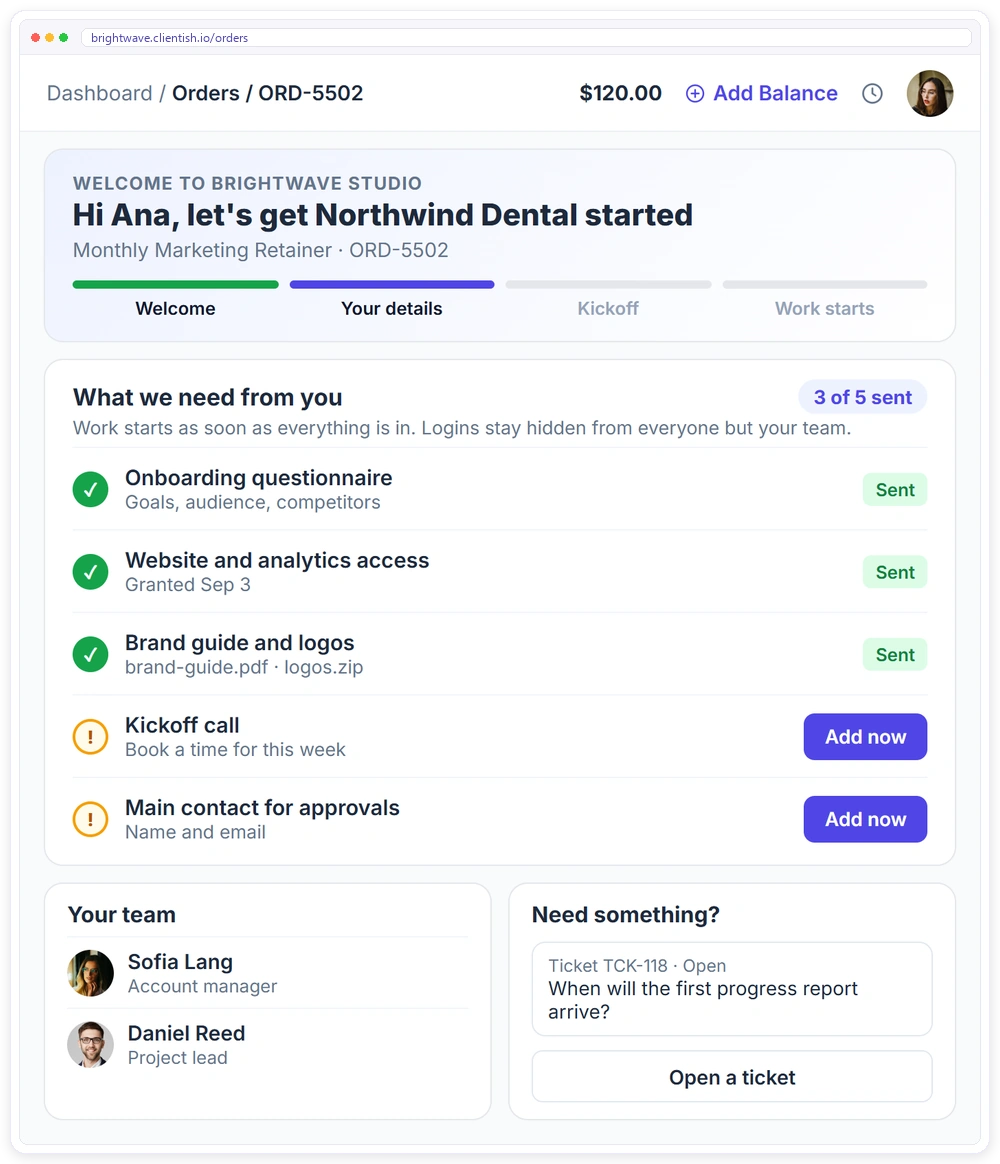
A checklist keeps your team on track. The part the client actually experiences, though, is the welcome, the access requests, the first report, and knowing who to contact, and that experience is what a client portal is built to carry.
- ✓A branded client portal on your own subdomain from day one, with orders, invoices and subscriptions
- ✓An onboarding form attached to the service, so the order waits until the client sends what you need
- ✓Logins collected in hidden fields that only your team sees
- ✓Clients open a support ticket with SLA response times instead of chasing you by email
- ✓A task template creates the onboarding tasks with owners and due dates for every new client
Download the free client onboarding checklist template
The editable Word checklist with 24 tasks across three phases, plus access checklist, onboarding questionnaire — core questions, kickoff call agenda (30–45 minutes). Add your branding and run it for every new client.
Frequently asked questions
A client filled in half the questionnaire and hasn't responded since. What should I do?
Chase with a specific ask, not an open nudge. Reply to the original email thread (so there's context), name the exact fields still missing, and give a soft deadline: "I need X and Y by Thursday to keep your start date." If you still get nothing, offer to jump on a ten-minute call and fill it in together — most clients stall because a question confuses them, not because they've lost interest. If the questionnaire is sitting inside a Clientish portal, you can see which sections are incomplete and reference them directly in your message rather than asking the client to re-find the form.
Should onboarding look different for a £500/month client versus a £5,000/month client?
Yes. Use the same three phases for both, but calibrate the depth of each step to the retainer size: a lean intake and one kickoff for a small account, fuller discovery and more frequent early check-ins for a large one. Over-onboarding a small client eats the first month's profit, while under-onboarding a large one signals an informal process and erodes confidence early.
Can I run this checklist for multiple clients at once without things falling through the cracks?
Only with a system around the checklist, not just copies of the file. When two clients sign in the same week and the process lives in someone's memory, one gets a kickoff by day five while the other is still waiting, and the one who got the weaker start is the one who starts to doubt the decision. A shared tracker, a project-management column showing each client's phase, or a client portal that manages all of them from one dashboard is what keeps the start consistent.
What if a client pushes back on the kick-off call, they just want you to get started?
Do not skip the call; shorten it, and reframe it as the thing that saves them from being asked questions every few days. If they still refuse a live call, collect the same answers through a short async video or the questionnaire. What you cannot skip is the kickoff's output: agreed scope, confirmed contacts, and signed-off priorities, in whatever format gets you there.
Does the checklist still apply if I'm onboarding a client onto a retainer I'm inheriting from another agency?
It applies, but add a "transition audit" step at the start of Phase 1: document what you are inheriting (access the previous agency held, commitments made, what the client believes is included), flag anything broken or missing, and be explicit about what you are starting fresh versus continuing. Clients who had a bad experience with a previous agency watch closely in the first 30 days, so a clean, documented handover is itself an early confidence signal.
Related Templates
If you want to tighten the rest of your client paperwork around onboarding, these free templates pair well with this one: More free, editable templates from the Agency Templates Library.
Agency Retainer Agreement
The core retainer contract, ready to brand.
CONTRACTStatement of Work (SOW)
Scope, deliverables, acceptance and milestones per project.
ONBOARDINGProject Intake Questionnaire
The discovery questions to ask before you scope.
CHECKLISTClient Offboarding Checklist
End an engagement cleanly, with nothing missed.
CHECKLISTSEO Client Onboarding Checklist
Access, baseline and Search Console set up in week one.
CHECKLISTSocial Media Onboarding Checklist
Voice, content pillars and the approval workflow.
CHECKLISTSocial Media Onboarding Checklist
Voice, content pillars and the approval workflow.
CHECKLISTPPC Client Onboarding Checklist
Conversion tracking, MCC access and billing ownership.
CHECKLISTWeb Design Onboarding Checklist
Content owners, assets, brief and sitemap.
CHECKLISTCreative Agency Onboarding Checklist
The full brand kit before the first concept.