
Project Intake Questionnaire Template
Most of what goes wrong on a project was decidable on day one — the budget nobody named, the real approver who surfaced in week three, the "success" the client was quietly measuring that the agency never asked about. None of these were hidden.
Free to download and edit · No watermark · Add your own branding
They were simply never asked, because the project started on enthusiasm and a rough brief instead of a structured set of questions. A project intake questionnaire is that set of questions: the handful you ask every new client before scoping anything, so the project is built on answers rather than assumptions.
This page gives you a free, editable project intake questionnaire template for agencies and freelancers — the discovery form you send a new client before you write a proposal or a Statement of Work. It is organised into the categories that actually shape a project: the client's goals and how they define success, the budget and timeline they are working to, who makes the decisions, and the access and assets the work will need. Download it, trim it to the questions your service needs, and send it to every new client before scoping begins.
What Is a Project Intake Questionnaire?
A project intake questionnaire is a structured set of discovery questions an agency sends a prospective or new client to gather the information needed to scope and price a project accurately.
It is completed before the proposal or Statement of Work is written, and its answers are the raw material those documents are built from. Where a conversation wanders, a questionnaire ensures the same essential questions get asked and answered every time.
Its job is specifically to surface the things that determine scope: what the client wants to achieve, how they will judge whether it worked, what they can spend, when they need it, who signs off, and what they already have. Asked up front and in writing, these answers let an agency scope a project it can actually deliver and price it against reality, rather than discovering the constraints halfway through.
How it differs from the documents around it
It is worth separating from the two documents it is often confused with. An onboarding checklist is an internal list of the steps your team runs after a client signs — it tracks your tasks. An intake questionnaire is the opposite direction: a list of questions you ask the client, before they sign, to decide whether and how to take the project on. And unlike a Statement of Work, which records the decisions, the questionnaire gathers the inputs those decisions are made from. Intake comes first; the SOW is written from what it returns.
Why Your Agency Needs an Intake Questionnaire
The cost of skipping structured intake is not visible at the start. It shows up later as a mis-scoped project, a budget mismatch, or an approval that unravels work already done — each traceable to a question that was never asked.
It prevents the budget mismatch
Asking the budget range up front — a question many agencies avoid out of awkwardness — is what stops you from scoping a project the client was never going to pay for, or under-pricing one they would have paid more for.
It surfaces the real decision-maker
Asking who gives final approval, before work starts, avoids the most expensive kind of rework: the version everyone liked being overturned by a stakeholder who was never in the room.
It captures how the client defines success
A client measuring success by leads, and an agency optimising for traffic, can both be satisfied with the work and still part ways unhappy. Asking the success metric aligns the project to what the client is actually counting.
It makes the scope accurate
Deliverables, timeline, and must-haves gathered in writing become the basis of a Statement of Work you can stand behind, rather than a scope assembled from memory of a call.
It reveals the constraints early
The fixed launch date, the platform you must use, the content that does not exist yet — the things that break a timeline are the things intake is designed to expose before you commit to one.
The Risks of Scoping Without Structured Intake
Scoping a project from a loose brief and a good feeling is how most scope disputes begin. Here is how the gaps tend to surface.
The agency scopes and proposes, then learns the client's budget is a fraction of the quote. Days of back-and-forth, or the whole opportunity, are lost to a number that one question would have surfaced on day one.
The work is done and approved by the contact, then a founder or head of marketing who was never mentioned sees it, disagrees, and sends it back. The rework is unpaid and the timeline is wrecked.
The project delivers exactly what was scoped, and the client is still unhappy, because they were measuring something — revenue, sign-ups, a specific ranking — the agency never knew was the real goal.
Scope assumed the client had copy, images, or data ready. They did not. The project sits in limbo because the question "what do you already have?" was never asked.
Without structured intake, the scope is a set of guesses about what the client meant. Each guess that turns out wrong is a change, a delay, or an argument later.
Each of these is a question in the template below.
The Question Categories of a Strong Intake Questionnaire
The template groups its questions into the categories that shape a project. Here is what each category is for and the one question in it you cannot skip.
Contact and Basics
Who you will be working with day to day, their role, preferred way to communicate, and time zone. Short, but it sets the logistics of the whole engagement. The question not to skip: who is the primary point of contact, and is that person also the final approver?
Business and Background
What the company does, who its customers are, where it sits against competitors, and what makes it different. This is the context the work has to fit inside. The question not to skip: what does your company do, and who is the primary customer you serve? A client who sells software to enterprise procurement teams needs fundamentally different messaging, visuals, and deliverables than one selling direct to consumers. You cannot make those calls correctly without this answer.
Goals and Success Metrics
What the project is meant to achieve and, critically (the part most forms miss), how the client will measure whether it worked. The question not to skip: how will you know this project succeeded? A client who answers "more qualified leads" has just told you what to optimise for, and what they will judge you on.
Project Scope and Deliverables
What the client thinks they need, the must-haves, and anything explicitly out of bounds. This is the first sketch of the scope your Statement of Work will formalise. The question not to skip: what are the specific deliverables or outcomes you expect from this project?
Budget and Timeline
The budget range and any fixed dates. Both are questions agencies hesitate to ask, and both are the ones that most determine whether a project is viable. The question not to skip: what budget range are you working with for this project? Asking it is not pushy; it is how you avoid wasting everyone's time.
Decision-Making and Approvals
Who signs off, how many stakeholders are involved, how feedback is given, and the expected turnaround on approvals. The question not to skip: who gives final sign-off, and who else needs to approve along the way? This single answer prevents the end-of-project reversal.
Access, Assets, and Logistics
What the client already has (brand guidelines, content, platform access, existing tools) and what will need to be created or granted. The question not to skip: what assets and access do you already have ready, and what still needs to be produced?
Tips for an Intake Questionnaire That Actually Gets Answered
A questionnaire only helps if the client completes it and the answers are usable. A few disciplines make the difference.
Send the form 24–48 hours before the discovery call, not after it
Sending it too late means you spend the call gathering basics instead of pressure-testing scope. Sending it too early (more than a week out) and clients treat it as optional homework they never return to. The window between booking and the call is when motivation is highest.
Ask one thing per question
A bundled question like "What is your timeline and do you have an existing brand identity we should follow?" routinely produces a single answer about timeline and nothing about brand assets — the omission that later forces a mid-project creative reset. Separate every compound ask so each question returns exactly one usable answer.
Always ask the budget
It is the question agencies most want to skip and the one that saves the most wasted effort. Offer ranges if a blank field feels too direct, but ask it.
Always ask who approves
Naming the final decision-maker up front is the cheapest insurance against end-of-project rework there is.
Decide in advance whether a skipped question blocks progress or triggers a follow-up
Budget and decision-maker fields warrant a follow-up message before the discovery call proceeds; a skipped "anything else we should know?" does not. Having that policy written down stops your team from inconsistently chasing some gaps and silently absorbing others into scope.
Write questions whose answers go straight into a Statement of Work
Deliverables, timeline, budget, and success metric are not just getting-to-know-you questions. They are the fields of the SOW you will write next, so ask them in a form that makes that transfer easy.
Leave room for what you did not think to ask
A final open question — "is there anything we have not asked that we should know?" — regularly surfaces the single most important constraint on the project.
How to Use the Free Intake Questionnaire Template
Putting the questionnaire to work takes four steps.
Start from a copy
Download the Word (.docx) file, or upload it to Google Docs, and work on your copy, not the original.
Trim to your service
Keep the ten to fifteen questions that matter for the work you do, and cut the rest so the form stays short enough to complete.
Send it before you scope
Make completing the questionnaire the step between the first conversation and the proposal, so you are scoping from answers, not assumptions.
Scope the project from the answers
Carry the deliverables, budget, timeline, success metric, and approver straight into the Statement of Work you write next.
Collecting Intake and Running the Project in One Place
A questionnaire gathers the answers. Once the client signs, the relationship moves on to invoices, approvals, and a shared place to work — and that is where a client portal takes over from the intake form.
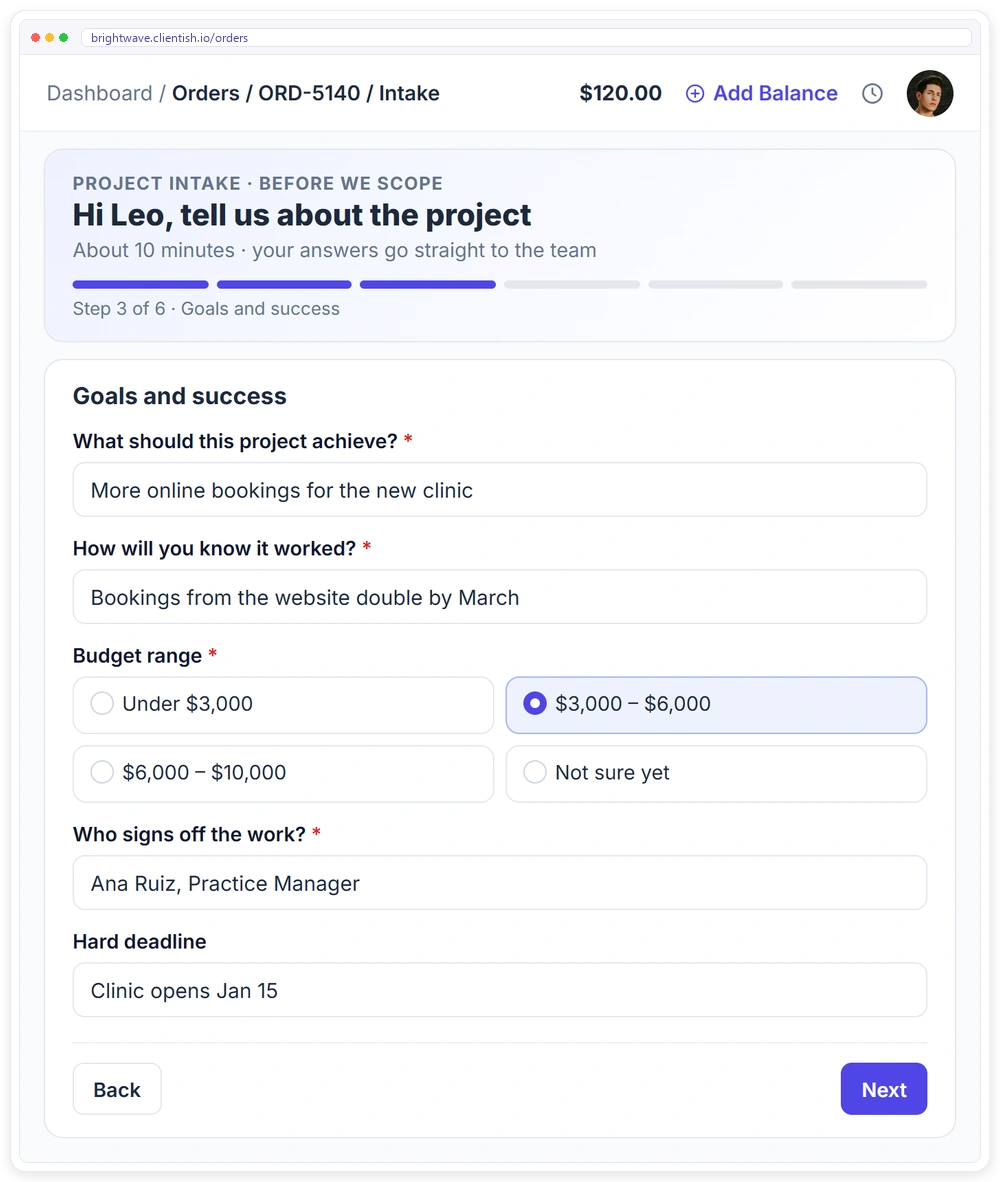
- ✓The questionnaire as an intake form clients fill in from their portal
- ✓Attach it to a service, and the order waits until the answers are in
- ✓Logins collected in hidden fields that only your team sees
- ✓Files and brand assets uploaded with the answers
- ✓Every answer saved on the client’s order, next to the work
Download the free project intake questionnaire template
The editable Word file with all 8 sections. Replace the brackets, add your branding and use it with every client.
Frequently asked questions
Is this project intake questionnaire template free to use?
Yes. There is no watermark and no cost. Open it in Google Docs or Word, trim it to the questions your service needs, and send it to every new client before you scope their project.
What is the difference between an intake questionnaire and an onboarding checklist?
An intake questionnaire is a set of questions you ask the client before scoping, to gather the information a proposal needs. An onboarding checklist is an internal list of the steps your team runs after the client signs. Intake is client-facing and comes first; the checklist is internal and comes after the contract.
How many questions should an intake questionnaire have?
Enough to scope accurately, few enough that the client actually finishes, which in practice tends to mean a focused set of around ten to fifteen rather than fifty. A short form that can be completed in one sitting gets returned, while a long one gets abandoned or half-answered. Pick the questions your specific service needs and cut the rest.
Should I really ask the client's budget?
Yes. It is the question agencies most often skip and the one that prevents the most wasted effort, since scoping without knowing the budget risks pricing something the client was never going to buy. If a blank field feels too direct, offer ranges, but ask it.
What if a client pushes back on filling in a form first?
Frame it as saving them time, not gatekeeping: the form means you arrive at the first call already familiar with their situation, so the call can focus on decisions rather than background. If a client still refuses, run a discovery call and fill the questionnaire in yourself from their answers, since the structure matters more than who types it.
How does the questionnaire connect to a Statement of Work?
The questionnaire gathers the inputs; the Statement of Work records the decisions made from them. The deliverables, budget, timeline, success metric, and approver you collect in intake become the fields of the SOW you write next, which is why a good questionnaire is structured so its answers transfer straight into scope.
Related Templates
If you take on new client projects, these free templates pair well with the Intake Questionnaire: More free, editable templates from the Agency Templates Library.
Statement of Work (SOW)
Scope, deliverables, acceptance and milestones per project.
CONTRACTClient Service Agreement (MSA)
The legal terms you sign once with every client.
CHECKLISTClient Onboarding Checklist
The 3-phase onboarding checklist for any agency.
RETAINERAgency Retainer Agreement
The core retainer contract, ready to brand.
BRIEFCreative Brief
Align the team and the client before work starts.
PROJECTChange Request Form
Turn scope creep into a priced, approved decision.