

ManyRequests and Clientish are both client portals for agencies that sell defined services, so on paper they look alike: a catalogue, a request or order queue, billing and a branded login. The differences show up in three places: how each one prices your team, how clients pay you, and what sits around the queue, such as proofing on the ManyRequests side and tickets, proposals and accounting sync on the Clientish side.
Quick answer: ManyRequests suits creative and video agencies that need annotated proofing, large file delivery and their own domain on every plan. Clientish suits agencies with growing teams and mixed payment methods: eight people cost $39 a month on Clientish Growth against roughly $144 on ManyRequests Core, and Clientish adds a ticket desk with reply targets, native proposals and direct QuickBooks and Xero connections.
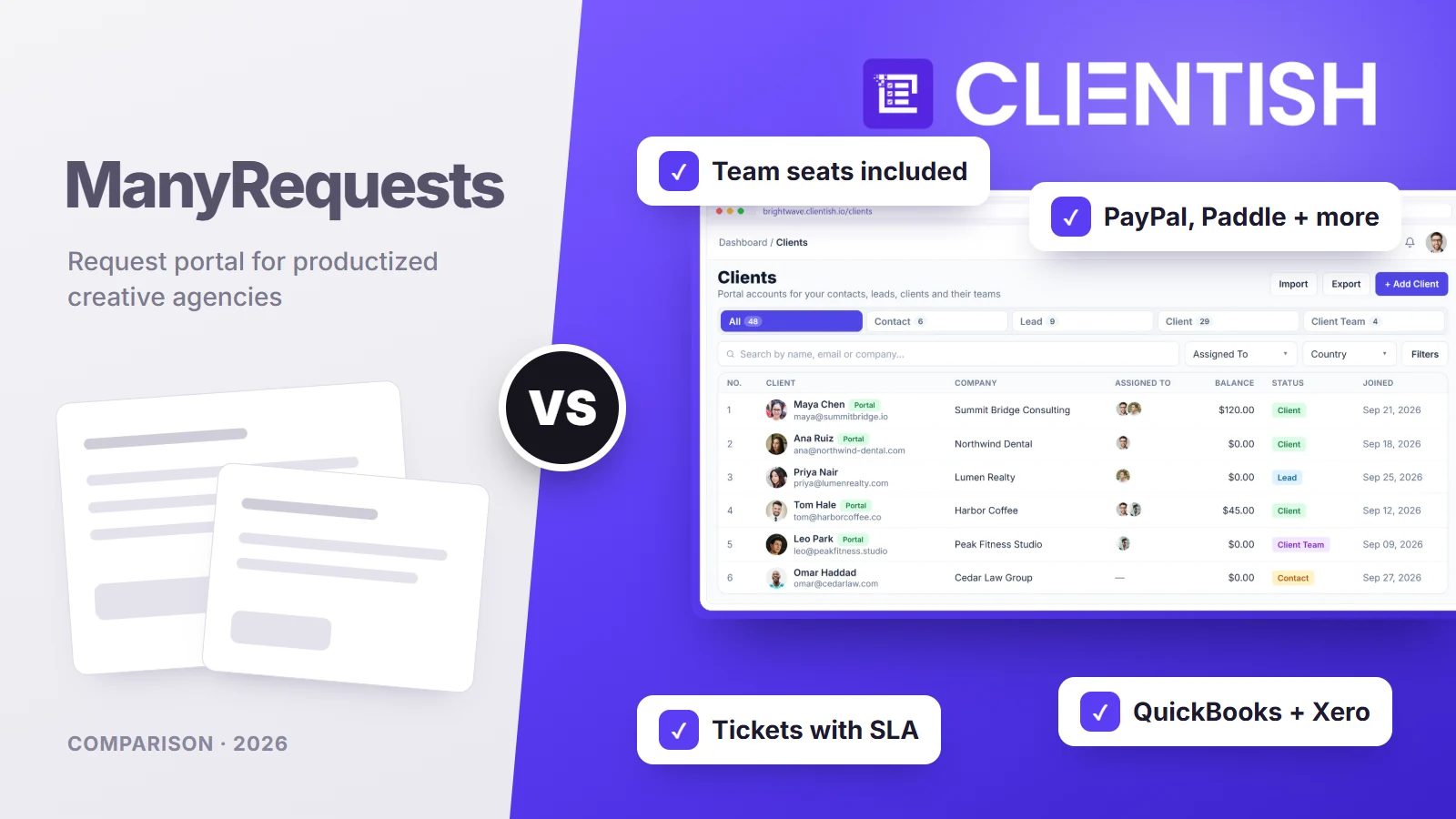
The sections below cover seat pricing, files and proofing, billing models, the portal and queue, branding, support tickets and reliability, based on ManyRequests’ pricing page, help centre and changelog as of October 2026.
Key Takeaways
ManyRequests rebuilt its pricing in August 2025 and has shipped a lot since: an API, an MCP server, time approvals and self-serve plan changes. Many third-party pages haven’t caught up. Five points matter most today.
- Seats: every ManyRequests plan includes one team seat; each extra costs $15 to $30 a month. Clientish plans include 5, 15, 30 or 50 people.
- Payments: Stripe is ManyRequests’ only automatic gateway; PayPal, Wise and bank transfers are recorded by hand. Clientish takes Stripe, PayPal, Paddle and SSLCommerz, plus bank transfer.
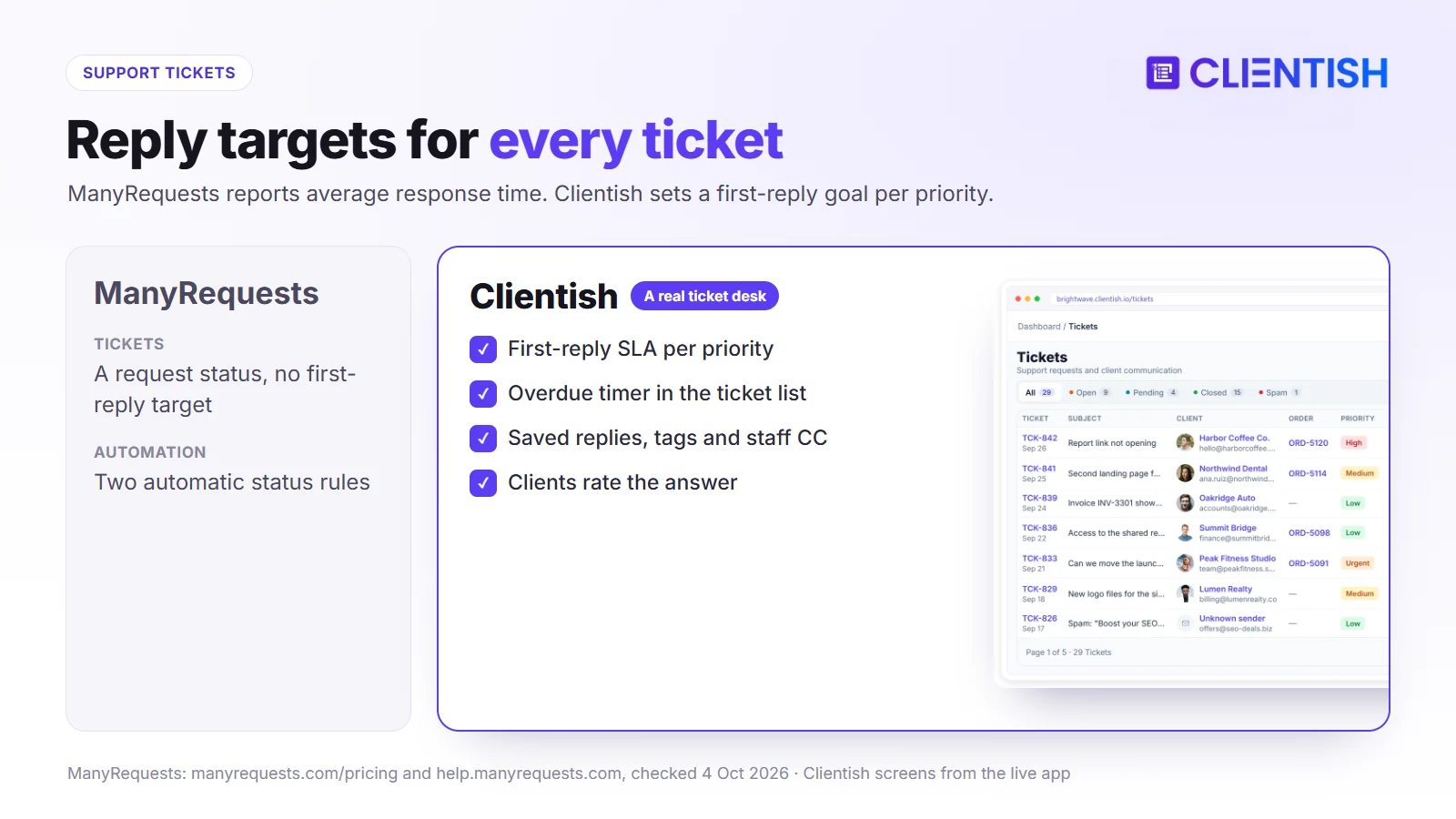
- Support work: ManyRequests handles tickets as requests with a “ticket” status and has no first-reply targets. Clientish has a separate ticket desk with SLAs per priority.
- Where ManyRequests leads: custom domain on every plan, design and video proofing, files up to 10 GB each, eight portal languages and automatic card billing for subscriptions.
- Sales and books: Clientish has proposals, a leads pipeline and QuickBooks and Xero connections; ManyRequests has none of the three.
ManyRequests vs Clientish at a Glance
The table below sets ManyRequests’ October 2026 plans against Clientish’s, row by row, from seats and payments to proofing, tickets and integrations. The Clientish column is shaded.
| Dimension | ManyRequests | Clientish |
| Plans (monthly / yearly) | Core $59 / $39; Pro $99 / $79; Enterprise from $1,000 | Starter $29 / $23; Growth $49 / $39; Pro $99 / $79; Enterprise $149 / $119 |
| Team seats included | 1 (extra $15–$30 each) | 5, 15, 30 or 50 |
| Clients | Unlimited | New clients per month: 10, 50, 100, unlimited |
| Automatic payments | Stripe (cards, ACH); others manual | Stripe, PayPal, Paddle, SSLCommerz; bank transfer |
| Custom domain | Every plan | No; clientish.io subdomain |
| Proofing | Annotations on images, PDFs and video | Not offered |
| Support tickets | Requests with a ticket status; no SLA | Ticket desk with first-reply SLA |
| Proposals and leads | Not offered | Proposals; leads pipeline on Growth+ |
| Live chat | Through Intercom, Crisp or similar embeds | Native, Growth and up |
| QuickBooks / Xero | No | Yes |
| Free trial | 14 days, no card | 14 days |
ManyRequests is stronger for visual delivery and branding depth. Clientish is stronger for team cost, payment options and everything around the sale.
Who This Comparison Is For
You run a productized or retainer agency (design, video, web, content or marketing) and you’re choosing a portal clients will submit work through. ManyRequests is likely on your shortlist because it was built for exactly that model and says it serves 1,800+ agencies.
The decision mostly turns on your team and your clients. A small design shop where most work is visual feedback will value ManyRequests’ proofing. A growing agency with account managers, writers and freelancers, clients paying in different ways, and support questions alongside the work will feel the seat costs and the gaps around sales and support.
What ManyRequests users ask for
ManyRequests has few public reviews (seven on Capterra, all from May 2026, and no Trustpilot page), so these themes come from those reviews and the limits stated on its own pricing page:
- Seat costs as the team grows. One seat is included; every colleague after that is billed.
- Pro-only features. Removing “Powered by”, Slack, webhooks, the API and workload planning all need Pro.
- Light automation. Only two automatic status rules can be set.
- The request model on custom work. A queue fits defined services better than bespoke projects.
- Nothing for the sales side. No proposals, no sales pipeline and no accounting sync.
Meet ManyRequests: Best for Creative Shops That Run on Requests
ManyRequests calls itself a “client portal for agencies and productized services”. Clients submit requests through forms, the team works a queue, and billing runs through Stripe. It has added a public API, an MCP server for AI assistants, Hubstaff sync and time-entry approvals over the past year.
Key features:
- Requests: forms per service with conditional rules, requests by email, limits on active or monthly requests, Kanban, list and queue views.
- Proofing: annotations on images, PDFs and video with timestamps, plus version control.
- Billing: subscriptions and retainers, hourly and credit billing, top-ups, setup fees, add-ons, discount codes and trials, through a catalogue or custom order forms.
- Messaging: an organisation chat plus private chats, canned and scheduled responses.
- Time: timers, timesheets and client-visible time, with approvals added in October 2026.
- Branding: custom domain, SMTP email, custom CSS and eight portal languages.
Seat add-ons and the Enterprise tier are covered in the pricing section below.
Meet Clientish: Best for Agencies That Need Room for a Team and More Ways to Get Paid
Clientish puts each client’s orders, invoices, subscriptions and support history on one record, and gives the client a portal to buy services, follow the work, request changes and raise problems. Each plan includes a set number of team members (5, 15, 30 or 50) instead of one seat.
How Clientish differs from ManyRequests:
- Seats in the price: a whole team fits in one price (up to 50 people on the top tier), and access is shaped with your own roles, individual exceptions, departments and deputies.
- Four automatic gateways: Stripe, PayPal, Paddle and SSLCommerz, plus bank transfer and a prepaid client balance.
- A separate ticket desk: priorities with first-reply targets and an overdue timer, saved replies, tags, staff CC and client ratings.
- Proposals and leads: eleven proposal designs; acceptance sets up the client, invoice and order at once.
- QuickBooks and Xero: invoices flow into your books without Zapier.
- Native live chat (Growth and up): no third-party widget needed.
- Catalogue to order: a cart with coupons, an order per purchase, the service’s brief and a revision allowance.
- Remote members with approved hours: contractors see only what their remote role allows, and clients sign off their time before billing.
Clientish’s four tiers run from $29 to $149 a month, or $23 to $119 on yearly billing. See the pricing page for each plan’s monthly allowances.
How We Compared
We tested both against the way a productized agency works week to week, and against the specific limits ManyRequests and its users mention most.
- Team pricing at one, three, eight and fifteen people
- Files and proofing for design and video work
- Billing models: subscriptions, one-off work, credits and gateways
- The client portal and request queue
- Branding and what each plan unlocks
- Support tickets and client management
- Reliability and support from each vendor
ManyRequests’ pricing page contradicts itself in places (included seats, storage, which plan has the API); where it does, we used its help centre. Sources are listed at the end.
Pricing: Per Seat or Seats Included, What Happens as Your Team Grows?
Winner: Clientish from the second team member onwards. A solo operator pays a similar amount on either; after that, ManyRequests adds a seat charge per person.
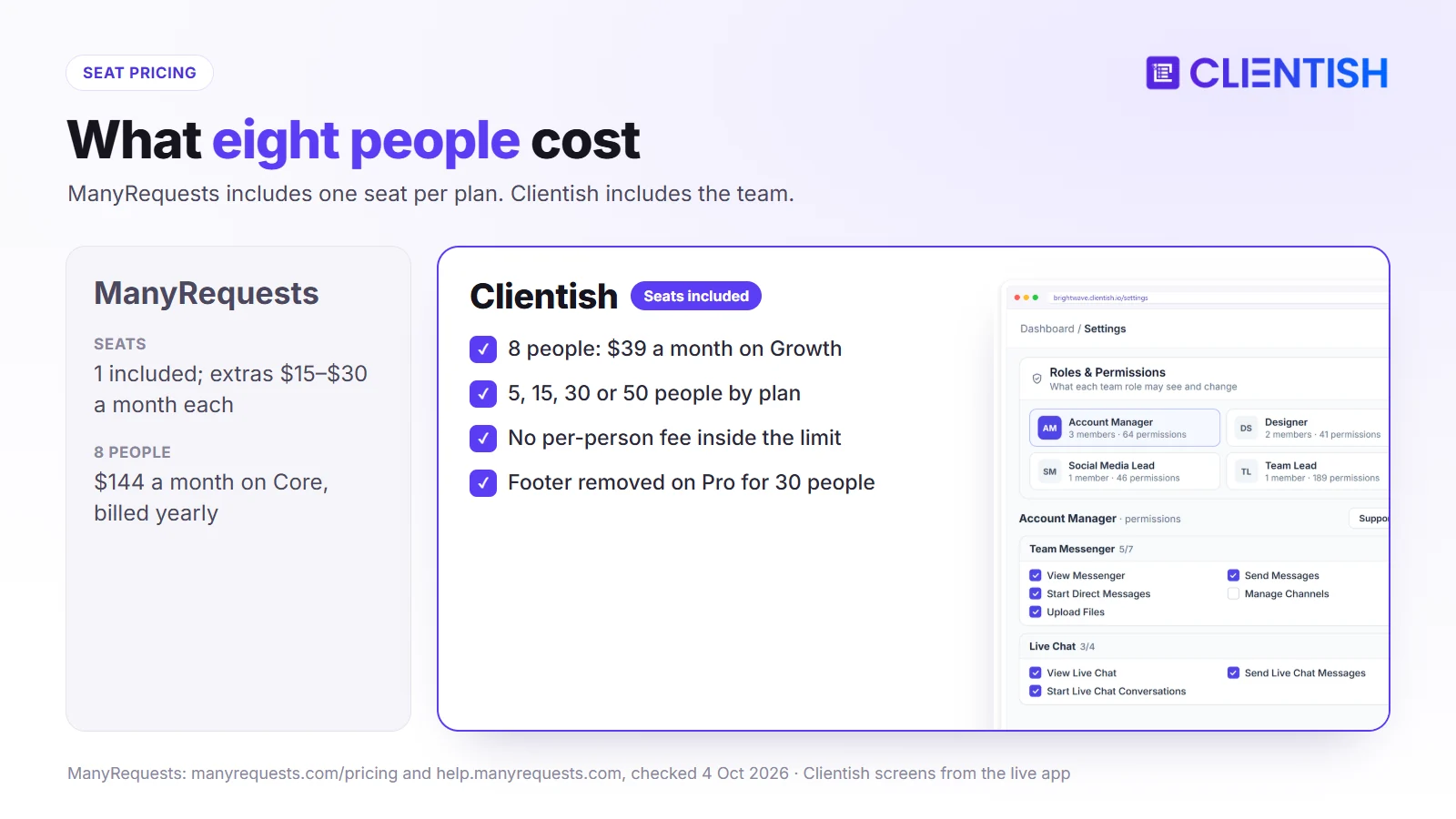
Since August 2025, every ManyRequests plan includes one seat. Its own help example: Core at $59 plus two extra seats at $20 each is $99 a month.
What the Per-Seat Model Costs at Team Scale
All figures use yearly billing: ManyRequests Core at $39 plus $15 per extra seat, or Pro at $79 plus $25; Clientish Starter at $23 for up to five people and Growth at $39 for up to fifteen.
| Team | ManyRequests Core | ManyRequests Pro | Clientish |
| 1 person | $39/mo | $79/mo | $23/mo (Starter) |
| 3 people | $69/mo | $129/mo | $23/mo (Starter) |
| 8 people | $144/mo | $254/mo | $39/mo (Growth) |
| 15 people | $249/mo | $429/mo | $39/mo (Growth) |
Where ManyRequests Holds Its Own on Price
ManyRequests has no cap on clients, while Clientish limits new clients per month on its lower plans (10 on Starter, 50 on Growth). An agency signing dozens of new clients every month with a tiny team could hit that limit before it notices the seat difference. ManyRequests also includes a custom domain on Core, which Clientish doesn’t offer at any price.
What Clientish’s Plans Get You
For the same eight-person team, Clientish Growth includes live chat, leads and five remote members on top of the 15 seats, and every plan includes branding, tickets and the catalogue. Removing the “Powered by” line needs Pro on both products, at $79 a month yearly, but Clientish Pro covers 30 people against ManyRequests Pro’s one.
The Billing Flexibility Gap
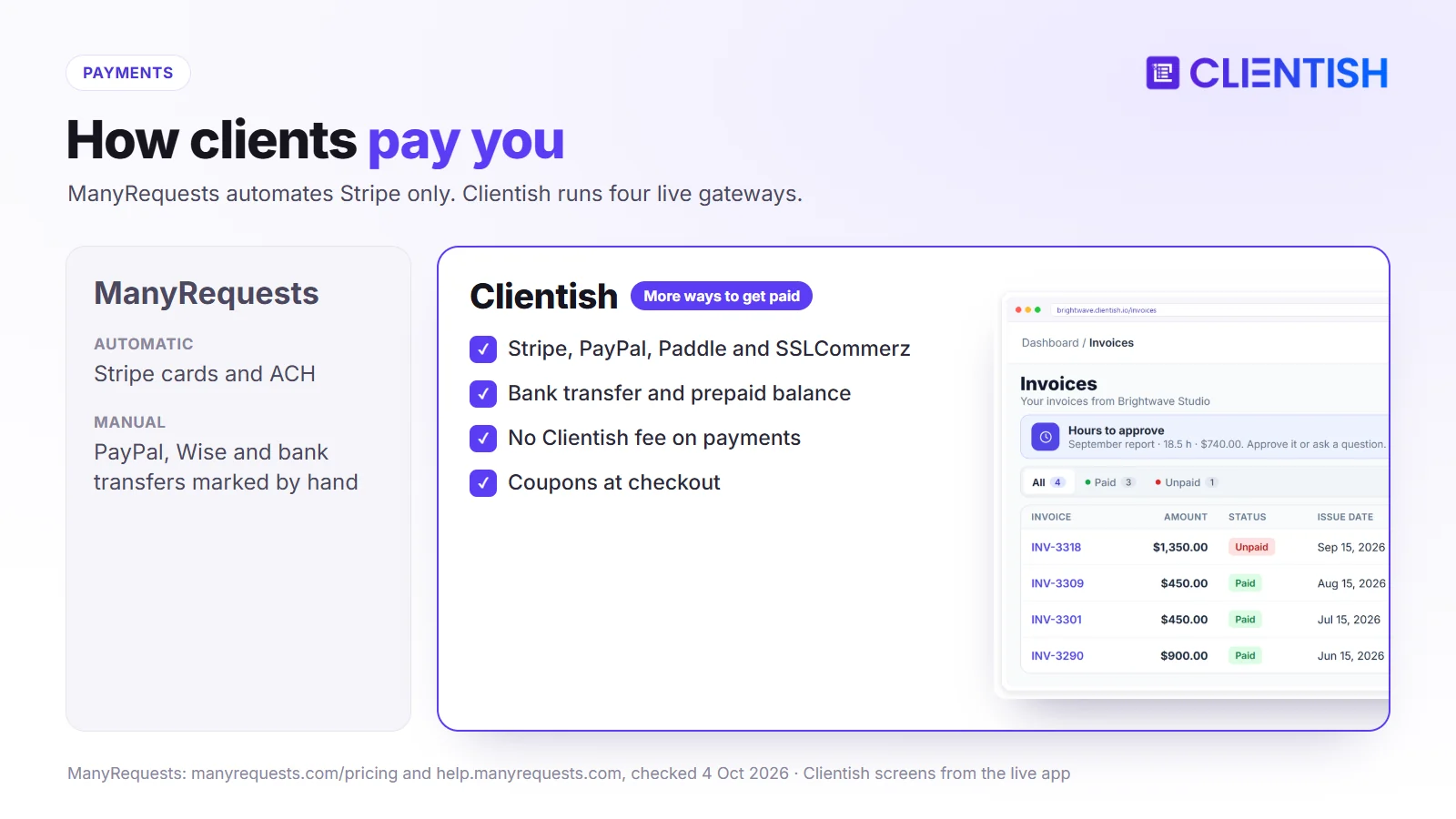
Neither charges a transaction fee. The difference is reach: ManyRequests automates only Stripe, so a client who wants to pay by PayPal is handled as a manual payment you mark as paid. Clientish runs PayPal, Paddle and SSLCommerz as live gateways, which matters for agencies whose clients pay outside Stripe’s markets. Try your own gateway on a 14-day Clientish trial.
Storage and Asset-Heavy Delivery: Who Handles Design and Video Files?
Winner: ManyRequests. It’s built for creative delivery: annotated proofing on images, PDFs and video, version control and files up to 10 GB each.
If your clients review logos, layouts or edits, the feedback tool matters as much as the queue.
ManyRequests lets clients and staff place comments on an exact spot of an image or PDF, or at a timestamp in a video, with Loom recordings attached to files. Storage starts at 500 GB on Core by its help centre (the pricing table says more), with extra space at $25 per 500 GB. Clientish attaches files to orders and deliveries, but it has no proofing tool; agencies doing heavy visual review alongside Clientish typically link a proofing app or shared drive, and Clientish orders can hold Google Drive links.
Billing Flexibility: Subscriptions Only, or Mixed Models?
Winner: tie on models, Clientish on gateways. Both handle subscriptions and one-off work; ManyRequests adds credits and hourly billing, Clientish adds more ways to collect payment.
Productized agencies rarely bill one way. Some clients pay monthly, some buy a one-off audit, some prepay a block of hours.
What ManyRequests handles well, and where it strains
ManyRequests supports subscriptions and retainers, one-off services, hourly and credit-based billing with roll-over, top-ups and client balances, setup fees, add-ons, discount codes, trials and request-based invoices billed outside the subscription cycle. Subscriptions charge the client’s card automatically through Stripe, with retries and email notices when payment fails. The strain is the gateway: anything other than Stripe is manual.
How Clientish handles the same scenarios
On Clientish, retainers, single purchases, discount codes and money held on account all live in the same billing area. A subscription doesn’t charge a stored card; each cycle reopens the invoice and the client pays it in the portal with whichever gateway you’ve connected. There’s no credit or hours-bank system, but contractor hours can be logged and approved by the client before invoicing.
Client Portal and Request Queue: How Do Clients Work Day to Day?
Winner: depends on the work. ManyRequests’ queue suits a steady flow of design or video requests; Clientish’s order-and-ticket split suits agencies where delivery and support are different jobs.
Clients judge a portal by how easily they can ask for something and see where it stands.
ManyRequests: The Request Queue
Clients submit requests through service forms with conditional rules, or simply by email; the subject becomes the title and attachments come along. They can reorder priorities, see status, chat with the team and leave a rating when a request is complete. Agencies can cap active requests or requests per month for each service, and onboarding screens walk new clients through setup.
Clientish: The Client Portal
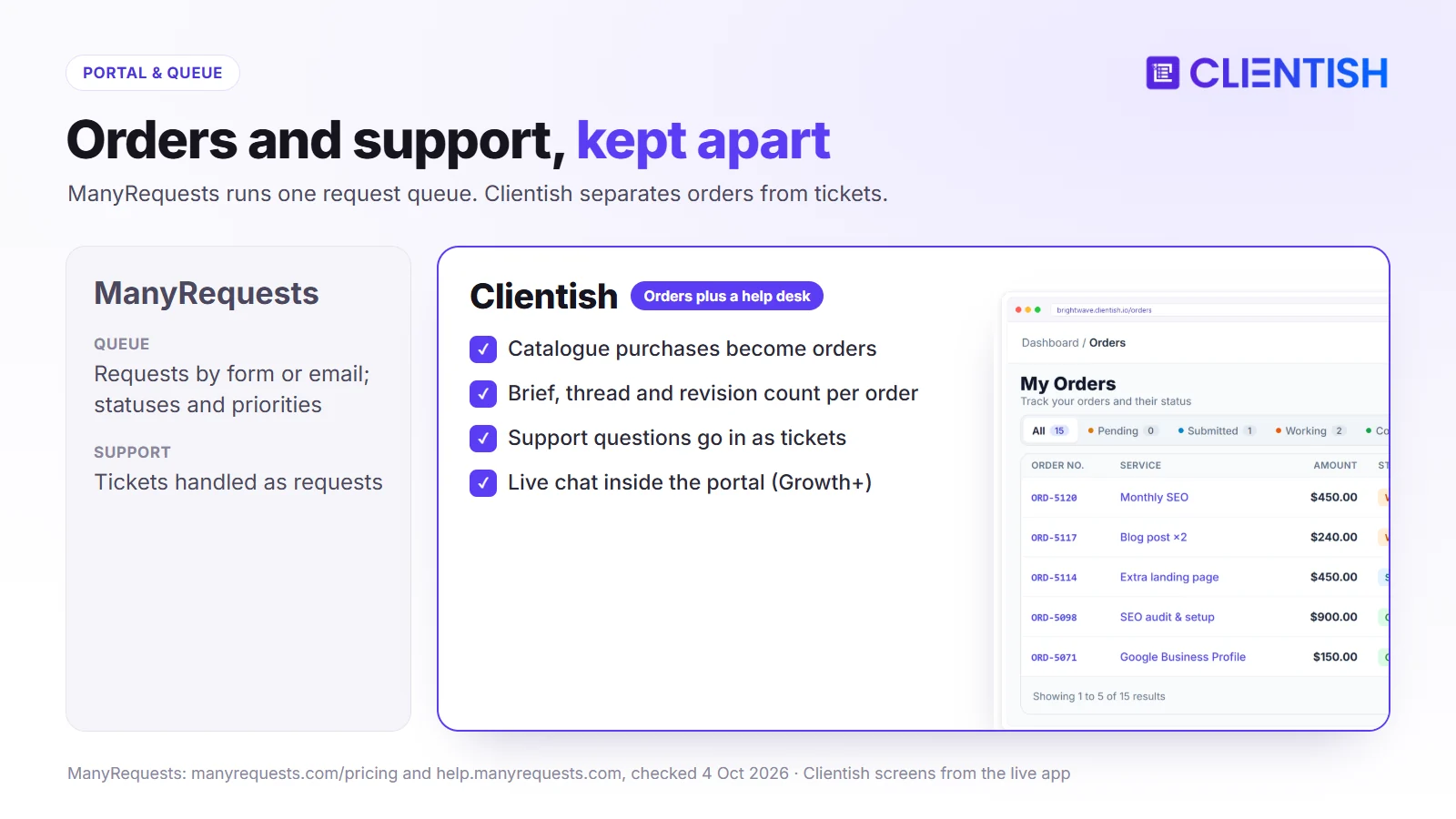
Clientish separates buying from asking for help. Purchases become orders that hold the brief, the conversation, the files delivered and the revisions used; anything that’s a problem rather than a job is raised as a ticket instead. Subscriptions, invoices and a prepaid balance sit in the same portal, and Growth adds live chat.
How Portal Fit Depends on Your Agency Shape
An unlimited-design subscription with a queue of small tasks maps naturally onto ManyRequests. Packaged services sold to many clients, with account managers and a support load, map onto Clientish’s orders and tickets.
White-Label, Branding, and Reporting: What’s Gated?
Winner: ManyRequests on branding: custom domain and SMTP from Core, plus custom CSS and eight languages. Clientish’s branding is on every plan but runs on a subdomain.
Both tools keep a small vendor credit until the Pro plan; what differs is the address and how far you can restyle.
How ManyRequests Handles White-Label and Reporting
Every plan includes a custom subdomain such as portal.youragency.com with SSL, email through your SMTP, logos, favicon, colours, custom CSS and scripts, and portal languages including French, German, Spanish and Korean. “Powered by” removal, Slack, webhooks, the API and workload reports are Pro features. Reports cover time, usage, revenue, reviews and client health.
How Clientish Handles White-Label and Reporting
Clientish applies your logo, colours and favicon and sends mail through your SMTP server on every plan, on a youragency.clientish.io address; the “Powered by Clientish” line goes on Pro. Its reporting focuses on money, services, clients, orders, discounts and logged time; outside tools hook in through webhooks or a read-only API.
Support Tickets and Ongoing Client Management
Winner: Clientish. Tickets are a separate tool with reply targets, saved replies, tags, staff CC and ratings, rather than a status on a request.
Support questions behave differently from production work: they need a fast first answer, not a place in the delivery queue.
What ManyRequests Offers
ManyRequests suggests handling tickets as requests: a client submits one, an automatic rule sets a “Help needed” or “Investigation” status, and Zapier can fire on “Ticket Created”. There’s an average response-time report, but no first-reply target per priority and only two automatic status rules.
What Clientish Offers
Clientish tickets sit next to orders on the client’s record. Each priority has a first-reply target with an overdue timer in the list, and your team works with saved replies, tags, internal notes hidden from the client and colleagues copied in. Clients open, follow and rate tickets from the portal; your staff can attach files and open a ticket straight from an order.
Support and Reliability
Winner: ManyRequests for published support hours, a stated reply goal and a public status page. Clientish counters with chat and trackable tickets on every plan, plus uptime targets by plan in its service level agreement.
Knowing when and how you’ll get help matters most on the day something breaks for a client.
ManyRequests offers email and live chat on all plans, Monday to Friday 9am to 6pm Eastern, aiming to reply “within a few hours”, with priority support and a dedicated account manager on Pro and a public status page. It added two-factor sign-in in September 2026. Clientish gives every plan chat with its team and trackable support tickets, with dedicated support on Enterprise, and uses two-factor sign-in, encrypted secrets and login lockout. ManyRequests links a public status page from its site; Clientish’s service level agreement sets uptime targets from 99.5% (Starter and Growth) to 99.95% (Enterprise).
Where ManyRequests and Clientish Are Similar
Both were designed for agencies selling defined services, so the core loop overlaps more than most comparisons suggest, and switching won’t cost you any of these basics:
- packaged services clients purchase themselves, coupons included
- forms that collect a brief per service
- subscriptions and one-off billing with no transaction fee
- prepaid client balances
- time tracking that clients can review
- Zapier, webhooks and AI assistant connections
- 14-day free trials
The differences are in who pays per seat, how clients pay, and what surrounds the queue.
Where Both Fall Short
Neither is a complete agency operating system, and a few gaps apply to both, so plan for an extra tool here whichever portal you choose:
- Project planning: no Gantt charts or task dependencies in either.
- Contracts: neither has a contract module with e-signature; Clientish captures a typed signature on proposals.
- Native apps: Clientish has no mobile app, and ManyRequests lists a branded mobile app only on Enterprise.
- Deep reporting: ManyRequests reports time, usage and revenue; Clientish reports revenue by service and client, plus margin on remote members’ logged hours. Neither is a full BI tool.
A Real Example: Which Fits a 7-Person Design Agency?
A seven-person design agency (founder, account manager, four designers and a part-time copywriter) sells monthly design subscriptions and one-off brand projects to 30 clients, a third of them in Europe paying by PayPal.
How the Team Size Hits Differently
On ManyRequests Core with yearly billing, seven people cost $39 plus six seats at $15, or $129 a month. On Clientish Growth they cost $39 a month, with room for more people inside the plan’s 15 team members.
Where the Work Breaks Down
On ManyRequests, the European clients’ PayPal payments would be recorded by hand, proposals for brand projects would live in another tool, and the bookkeeper would need an export or a Zapier step to reach Xero. On Clientish, PayPal runs as a live gateway, proposals turn into orders, and invoices sync to Xero; clients’ support questions get their own reply targets.
Where ManyRequests Wins
The designers would miss ManyRequests’ proofing: clients pinning comments to an exact spot on a mock-up or a frame in a video. The agency would also get its own domain on Core.
The Call for This Team
If feedback on visuals is the daily bottleneck, ManyRequests’ proofing may be worth the extra $90 a month. If payments, proposals and support take more of the team’s time, Clientish fits better and costs less.
Pros and Cons
A side-by-side summary of the strengths and drawbacks covered above, to check against what your agency needs most: team size, payment methods, proofing and support.
ManyRequests
| Pros | Cons |
| Proofing for images, PDFs and video | Each extra team member costs $15–$30 a month |
| Custom domain and SMTP on every plan | Only Stripe is automated |
| Credits, hourly billing, top-ups | No proposals, pipeline or QuickBooks/Xero |
| Requests by email; 8 portal languages | No ticket SLAs; two automation rules |
Clientish
| Pros | Cons |
| Team seats included (5 to 50) | No custom domain or proofing |
| PayPal, Paddle and SSLCommerz as live gateways | Subscriptions aren’t charged automatically |
| Ticket desk with SLAs and ratings | Monthly new-client caps on lower plans |
| Proposals, leads, QuickBooks and Xero | English only; no credit-based billing |
Good For / Avoid If
Weigh these against your team size, how clients pay and how much of your work is visual feedback; most agencies will find their answer in the avoid-if lists.
ManyRequests
Good for:
- design and video agencies that live on annotated feedback
- small teams selling unlimited-request subscriptions
- agencies that want their own domain on the entry plan
- credit- or hours-based billing
Avoid if:
- your team will grow past three or four people
- clients pay by PayPal or in markets Stripe doesn’t cover
- you send proposals or need a sales pipeline
- your books are in QuickBooks or Xero
Clientish
Good for:
- agencies with account managers, delivery staff and freelancers
- clients paying through several gateways
- agencies where support questions need fast first replies
- teams that sell with proposals and track leads
Avoid if:
- proofing on images and video is central to your service
- you need your own domain on the portal
- you sign many new clients a month on a very small budget
Migrating from ManyRequests to Clientish
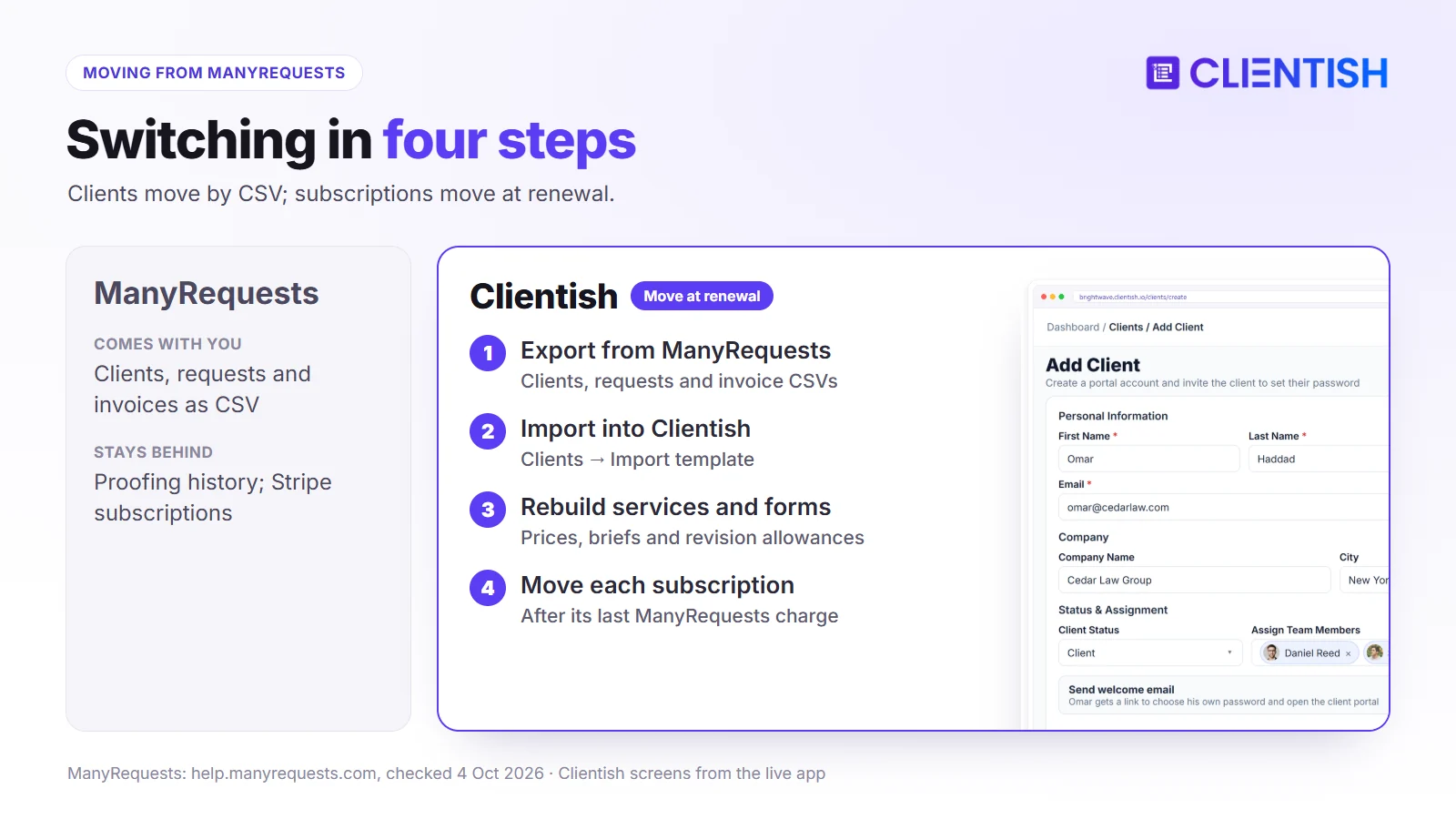
ManyRequests exports requests, clients and team as CSV, and invoices to CSV, so getting your data out is straightforward. The work is in moving billing.
What moves over without much friction
Pull the client CSV out of ManyRequests, map its columns onto the import template in Clientish (Clients → Import) and give each account an owner. Keep the requests export and invoice CSV as your history.
What you’ll need to rebuild
- services and their forms, with prices and revision allowances
- discount codes as Clientish coupons
- proofing, which has no Clientish equivalent; keep a proofing tool or drive links for visual review
- active subscriptions, which live in your Stripe account and need recreating in Clientish
One practical sequencing note
Move retainers at renewal: let each ManyRequests subscription run to its final charge, stop it there so the card isn’t hit twice, and begin the Clientish version from the following cycle. ManyRequests keeps paused portal content for at least a year, which covers the handover.
Frequently Asked Questions
Quick answers for agencies deciding between the two, from seat costs and payment options to proofing, tickets, accounting and switching, each one short enough to scan.
How much does ManyRequests cost?
Core is $59 a month ($39 yearly) and Pro $99 ($79 yearly), each with one seat. Extra seats cost $20 or $30 a month ($15 or $25 yearly). Enterprise starts at $1,000 a month.
How many team members does ManyRequests include?
One per plan. Clientish plans hold between 5 and 50 people.
Which payment gateways does ManyRequests support?
Stripe for automatic card and ACH payments; PayPal, Wise and bank transfers are recorded manually. Clientish runs Stripe, PayPal, Paddle and SSLCommerz, plus bank transfer.
Does ManyRequests charge transaction fees?
No, and neither does Clientish. You pay only your processor’s fees.
Can I use my own domain with ManyRequests?
Yes, on every plan. Clientish uses a subdomain and doesn’t support custom domains.
Does ManyRequests have proofing?
Yes, with annotations on images, PDFs and video. Clientish has no proofing tool.
Does ManyRequests have support tickets?
Tickets are handled as requests with their own statuses, without first-reply targets. Clientish has a ticket desk with SLAs per priority.
Does ManyRequests connect to QuickBooks or Xero?
No. Clientish connects to both.
Is ManyRequests only for subscription agencies?
No. It also handles one-off services, hourly and credit billing, and request-based invoices.
Can I move from ManyRequests to Clientish?
Yes. Export clients as CSV and import them; rebuild services and forms, and move subscriptions at each renewal.
The Verdict: Which Should Your Agency Pick?
ManyRequests is a strong choice for a small creative or video agency whose daily work is visual feedback, that wants its own domain from the first plan and bills mostly through Stripe.
As the team grows and clients pay in more ways, the trade-offs show: each colleague adds a seat charge, non-Stripe payments are manual, and proposals, ticket SLAs and accounting sync are missing.
Clientish covers those: team members are included up to the plan’s limit, PayPal, Paddle and SSLCommerz run alongside Stripe, support has its own desk with reply targets, and proposals and QuickBooks or Xero are built in.
- ManyRequests if proofing and your own domain matter most and the team will stay small.
- Clientish if your team is growing, clients pay through different gateways and support is part of the service.
Start a free Clientish trial, invite your whole team and connect the gateway your clients pay with today.
Sources
Clientish publishes this comparison. We confirmed every ManyRequests detail on October 4, 2026, using its pricing page, help-centre articles on seat pricing, payment gateways, billing models, file limits and custom domains, and its changelog.
ManyRequests is a trademark of its owner; Clientish is not affiliated with ManyRequests. Notice something out of date? Tell us and we’ll update it.

