

Choosing between Dubsado and HoneyBook usually comes down to one question: how much setup time are you willing to trade for more control over how your client experience looks and runs?
Quick answer: HoneyBook is the quicker start. With its template gallery, Smart Files and phone app, a solo business can send a first proposal soon after signing up, though HoneyBook takes customers from just four countries (US, Canada, UK, Australia). Dubsado asks for more setup in return for deeper brand control (your own domain, CSS on forms), per-step automation triggers and a choice of payment processors, though its automations and scheduler sit on the $55 Premier plan. Neither tool has a clear overall edge; the right choice depends on where your business is registered, how your workflow branches and how much time you can give the first build.
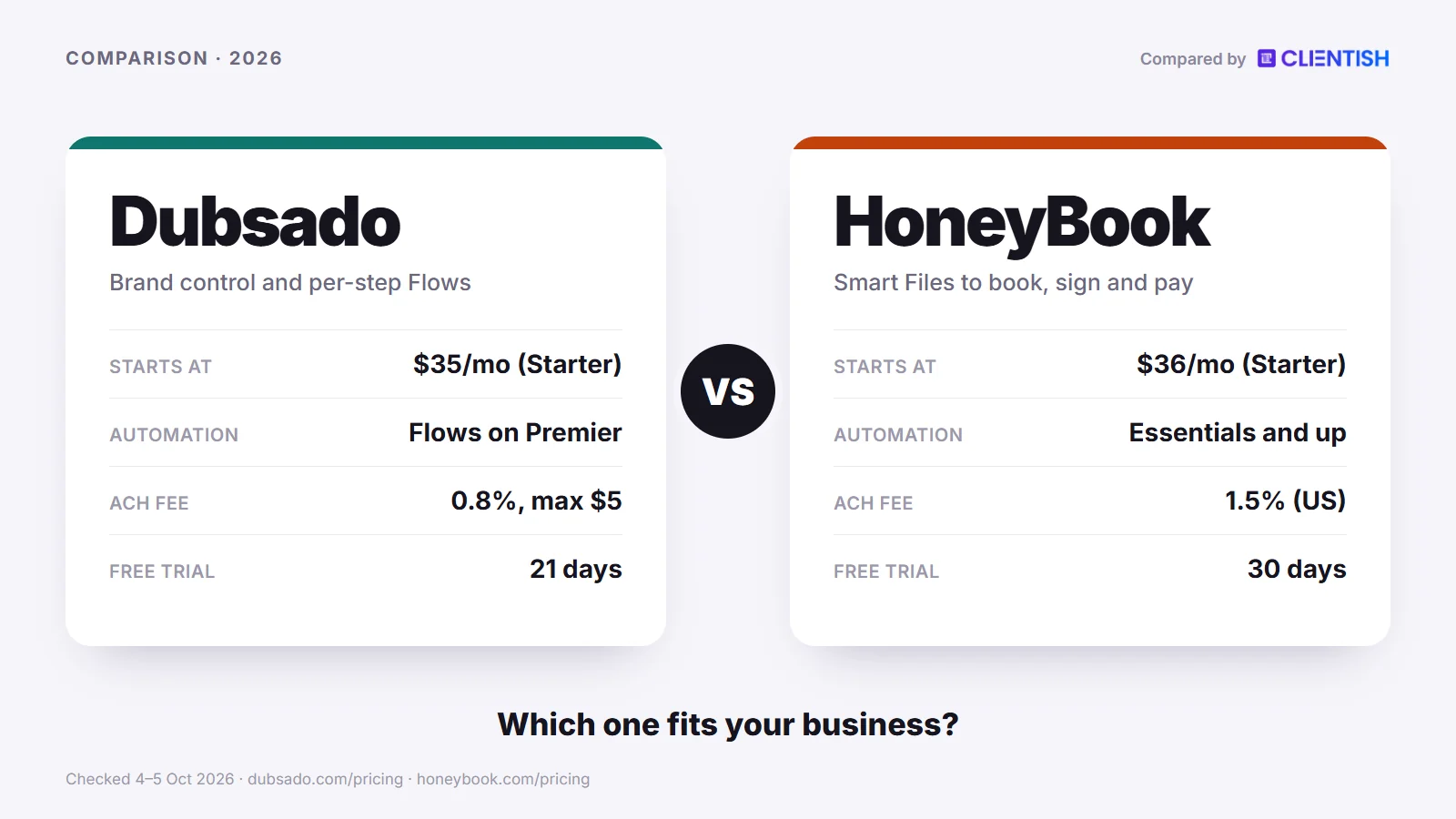
Below, the two are set side by side on cost and fees, automation, setup, branding, payment countries, proposals and phones, followed by the gaps that matter to agencies. Vendor details were read from Dubsado’s and HoneyBook’s own sites on October 5, 2026.
Key Takeaways
Dubsado and HoneyBook are built for overlapping audiences (solo service providers and small creative teams), but they make different trade-offs. Dubsado leans toward configuration and brand control; HoneyBook leans toward speed and ready-made documents.
- Automation: a split decision. Dubsado’s Flows give every step its own trigger (a form completed or still unanswered, a contract signed, an invoice paid) and can change a project’s status or add tags. HoneyBook’s Automations 2.0 branch yes/no on eight kinds of condition, though date-based steps (before or after the project date) can only start an automation. A Dubsado consultant’s 3.0 review reports that if/else branching in Flows is announced but not yet out, and Dubsado’s help pages describe none. Full automation needs Dubsado’s higher plan, Premier, or HoneyBook’s middle plan, Essentials.
- Setup speed: HoneyBook wins. On Capterra, reviewers score its ease of use 4.6 out of 5 against 3.7 for Dubsado, and a recurring Dubsado review theme is that learning to automate takes a long time.
- Mobile: HoneyBook has the edge for proposals on the go, since its app edits Smart Files. Dubsado’s app handles invoices, emails and Tap to Pay too, but Dubsado calls it a companion to the desktop product.
- Where you can be based: Dubsado wins on choice. Dubsado connects to its own Stripe-based Dubsado Payments, to Square or to PayPal. HoneyBook is its own processor and signs up businesses from four countries only: the US, Canada, Britain and Australia.
- Branding: Dubsado wins, by a smaller margin than older reviews suggest. Both let you put client links on your own subdomain. Dubsado adds optional form CSS and keeps its logo off client documents; HoneyBook removes its “Powered by HoneyBook” label only from the Essentials plan up.
- ACH cost: Dubsado wins. Bank transfers through Dubsado Payments cost 0.8% up to a $5 ceiling, while US bank transfers on HoneyBook cost an uncapped 1.5%. On a $5,000 invoice that is $5 against $75, a $70 gap.
Pick Dubsado if your business is outside HoneyBook’s four countries, you want to choose your payment processor, or you want brand control down to form styling. Pick HoneyBook if you are based in one of its four countries, want to be sending proposals this week, and like running client work from your phone.
Dubsado vs HoneyBook at a Glance
Both sit in the same broad category, client management for service professionals, but with different priorities: Dubsado puts its effort into configuration and brand control, HoneyBook into templates and a short path to the first booking. The table shows where each leads.
| Dimension | Dubsado | HoneyBook |
| Starting price | $35/mo, or $335/yr (Starter) | $36/mo, or $29/mo billed yearly (Starter) |
| Client portal | Logo, banner, colours and welcome message; homepage and login screen not editable | Custom branding on every plan; “Powered by HoneyBook” removable from Essentials |
| Own domain and styling | Own domain via CNAME; optional CSS on forms | Own subdomain via “Custom URLs” on every plan; custom fonts from Essentials |
| Setup and ease | Capterra ease of use 3.7/5; long first build | Capterra ease of use 4.6/5; free file setup |
| Automation | Flows (Premier): a trigger per step, status and tag actions, no if/else yet | Automations 2.0 (Essentials+): yes/no branches and an AI builder; pipeline automations on every plan |
| Mobile app | iOS and Android companion app with Tap to Pay | iOS and Android app that edits Smart Files, with Tap to Pay |
| Proposal, contract and invoice together | Proposal leads into contract and invoice through one link | Smart Files: one scrolling document to book, sign and pay |
| ACH fee | 0.8%, capped at $5 (Dubsado Payments) | 1.5% (US) |
| Where the business can be based | Dubsado Payments covers 39 countries; Square or PayPal elsewhere | US, Canada, UK and Australia only |
| Free trial | 21 days, no card (the old 3-client free plan ended November 17, 2025) | 30 days, no card, plus a 60-day money-back guarantee |
| Best for | Established service businesses that want control over branding and flows | Creative solos and small teams in its four countries who want to start fast |
A few things stand out. Monthly list prices are a dollar apart, but on yearly billing HoneyBook Starter costs $348 a year against Dubsado’s $335, and Dubsado’s capped ACH fee matters if clients pay large invoices by bank transfer. HoneyBook bundles the paperwork into a single Smart File; Dubsado gets close by linking a proposal to its contract and invoice, at the cost of more setup.
On branding the gap is narrower than it used to be. Each lets you use your own subdomain for client links, and Dubsado goes further with CSS on forms and no Dubsado logo to switch off. What neither is built for is an agency running many retainer clients through a team, a category gap we come back to later.
Put plainly: a business registered beyond HoneyBook’s four countries cannot become a HoneyBook customer. Dubsado says it serves business owners internationally: its own Dubsado Payments supports merchants in 39 countries, and Square or PayPal can cover others.
What Changed at Dubsado and HoneyBook in 2025–2026
Much of what still ranks for this search predates Dubsado 3.0, HoneyBook’s move into two new countries and the price rises at both companies. The dated list below comes from each vendor’s own blog, help centre and update feed, so you can judge which older claims to ignore.
Dubsado
- March 2025, Tap to Pay: the phone app gained in-person card payments, so a client can tap a card against your phone at a session or venue.
- November 2025, version 3.0: Dubsado replaced workflows with Flows, built by linking nodes on a canvas, and added Kanban and table views for projects, one inbox for client email, a time tracker reachable from anywhere and a redesigned calendar.
- November 17, 2025, trial change: the old trial with no end date and a three-client cap closed to new accounts; newcomers now get 21 days of Premier features with no card.
- December 1, 2025, new prices: Starter went to $35 and Premier to $55 per month for new sign-ups ($335 and $525 on yearly billing), while customers already subscribed stayed on what they paid before.
- May to September 2026, smaller releases: a redesigned invoice builder (May 27), forms drafted by AI from a description or a PDF (June 2), a public checkout page for taking money without an invoice (June 4), a Notetaker that records calls and writes a summary (June 11), a sidebar layout (August 4) and dark mode (September 2).
HoneyBook
- Early 2025, price rise: Wayback Machine snapshots from December 2024 and March 2025 show the yearly-billed Starter plan going up by $13 a month to $29, Essentials by $17 to $49 and Premium by $43 to $109.
- Automations 2.0 (rolled out in 2025, according to third-party reviews): the rebuilt automation builder added yes/no conditions and an AI helper, though project-date steps can now only start an automation.
- March and April 2026: in-person tap payments came to the iPhone app first and Android next, and Canadian members gained instant deposits.
- May 21, 2026, two new countries: HoneyBook opened to businesses in the UK and Australia, with subscriptions billed in pounds and Australian dollars.
- August 2026, AI and phone features: HoneyBook released an MCP connector, through which AI assistants like Claude can look at pipeline, invoices and contracts and, once allowed, make changes; a business phone line with two-way SMS and floor plans for event planners arrived the same month.
- September 7, 2026, Time Tracker retired: the built-in hours tracker was turned off, with old entries kept readable through 2027.
Who Each Tool Is For
This comparison is written for a service-business owner choosing a platform for client work: a photographer, copywriter, brand designer or small marketing team selling a service, delivering it, collecting payment and tracking each client without living in the inbox.
Both aim at that reader; the choice turns on setup time, where you are registered and how much brand control you want.
Dubsado is built for service providers who want to automate step by step and shape the client experience in detail. It suits freelancers and small agencies who will spend real time on configuration up front in exchange for flows that send forms, contracts and invoices as clients reach each stage. If your business sits outside HoneyBook’s four countries, or you want your own domain plus CSS on your forms, Dubsado gives you that control. It asks for patience up front.
HoneyBook is built for solo creatives and small service businesses who want to look professional and start booking clients fast. If your priority is getting a proposal, contract and invoice in front of a client this week rather than next month, HoneyBook gets you there with less configuration. Its Smart Files format suits project-based creative work: photography, event planning, copywriting, interior design.
The clearest way to frame the split:
- A solo or small-team business registered in one of HoneyBook’s four countries, whose process is mostly book, deliver, done, will find HoneyBook matches its rhythm.
- When you want per-step automation triggers, brand control down to form CSS, or a free choice between Dubsado Payments, Square and PayPal, Dubsado is the closer fit.
- When you run an agency with a growing roster of ongoing clients (retainers, team members handling different accounts, clients raising issues between deliveries), neither tool was designed around that operating model.
Meet Dubsado: Brand Control and Per-Step Flows
Dubsado is a client management platform for service-based small businesses that want control over how their client process runs. It covers the lifecycle from first inquiry through contract, project and final invoice. Version 3.0, launched in November 2025, turned the old workflows into Flows, now drawn in a visual builder of connected nodes.
The platform has a reputation for rewarding people who put in the setup work. Configure your flows and Dubsado sends much of the routine client communication on its own; skip that phase and the tool can feel like a maze. Its list prices, Starter at $35 and Premier at $55 a month, apply to anyone subscribing from December 1, 2025; earlier customers kept the rates they had.
Key features:
- Flows (Premier only): each action in a flow has its own trigger, such as a form completed, a form still not completed after a set time, a contract signed or the primary invoice paid. Actions include sending emails, forms, contracts, schedulers and invoices, creating tasks, updating the project status, adding tags, holding actions until a date and starting another flow. Several actions can wait for your manual approval.
- Brand control: your own domain through a CNAME record, your logo and colours on client documents, and optional CSS for form design. According to Dubsado, forms, invoices and schedulers carry none of its branding; its name appears only in web addresses, tab titles and shared-link previews, and each of those can be changed.
- Client portals: each client gets a portal showing proposals, contracts, forms, invoices (paid and unpaid), appointments, emails and public task boards.
- Canned emails and lead capture forms: reusable email templates, plus lead capture forms you can embed on your site. Only one lead capture form can be live on Starter, against no limit on Premier.
- Payment processor choice: Stripe-based Dubsado Payments, or Square, or PayPal. The first two are mutually exclusive, while PayPal can sit alongside either, and Dubsado itself takes no cut.
- Scheduler (Premier only): booking pages for discovery calls and client meetings, linked to your Google or Microsoft calendar, without a separate scheduling subscription.
- ACH at 0.8%, capped at $5: through Dubsado Payments. US card payments cost 2.9% + 30¢ and international cards 4.4% + 30¢.
| Pros | Cons |
| A separate trigger on every flow step, including “form not completed” | Long first build; Capterra ease-of-use score of 3.7/5 |
| Own domain plus CSS for forms | Flows, the scheduler and Zapier need the $55 Premier plan |
| Choice of Dubsado Payments, Square or PayPal | No if/else branching inside Flows yet, per a consultant’s 3.0 review and Dubsado’s help pages |
| Capped ACH fee on bank transfers | Mobile app is a companion; full functionality is on desktop |
Pricing: Dubsado Starter costs $35 a month, or $335 paid annually; Premier costs $55, or $525 paid annually. Three additional users are included, and larger teams pay $25, $45 or $60 a month by user tier.
Bottom line: Dubsado fits a service-business owner who plans to build their flows properly at the start and wants them to send the routine client messages afterwards. It offers a choice of three processors and form-level brand control at $35 or $55 a month, as long as you budget for Premier when automation is the reason to buy.
Meet HoneyBook: Smart Files, Templates and a Phone App
HoneyBook is a client management platform for creative professionals and small service businesses that want to go from first inquiry to signed contract to paid invoice without a long setup. It is shaped around photographers, event planners and freelance designers.
Its main focus is the path from “a potential client filled in your contact form” to “the client has booked and paid a deposit.” Smart Files put your proposal, contract and invoice into one scrolling document the client can sign and pay without switching screens. That removes a back-and-forth that solo operators deal with constantly.
Where HoneyBook is thinner is reach and team size. Sign-ups are limited to four countries (Britain and Australia joined on May 21, 2026), payments run only through HoneyBook’s own processor, and the Starter plan includes no team members. In 2025 HoneyBook raised its prices, in August 2026 it launched an MCP connection that lets AI assistants such as Claude read and, with your permission, act on your pipeline, invoices and contracts, and in September 2026 it retired its Time Tracker.
Key features:
- Smart Files: proposal, contract and invoice in one document; clients review, sign and pay in a single pass, which cuts the usual chain of emails down to one link.
- Ready-made templates: every plan includes HoneyBook’s templates, including lawyer-vetted contract templates, so you can start without building documents from scratch.
- Scheduler: Starter allows a single session type; Essentials removes that limit and adds SMS reminders.
- Built-in payment processing: HoneyBook itself handles cards, bank transfers and Apple or Google Pay. Clients pay without creating a HoneyBook account.
- Mobile app: iOS and Android apps let you answer inquiries, email clients, create projects, edit Smart Files and approve automation steps. Some settings, lead forms and refunds stay on desktop.
- Automations (Essentials and up): each automation starts from a trigger and can hold as many actions, waits and yes/no conditions as you need; an AI builder drafts one from a description.
- Pipeline: customisable stages showing where each inquiry or project sits, with pipeline automations on every plan.
| Pros | Cons |
| Capterra ease-of-use score of 4.6/5; free file setup | Project-date steps can only start an automation; full automations need Essentials |
| Smart Files let a client book, sign and pay in one place | Only for businesses in the US, Canada, the UK and Australia |
| App edits Smart Files and approves automation steps | Price rises and the removed Time Tracker are recurring review themes |
| Built-in payments, no external account required | US bank transfers cost 1.5% with no cap |
Pricing: Monthly billing: Starter $36, Essentials $59, Premium $129. Yearly billing works out at $29, $49 and $109 per month.
Bottom line: HoneyBook is the faster path to a working client system. For a solo operator or very small creative team in one of its four countries whose priority is booking clients and getting paid, it covers that job. A team of more than three, a processor of your own choosing or a base elsewhere takes you past what it was built for.
How We Compared
This comparison draws on the tools’ own pricing pages, help centres and product pages, plus published reviews on Capterra and Trustpilot, not on promotional claims from either company.
The criteria reflect the questions owners ask before switching tools:
- Pricing: the list price and the yearly cost for a small team, including transaction fees (the ACH gap between 0.8% capped and 1.5% uncapped grows with invoice size).
- Client portal depth: what a client can see and do once logged in.
- Branding: own domain, styling control, logo placement and platform labels.
- Automation: triggers, conditions, status-based actions and which plan unlocks them.
- Setup and learning curve: based on reviewer scores and comments on Capterra, not our own estimate.
- Payments and invoicing: built-in versus connected processors, card and ACH rates, and supported countries.
- Support and reliability: published support channels and hours, and recurring themes in user reviews.
Prices and plan limits were checked on each vendor’s public pages on October 5, 2026; check again before you decide. Review platforms are named where their themes are used and listed in the Sources.
Pricing and Payment Fees: Which Costs Less to Run?
At list price the two tools sit close together. Dubsado Starter costs $35 a month and HoneyBook Starter $36, but yearly billing flips the order: Dubsado Starter is $335 a year and HoneyBook Starter $348. The larger cost difference shows up in how you collect money from clients, and that gap matters more than a dollar a month.
Winner: Dubsado on bank-transfer fees and on small-team pricing. HoneyBook’s built-in processor removes setup work, so the right answer depends on your volume and payment mix.
Both raised prices recently: Dubsado for new subscribers in December 2025, and HoneyBook in early 2025, when the Wayback Machine’s copies of its pricing page record yearly Starter going from $16 to $29 a month, Essentials from $32 to $49 and Premium from $66 to $109.
Team size changes the picture quickly. Three extra users come free with either Dubsado plan; past those three, 4 to 10 extra users add $25 a month, 11 to 20 add $45, and 21 to 30 add $60. HoneyBook’s teammates go from none on Starter to two on Essentials and any number on Premium, and single seats are not sold.
| Plan | Dubsado | HoneyBook |
| Entry plan | Starter: $35/mo or $335/yr | Starter: $36/mo or $29/mo yearly ($348) |
| Middle plan | Premier: $55/mo or $525/yr | Essentials: $59/mo or $49/mo yearly ($588) |
| Top plan | None (Premier plus user tiers) | Premium: $129/mo or $109/mo yearly ($1,308) |
| Team members | 3 extra included; paid tiers above that | 0 / 2 / unlimited by plan |
| Automations | Premier | Essentials and Premium |
How the fees compare
For online card payments the two are close: Dubsado Payments charges 2.9% + 30¢ on US cards and HoneyBook 2.9% + 25¢. They diverge on bank transfers, on cards saved on file and on international cards.
| Fee type | Dubsado | HoneyBook |
| Monthly plan (Starter) | $35/mo | $36/mo |
| Online card | 2.9% + 30¢ (US cards); 4.4% + 30¢ (international cards) | 2.9% + 25¢; 3.4% + 9¢ for a card on file |
| ACH / bank transfer | 0.8%, capped at $5 | 1.5% (US); 1% plus a fixed fee in the UK and Australia |
| Payment processor | Dubsado Payments (Stripe), Square or PayPal | HoneyBook only; Stripe and PayPal cannot be connected |
| Where the business can be based | Wherever a connected processor serves | US, Canada, UK and Australia |
Rates are from each vendor’s pages on October 5, 2026; fees do change.
What this means at real volume
If a large share of your clients pay by bank transfer, for example on retainer invoices of $1,000 or more, Dubsado’s capped ACH fee saves real money. On a $3,000 invoice Dubsado charges $5; HoneyBook’s 1.5% comes to $45. An illustrative example: ten $3,000 bank-transfer invoices a month cost $50 in Dubsado fees and $450 with HoneyBook, a difference of $4,800 over a year.
On the other side, HoneyBook’s built-in processor means you can start collecting payments once your bank details are verified, with no separate Stripe, Square or PayPal account to set up. For newcomers, that simplicity has value.
The international factor
Dubsado’s support for several processors makes it workable for service businesses based outside HoneyBook’s markets. HoneyBook signs up only businesses registered in its four countries; anywhere else, the fee maths is beside the point. Clients themselves can be anywhere: HoneyBook bills them by card in your account’s currency.
The takeaway: if you are based in one of HoneyBook’s four countries and send smaller invoices, the fee gap is small enough that HoneyBook’s convenience can win. Large retainer invoices paid by bank transfer, a team of more than three people without a $109 plan, or a base elsewhere all tip the balance to Dubsado’s ACH cap, user tiers and processor choice.
The Real Cost for 1, 3, 5 and 10 People
Sticker prices hide what a growing team pays, because Dubsado adds a monthly user band past four people and HoneyBook moves you up a whole plan past three. The table prices one year at list rates on the plan each tool needs for automations, with every seat and add-on counted.
| People on the account | Dubsado Premier, yearly | HoneyBook, yearly (cheapest plan with automations that fits) |
| 1 | $525 | $588 (Essentials) |
| 3 | $525 | $588 (Essentials) |
| 5 | $825 | $1,308 (Premium) |
| 10 | $825 | $1,308 (Premium) |
How we got these figures:
- Dubsado: Premier is $525 a year and already covers the owner plus three more users, so up to four people pay $525. Adding a fifth person triggers the $25-a-month band for 4–10 users; that is $300 more a year, so five to ten people pay $825. On Starter the same four people would pay $335, giving up Flows, scheduling, Zapier and the QuickBooks and Xero link.
- HoneyBook: the cheapest plan with automations is Essentials at $588 a year ($49 a month on yearly billing), and it takes the owner and at most two teammates. A fourth person forces Premium at $109 a month yearly ($1,308), which has no seat limit. HoneyBook sells no single extra seats, and Starter ($348) is for the owner alone with no automations.
- Left out: card and bank-transfer fees, which depend on your clients, and any promotional discount running on the day you buy.
At every size in the table Dubsado costs less: $63 a year less for one to three people and $483 less for five to ten. The gap comes from seats, not from the headline price, so count the people who will log in before you compare plans.
Workflow Automation: Per-Step Triggers or Yes/No Branches?
Winner: depends on your process. Older comparisons call Dubsado the clear automation leader, but today’s help pages describe a closer contest. Dubsado gives every step of a flow its own trigger; HoneyBook’s Automations 2.0 lets one sequence split into yes and no paths. Full automation needs Dubsado Premier (the higher of its two plans) or HoneyBook Essentials (the middle of three).
Dubsado’s flows react to the client’s pace. One step can wait for a form to be completed, another can fire three days after a form is still not completed, another when the contract is signed, and another when the primary invoice is paid in full. Steps can move the project to a new status, add tags, hold until a date or hand over to another flow. What Dubsado’s help pages do not describe is if/else branching, and a consultant who reviewed Dubsado 3.0 reports that conditional logic is announced as in progress.
What HoneyBook’s Automations Do
HoneyBook’s automations are trigger-based: an inquiry, a booked session, a completed file, a signature, a payment or a stage change sets a sequence going. From there you can send emails and Smart Files, wait, assign tasks and schedule reminders, all automatically.
The difference from older versions is conditions. A condition splits the automation into a yes path and a no path, depending on whether a tag was added, a file was viewed or completed, the contract was signed, a questionnaire was submitted, a session was scheduled, a task was completed, the first payment was made or the invoice was paid in full. For example, a follow-up can wait three days and then send only if the contract is still unsigned.
The fair complaint today concerns dates. Steps timed before or after the project date can start an automation but cannot sit inside a running one; in a March 2026 community reply HoneyBook said each time-based trigger lives as its own automation, so date-heavy processes end up split across several. Some Capterra complaints about missing conditional logic date from March 2025; HoneyBook’s automations now include conditions.
Key things HoneyBook can automate:
- Send emails and Smart Files automatically after an inquiry or booking
- Send payment reminders (these go out under the HoneyBook name)
- React when a project moves to a new pipeline stage or gets a tag
- Branch yes/no on whether the client signed, paid or completed a file
What Dubsado’s Flow Builder Adds
Because each action carries its own trigger, one flow can wait on several client events in turn, and six kinds of action can be held for your approval before they send.
In use, that means one onboarding flow can send the welcome questionnaire, chase it if the client goes quiet for three days, send the contract once the questionnaire is in, and issue the invoice once the contract is signed. What it cannot yet do is take two different routes from the same step depending on what the client chose.
What Dubsado’s automation layer covers:
- A separate trigger on each action, not only a starting event
- Triggers on forms completed or not completed, contracts signed and primary invoices or instalments paid
- Actions that update the project status, add project tags, archive a project or turn the client portal on or off
- Automated emails, forms, contracts, schedulers and invoices in sequence
- Delays counted from the start of the flow or from the previous step, and holds until a set date
- Tasks created automatically within the flow
The trade-off is setup time: you plan the process before building, and the time it takes to learn automation is a recurring Capterra complaint.
| Automation feature | Dubsado | HoneyBook |
| Triggers | One per action, so several per flow | One to start each automation; project-date triggers only at the start |
| Conditional branching | No if/else yet; “form not completed” timers | Yes/no conditions on eight event types |
| Status or stage actions | Update project status, add tags | Triggers on stage changes and tags |
| Time-delayed steps | Yes | Yes (waits) |
| Manual approval of steps | Yes, on six action types | Yes, including from the app |
| Plan needed | Premier ($55/mo) | Essentials ($59/mo); pipeline automations on Starter |
If your client process runs the same way every time and your main goal is ending manual follow-up on bookings, either tool will do it, and HoneyBook will have it running sooner. If your process waits on several client actions in a row, Dubsado’s per-step triggers fit naturally; if it needs to split on what a client did, HoneyBook’s conditions do that today.
Ease of Setup and Learning Curve: Which Gets You Live Faster?
Winner: HoneyBook. To have a working client system this week, HoneyBook gets you there sooner. Dubsado’s depth is real, but reviewers keep raising its configuration cost, so go in with open eyes.
HoneyBook’s setup path is short. You add your branding, pick a template, and you have a working proposal-to-invoice flow ready to send. Free file setup comes with each plan, and Premium buyers get an onboarding specialist for 90 days. Reviewers on Capterra rate its ease of use 4.6 out of 5.
Dubsado is a different story: you build flows, forms and packages yourself, helped by setup guides, recorded walk-throughs, live workshops or a hired Certified Dubsado Specialist. Dubsado’s Capterra ease-of-use rating sits at 3.7 of 5, and a January 2026 Capterra review still calls the first build heavy going.
In practice, the two setup paths look like this:
HoneyBook setup path:
- Branding (logo, colours) applied in one place
- Templates for proposals, contracts and invoices ready to adapt
- Scheduling and payments set up from the same account settings
- A Smart File ready to send after light editing
- Free file setup on every plan
Dubsado setup path:
- Branding and domain setup (more control, more steps)
- Flows built step by step: triggers, delays, statuses and approvals
- Canned emails, forms, packages and payment schedules all built before they connect
- You work through the feature set and assemble the pieces yourself
- Optional CSS for forms, if you want another layer of styling
In short: HoneyBook needs less building before the first send. Dubsado, done properly, takes longer (much longer for complex workflows), but ends up shaped to how you work, and the setup pays back over months, not days.
Branding and White-Label: How Far Can You Customize?
Winner: Dubsado, though by less than many comparisons claim. Both tools now let you put client-facing links on your own subdomain. Dubsado adds form CSS and has no platform label to remove, while HoneyBook keeps a “Powered by HoneyBook” label on Starter.
A creative agency that sends clients to a page carrying another company’s name undercuts the brand it is selling.
What Dubsado lets you do
Dubsado’s branding controls go several layers deep:
- Own domain: map invoices, forms, schedulers and portals to a subdomain like portal.yourdomain.com with a CNAME record.
- Logo and colours: applied to proposals, contracts, invoices and forms.
- CSS for forms: optional custom CSS on form designs.
- Email: two-way Gmail or Outlook/Microsoft 365 integration, so client emails come from your own address (one email account per brand).
- Client portal: you can set a portal logo, a banner, colours and a welcome note. Custom code is not allowed in the portal, and its homepage and login screen cannot be edited.
Where the brand experience is part of what clients pay for, this level of control counts. Dubsado’s own help pages say that, once URLs, page titles and link previews are customised, clients will not see Dubsado branding.
What HoneyBook offers
HoneyBook’s branding covers more than it used to, with a plan gate on the platform label:
- Logo and brand colours: custom branding on every plan, across Smart Files and client documents.
- Own subdomain: “Custom URLs” on every plan let client links and the portal use your company subdomain through a CNAME record.
- Platform label: “Powered by HoneyBook” can be hidden on emails, forms and the client portal from the Essentials plan up; custom fonts also start there.
- Email: connect Gmail or Outlook and client messages carry your business address, but automated ones such as payment reminders name “HoneyBook” as the sender.
On Essentials or Premium with your subdomain connected, HoneyBook’s name shows mainly as the sender of automatic reminders; on Starter, the “Powered by HoneyBook” label shows as well.
For a solo photographer or a small event company, that is unlikely to bother clients. For an agency pitching brand strategy to mid-size businesses, it may feel out of step with what you sell.
Branding side by side
| Branding feature | Dubsado | HoneyBook |
| Own domain or subdomain | Yes (CNAME) | Yes (“Custom URLs”, every plan) |
| Logo and brand colours | Yes | Yes |
| CSS-level styling | On forms; not in the portal | No; custom fonts from Essentials |
| Platform label on client pages | None on forms, invoices or schedulers | Removable from Essentials |
| Email sender | Your Gmail or Outlook address | Your address, but automatic reminders show “HoneyBook” |
Dubsado suits operators who want the tool out of sight and will configure it to get there; HoneyBook gets close on its paid tiers with far less work.
Payments and Geography: Who Can Get Paid, and Where?
Winner: Dubsado for any business registered beyond HoneyBook’s four countries, or one moving enough money by bank transfer for the ACH gap to count. Inside those four countries the choice is closer.
For businesses in HoneyBook’s countries, its built-in payment processing is convenient: you verify your bank account and start collecting through Smart Files and invoices without a third-party account. The trade-off is that HoneyBook is the only processor; its help centre states that PayPal, Venmo, Stripe and other processors cannot be used. Dubsado lets you connect a processor, which adds a step but opens more countries.
Where HoneyBook Draws the Line
HoneyBook’s own site says it only supports professionals located in its four countries. It launched in the UK and Australia on May 21, 2026, with subscriptions priced in pounds and Australian dollars. A business registered anywhere else cannot use it, and there is no workaround through another gateway, because HoneyBook is the gateway.
For businesses it does serve, the payment experience is tidy. Clients pay inside the same Smart File where they signed, with no login needed. In the US, online cards cost 2.9% + 25¢ and bank transfers 1.5%; British bank transfers cost 1% + 20p and Australian ones 1% + A$0.30. Its terms let HoneyBook keep part of your money in a reserve, and a minority of one-star Trustpilot reviews report payouts being held.
How Dubsado Handles Payments
Dubsado lets you pick between three processors, and that choice is what opens it to more countries. Your business must be based in a country Dubsado Payments supports, while clients can pay from anywhere; Square or PayPal can serve businesses elsewhere. Dubsado Payments supports merchants in 39 countries; through it, ACH costs 0.8% capped at $5, US cards 2.9% + 30¢ and international cards 4.4% + 30¢. Dubsado also offers Affirm and Klarna instalments and Tap to Pay.
The fee comparison at a glance:
| Fee type | Dubsado | HoneyBook |
| ACH / bank transfer | 0.8%, capped at $5 | 1.5% (US) |
| Online card (US) | 2.9% + 30¢ | 2.9% + 25¢ |
| Where the business can be based | Depends on the processor you connect | US, Canada, UK and Australia |
| Built-in processor (no external account) | Dubsado Payments, or bring Square or PayPal | Yes, and the only option |
Check each tool’s site for current payment terms, as rates change.
The Real Decision Here
For a business inside HoneyBook’s four countries collecting mostly card payments, the fee gap is small enough that it probably won’t decide things. HoneyBook’s convenience, where clients pay without leaving the proposal, can outweigh a modest bank-transfer difference.
Beyond those four markets, only Dubsado is open to you. And with a steady volume of larger ACH payments (monthly retainers of a few thousand dollars), 0.8% capped at $5 against an uncapped 1.5% adds up across a full client roster over twelve months.
Proposals, Contracts and Templates: Smart Files vs Custom Builds
Winner: HoneyBook for speed out of the box. Dubsado gives you more control over what a proposal looks like and how it connects to your flows, but that control has a cost: you build most of it yourself.
HoneyBook’s Smart Files are its clearest feature in this area. Each Smart File runs top to bottom as one page: they read the scope, sign the contract and pay the deposit without switching tabs or waiting for a follow-up email. For a photographer or event planner closing a new booking, that single document removes most of the friction between “interested” and “paid.”
Dubsado takes a different route. Its proposals can lead the client straight on to the contract and the invoice (with a payment plan if you set one) through a single link, and proposals, contracts and invoices also exist as separate items you can send at different points in a flow. You might send a proposal now, the contract only after a discovery call and the invoice at project kick-off. Setting that chain up takes configuration time that HoneyBook’s bundled format skips.
Where each tool stands on the specifics:
- HoneyBook Smart Files: the three documents travel as one, and the client scrolls, signs and pays in one session, on a phone or a laptop.
- HoneyBook templates: every plan includes HoneyBook’s template gallery, with lawyer-vetted contract templates and smart fields.
- HoneyBook services: services and pricing guides let a client select what they want inside a file, and the contract updates with the selected services.
- Dubsado proposals: you control sections, content and styling. Packages let clients choose what they buy, and clients can enter discount codes.
- Dubsado contracts: separate from proposals but chained to them by the proposal link or a flow, and signed online.
- Dubsado public proposals (Premier): a shareable proposal page where new clients pick packages and pay without being sent a file first.
Dubsado pulls ahead after acceptance: a signed contract or paid invoice can fire the next flow steps, from a welcome email and questionnaire to a status change and team tasks. HoneyBook also reacts to signatures and payments and can branch on them, so Dubsado’s remaining edge is the status and tag actions it takes on the project.
Each lets the client choose between packages, so build one real proposal in each trial before deciding which suits your offers.
In summary: if your priority is a client experience that needs no instructions, HoneyBook’s approach is the easier one. If the proposal is the first step in a sequence you want to design precisely, Dubsado’s build-it-yourself model pays off once it is set up.
Mobile App: Managing Clients on the Go
Winner: HoneyBook, by a smaller margin than its reputation suggests. Each vendor offers iOS and Android apps that take Tap to Pay. HoneyBook’s app lets you edit and send Smart Files from your phone; Dubsado describes its own app as an on-the-go companion, with full functionality in the desktop web app.
HoneyBook’s app covers most of the booking loop from your phone: reply to new leads, email clients, open projects, change the text, images, contract and invoice inside a Smart File, send it by link or email, and approve automation steps. Some things stay on desktop: scheduler, questionnaire and services blocks in Smart Files, company settings, lead forms, bookkeeping and refunds. The app is for you only; clients cannot use it.
Dubsado’s app does more than older reviews credit: invoicing, project email, sending schedulers and forms, managing leads, pausing or approving flow steps, and Tap to Pay. Dubsado says full functionality stays in the desktop web app.
Here is where the gap shows most clearly in daily use:
- Responding to new leads quickly: both apps let you reply from your phone.
- Sending a proposal and contract: HoneyBook edits and sends a Smart File in the app; Dubsado’s app sends forms and invoices, with documents usually built on desktop.
- Collecting payments: both apps take in-person payments with Tap to Pay; Dubsado’s app also builds and sends invoices.
- Reviewing client records: both apps let you look up a client or project and see where things stand.
- Editing automations: neither app is built for this. Both let you approve or manage steps on a client’s project, while the automations themselves are designed on desktop.
If most of your client-facing moments happen at a computer, the difference is small. Away from your desk when an inquiry lands and keen to answer with a proposal from your phone? Then HoneyBook’s app is a material advantage.
Where Dubsado and HoneyBook Are Similar
For all their different setup demands, the two share more common ground than their differences suggest, and on several core points the choice makes little difference.
Both tools are built around the same client lifecycle: someone inquires, you send a proposal, they sign a contract, they pay, you deliver and the project closes. That loop is the heart of both products.
The overlap covers:
- Proposals and contracts in one place. Each lets you send a proposal with a contract, collect an e-signature and move on to an invoice without a separate signing tool.
- Payment plans and reminders. Dubsado Starter already includes payment plans with automatic reminders and autopay; HoneyBook offers payment plans, autopay and late fees on every plan.
- Recurring invoices. Dubsado schedules recurring invoices with autopay that can be optional or required; HoneyBook’s recurring invoices include autopay by default.
- Questionnaires and intake forms. You can collect project briefs, onboarding details and preferences through built-in forms on either platform.
- Scheduling and calendar sync. Each connects to Google Calendar and has a scheduler, though Dubsado’s needs Premier and HoneyBook’s Starter plan allows one session type.
- Project and pipeline tracking. Each gives you a view of where every client sits in your process.
- Email inside the platform. Each connects to Gmail or Outlook so client emails stay tied to the client record.
- A free trial with no card. Dubsado’s runs 21 days with every Premier feature open (its old free plan closed to new accounts on November 17, 2025); HoneyBook’s runs 30 days and is followed by a 60-day money-back guarantee.
Entry pricing is also close: $35 a month for Dubsado Starter and $36 for HoneyBook Starter, so cost alone will rarely decide it.
Project-based work (take on a client, finish the engagement, move on) is a cycle both are built for. What separates them is how you configure that cycle and who you serve: automation style, branding control, countries and team size.
Where Both Fall Short for a Growing Agency
The two products are built around the same arc: a prospect becomes a client, a project gets delivered, and the engagement ends. That lifecycle suits a photographer booking a wedding or a consultant running a fixed-scope job. It fits the agency model less cleanly.
The strain shows once you run many active clients at the same time, with different team members responsible for different accounts, work repeating on monthly retainers, and clients who need somewhere to raise issues between deliveries.
Judged by their own feature pages and plan limits, neither covers these needs well:
- Team structure. Dubsado offers three fixed roles (Basic, Accountant, Admin) with no custom role builder, and charges by user tier past three extra users. HoneyBook allows two team members until its $109-a-month Premium plan. Both are structured for a small group working around one owner.
- Recurring delivery, not just recurring invoices. Both handle repeating invoices with autopay. What neither has is a repeating order: a monthly package with its own brief, deliveries and revision count that restarts each cycle.
- Support tickets with response deadlines. We found no support-ticket system in either product. A client with a problem between deliverables writes an email or a project message, with no priority or response deadline attached.
- Self-serve buying. Dubsado has public proposals and HoneyBook has services and pricing guides inside files, but neither gives logged-in clients a catalogue with a cart where they can order more work.
- Order-to-delivery tracking. There is no built-in “service ordered, work delivered, client approves” record in either. You assemble it from projects, forms and automations, which works at small scale and gets fragile as headcount and client count grow.
Filling the Gaps: What Agencies Use
This is a category gap, not a product flaw. Both products are built for service businesses that complete projects; agencies running ongoing operations need something closer to a client operations platform than a booking system. The useful test for any alternative is whether it answers the gaps above. Clientish is one option built for that agency shape, and here is how it maps against each one:
- Repeating orders: logged-in clients browse a service catalogue, fill a cart and apply coupons. An invoice is created at checkout, and paying it opens the order, after which the client answers your intake questions. Every order keeps its brief, its deliveries and a per-service revision cap together; unless changed, delivered work the client ignores is approved after 7 days.
- Retainers: a subscription renewal marks that same invoice unpaid again, and the client clears it through a gateway or from money held on account. Unlike the autopay in Dubsado and HoneyBook, Clientish does not charge a saved card on its own.
- Support: a help desk comes with every plan; urgent tickets get a shorter first-response window than routine ones, and staff work with canned answers, labels and private notes, while clients rate the help they got.
- Teams: Seat allowances grow with the plan (5, 15, 30, 50), extra seats can be added, and client logins never take one.
- Payments: clients pay into accounts the agency already holds (Stripe, PayPal, Paddle, SSLCommerz) or use manual methods (bank transfer, Wise, and the Bangladeshi wallets bKash, Nagad and Rocket); Clientish keeps no percentage.
The trade-offs are real. Clientish has no app to install (its workspace and portal run in a phone browser instead) and no booking calendar, the interface is English only, and no SOC 2 report has been issued. Both rivals beat it on web addresses, because a Clientish portal cannot move off its clientish.io subdomain. Getting started costs $29 a month (or $276 up front for twelve months), and a two-week trial runs without card details.
It is not a universal upgrade from either tool. A solo creative in the US running project bookings will be better served by HoneyBook, with its scheduler and phone app. A custom service business that wants per-step flows and its own domain will find Dubsado the stronger fit. But if neither feels right because your work looks more like ongoing agency operations than project-by-project delivery, that is the category signal worth paying attention to.
An Illustrative Example: Which Fits a Solo Pro vs a Growing Agency?
Walking two invented scenarios through each tool makes the choice concrete. Neither business is a real customer; the figures come from each vendor’s published prices.
Scenario 1: Solo Wedding Photographer Based in Texas
Imagine you shoot weddings and book 30 to 40 clients a year, each following the same arc: inquiry, contract, deposit, shoot, final gallery, done. You manage this from your phone as often as from your desk.
HoneyBook fits more cleanly. You can start from a ready-made template instead of building documents from scratch. With a Smart File, one link takes the couple from reading the package to signing and paying the deposit. The app lets you answer new inquiries and send files while you are on location, and because you are US-based, payments are built in. Starter at $36 a month covers a one-person business, and its single scheduler session type is enough for consultation calls.
Dubsado could handle the same workflow, but you would spend more time configuring it before your first client saw anything, and its scheduler and flows would need the $55 Premier plan. In a volume-based solo business where the booking experience is the product, that investment pays back less than in a complex operation.
Scenario 2: A 9-Person Content Agency Running Monthly Retainers
Now imagine a US-based agency with 25 ongoing clients across SEO content, social and email. Each client has a monthly deliverable package, a recurring invoice and several team members contributing. Clients are in the US, the UK and Australia.
Here Dubsado is the stronger of the two. Premier at $55 a month plus the $25 user tier for a team of nine comes to $80 a month. Per-step flows can chase unanswered questionnaires and send each contract and invoice as the previous step completes, across every account, without anyone checking by hand. Brand control with your own domain keeps client-facing pages in the agency’s name, and each US bank-transfer invoice costs the agency at most $5 in ACH fees.
HoneyBook runs into structural problems at this scale:
- Team size: nine people is beyond Essentials’ two team members, so the agency needs Premium at $129 a month, or $109 billed yearly.
- Foreign clients: UK and Australian clients can pay, but by card in the agency’s US-dollar account currency, and US bank transfers cost 1.5% each time.
- Delivery structure: neither tool has support tickets or an order-to-delivery record built around monthly service packages.
That last point applies to Dubsado as well: even with per-step flows, you are adapting a project-completion tool to a retainer operation it was not designed for.
The split in practice:
| Situation | Better fit |
| Solo creative in the US, Canada, UK or Australia, booking-focused | HoneyBook |
| Solo or small team based elsewhere, wants automation | Dubsado |
| Multi-person agency, recurring retainers, 20+ active clients | Neither fits cleanly; see the sections on gaps and on agency-first platforms |
For the nine-person agency, Dubsado goes further than HoneyBook at a lower monthly price, but the gaps in recurring delivery and support remain, to be worked around by hand.
Pros and Cons
Every tool has trade-offs. Below, each tool’s strengths sit beside the friction it creates, so you can weigh both before committing.
Dubsado
Dubsado asks for setup effort up front. Per-step flows, brand control and processor choice suit established service businesses, but you pay for them in setup time, and the automation half of that needs Premier.
| Pros | Cons |
| Flow steps react to each client’s progress: forms, contracts and payments | Setup is front-loaded; a recurring Capterra theme is the time it takes to learn to automate |
| Own domain, form CSS and no platform label | The app is a companion; Dubsado puts full functionality on desktop |
| Dubsado Payments, Square or PayPal, so more countries are covered | No if/else branching in Flows yet, according to a consultant’s 3.0 review |
| ACH fees capped at $5, which adds up on larger retainer invoices | Prices for new users rose on December 1, 2025, to $35 and $55 a month |
| Three extra users on both plans, then tiered pricing | Flows, the scheduler, Zapier, QuickBooks and Xero all need Premier |
If you will invest in configuration up front, the payoff is a system that runs multi-step client sequences on its own.
HoneyBook
HoneyBook is the easier entry point for most solo operators and small creative teams. The trade-off is that simplicity has a ceiling: what feels like enough at launch can feel restrictive once your team or your location changes.
| Pros | Cons |
| Quick to get live; Capterra rates its ease of use 4.6/5 | Closed to businesses outside its four countries |
| One Smart File takes a client from scope to signature to payment | Automations need Essentials or Premium, and date-based steps cannot sit mid-automation |
| Phone app can change and send Smart Files | Price rises in 2025 (Capterra, Trustpilot) and the Time Tracker’s removal in 2026 (HoneyBook’s forum, Trustpilot) are recurring complaints |
| Template gallery with lawyer-vetted contracts on every plan | No team members on Starter and two on Essentials |
| Built-in payment processing with no external account needed | No Stripe or PayPal option, no Xero integration, and 1.5% uncapped on US bank transfers |
HoneyBook’s focus is getting a client experience running with little setup, for project work in its four markets. The limits surface when your team grows past three people or your business is registered elsewhere.
Good For / Avoid If
Feature wins only go so far; the more useful question is whether your client base, your location and the setup time you can give match what each tool is built for.
Dubsado
Good for:
- Agencies and freelancers registered somewhere HoneyBook does not operate who still need to take card payments online
- Service businesses that run multi-step client sequences (inquiry, proposal, contract, payment, follow-up) and want each step to fire when the client completes the one before
- Studios or solo operators who want their portal, emails and forms on their own domain and in their own style
- Owners willing to spend real upfront time on configuration in exchange for a hands-off system once it is running
- Teams that invoice larger amounts by bank transfer and want the 0.8% ACH fee, capped at $5, working in their favour
Avoid if:
- You need to be working in the tool within a day or two; the flow builder has a real learning curve, and reviewers say getting automation right takes time
- You manage clients mainly from your phone; Dubsado calls the app a companion and puts full functionality on desktop
- You want automation but only plan to pay for Starter, since Flows and the scheduler are Premier features
HoneyBook
Good for:
- Photographers, designers and event planners in HoneyBook’s markets who book quickly and get paid up front
- Solo operators and small teams who want a professional client experience without spending time on automation logic
- Anyone who wants to send proposals and answer inquiries from a phone
- Businesses whose typical work is a defined project with a clear start and end, rather than ongoing retainers
- Owners who prefer building one Smart File over assembling a proposal, contract and invoice separately
Avoid if:
- Your business is registered beyond HoneyBook’s four countries; that is a hard stop however much you like the interface
- You need four to ten people on a mid-priced plan; Essentials stops at the owner plus two team members and Premium costs $129 a month
- You would rather keep an existing Stripe or PayPal account, or your accountant works in Xero; HoneyBook processes payments itself and its native accounting link is QuickBooks
- Hourly billing is central to your work: HoneyBook’s Time Tracker went dark on September 7, 2026
Which Fits Your Business Type
What you sell, where you are registered and how many people share the account matter more than any single feature here. This table matches five common service businesses to the tool whose plan details above suit them better, with the main reason for each.
| Business type | Better fit | Why |
| Photographer | HoneyBook, if based in its four countries | One Smart File takes a couple from package to signature to deposit, the app edits and sends files on location, and Tap to Pay covers print or session sales. Dubsado if you work elsewhere. |
| Wedding or event planner | HoneyBook | Floor plans arrived in August 2026, a signed contract can be required before a calendar booking, and the scheduler sends SMS reminders from Essentials up. |
| Designer | Dubsado | Optional CSS on forms, client pages on a domain you own through a CNAME, and no platform label to pay to remove. |
| Coach or consultant | Dubsado Premier | A scheduler linked to Google or Microsoft calendars, video conferencing, and tracked time that goes straight onto an invoice; HoneyBook retired its Time Tracker in September 2026. |
| Small agency on retainers | Neither; consider an agency platform such as Clientish | Monthly work needs orders with a brief and a revision count, a client ticket queue and seats for a growing team, which we did not find in either tool. |
Switching Between Dubsado and HoneyBook
There is no direct import between these two products. Only contacts cross over, as a spreadsheet; the rest is set up again by hand once you are in the new account. Plan for a short overlap while open projects finish in the old account.
What you can export:
- From Dubsado: your contacts as a CSV with the fields you choose, and a client-and-project export filtered by project status.
- From HoneyBook: pick “Download spreadsheet” on the Contacts page for a CSV holding names, emails, phones, addresses, notes and when each contact was created; payment records export to CSV separately.
What you rebuild: every Flow or automation; Smart Files, packages and the templates behind proposals, contracts and invoices; email templates; lead forms, plus the code that embeds them on your website; scheduler availability; the payment and QuickBooks connections; and your domain and branding settings.
Steps that keep the move clean:
- Before cancelling, save a copy of every signed contract and paid invoice for clients you are still working with.
- Export contacts and tidy the file: remove duplicates and old leads, and make sure every row has an email address.
- Import. In Dubsado the upload lives at Utilities, Address Book, Import, and ticking “Import as leads” gives each client a project. On the HoneyBook side, each spreadsheet (CSV or XLSX) is capped at 500 contacts and 2 MB, and importing from Projects rather than Contacts opens a project for every row.
- Rebuild one complete client journey and send a test client through it, from enquiry to paid invoice.
- Connect payments and accounting, then keep the old subscription for a month so running projects can close there.
Moving to an agency platform instead? Clientish accepts the same exported list as a CSV, XLS or XLSX upload, and nobody on it hears from you until you send invitations yourself, because imported records begin inactive.
Which Should You Pick: Dubsado or HoneyBook?
Dubsado and HoneyBook solve the same core problem (moving a prospect through booking, contracts and payment), but they suit different operators at different stages of business.
For an owner in one of HoneyBook’s countries who wants a quick setup and whose client work follows a clear booking-to-delivery arc, HoneyBook is the easier choice. Smart Files remove a lot of back-and-forth, the app lets you handle inquiries and send files from anywhere, and you won’t spend your first month configuring the tool instead of working.
If you run a service business elsewhere, want a free choice of payment processor, or want your client-facing pages to carry your brand down to form styling, Dubsado is the stronger fit. Its per-step flows pay off over time: once built, your follow-ups and onboarding steps run without you touching them. The setup cost is real, but you pay it once.
Neither tool is a clear overall winner. The choice comes down to two questions:
- Where is your business based? HoneyBook takes businesses from four countries and no others.
- How does your process branch, and how fast do you need to launch? Dubsado chains steps to each client action and gives fuller brand control; HoneyBook branches yes/no on conditions and gets you billing clients this week.
Go with Dubsado when HoneyBook does not serve your country, you want your own processor and your own domain with form styling, or you have the patience to build flows that move at each client’s pace.
Pick HoneyBook if you are in one of its four countries, work alone or with one or two teammates, and your client work follows a repeatable book, deliver, done pattern. Its shorter setup and ready-made files suit that profile.
If you run a multi-person agency with ongoing retainer clients, recurring delivery and a team that needs scoped access, neither tool is quite the right shape. In that case an agency-first platform is the better direction, and the next section explains when to consider one.
When to Consider an Agency-First Platform Like Clientish
Dubsado and HoneyBook are tuned for the moment a client books, which is why photographers, planners and consultants pick them. Once your income depends on the same clients returning every month and a team splitting the delivery, the work they leave to email starts to pile up.
Signs You’ve Outgrown Dubsado or HoneyBook
The change usually shows in your week before your software. Count how many of these happened last month.
- Clients write to ask what stage their work has reached.
- Requests arrive in email or project messages, with no ticket number or reply deadline attached.
- A returning client’s monthly package means setting up another project or file each time.
- Your next hire would push you past Dubsado’s four included users or HoneyBook’s Essentials limit.
- Retainer clients want to keep credit with you, and we found no prepaid balance in either tool.
Dubsado, HoneyBook and Clientish Side by Side
These rows cover the routine jobs of a retainer agency, not the booking steps compared earlier in this guide. Clientish cells are shaded.
| Job | Dubsado | HoneyBook | Clientish |
| Client buys more work | Packages on Premier public proposals; no order record found | Services picked inside a Smart File; no order record found | Cart checkout; the paid invoice opens an order with a revision allowance |
| Client questions | No ticket queue found | No ticket queue found | Ticket desk on every plan, reply deadline set by priority |
| Retainer renewals | Recurring invoices, autopay off, optional or required | Recurring invoices with autopay on by default | The same invoice reopens for the client to pay |
| Client portal address | Your own domain through a CNAME | Your subdomain on every plan | A clientish.io subdomain, branded on every plan |
| Where payments go | Dubsado Payments, Square or PayPal | HoneyBook’s own processor only | Your Stripe, PayPal, Paddle or SSLCommerz; no Clientish fee |
| Team included | Owner + 3, then $25–$60/mo bands | None, owner + 2, or unlimited by plan | 5, 15, 30 or 50 seats; clients take none |
| Yearly cost, 5 people | $825 (Premier + user band) | $1,308 (Premium) | $276 (Starter, billed yearly) |
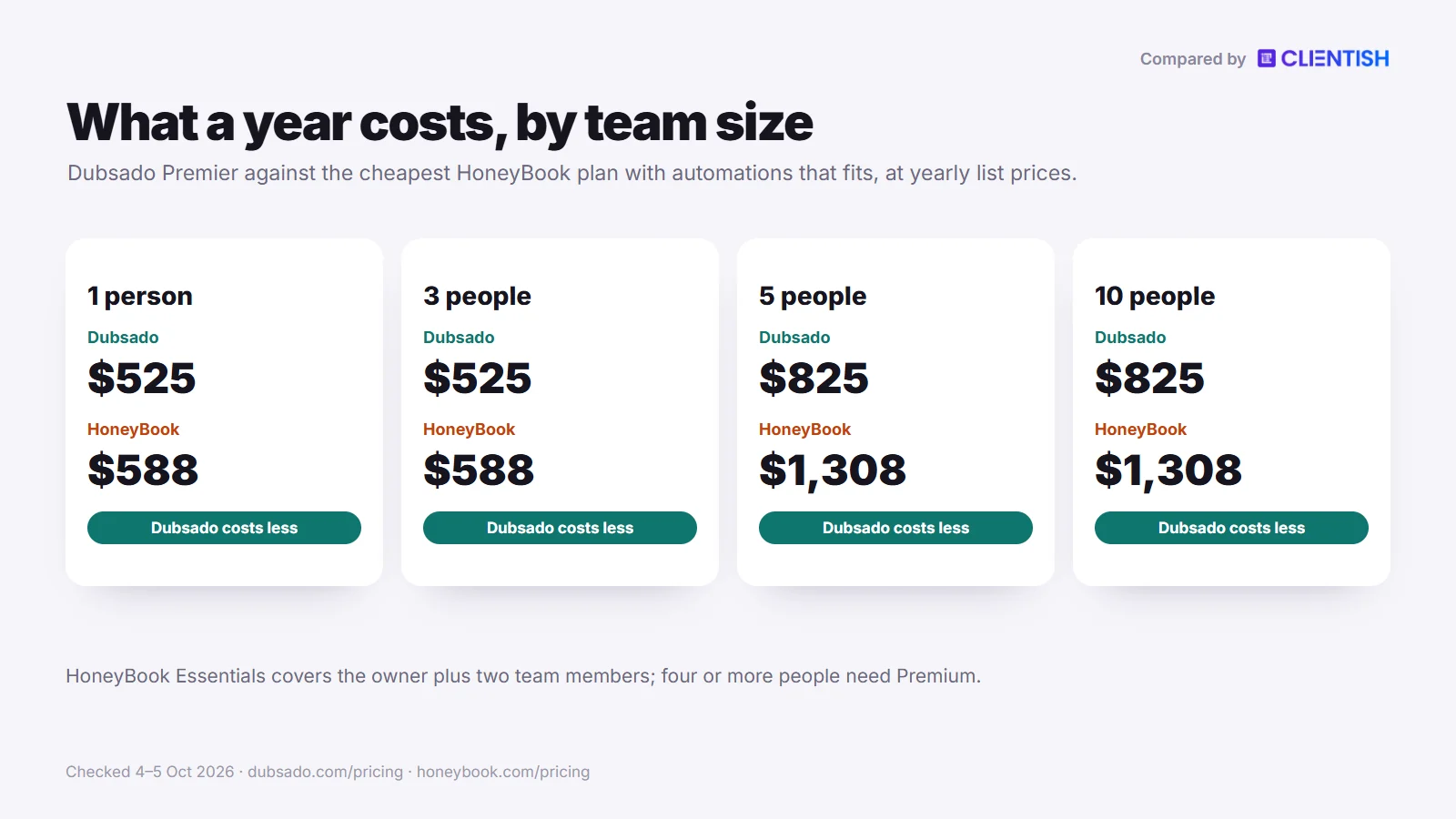
On Clientish Starter those five seats come to $276 for the year, about a third of the Dubsado figure ($825) and a fifth of HoneyBook’s ($1,308). Run a 14-day trial with real clients; no card is asked for.
What You Get in Clientish
Clientish picks up where these two tools stop, after a client has signed and paid for the first time. These are the parts an agency arriving from Dubsado or HoneyBook leans on most.
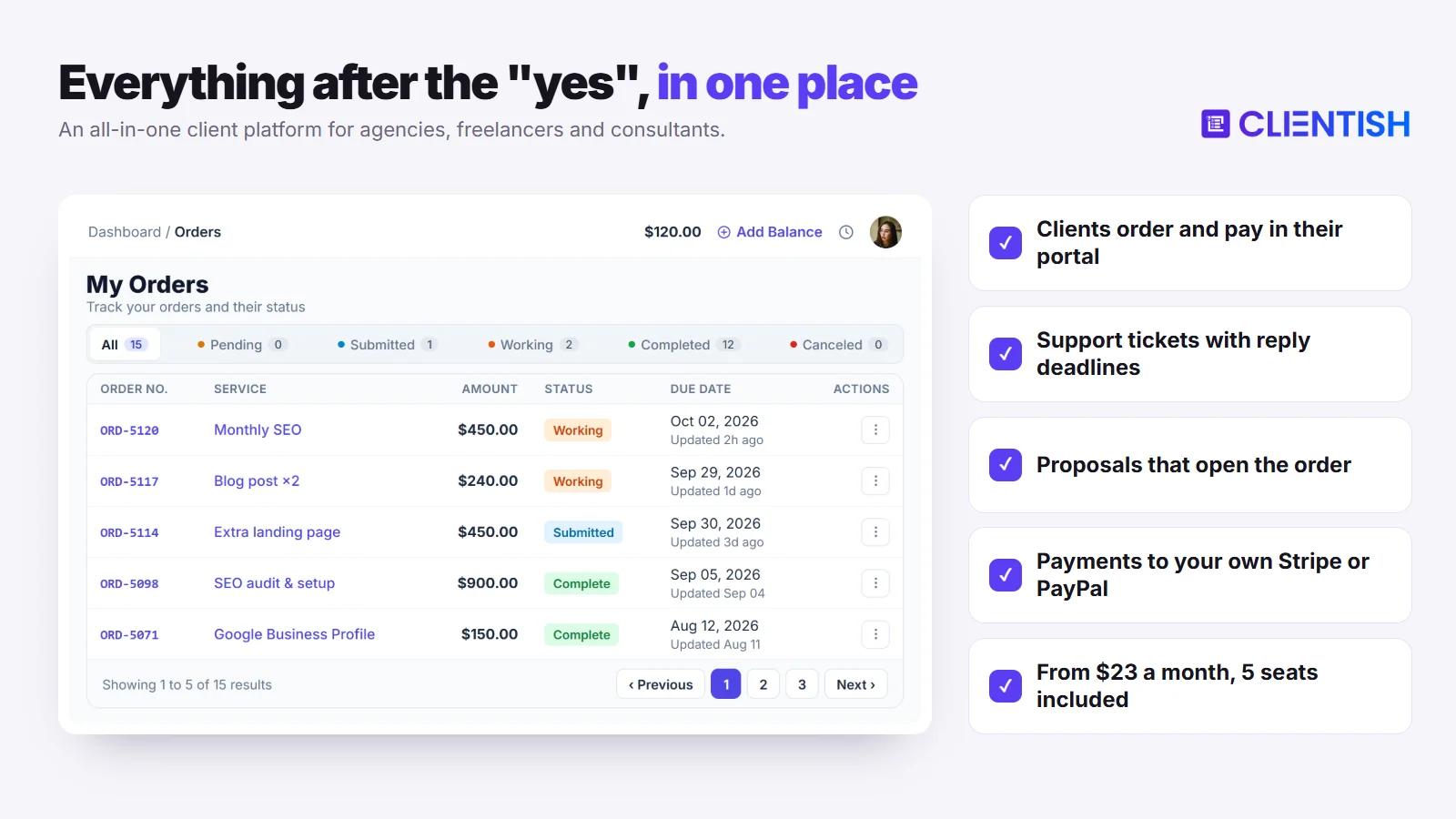
- Orders from a catalogue: a client fills a cart from your catalogue, pays the checkout invoice, and the order then holds their brief, your uploads and a revision count.
- A portal under your brand: the client portal shows your favicon, logo and brand colours on all plans; its address is a clientish.io subdomain, and mail to clients is sent from your agency’s SMTP.
- Tickets instead of inbox threads: on every plan, each ticket gets a reply-by time from its priority, with saved replies, tags, private staff notes and a client rating.
- Proposals that open the account: choose one of 11 proposal designs. Signing means typing a name; Clientish keeps the IP and a signed PDF, and acceptance sets up the client, the order and one invoice asking for the deposit (50% by default) first.
- Seats for the whole team: five team members on Starter, then 15, 30 and 50, with paid extras and no seat taken by a client login.
- Hours the client signs off: from Growth up, remote members record hours against each client, who reviews and approves them before anything reaches an invoice.
- Leads and chat: Growth and the plans above it add lead management and live chat.
When Dubsado or HoneyBook Is Still the Better Pick
Clientish is the wrong move for some readers of this comparison. Keep the tool you have if one of these describes your business.
- Clients book sessions or calls with you directly: Dubsado and HoneyBook each ship a scheduler, while Clientish offers no booking calendar at all.
- You take card payments in person and want an installed app with Tap to Pay: Clientish is browser-only on phones, with nothing to download.
- Client pages must sit on a web address you own: Dubsado’s CNAME and HoneyBook’s Custom URLs allow it, but a Clientish portal cannot leave its clientish.io subdomain.
Two more limits apply: Clientish has no SOC 2 attestation, and every screen is in English.
Starter, Growth, Pro and Enterprise cost $29/$49/$99/$149 a month, or $23/$39/$79/$119 billed yearly. No plan leaves out the portal, tickets, proposals or invoicing, so even the cheapest one runs the whole path from order to payment.
Outgrowing Dubsado or HoneyBook? Bring orders, support and renewals together.
Orders, tickets, renewals and payments to your own Stripe or PayPal, for your whole team. Plans start at $23 a month billed yearly, with 5 team members included.
Start your 14-day free trial →No card needed · See all plans
Frequently Asked Questions
These questions come up in nearly every conversation about Dubsado and HoneyBook. The answers below are short and based on the vendors’ own pages as of October 5, 2026.
Is Dubsado or HoneyBook better for beginners?
HoneyBook. With ready-made templates, free setup of your files and Smart Files, there is less to build before the first send; on Capterra, HoneyBook gets 4.6 for ease of use and Dubsado 3.7.
Can I use HoneyBook if I’m based outside the US or Canada?
Only in the UK or Australia, where HoneyBook opened on May 21, 2026. A business registered in any other country cannot sign up, while Dubsado can still work there through Dubsado Payments, Square or PayPal.
How do Dubsado and HoneyBook compare on price?
They sit close at entry level: $35 monthly or $335 yearly buys Dubsado Starter, and $36 or $348 buys HoneyBook’s. Automations need Dubsado Premier at $55 a month or HoneyBook Essentials at $59.
Does either tool offer white-label client portals?
Both come close. Dubsado maps client pages to your own domain, accepts CSS on forms and shows no logo of its own. HoneyBook uses your subdomain on every plan and hides its label from Essentials up.
Can I automate follow-up sequences in HoneyBook?
Yes, on Essentials or Premium. An automation can send a follow-up only if the contract is still unsigned after three days. Starter has pipeline automations alone, and project-date steps must start an automation of their own.
What is a Smart File in HoneyBook?
It is one scrolling document holding a proposal, contract and invoice, optionally with a scheduler or questionnaire. Clients go through the scope, add a signature and pay the deposit without leaving that page or waiting for another email.
Is Dubsado good for agencies managing many clients at once?
Only up to a point. Its Basic role limits staff to assigned projects, and extra users past three cost $25 to $60 a month, but we found no ticket desk and no repeating order with deliveries and revisions.
Which tool has a better mobile app?
HoneyBook, if you send proposals on the move: its app edits and shares Smart Files and approves automation steps. Dubsado’s app builds invoices, sends forms and takes Tap to Pay, but Dubsado calls it a companion.
Can Dubsado handle recurring retainer billing?
Yes, for billing. Even Starter repeats an invoice monthly or on another schedule, with autopay off, optional or required. We found no prepaid client balance, and nothing links each cycle to fresh deliverables.
Are there alternatives if neither Dubsado nor HoneyBook fits my agency?
Yes. Agency platforms are built for a team serving the same clients every month. Clientish is one: clients order from a catalogue in its portal, each order carries a revision limit, and a ticket desk handles questions.
Does Dubsado still have a free plan, and how long are the free trials?
No. The open-ended three-client trial closed to new accounts on November 17, 2025. New Dubsado accounts get a 21-day Premier trial without a card, and HoneyBook offers 30 card-free days followed by a 60-day money-back guarantee.
Does Dubsado Starter include automations?
No. Flows, the scheduler, public proposals, Zapier and the QuickBooks and Xero sync are Premier features at $55 a month. Starter still repeats invoices with autopay and runs instalment plans that send their own nudges.
Does HoneyBook have conditional logic in its automations now?
Yes. Since Automations 2.0, a condition splits an automation into yes and no paths based on eight events, such as a signed contract, a viewed file, a submitted questionnaire or an invoice paid in full.
Will I lose data switching from HoneyBook to Dubsado?
Your contacts move by spreadsheet, but templates, automations, Smart Files and project history do not transfer. Download signed contracts and paid invoices first, then rebuild your client journey in Dubsado before you cancel HoneyBook.
How many team members can I add, and what does each extra seat cost?
Dubsado covers the owner plus three users, then adds $25 a month for 4–10 extra users, $45 for 11–20 and $60 for 21–30. HoneyBook’s Starter is a one-person plan, Essentials takes two teammates and Premium has no ceiling.
Does HoneyBook charge more for autopay or saved cards?
Yes. A card the client types in costs 2.9% plus 25 cents, while a card kept on file, which autopay charges, costs 3.4% plus 9 cents. Dubsado’s fee page lists no separate rate for saved cards.
Do Dubsado and HoneyBook integrate with QuickBooks, Xero or Zapier?
Dubsado connects QuickBooks Online, Xero and Zapier, all on Premier. HoneyBook connects QuickBooks Online and Zapier from Essentials up; we found no Xero integration, so Xero users would need a Zapier workaround.
Is Dubsado or HoneyBook better for photographers?
HoneyBook, for most photographers in its four countries: a Smart File books, signs and collects the deposit through one link, and the app works on location. Photographers based elsewhere, or wanting CSS-styled forms, should choose Dubsado.
Does Dubsado have time tracking?
Yes. A time tracker came with version 3.0, though turning logged hours into invoice lines is a Premier feature. HoneyBook went the other way and dropped its tracker on September 7, 2026; earlier entries stay readable until 2027 ends.
Is it possible to run Dubsado and HoneyBook at the same time?
You can, and running both for a month makes a move easier. Over the long run it means two client records, two sets of templates and two subscriptions to pay.
Is Dubsado worth it after the December 2025 price increase?
It depends on whether you will use Premier. At $525 a year it still costs less than HoneyBook Essentials ($588) and covers four people, but Starter at $335 gives you no Flows and no scheduler.
Is HoneyBook worth it after its 2025 price rise?
It can be, for a solo creative in its four countries who wants speed: Starter costs $348 a year. Teams feel the rise more, because a fourth person needs Premium at $1,308 a year.
Is Clientish a good alternative to Dubsado or HoneyBook for an agency?
Yes, for an agency whose clients buy month after month. Clientish gives each purchase an order with a revision limit and answers client questions through tickets, two things we found in neither Dubsado nor HoneyBook.
How much does Clientish cost compared with Dubsado and HoneyBook?
Clientish plans cost between $29 and $149 monthly, or $23 and $119 on yearly billing. A five-person year on Starter is $276; Dubsado Premier with its user band is $825, and HoneyBook Premium $1,308.
Can I use Clientish on my phone?
Yes, through the browser. Your team’s workspace and your clients’ portal both resize to a phone screen, so nobody is tied to a desk. You simply skip the app store, and you get no booking calendar.
Can I move my clients from Dubsado or HoneyBook to Clientish?
Yes. Download your contact list from Dubsado or HoneyBook, then load that file (CSV, XLS or XLSX) into Clients, Import. Each imported record waits inactive, with no message sent, until you invite that client.
Does Clientish charge a fee on client payments?
No. Clientish adds no percentage to client payments. Online payments go to whichever gateway the agency has connected (Stripe, PayPal, Paddle, SSLCommerz). Manual methods (bank transfer, Wise and the bKash, Nagad and Rocket wallets) are also accepted.
Final Thoughts
Each of these products takes a service business from first enquiry to a booking that is signed and paid, yet each suits a different owner. The deciding questions are where you are registered, how much setup you will take on and whether clients come back every month.
- Dubsado suits an owner who will spend time building Flows and branded forms, needs a choice of processor or a base outside HoneyBook’s four countries, and wants four people on one $525 Premier year.
- HoneyBook suits a solo creative or small team in the US, Canada, UK or Australia who wants Smart Files, an app that edits them and less to build before the first booking.
- Clientish suits an agency with repeat monthly clients, delivery shared across several staff and client questions that need tracking, at $276 a year for five people on Starter.
If that last description fits, put a handful of real clients through it: 14 days cost nothing and need no card, the plans and their limits are laid out side by side, and our Dubsado vs Clientish post weighs that pair directly.
Sources
Clientish publishes this comparison. Every Dubsado and HoneyBook fact was checked on October 4 and 5, 2026, against each company’s own pricing and help pages; review themes come from Capterra and Trustpilot.
Dubsado and HoneyBook are trademarks of their owners. Clientish is not affiliated with either of them. Prices and features change; if you spot something out of date, let us know and we’ll correct it.

