

Client feedback is a client’s verdict on your work, your process and the result: praise, change requests and complaints. Good feedback is specific, such as “you launched on the day you promised”, because it tells you what to repeat or fix. Below are 60 examples by type and by service, with messages to ask for feedback and replies to send.
Across fifteen years of client work at Giant Marketers, the feedback that changed how we worked was rarely the five-star kind. It was the client who said the monthly report was too long to read, or the one who admitted they felt they were managing us instead of the other way round. Those lines are uncomfortable, and they are worth more than a dozen “great job” emails. This guide shows what useful feedback sounds like, how to ask for it and what to say when it stings.
Key takeaways
- Useful feedback names a specific detail; “great job” tells you nothing to repeat.
- Vague feedback is a question in disguise: answer it with a better question.
- Ask right after a milestone, with two short questions, and follow up once.
- Turn praise into a testimonial on the spot, with the client’s approval of the final words.
- Reply to negative feedback by owning it, giving a date and telling the client what changed.
What Is Client Feedback, and What Does Good Feedback Sound Like?
Client feedback is what a client tells you about three things: the work itself, the experience of working with you, and the result they got. Good feedback names a specific detail, so you know what to repeat or fix. “Looks good!” and “the menu now works on my phone, and the booking button is easy to find” are both positive, but only the second one helps you.
Weak vs specific: the same comment, two ways
Weak feedback gives a feeling without a reason. Specific feedback names what happened, so you know what to keep or change. The same client might write either version; your job is to ask the questions that turn the first into the second.
| Weak | Specific |
| “Great job on the site.” | “The site launched on time and our team can update it without calling you.” |
| “The report is confusing.” | “Put the leads and cost per lead on page one; that’s all my boss reads.” |
| “Not really feeling it.” | “The colours are too dark for a kids’ brand; something brighter, like our packaging.” |
Client feedback vs customer feedback
Customer feedback usually means reviews of a product or a shop: one purchase, one rating. Client feedback in service work is ongoing and tied to deliverables, deadlines and conversations over weeks or months. That is why the examples below talk about drafts, reports and replies, not delivery times and packaging.
Positive Client Feedback Examples
Positive client feedback is praise that names exactly what went well, such as a deadline met, a quick reply or a problem caught early. Specific praise motivates your team and, with the client’s permission, works as a testimonial on your website and in proposals. Praise is the easiest feedback to receive and the quickest to waste, so look for the detail in it. All examples below are illustrative, written for this guide.
Short positive feedback (one line)
Good short positive feedback names one specific thing the client noticed, like a launch on schedule, a fast answer or an early catch. One line is enough when it says what happened, because it tells your team exactly what to keep doing on the next project.
- “The new site went live on the day you promised, and nothing broke.”
- “You answered every question within a day. That alone made this easy.”
- “Our team reads the monthly report now because it’s one page.”
- “The logo works at tiny sizes too, which we never had before.”
- “You spotted the tracking problem before we did. Thank you.”
- “Clear updates, no chasing. That’s rare.”
- “The first draft was ninety percent there. Two small edits and it was done.”
- “You pushed back on our idea and you were right.”
- “Booking the kickoff call took one message instead of ten.”
- “Every invoice matched what we agreed. No surprises.”
Professional positive feedback (for proposals and case studies)
Professional positive feedback is longer praise that describes the situation before, what you did and the result, written so it can be shared with permission. These are the lines that work as testimonials on your website, in proposals and in case studies, because a future client can picture the same story.
- “We came to Copperwick Studio with a messy brief and a fixed launch date. They turned it into a three-step plan in the first call, shared drafts every Friday and launched on time. I’d hire them again without a pitch.”
- “What I valued most was candour. When a feature wasn’t worth the cost, they told us, and we saved the budget for the part that mattered.”
- “Working with [freelancer name] felt like having a senior person on our own team. They knew when to ask and when to just get on with it.”
- “Our inbound enquiries now come from the service pages we rewrote together, not only from referrals. That was the goal, and they got us there.”
- “Every file, invoice and update was in one place. I never had to dig through email to find the latest version.”
Constructive Client Feedback Examples
Constructive client feedback points out what is not working and suggests what would help, usually in one or two sentences. It follows a simple shape: what works, what does not, and what to change next, so you can act on it the same week.
- “The designs are strong, but I’d like to see them on a phone screen before we sign off.”
- “The blog posts read well. Could the intros get to the point faster? Our readers skim.”
- “Reports are useful, but I need the three numbers my boss asks about at the top, not on page four.”
- “We like the ad copy. Next round, can we test one version that mentions price?”
- “The work is good. Updates come at random times, though; a fixed weekly check-in would help us plan.”
- “The site is fast, but the contact form sends to an inbox nobody checks. Can we route it to sales?”
- “Great first draft. The tone is a bit formal for us; think of how we talk on our Instagram.”
Revision notes that are easy to act on
The best constructive feedback reads like a to-do list: one change per line, tied to a place in the work, with a reason. When a client sends a paragraph of mixed thoughts, reply with a numbered list of what you understood and ask them to confirm it. That one step prevents most “that’s not what I meant” moments in the next draft.
Negative Client Feedback Examples
Negative client feedback is a complaint about missed deadlines, work that does not match the brief, unclear invoices or results that fall short. It is hard to hear, but it tells you where the problem is while the client is still there to keep. “There’s few things worse than feeling a clients negativity building and you’ve no notion why,” one freelancer wrote on Reddit.
- “We were promised the landing page last Monday and still don’t have a date.”
- “This doesn’t match the brief we signed off. The colours and the audience are both off.”
- “I’ve asked twice about the invoice line for extra hours and haven’t had an answer.”
- “Traffic went up, but sales didn’t. I’m not sure what we’re paying for.”
- “Your writer is good, but every draft needs heavy edits from our side, which defeats the purpose.”
- “I feel I’m managing the project instead of you. I shouldn’t have to chase every step.”
Notice that most of these are fair and partly positive. Clients often split their verdict: good skills, poor communication. That split tells you the problem is in your process, which is usually easier to fix than the quality of the work itself.
Vague and Difficult Client Feedback (and What to Ask Back)
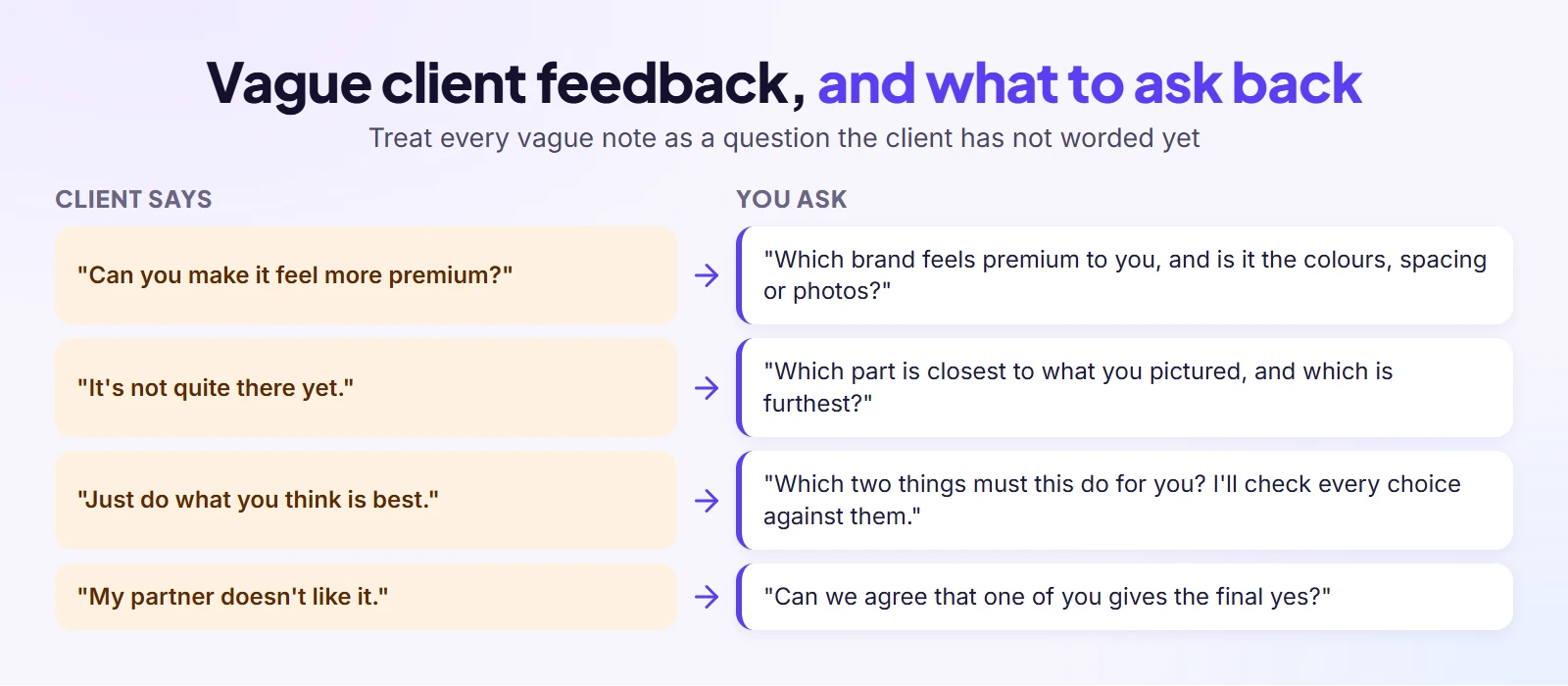
Vague client feedback, such as “make it pop” or “it’s not quite there”, is best handled by asking a specific question back: which part, compared with what, and why. Vague feedback is not useless; it is a question the client has not worded yet. “This just feels wrong.” “None of these concepts speak to me.” A designer on Reddit shared client notes like these, and every agency has its own collection.
| Client says | Ask back |
| 29. “Can you make it feel more premium?” | “Is there a brand or site that feels premium to you? What about it: the colours, the spacing, the photos?” |
| 30. “It’s not quite there yet.” | “Which part is closest, and which part is furthest from what you pictured?” |
| 31. “Just do what you think is best.” | “Happy to. Before I start, which two things must this do for you? I’ll check every decision against those.” |
| 32. “My partner doesn’t like it.” | “Could we get your partner on a 15-minute call, or agree that one of you gives the final yes?” |
| 33. (No reply for two weeks) | “I’ll keep the draft as is unless I hear otherwise by Friday. If anything’s bothering you, even something small, I’d rather hear it now.” |
| 34. “Can you also add a blog, a shop and a newsletter?” | “Good ideas. They’re outside this project, so I’ll send a short quote for them separately and keep the current launch date.” |
When taste and the audience disagree
Sometimes the client’s personal taste is at odds with what works for their customers. Bring the conversation back to the goal agreed at the start: “We chose this for parents booking on their phones; if we change it, here is what we risk.” If the client still prefers their version, make the change and note the decision, so the result is judged fairly later.
Feedback that is really new scope
Example 34 above is not feedback; it is a new project wearing feedback’s clothes. Say so kindly and quote it separately, while keeping the current launch date. A written change request form makes this routine, so neither side feels awkward about it.
Client Feedback Examples by Service
Client feedback differs by service: SEO clients talk about leads and reporting, design clients about how the brand feels, web clients about whether the site works, and ads clients about cost and lead quality. Below are positive, constructive and negative examples for seven common agency and freelance services.
SEO
SEO client feedback usually centres on visibility, leads and how clearly you report progress. Clients praise rankings for the services they sell, ask for shorter reports with clear priorities, and complain when months pass without being able to see which changes made a difference.
- (+) “We’re now showing up for the services we sell, not only our brand name.”
- (Constructive) “The keyword report is long. Tell me which three pages to fix this month.”
- (−) “Six months in, and I can’t tell which of your changes moved anything.”
Design and branding
Design and branding feedback is often about how the brand feels and how it works in real use. Happy clients mention designs that make them look established, suggest small adjustments to weight, colour or spacing, and push back when the result is busier than the brief asked for.
- (+) “The new colours finally make us look like the size of company we are.”
- (Constructive) “Love the icon. The wordmark feels thin next to it; can it be a weight heavier?”
- (−) “We asked for something simple and got something busy.”
Web design and development
Web design and development feedback tends to focus on whether the site works for the client and their customers. The praise is usually about being able to update pages themselves; clients flag problems on mobile screens, and are least forgiving about downtime or slow answers at launch.
- (+) “Our team can update the pages ourselves now, without calling you every time.”
- (Constructive) “Works great on desktop. On my phone the menu covers the booking button.”
- (−) “The site went down during our launch email and nobody answered for hours.”
Content writing
Content writing feedback is mostly about voice, accuracy and how easy the writing is to read. Writers earn praise for sounding like the industry; clients ask for simpler structure or faster intros, and are most upset by outdated facts they only spot after publishing.
- (+) “You write like you’ve worked in our industry. Customers keep quoting the FAQ page back to us.”
- (Constructive) “Please use fewer headings; it reads like a manual.”
- (−) “The facts in the third article were out of date, and we only noticed after posting it.”
Social media
Social media feedback is about engagement from real customers, the approval process and the details that go out in public. Good notes mention comments from genuine buyers; clients ask to see the weekly plan earlier, and react strongly to typos or mistakes in posts that are already live.
- (+) “The comments are from real customers now, not only our staff.”
- (Constructive) “The posts look great. Can we see the week’s plan a few days earlier so we can approve it?”
- (−) “Two posts went out with a typo in our product name.”
Paid ads
Paid ads feedback usually comes down to lead quality, cost and how spend decisions are explained. Satisfied clients point to a lower cost per lead with the right audience, ask to hear about budget changes before they happen, and complain when spend produces leads they cannot use.
- (+) “Cost per lead is lower and the leads are the right kind of people.”
- (Constructive) “Please explain spend changes before you make them, not after.”
- (−) “We spent the budget, but most leads were from outside our service area.”
Consulting
Consulting feedback judges whether your advice can be put to work with the budget and people the client has. Clients praise sessions that align their managers, ask for recommendations ranked by cost and effort, and are disappointed when the final report repeats what they already knew.
- (+) “Your workshop gave our managers one shared plan instead of five opinions.”
- (Constructive) “The recommendations are good; we need them ranked by cost and effort.”
- (−) “The final deck repeated what we told you in the first meeting.”
Star Ratings vs Written Feedback
A star rating shows how satisfied a client is at a glance, while written feedback explains why, so the most useful setup asks for both. A five-star rating tells you a client is happy; it does not tell you what to repeat. Ratings and written comments do different jobs.
| Type | Good for | Misses |
| Star rating (1 to 5) | Spotting trends across many orders, quickly | The reason behind the score |
| Written comment | Knowing what to repeat or fix; testimonials | Easy comparison across clients |
| Short call | Candid detail and tone | A written record, unless you take notes |
A dip in ratings is your signal to pick up the phone. A string of fives is your signal to ask for a testimonial. Neither replaces a direct conversation with a client who seems quietly unhappy.
How to Ask Clients for Feedback (Email and Portal Messages)
To ask a client for feedback, send two short questions right after a milestone: what worked well, and what you should do differently next time, then follow up once if there is no reply. Some freelancers feel that asking for a testimonial is somehow “cheeky”, as one put it on Reddit. It is not, and a short, well-timed question is far more likely to get an answer.
When to ask
Ask right after a milestone, while the work is fresh: a launch, a first report, the end of a project. If your packages spell out revision rounds and limits, feedback also stays within those rounds. For monthly work, ask after the first clear win and then at a set review every quarter. One commenter on Reddit’s r/agency put the timing simply: “after the first big win.” Asking at the end of a long silence gets you polite answers, not useful ones.
Questions that get useful answers
Two short questions beat a ten-question survey: one about what worked, and one about what to change next time. For a testimonial, ask about before and after: what was going on before you worked together, what changed, and what is different now. A short call often gets more candid answers than email.
Message templates
End-of-project email: “Hi [Name], now that [project] is live, I’d like to hear how it went for you. Two questions, a line or two each is plenty: what’s one thing that worked well, and what’s one thing we should do differently next time? Frank answers help me more than polite ones. Thanks, [Your name]”
Mid-project check-in: “Hi [Name], we’re halfway through [project]. Before the next draft: is anything about the work or how we’re running it bothering you, even a small thing? It’s easier to fix now than at the end.”
After delivery, in your client portal: “Hi [Name], [deliverable] is ready for you. Please review the files and either approve them or tell us what to change. If you have a moment, a star rating on the order helps us see how we did.”
One gentle follow-up: “Hi [Name], bumping this in case it got buried. Even a one-word answer is useful. No worries if this is a busy week.” Send it once, then leave it until the next milestone.
How to Turn Client Feedback Into a Testimonial
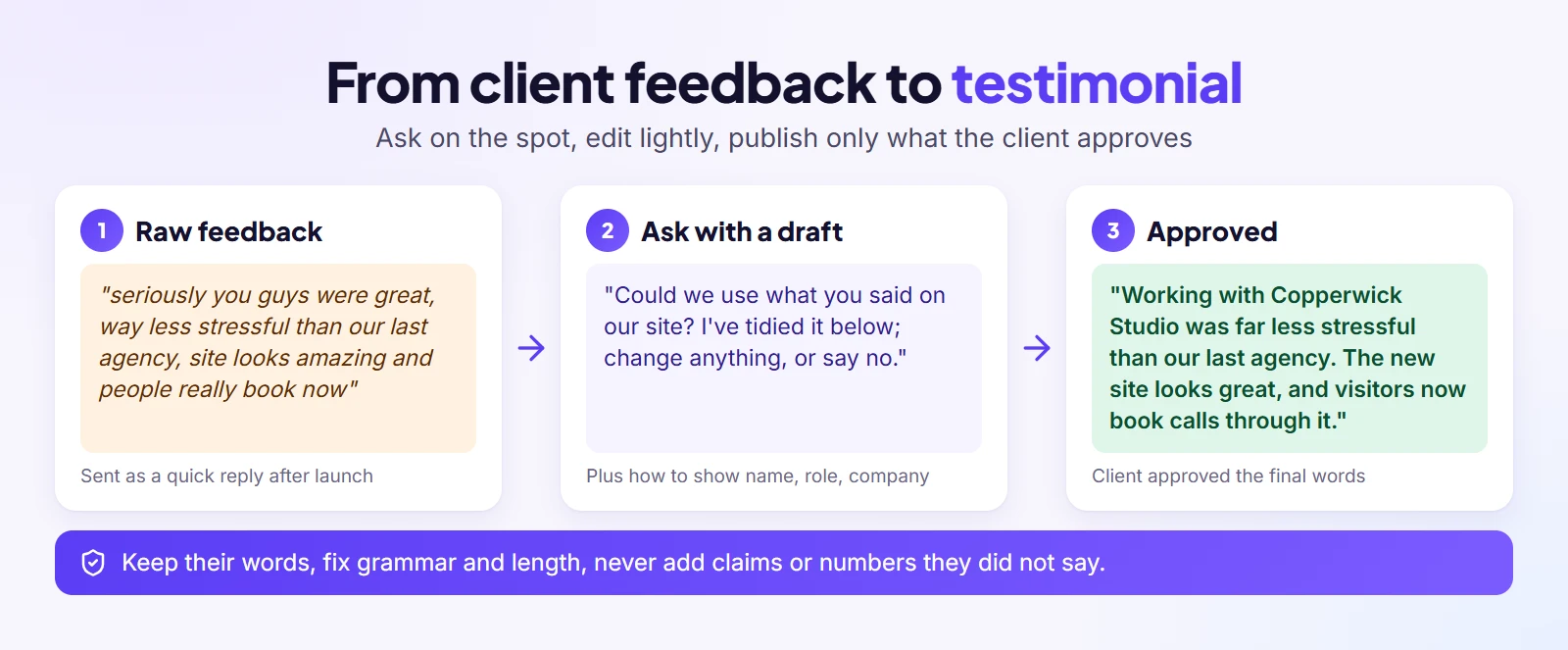
To turn client feedback into a testimonial, ask for permission while the client is pleased, send a lightly edited draft of their own words, and publish only the version they approve, with the name and role they agree to. Say a client writes “seriously you guys were great, way less stressful than our last agency, site looks amazing and people really book now”. That is a testimonial waiting to happen.
Ask on the spot, with a draft
Reply with thanks, ask whether you may use their words, and offer a tidied version so they do not have to write anything: “Could we use what you said as a short testimonial on our site? I’ve tidied it into two sentences below; change anything you like, or say no, no problem at all.” Then ask how they want their name, role and company shown.
Edit lightly, never add
Keep the client’s words, fix grammar and length, and never add claims or numbers they did not say. The same rule applies if a white label partner did the work: the testimonial is about your agency. The raw line above becomes: “Working with Copperwick Studio was far less stressful than our last agency. The new site looks great, and visitors now book calls through it.” Send the final text back for approval before it goes anywhere public.
How to Respond to Client Feedback (Templates)
To respond to client feedback, thank the client, name the specific point they raised, say what you will do and by when, and later tell them what changed. Every piece of feedback deserves a reply, and the reply matters most for complaints. The templates below cover praise, change requests and the four most common complaints.
Replying to praise and constructive notes
Praise: “Thank you, [Name]. Good to hear [specific thing] made a difference. I’ll pass this on to [team member], who did most of that work.”
Constructive: “Thanks, that’s clear. We’ll [change] in the next draft and send it by [day]. If it still isn’t right, tell us which part.”
Replying to negative feedback
Missed deadline: “You’re right, we missed the date we gave you, and I’m sorry. The [deliverable] will be with you by [date]. From now on you’ll get an update from us every [day], whether there’s news or not.”
Work doesn’t match the brief: “Thanks for saying it straight. Looking at the brief again, I can see where we drifted: [point]. We’ll redo [part] at no extra cost and share it by [date]. Could we have a 15-minute call first so we get it right this time?”
Results not as hoped: “I understand the frustration. Here’s what we’ve done, what moved and what didn’t: [three points]. My suggestion for next month is [change]. If you’d rather pause, we can talk about that too.”
Invoice question: “Sorry for the slow reply on this. The extra [hours or item] came from [reason, date]. If that doesn’t match your understanding, tell me and we’ll fix the invoice.”
Close the loop
A few weeks later, tell the client what changed because of their note: “After your comment about [issue], we’ve changed [what] for all your future [reports]. Thanks for pointing it out.” Few suppliers bother to do this, and it can be what turns a complaint into loyalty.
Upwork and Fiverr Client Feedback Examples
Good Upwork and Fiverr feedback is one to three sentences that say whether the work matched the brief, how communication went and whether deadlines and payments were on time. Clients review freelancers on both platforms, freelancers can review clients too, and most of that feedback is public, so the next person you work with will likely read it first. Keep the tone factual and specific, even after a hard project, as in the examples below.
Client to freelancer
Good feedback from a client to a freelancer on Upwork or Fiverr is short, factual and specific about delivery and communication. It mentions whether the brief was met, how questions were handled and whether deadlines held, which helps the next client judge the freelancer fairly.
- “Delivered exactly what was in the job post, asked smart questions early, and finished a day ahead.”
- “Strong skills. Communication slowed down in the second half, so I’d agree on check-in days up front.”
On Upwork, clients score skills, communication and availability separately, so a freelancer can get full marks for quality and lower marks for availability; Fiverr buyers also rate communication apart from the quality of the delivery. Upwork also asks clients for private feedback that the freelancer does not see.
Freelancer to client
Good feedback from a freelancer to a client describes the brief, communication and payment in calm, factual terms. It helps other freelancers decide whether to take on that client, so keep it positive where you can and measured where the project was hard.
- “Clear brief, quick answers and on-time payment. I’d gladly work on this project’s next stage.”
- “Gave detailed feedback on each draft, which made revisions fast. A good client to work with.”
- “Organised, respectful of deadlines on both sides, and easy to reach. Recommended.”
Keep marketplace feedback factual and calm, even after a hard project. Future clients read it, and a measured line about a difficult job reflects well on you.
Where to Keep Client Feedback So You Can Use It
Keep client feedback next to the order or project it is about, not scattered across email and chat, so patterns show up and testimonials are easy to find later. Feedback that lives only in an inbox gets forgotten by the next project. Write down how your team logs feedback as a short procedure; the guide to agency SOPs shows how.
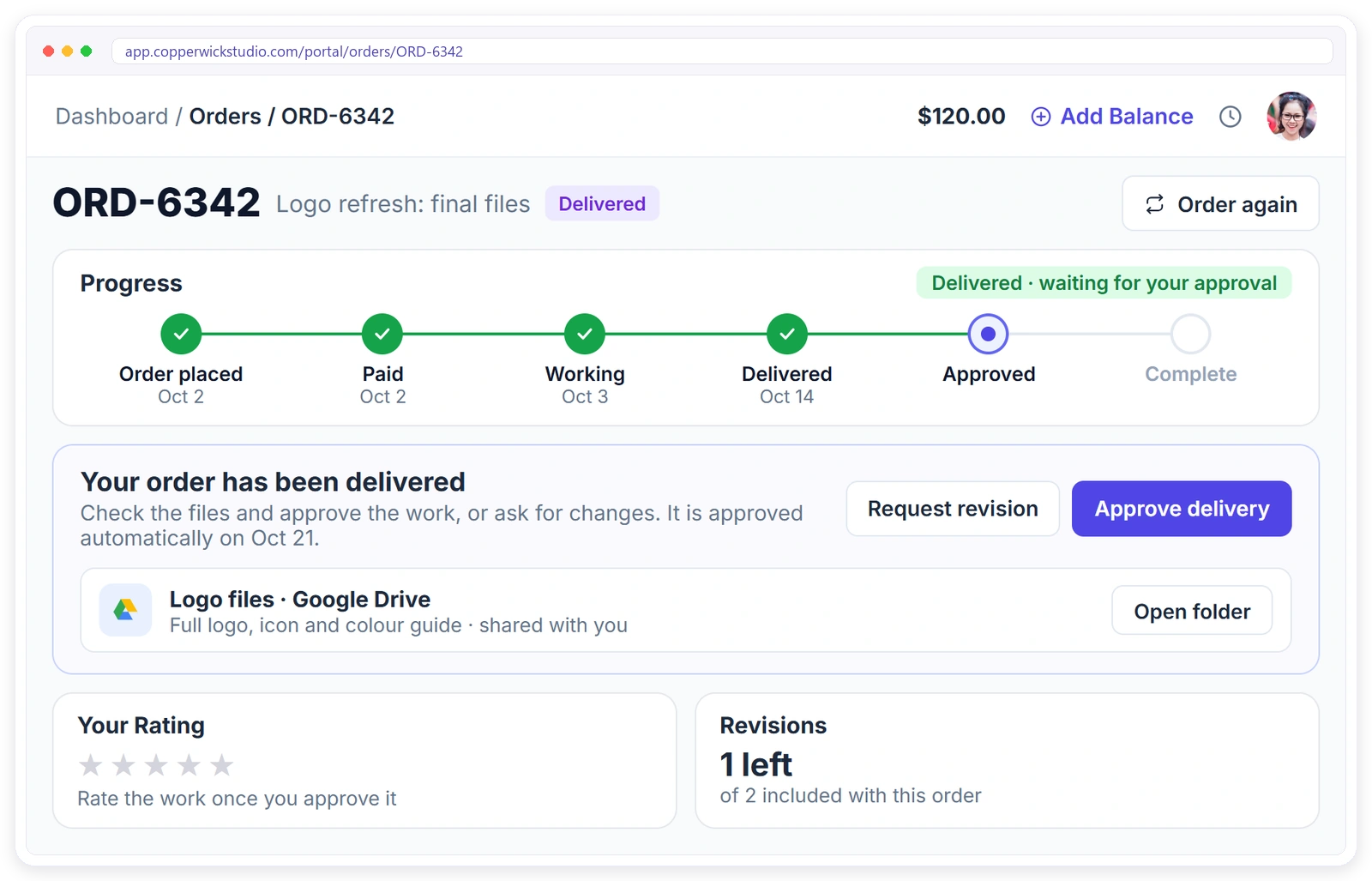
Clientish is an all-in-one client management portal for agencies, freelancers, consultants and service-based businesses: leads, proposals, a branded client portal, orders, invoices and subscriptions, support tickets and live chat in one place. In your portal, feedback lives with each order:
- Approval or changes: when you deliver, the client approves the work or asks for changes, and file proofing lets them review files and request edits. Deliveries are approved automatically after seven days by default.
- Ratings: if you turn ratings on, clients rate each order from 1 to 5 stars, and the Client Satisfaction card shows how clients feel across orders. Ratings can be exported.
- Support ratings: support tickets can be rated too, when you turn that on.
- Revision limits: each service sets how many revisions are included, so clients see how many rounds are left.
You can try it free for 14 days and turn on ratings for your next delivery.
Frequently Asked Questions
Here are the questions agency owners and freelancers ask once feedback starts coming in, the good, the mixed and the hard to read.
What is the difference between client feedback and a testimonial?
Feedback is private and can be positive, mixed or negative; it is for you to learn from. A testimonial is positive feedback the client has agreed to let you publish, usually lightly edited with their approval. Every testimonial starts as feedback, but most feedback should never become one.
How long should client feedback be?
One or two sentences is enough if they name something specific. Long feedback is welcome but often harder to act on. If a client writes several paragraphs, turn them into a numbered list of changes and ask them to confirm it before you start the next round.
Is it okay to edit a client’s words for a testimonial?
Yes, lightly: fix grammar, trim length and remove repetition. Never add claims, numbers or praise the client did not give. Always send the edited version back and publish only what the client approves, along with the name, role and company format they agreed to.
What if a client refuses to give feedback?
Accept it gracefully and do not keep asking. Watch the signals you already have, such as approvals, revision requests and how quickly they reply, and ask again at the next natural milestone. Some clients simply prefer a short call to writing anything down.
Should I offer a discount in exchange for feedback?
Not for testimonials, because paid praise reads as paid and can mislead future clients. Many review platforms also have rules about incentives, so check them before offering anything. A plain, well-timed ask works better than a reward and keeps the feedback believable.
How do I handle feedback from several people at the client?
Ask the client to name one person who collects everyone’s comments and sends a single, agreed list. Otherwise you will receive conflicting notes and end up refereeing their internal debate. Agree this at the start of the project, before the first draft goes out.
Can I publish negative feedback?
Not a client’s private feedback without permission. If a negative review is already public, reply calmly and briefly with what you did to fix the issue. Future clients read the reply more closely than the review, so a measured answer often helps more than it hurts.
How is client feedback different from employee feedback?
Employee feedback runs from a manager to a member of staff about their performance. Client feedback comes from the person buying your service, about the work, the experience and the result. The skills overlap, such as being specific and fair, but the relationship and the stakes are different.
What should I do with feedback after I get it?
Log it by client and project, look for themes that repeat across clients, and change your process where they do. Then tell the client what you changed. A single comment is an opinion; the same comment from three clients is a fix worth making.
Is a star rating enough?
It shows how a client feels at a glance, which helps you spot trends. It does not tell you why, so pair it with one written question or a short call. When the rating drops, talk to the client before the next order rather than guessing.
Final Thoughts
Pick your last finished project and send the two-question email today. Whatever comes back, reply within a day, and if it is praise, ask on the spot whether you may use it as a testimonial.
Then set one habit: a feedback ask after every milestone, logged next to the work. If you want approvals, ratings and revision limits in one branded place, Signup & Try Demo. And when feedback points to a messy start, our guide on onboarding clients without email fixes the first week.
Sources
Clientish publishes this guide. It reflects the author’s 15 years of client work at Giant Marketers and experience building client management software for agencies, plus client feedback guides, freelancer and agency discussions on Reddit, and Google’s AI Overview and “People also ask” answers reviewed as of October 2026. All 60 numbered feedback lines, the other client comments used as examples (including the weak-vs-specific table and the testimonial example) and the message templates were written for this guide and are illustrative, not real client quotes; the short quotes attributed to Reddit users are real. Copperwick Studio is a fictional demo agency. The Clientish section describes the product as documented on clientish.co in October 2026.

