

The fastest way to get SEO clients is the warm route, starting with people who already trust you: your network, past employers and referrals from happy clients. Then add one outbound channel, such as a short audit sent to local businesses or LinkedIn messages, and one slow channel that brings buyers to you, like a blog or an active community.
I got my first SEO clients on a freelance marketplace around 2012. Later I stopped working there, because the work kept me up through the night and I did not want that life. What replaced it was personal branding: posts on Facebook and my blog, answers in community groups, talks at events and meetups, and our own official Giant Marketers group. Local businesses began contacting me directly, and my international clients came through referrals.
Key takeaways
- Start with people who know you; strangers need proof you do not have yet.
- Pair one fast channel (outreach, network) with one slow one (content, community).
- Ask for referrals right after a measurable result, and name the type of business you want.
- Marketplaces are a starting point, not a business model.
- Many SEO deals die in follow-up, not in the first message, so track every lead until it says yes or no.
How Do You Find Clients for Your SEO Services?
You find SEO clients through five main routes: people you already know, referrals from clients and partners, direct outreach by email, LinkedIn, phone or walk-in, freelance marketplaces, and content that brings buyers to you. A good mix is one fast route with one slow one, because the fast routes run dry and the slow ones take months.
Speed and cost differ a lot between these routes. In forum threads and a practitioner video, people report cold email needing months to tune and a new Upwork profile taking two to three months to win work. Your network and referrals cost nothing but time, partners usually expect a referral fee or a margin, cold email needs domains, inboxes and contact data, and marketplaces take fees and charge for bids.
| Route | How fast | Best for | Main risk |
| Your network | Days to weeks | Your first client | Runs out quickly |
| Client referrals | After first results | Anyone with one happy client | Hard to scale alone |
| Partners (web, PPC) | Weeks | Freelancers with spare capacity | Partner owns the client |
| Cold email | Months to tune | A narrow niche with a clear offer | Spam filters, fatigue |
| Months | B2B and consultants | Peers, not buyers, in your feed | |
| Marketplaces | 2 to 3 months | Total beginners | Price-driven buyers |
| Content and community | 6 to 12 months | Long-term inbound | Quitting too early |
The times are rough ranges: the marketplace and content figures come from practitioner reports, the rest are typical estimates, and yours will vary with your niche and offer. One agency owner with fifteen years in the trade put the gap plainly on Reddit: direct prospecting “works but takes 5–10× longer per acquired client” than referrals from contacts, clients and nearby freelancers. That matches what the table shows. The warm routes are cheap and quick but limited; the cold and slow routes cost more effort but have no ceiling.
How do you get SEO clients through referrals?
Ask for a referral right after a client sees a result they can measure, such as a new top-three ranking or more calls from Google Maps, and make the ask specific by naming the type of business you want. A vague “let me know if anyone needs SEO” rarely brings anything, because the client cannot picture who to send.
Timing matters more than wording. A client who just saw their phone ring more often is happy to help; the same client three months into a flat patch is not. Keep the ask short and easy to act on, with a one-line intro by email as the only thing you need from them:
“[First name], glad the calls are up this month. I’m taking on two more [type of business] clients this quarter. Is there one owner you know who’d want the same? A one-line intro by email is all I need.”
A small thank-you can help the ask along. One commenter in an r/agency thread suggested a referral discount of “20% off once for a specific project or 20% off for 6 months if it is a retainer”. Whatever you offer, keep it simple and mention it in the same message as the ask, so the client knows what happens when they introduce someone.
Referrals also come from people who are not clients: former colleagues, a mentor, the accountant who looks after several local firms. A Reddit freelancer said their very first client came from a mentor who asked a friend to trust them with his SEO. Tell these people exactly what you do and for whom, once, clearly, and they will remember you when the topic comes up.
Can web designers and PPC freelancers send you SEO clients?
Yes, when you offer to handle SEO for the clients of web designers, developers and PPC freelancers who do not sell it themselves, either as a referral to you or under their name as white-label work. Their clients already trust them, so you borrow that trust instead of building it from zero with every cold prospect.
Pick partners whose clients look like yours: a designer who builds sites for dentists is a better match for a dental SEO freelancer than a large dev shop. Keep the pitch about their benefit, which is one more service for their clients with no extra hiring. If you choose the white-label route, our guide on how to offer white-label services covers pricing, contracts and who talks to the client.
“Hi [First name], I do SEO, mostly for [niche]. I noticed you build sites for [type of client] but don’t list SEO. When a client asks for it, I can take that part, under your name or as a referral to me. Open to a 15-minute chat to see if our clients match?”
Does cold email work for getting SEO clients?
Cold email works for SEO clients when each message points to one specific problem on the prospect’s own site or Google listing and asks a small question, not when it pitches “SEO services” to a long list. Expect it to take months to tune, because the first versions of your list, subject line and offer will be wrong.
Business owners are tired of these emails. A buyer in one Reddit thread said they receive “at least one solicitation for web design or SEO per day”, and that these pitches talk about the sender rather than the buyer’s goals. Another SEO in a Reddit thread on cold email said: “Realistically you will see some nice results after 6 months.” Send fewer, better messages, and follow up by hand.
This four-step sequence keeps every message short and adds something new each time, so a follow-up never reads like a nag:
Email 1, subject: [Business name] on Google for “[service] [city]”
“Hi [First name], I searched ‘[service] [city]’ this morning and [Business name] shows up on page 2, while [Competitor] is in the top three. The main gap I can see is [one specific thing]. I put the three fixes I’d make first on one page. Want me to send it over?”
Email 2, three or four days later: “Quick nudge on the note about ‘[keyword]’. The one-page list is ready if useful. No call needed.”
Email 3, a week later: “One more thing I noticed: [second finding]. Happy to send both fixes. If SEO isn’t a priority right now, just say so and I’ll close the loop.”
Email 4, two weeks later: “I’ll leave it here. If [keyword] becomes a priority later this year, my notes on [Business name] will still be useful, so reply any time.”

Which businesses are most likely to buy SEO?
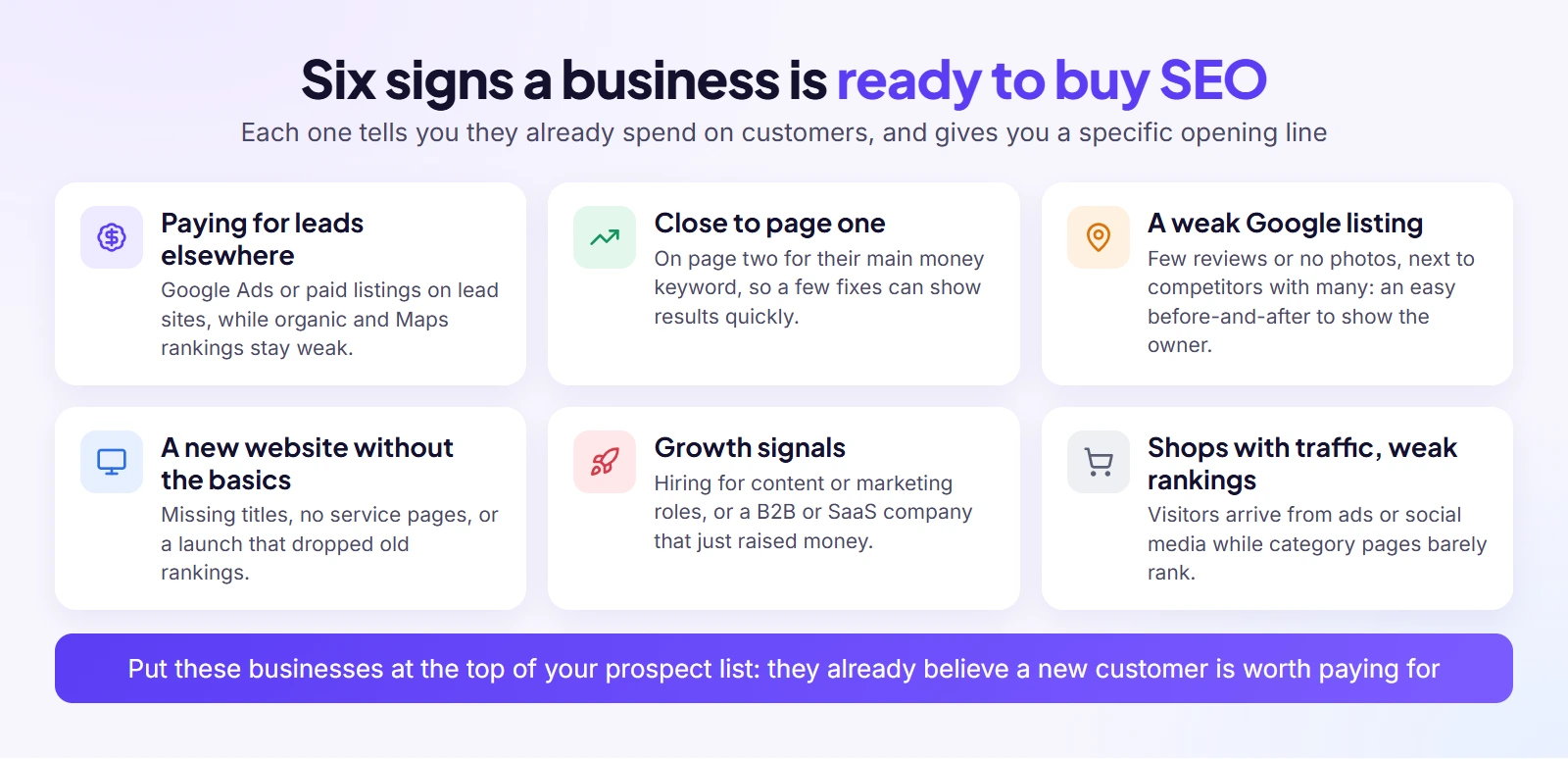
The businesses most likely to buy SEO are the ones already paying to get customers but getting little from Google for free: they run Google Ads or pay lead directories while their own listing and site sit on page two. Put them at the top of your prospect list, because they already believe a new customer is worth paying for.
Check for these signs before you write to anyone; each one tells you the business is ready to spend and gives you a specific opening line:
- Paying for leads elsewhere: Google Ads campaigns or paid listings on lead sites such as Thumbtack, while their organic and Maps rankings stay weak.
- Close to page one: they sit on page two for their main money keyword, so a few fixes can show results quickly.
- A weak Google listing: few reviews or no photos, next to competitors with many.
- A new website without the basics: missing titles, no service pages, or a launch that dropped their old rankings.
- Growth signals: they are hiring for content or marketing roles or, for B2B and SaaS companies, have just raised money.
- Online shops with traffic but weak rankings: visitors arrive from ads or social media while their category pages barely rank.
How to Get Your First SEO Client
Your first SEO client usually comes from someone who already knows you or from a marketplace, because at that stage you have no case studies to show strangers. Offer one small, clearly defined job, such as cleaning up a local business’s Google Business Profile and title tags, at a modest price, and ask for a written testimonial with numbers when it works.
That is the route I took around 2012: my first paying SEO work came from a freelance marketplace. A marketplace gives a beginner paying work before anyone else has a reason to hire them. It also taught me what I did not want, which was working through the night.
Other people’s first clients came from even closer to home. On Reddit, one SEO said their first client “was my employer from 5 years prior”; another started with a friend of a mentor. Make a list of every business owner, manager and former boss you know, and tell each of them, one by one, what you now do.
Can a beginner do SEO for clients?
Yes, a beginner can do SEO for clients if they take jobs they can finish and check: technical fixes, on-page changes, a Google Business Profile clean-up or a content brief. Practise first on your own site or a friend’s business, so you have before-and-after screenshots to show the first paying client.
What a beginner should not do is promise rankings for hard keywords or take a full monthly retainer before they have run one. Start with work that has a clear finish line, deliver it well and on time, and let the client see the result. A small job done properly is a better first case study than a big job half done.
Should you do free SEO work to get your first client?
Free SEO work makes sense once, for a real business you can name in a case study, with a fixed end date and a written promise of a testimonial if the results come. Doing it for many businesses at once, as some Reddit advice suggests, turns into an unpaid full-time job with nothing to show for it.
Put the free job in writing anyway: what you will do, by when, and what you get in return. Clients treat free work as less important, and a short written scope keeps both of you serious. When it ends, either they move to a paid plan or you leave with a case study, and both are fine outcomes.
How much should you charge your first SEO clients?
Charge your first SEO clients a fixed price for a defined job rather than an hourly rate or a cheap monthly retainer, and set it from the hours the job takes plus a margin. Being the cheapest option attracts the clients most likely to leave, and it leaves you no money to improve.
A fixed-scope offer, such as a local SEO setup or an on-page fix pack, is easier for a small business to say yes to than an open retainer. It also turns into a monthly plan naturally once results show. Our guide on how to price a productized service walks through the cost and margin maths step by step.
What Is the Fastest Way to Get SEO Clients?
Quick SEO clients come from the warm routes: tell your network, approach two or three web designers or PPC freelancers about partnering, and send short personal audits to a handful of businesses you can clearly help. These can bring a client within weeks; content and marketplaces usually take months.
Speed comes from focus, not volume. Pick one type of business you understand, such as dentists, plumbers or online shops, so every message can mention something real about their situation. A two-week sprint built on this idea looks like this:
- Days 1 to 2: write one clear sentence about who you help and what changes for them, and put it on your LinkedIn, Facebook and website.
- Days 3 to 5: message twenty people you already know, one by one, with that sentence and a simple ask: “Do you know a [type of business] owner I should speak to?”
- Days 6 to 9: contact five web designers or PPC freelancers who serve the same type of business, with the partner pitch above.
- Days 10 to 14: send ten personal mini audits to businesses with a visible, fixable problem, and follow up on every one.
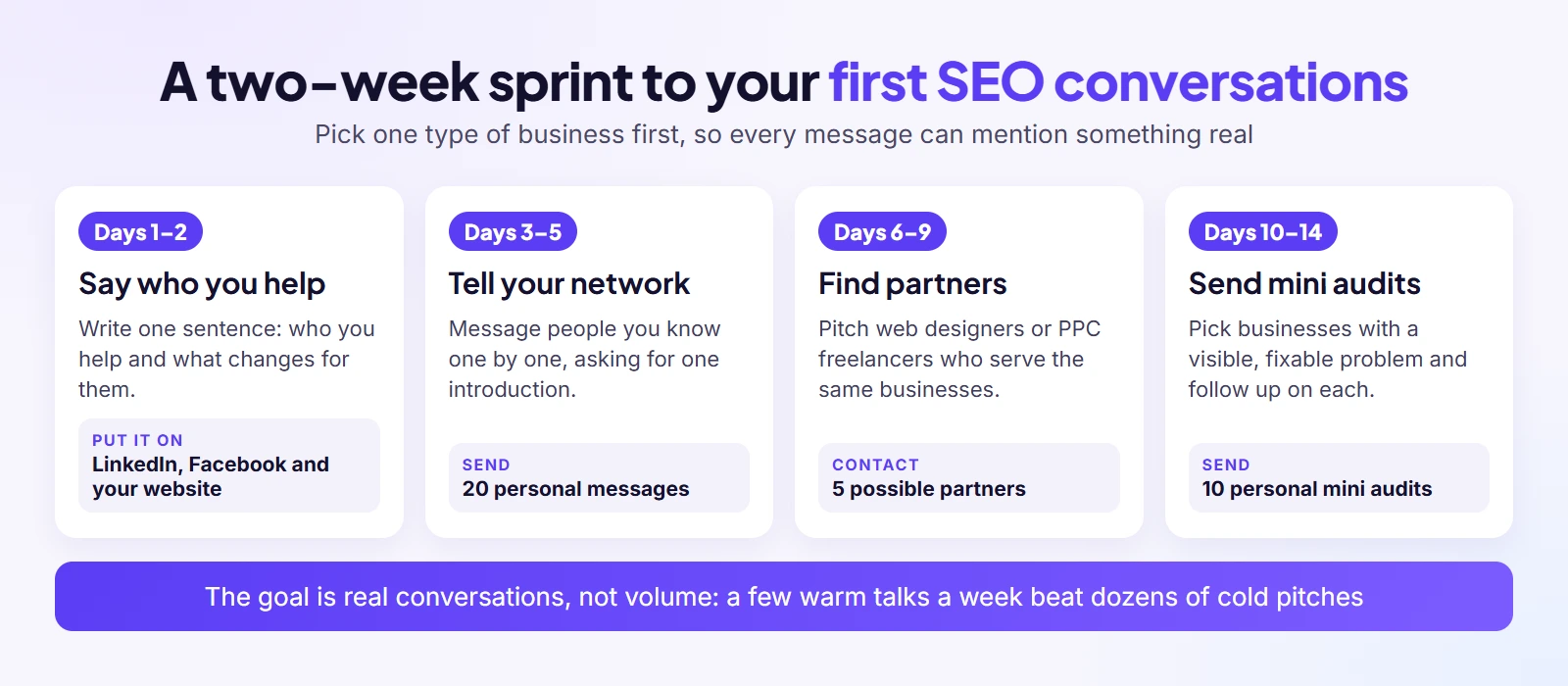
None of this guarantees a client in fourteen days, but it gives you real conversations quickly. Another Reddit reply summed it up well: “2 to 5 warm convos per week beats 50 cold pitches.”
Paid ads can speed things up once your offer is proven, but they are not a shortcut to a first client. One practitioner on YouTube put the cost of testing ads properly at “$500 to $1,000”, money that is easy to lose while your message and audience are still guesses.
Can You Get SEO Clients Without Cold Calling?
Yes, plenty of SEO freelancers never cold call; they let buyers come to them: build a personal brand where business owners spend time, offer a short free audit that shows your thinking, and publish proof of your results on your own site. These routes are slower to start than calling, but the clients arrive already warm and easier to close.
Cold calling works for some people; one practitioner on YouTube said it takes “hundreds of calls to get a handful of conversations”. If you would rather not live on the phone, the methods below replace it. They need patience, so start them early, even while you use the faster routes.
How does personal branding bring in SEO clients?
Personal branding brings in SEO clients by letting people see how you think before they ever hire you, so the first call starts with trust instead of doubt. It is slow and takes steady work: regular posts, helpful answers in groups, and talks at events where business owners gather. In my case it is what replaced the marketplace, and it still brings clients to me directly.
For me it was Facebook, my blog, writing in community groups, giving talks as a keynote speaker at community events, and running our own official Giant Marketers group. It built a lot of trust, and local business owners started contacting me directly.
You do not need a stage to start. Post short, useful notes about problems your buyers have, such as why a shop’s Google listing lost its calls, and answer questions in the groups where they ask. Give real answers, not teasers that end in “DM me”. Over months, people start to tag you when someone asks for an SEO.
What makes a free SEO audit win clients?
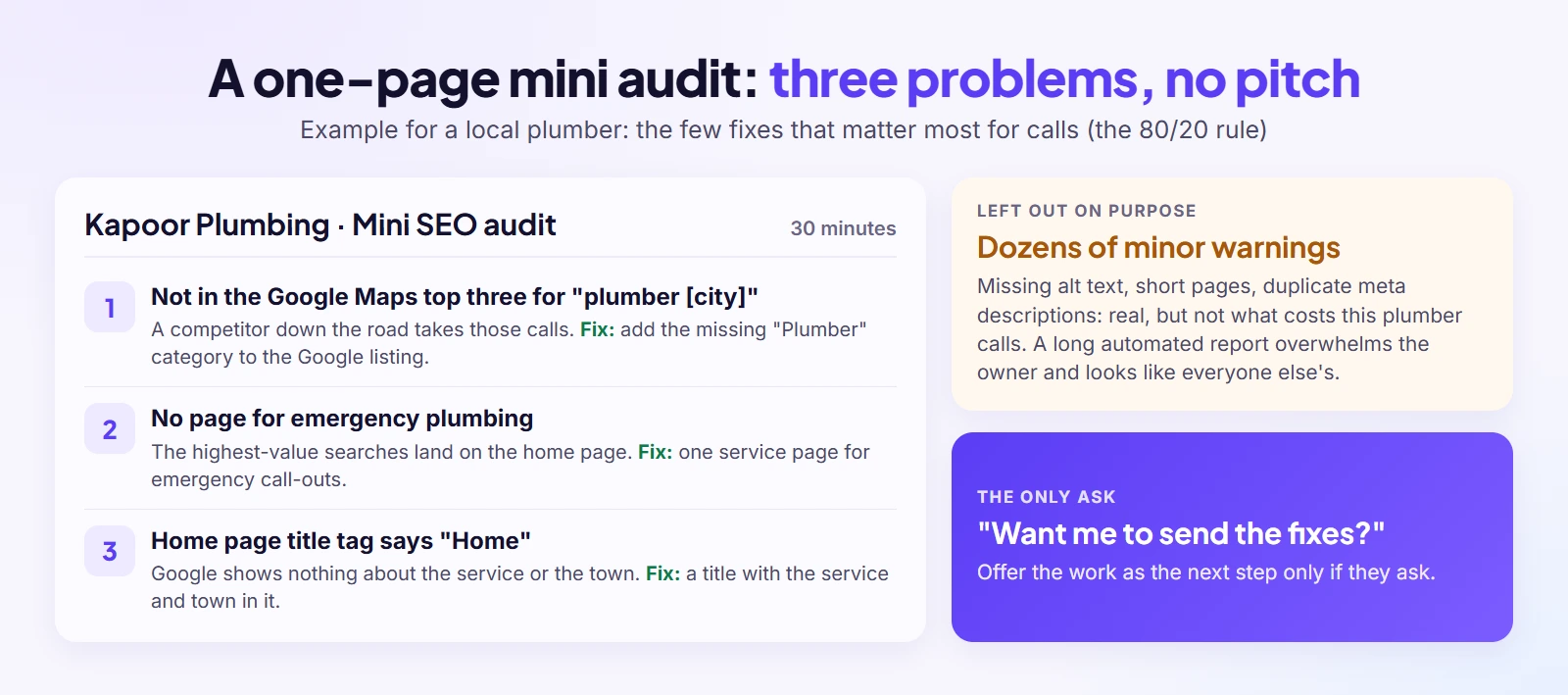
A free SEO audit wins clients when you keep it to one page or a short screen recording that shows three specific problems and why each one costs the business calls or sales. Send it with no pitch at the end, and offer the fixes as the next step only if they ask.
A long automated report full of warnings does the opposite: it overwhelms the owner and looks like everyone else’s. One Reddit SEO suggests “a one page audit offer that takes 30 minutes”, and others send it as a short video walking through the site. Spend your 30 minutes finding the few issues that matter most for that one business.
What is the 80/20 rule in SEO?
The 80/20 rule in SEO is the idea that a small share of the work, roughly 20 percent, produces most of the results, roughly 80 percent. In practice a few pages, keywords or fixes drive most of a site’s traffic and leads, so you find those first and leave the long list of minor warnings for later.
The rule is also the best way to shape a free audit. Instead of listing fifty issues, show the three that sit on the pages bringing in money: a service page that does not rank, a Google listing with missing categories, a title tag that says “Home”. A prospect who sees those three understands your value in a minute.
Does your own website help you get SEO clients?
Your own website helps you get SEO clients when it shows proof: one or two case studies with real numbers, a clear offer and, ideally, rankings for the problems your buyers search. Prospects will look you up before they reply, and an empty or outdated site raises the doubt you are trying to remove.
Do not try to rank for “SEO services” in your first year; those keywords are expensive and crowded. Write for your buyer’s problems instead, such as “why is my dental practice not on Google Maps”. As one Redditor put it, “build one site that ranks — that’s your resume.” If you track a site of your own month by month, that log is already a case study.
How to Get SEO Clients on LinkedIn
To get SEO clients on LinkedIn, make your headline say who you help and the result you deliver, post useful notes and real results for that audience, and connect with buyers without pitching in the first message. LinkedIn works best for B2B, SaaS and professional services, where the person who buys SEO uses the platform every day.
The common mistake is to connect and pitch in the same breath. Reddit commenters are blunt about it: “DONT connect to immediately send SEO pitches.” Another said most of the engagement on their posts came from fellow freelancers, not buyers, and yet a third reminded others that buyers often read without ever liking or commenting.
How should an SEO freelancer set up a LinkedIn profile?
Set up your LinkedIn profile so a buyer can tell in three seconds whom you serve and the result they get, for example “I help B2B software companies get demo requests from Google”. Put one case study or result in the Featured section and a clear next step, such as a link to book a call.
Then use the About section to describe the problems you fix in the buyer’s words, not a list of SEO terms. If your past work includes known clients or numbers you are allowed to share, add them. A profile like this turns every comment you leave on someone else’s post into a small advert.
What message should you send SEO prospects on LinkedIn?
Send SEO prospects on LinkedIn a short connection note with no pitch, then, after they accept and you have engaged with a post or two, a message that points to one specific observation about their search visibility and offers something small. Keep both messages under fifty words.
Connection note: “Hi [First name], I work with [type of company] on search and read your post about [topic]. Would be good to connect.”
Later message: “Thanks for connecting, [First name]. I was looking at how [Company] shows up for ‘[buyer search term]’. You rank well for [X], but [Competitor] takes most of the [Y] searches. I made a short video on what’s behind that. Want the link?”
Where Can You Find SEO Clients Online?
You find SEO clients online on freelance marketplaces such as Upwork and Fiverr, in communities and groups where business owners ask for help, on LinkedIn, and through your own website and content. Marketplaces bring paying work soonest for beginners; communities and content bring better-paid clients later, once people know your name.
Each of these places rewards a different behaviour. On marketplaces you win by being specific and fast; in communities you win by being helpful without selling; on your own site you win with proof. Pick one or two, not all of them at once.
Can you get SEO clients on Upwork and Fiverr?
Yes, you can get SEO clients on Upwork and Fiverr, especially as a beginner, but expect a slow start and price pressure. A new profile can take two to three months to win its first job, and Upwork charges for each proposal, so send fewer, tailored proposals rather than many copied ones.
The proposals that get answers open with something made for that buyer, such as a short screen recording of their site, instead of a summary of your skills. On Fiverr, a narrow “door opener” offer, one clearly defined task like a Google Business Profile setup, sells better than “full SEO”. Some buyers come back for more work, and a few grow into monthly clients.
I used a marketplace only at the very start, and that is the pattern I would suggest: use the marketplace to get paid experience and reviews, then move the relationships and your future clients to channels you control.
Can you get SEO projects from the USA and other countries?
Yes: international SEO projects, including work from US clients, usually come through marketplaces at first, then through referrals from overseas clients you have served well, and through partners abroad, such as agencies that need white-label SEO. Clear written English, working hours that overlap with the client and fixed-scope offers make the first project easier to win.
My international clients came through referrals. A happy client in one country tends to know other business owners there, and an introduction carries more weight than any proposal. Decide early how many late calls you can take; my reason for leaving the marketplace was the night work, and overseas clients bring the same question.
Can you find SEO clients on Reddit and in Facebook groups?
Yes, Reddit threads and Facebook groups do bring SEO clients, but only to people who answer business owners’ questions well and often, not to those posting offers. Pitching yourself in these groups tends to backfire, and the people who win clients there are the ones whose answers others start to recognise and tag.
An SEO on Reddit said three of their early clients came from their “first ever AMA at Reddit”. Another freelancer in a thread on finding clients said that “only being active on fb groups worked” for them. Local city groups and trade groups, where owners ask “who can help with our Google listing?”, are the most direct places to look.
How to Get Local SEO Clients
To get local SEO clients, choose one type of local business, such as plumbers, dentists or restaurants, find the ones that are missing from the Google Maps results in your area, and contact them with that specific gap. Local SEO is easier to sell than broader SEO because owners can see their own Map ranking and understand calls.
Being specific is what makes local outreach work. “Local SEO” sounds vague to an owner; “I help plumbers in [city] show up in Google Maps” does not. Look for businesses already spending money on ads or directory listings while their own Map listing is weak, because they already value new customers.
How do you sell SEO services to local businesses?
Sell SEO services to local businesses by showing the owner where they appear on Google compared with a named competitor nearby, explaining what that costs in calls, and offering a small first step with a fixed price. Owners buy more phone calls and customers, not rankings, so talk in those terms.
A walk-in at a quiet hour or a short phone call can work well, as long as the goal is permission to send your notes, not a sale on the spot. These two scripts keep it brief:
Walk-in: “Hi, I’m [name]. I help [trade] businesses here in [area] get more calls from Google. When I searched ‘[service] near me’ from [nearby street], you didn’t show in the map results, but [Competitor] did. I’ve written down the two things causing it. Could I leave this with you?”
Phone: “Hi, is this [owner]? My name’s [name], I do local SEO in [area]. I noticed your Google listing isn’t in the top three for ‘[service] [city]’. I’ve got two fixes written down that take under an hour. Can I email them to you?”
Leave a single printed page with the screenshot, the two fixes and your contact details. Many owners check their ranking from their own office, where they often appear near the top; a screenshot taken a few streets away shows them a different picture.

Where do you meet local business owners in person?
You meet local business owners at chamber of commerce events, business networking groups, trade meetups and local talks, where you can be introduced rather than cold-contacted. A local SEO on Reddit said joining a local chamber “helped me get my first three clients”. Speaking at these events, even for ten minutes, does more than any number of business cards.
Go to the same events regularly so people recognise you, and follow up the next day with something useful, such as a quick note on the owner’s Map ranking. Local communities talk to each other, so one well-served client often leads to the next.
How to Get More SEO Clients for Your Agency
Agencies win more SEO clients by turning the routes that already work into a repeatable system: ask every happy client for referrals on a schedule, follow up every lead until it answers, publish case studies from your best results, and keep the clients you have longer. Growth usually comes more from fewer lost leads and fewer lost clients than from more outreach.
The weak points are rarely at the top of the funnel. Leads arrive from forms, referrals and calls and then sit in an inbox; a promised proposal goes out a week late; a happy client is never asked for an introduction. Fix those leaks before buying more traffic.
How do you turn SEO leads into paying clients?
Turn SEO leads into paying clients by replying within a day, asking about their business goals before talking about SEO, sending a short proposal with two or three clear packages, and following up on a set schedule until you get a yes or a no. SEO deals often take a few weeks of back and forth before they close.
The first call decides most of what goes into the proposal, so ask before you pitch. These five questions show whether the lead is a fit and what the work is worth to them:
- What does a new customer bring you, on average, over a year?
- Where do most of your customers come from today?
- What have you tried for SEO or marketing before, and what happened?
- Who else needs to approve this decision?
- If this goes well, what would be different in six months?
Keep the proposal about outcomes the owner cares about: calls, bookings, sales. Tie each package to the work behind it, set a start date and give the offer an end date; our guide on how long a quote should be valid explains why. Write each lead’s next follow-up date down somewhere you will see it, because forgotten follow-ups lose deals that a good pitch already won.
Once a lead signs, make the start feel organised. A shared checklist of the logins and information you need, such as our SEO client onboarding checklist, shows a new client from the first day that they chose well.
How do you pitch SEO services to a business?
Pitch SEO services by talking about the business’s customers, not about SEO: show where they lose calls or sales to a named competitor today, what you would fix first, and what it costs, in that order. A good pitch fits into two minutes and ends with one small, clear next step.
Being good at SEO is only half the job. In the r/SEO thread where that fifteen-year agency owner replied, the top comment said: “it’s not who has the best product or service. It’s who the better salesperson is.” Someone in an r/bigseo thread on local SEO clients described the common trap as being “good at delivery, but invisible at trust-building”. Practise the pitch out loud until it sounds like a conversation, not a script:
“Right now, when someone in [town] searches ‘[service] near me’, [Competitor] shows up first and you don’t appear in the map at all, so those calls go to them. In the first month I’d fix your Google listing and build a page for [main service], and after that we track calls from Google every month. The first month is [price]. Shall I send a short proposal with two options?”
Can ChatGPT do SEO?
ChatGPT can do parts of SEO, such as drafting content, suggesting keywords and writing title tags, but on its own it cannot see a site’s analytics or Search Console data, decide what matters most for that business or make the changes and measure them. Prospects do ask this, so have a short, calm answer ready.
A reply that works on a sales call: “It’s a great writing tool, and I use AI where it helps. What you’re paying for is the judgement about what to fix first on your site, the work of fixing it, and someone watching the results each month.” It also helps to point out that AI answers in Google and ChatGPT draw on pages that rank and are cited, so SEO now affects both.
How do you keep SEO clients long term?
Keep SEO clients long term by setting a realistic timeline before they sign, reporting on leads and revenue rather than rankings alone, showing an early win in the first month or two, and talking to them regularly. Clients rarely leave because rankings moved slowly; they leave because they cannot see what they are paying for.
On a Reddit thread about retention, one agency owner said, “Our average client stays 2 years,” even without contracts, while another put the typical stay at six to nine months and added that “Retention jumps when you tie SEO to leads/revenue, not reports.” Ask each client what a new customer is worth to them, then show the results in that language. A clear SEO retainer agreement that sets expectations from the start helps too.
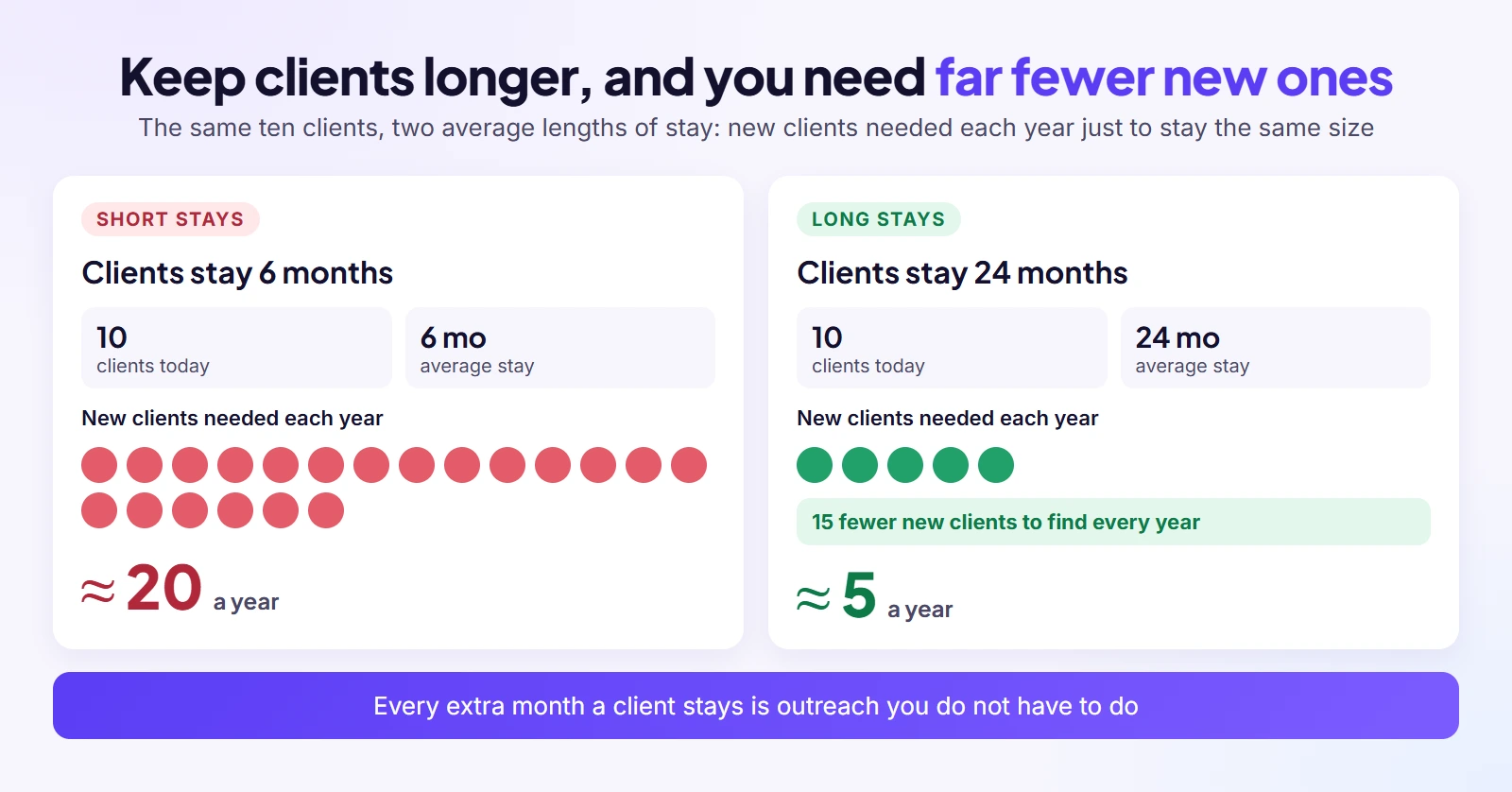
Retention also decides how much selling you need to do. With ten clients who stay six months on average, you need about twenty new clients a year just to stay the same size; if they stay twenty-four months, about five are enough. Every extra month a client stays is outreach you do not have to do.
Collect feedback along the way, not only at renewal time; our list of client feedback examples shows the questions to ask and how to turn good answers into testimonials, which then feed the next round of new clients.
Where Should You Keep SEO Leads and Clients?
Keep SEO leads and clients in one system, where every enquiry, follow-up date, proposal and paying client sits together instead of spread across email, spreadsheets and chat apps. That is what stops a warm lead from going cold because nobody remembered to reply.
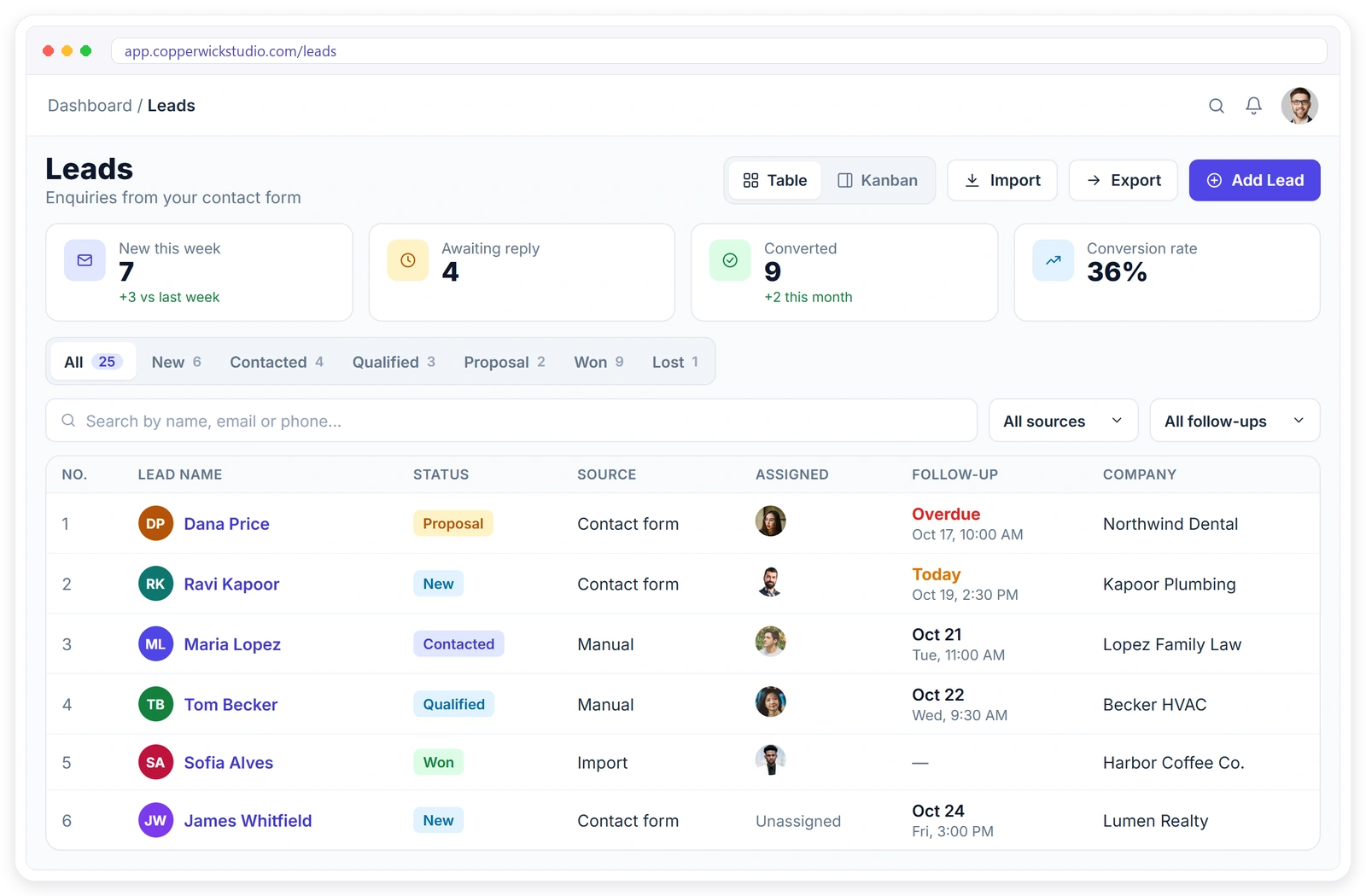
Clientish is an all-in-one client management portal for agencies, freelancers, consultants and service-based businesses: leads, proposals, a branded client portal, orders, invoices and subscriptions, support tickets and live chat in one place. For an SEO freelancer or agency, the lead management and sales pipeline covers the steps in this guide:
- Leads from many places: enquiries from your own forms, Facebook and Instagram Lead Ads, and calls booked through Calendly or Cal.com arrive as leads in one pipeline.
- Clear stages: each lead moves through New, Contacted, Qualified, Proposal, Won or Lost, with an expected value so you can see the pipeline’s worth.
- Follow-ups you will not forget: set a follow-up date with a note, and the Leads page marks overdue ones in red and today’s in amber.
- Proposals that close: send a proposal with packages and an e-signature; when the client accepts, the client record, invoice and order are created.
Once they sign, SEO clients get their own branded portal for reports, orders, invoices, support tickets and live chat, as set out on our client portal for SEO agencies page. Leads start on the Starter plan, and you can try it free for 14 days.
Frequently Asked Questions
These are the questions SEO freelancers and small agencies ask once the first few clients are in and they start thinking about the next ones.
What does “SEO clients” mean?
SEO clients are businesses that pay an SEO freelancer or agency to improve how they appear in search results, and now in AI answers too. They usually pay a monthly retainer for ongoing work or a one-off fee for a project such as an audit, a site migration check or a local listing setup.
How long does it take to get your first SEO client?
For most people it takes from a few weeks to a few months, depending on the route. Your own network and partners can produce a client within weeks; a new marketplace profile often needs two to three months; content and a personal brand usually take six months or more before clients come in steadily.
Should an SEO freelancer pick a niche?
A niche helps most when you are looking for clients, because every message, case study and post can speak to one type of business and its problems. You can still accept work outside it. Many freelancers start broad, notice which clients they serve best, and narrow down once they have two or three results in one field.
Is local SEO or national SEO easier to sell?
Local SEO is usually easier to sell when you are starting, because owners can see their Map ranking themselves and understand the link to phone calls. National and B2B SEO often pays more per client, but buyers expect stronger proof, the sales process is longer, and results take more time to show.
Do you need a website to get SEO clients?
You do not need a website for your first client, since that usually comes from people who know you. After that, prospects will look you up, and a simple site with a clear offer, one or two case studies and a way to contact you removes doubt that a profile on a marketplace cannot.
Is SEO still worth selling with AI Overviews and ChatGPT?
Yes. AI Overviews and chat assistants build their answers from pages that rank and are cited, so businesses now need SEO to appear in both search results and AI answers. The work has shifted towards clear, well-structured pages and a strong brand presence across the web, which gives you more to sell, not less.
What tools do you need to start getting SEO clients?
You need very little: a site audit or rank-checking tool to find real problems, a screen recorder for short video audits, a simple website or profile, and one place to keep leads and follow-up dates. Slow replies and forgotten follow-ups lose many deals, so that last tool matters more than the others.
How many SEO clients does a freelancer need?
Work it out backwards from the income you want and the hours each client takes, including reporting and calls. Divide your monthly income goal by your average monthly fee, then check that the total hours still leave time for finding new clients, because some clients will always leave and need replacing.
Should you sell SEO projects or monthly retainers?
Offer both. A fixed project, such as an audit or local setup, is an easy first yes for a cautious buyer, and a good result makes the move to a monthly retainer natural. Retainers give you steady income, but they need results you can show every month to keep going.
Final Thoughts
If you have no SEO clients yet, start this week with the people who already know you: send twenty personal messages saying who you help and asking for one introduction. Then pick one slow route that suits you, whether that is a personal brand, a community or your own site, and give it at least six months.
If you already have clients, look for leaks before you look for leads: the unanswered enquiry, the late proposal, the referral you never asked for. When you want one place to track every SEO lead from first message to signed client, Signup & Try Demo.
Sources
Clientish publishes this guide. It reflects the author’s 15 years of SEO client work as an SEO consultant and founder of Giant Marketers, and experience building client management software for agencies, plus Google results, “People also ask” answers and AI Overviews for SEO client questions, threads on Reddit (r/SEO, r/bigseo, r/DigitalMarketing, r/agency, r/localseo and r/freelance) and Quora, a practitioner video on YouTube, and guides on getting SEO clients, reviewed as of October 2026. Quotes attributed to Reddit users are real; outreach messages and templates were written for this guide. The Clientish section describes the product as of October 2026.

