

A digital marketing agency business plan is a short document that sets out who you serve, what you sell and at what price, how you win and deliver clients, and the numbers that show when the agency pays for itself. Below you will find a free template in Word and PDF, a guide to each of its 12 sections, and a fully filled sample plan with real tables.
Across fifteen years of client work at Giant Marketers, I have seen good marketers struggle as agency owners for one reason: they planned the marketing and skipped the business. They knew how to rank a page, but not how many clients paid the rent, which package made money or when to hire. A plan fixes that, and it does not need to be long. It needs real prices, real costs and a break-even number you can say out loud.
Key takeaways
- Start from your niche, packages and prices; the rest of the plan depends on them.
- Know your break-even client count before you sign the first lease or hire.
- Plan for three to six months of losses while clients ramp up, and hold that cash before you start.
- Write hiring triggers as numbers (clients or monthly revenue), not as hopes.
- Review the plan every 90 days and replace guesses with real numbers.
Free Digital Marketing Agency Business Plan Template (Word + PDF)
Most people searching for an agency business plan want a file they can fill in tonight, so here it is first. The template follows the 12 sections explained below, with a prompt under each heading telling you exactly what to write.
Digital marketing agency business plan template
What is inside the template
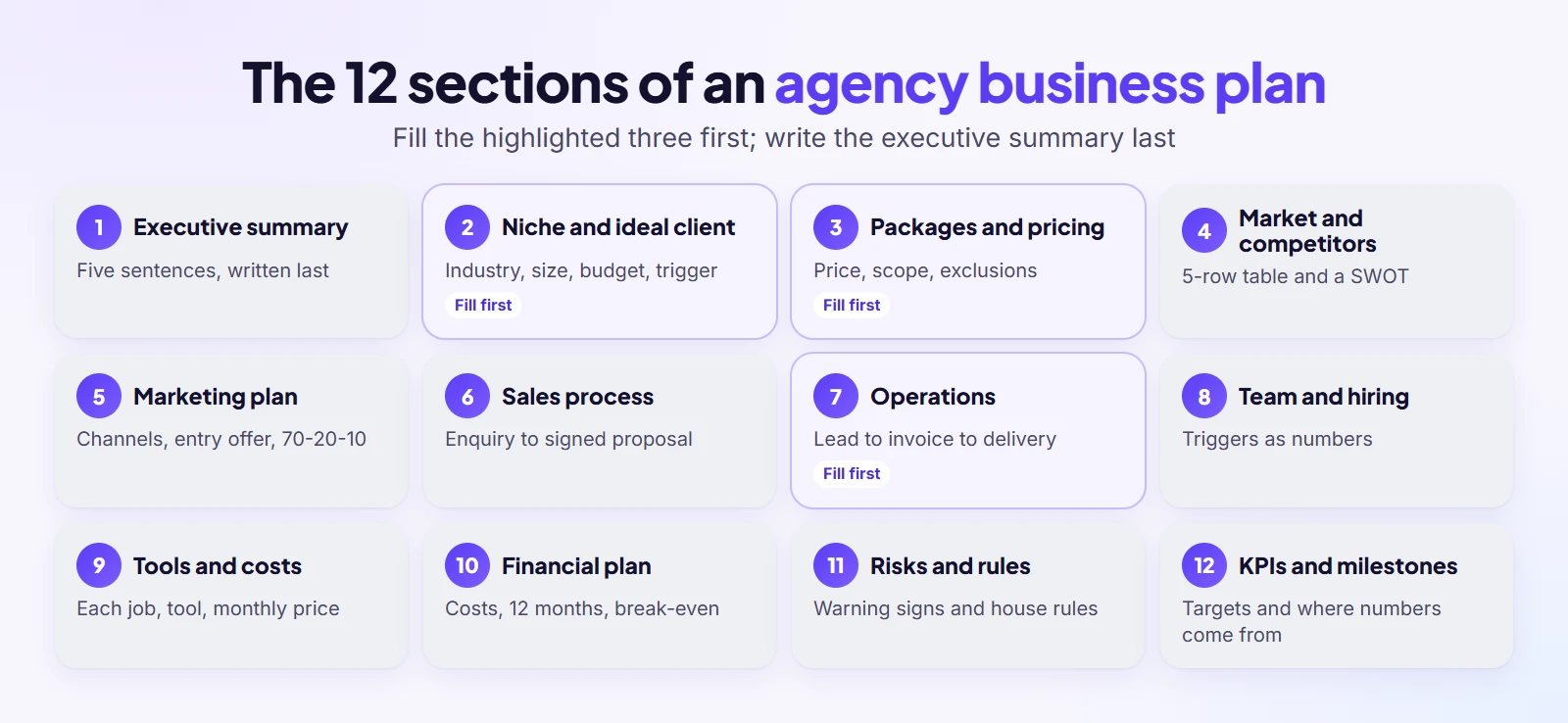
The file opens with a title block (agency name, date, version) and a short note on the order to fill it in: niche, packages and operations first, the executive summary last. Then come the 12 sections: executive summary, niche and ideal client, services and pricing, market and competitors, marketing plan, sales process, operations, team and hiring, tools and costs, financial plan, risks and rules, and KPIs and milestones. Each section has fill-in sentences or a table, so you write answers instead of essays.
How to use it
Fill sections 2, 3 and 7 first, because your niche, packages and delivery process decide almost every number elsewhere. Mark each number you are unsure of as an assumption. After 90 days of real sales, replace those assumptions with what happened. A plan with three guesses clearly marked as guesses is more useful than one with thirty confident numbers nobody checked.
Lean Plan or Full Plan: Which One Do You Need?
A bank manager and a freelancer starting from their spare room need very different documents. If you are self-funded, a one-page lean plan is enough to start; if you are asking a bank, an investor or a partner for money, write the full plan with financial tables.
The one-page version
The lean plan fits on a single page and answers ten questions. It takes an afternoon and covers what you need to start selling. You can expand it into the full template later, section by section, as the agency grows.
| Box | What to write |
| Problem | The problem your clients pay to fix |
| Ideal client | Industry, size, budget and buying trigger |
| Offer | Two or three packages, with what each includes |
| Price | Monthly price of each package and any setup fee |
| Channels | Where your first clients will come from |
| Entry offer | A small first step, such as a free audit |
| Key numbers | Break-even clients and the year-one client target |
| Costs | Fixed monthly costs, including your own pay |
| Team | Who does what now, and the trigger for each hire |
| 90-day goals | Three goals with dates |
When you need the full plan
Write the full plan when someone else’s money or name is involved: a bank loan, an investor, a business partner, or a large client that asks how you will deliver at scale. For a bank or investor it usually runs fifteen to thirty pages, with monthly cash flow for the first year and a summary for years two and three. The extra length should come from tables and evidence, not from longer paragraphs.
What to Write in Each Section of the Plan
You open the template, type your agency name, and then the cursor blinks under “Executive summary”. Here is what to put under each of the 12 sections, with a line from the filled sample further down so you can see what a finished answer looks like.
1. Executive summary
Write it last, keep it to one page, and make the money model obvious at a glance. Five sentences do the job: who you help and with what result, the packages and price range, where you are today, your target for month 12, and how the agency is funded. Every number here must match the financial tables. Sample: “Copperwick Studio helps home-service companies win more booked jobs; three packages from $1,000 to $3,500 a month; target 12 clients by month 12.”
2. Niche and ideal client
“Small businesses” is not a niche. Name the industry, company size, location, monthly marketing budget and the person who decides. Then list the top three problems they pay to fix, what triggers a purchase and where they spend time. Add who you will not take on, such as clients below a budget floor. Sample: “Plumbing, HVAC and electrical firms run by their owners, already paying for marketing, with nobody in-house to manage it.”
3. Services, packages and pricing
List each package with its monthly price, deliverables, what is not included, turnaround and revision rounds. State your pricing model (retainer, project, hourly advisory or performance) and why. Then check the unit economics: delivery cost per client against the price. A common rule of thumb is to charge about three times what delivery costs, which leaves room for overheads and profit. The step-by-step cost and margin maths is in our guide on how to price a productized service.
4. Market and competitors
Skip pages of global market-size statistics; they rarely change a decision. Instead, build a five-row table of real competitors in your niche (local agencies, specialist firms, freelancers and do-it-yourself tools) with their services, price range, strength and the gap you fill. Add a four-box SWOT with three points in each box. Sample gap: “No local agency reports on booked jobs; they report rankings.”
5. Marketing plan for your own agency
Name your main channel, two supporting channels, your entry offer and a monthly marketing budget, then set monthly targets for leads, calls, proposals and new clients. Two rules people search for fit here. The 70-20-10 rule, in its budget version, spends 70% on channels that already work, 20% on improving promising ones and 10% on tests. The 3-3-3 rule has no single definition; a common version is three key messages for three audiences on three channels.
6. Sales process
Map the steps from enquiry to signed deal: enquiry, call, proposal, signature, first invoice, onboarding. Write your follow-up rule (for example, a reminder three days after a proposal), your expected close rate and your deposit policy. When proposals are signed online, the acceptance can start the next steps automatically; our guide on how to send proposals to clients shows how that works in practice.
7. Operations
Describe how a client moves from lead to invoice to delivered work: intake form, task list, delivery, client approval, support and renewal, with the tool or person responsible for each step. Add your reporting rhythm and communication rules, such as which channel clients use and how fast you reply. Steps that repeat for every client belong in written procedures, and the guide to creating agency SOPs shows the format.
8. Team and hiring
List who handles sales, delivery and accounts today, and which contractors you use, at what rate. Then write each hiring trigger as a number of clients or a monthly revenue figure, whichever comes first, so the decision is made before you are tired and busy. Many small agencies start with contractors before full-time staff, because an early hire with no clients to serve is one of the fastest ways to burn cash.
9. Tools and monthly software costs
List each job and the tool that does it: client management, SEO research, design, social scheduling, email and documents, accounting. Put a monthly price next to each. Software for a small agency typically costs a few hundred dollars a month in total; writing it down stops subscriptions from creeping up unnoticed. The sample’s tools table below shows a full list for a two-person agency.
10. Financial plan
This section answers the questions a lender or partner asks first: what it costs to start, what it costs every month, how revenue grows, and when the agency breaks even. Use four tables (startup costs, fixed monthly costs, a 12-month client and revenue plan, and a year-one summary) plus a break-even line. Show the lowest point of your cash and how you will cover it.
11. Risks and the rules you run by
List the risks that would hurt most, each with an early warning sign and your response: losing a large client, late payments, scope creep, platform or algorithm changes. Then write the house rules that prevent them: a cap on how much revenue one client can be, payment before work starts, and a price for anything outside the package.
12. KPIs and milestones
Choose six to eight numbers and write where each comes from, so you can check them in minutes: pipeline value, proposal win rate, revenue by package, overdue invoices, client satisfaction, monthly revenue, churn and the cost of winning a client. Then set milestones for months 1, 3, 6 and 12, each with a date and an owner.
Sample Digital Marketing Agency Business Plan (Filled Example)
Reading section prompts is one thing; seeing them answered is another. Here is a complete plan for Copperwick Studio, a fictional two-person agency. All numbers are illustrative, built from public price ranges and simple maths; check your own market and vendor prices before you copy any of them.
Executive summary and ideal client
Copperwick Studio is a two-person remote agency that helps home-service companies (plumbers, HVAC and electrical firms) in one metro area win more booked jobs from Google and social media. It sells three monthly packages from $1,000 to $3,500, plans to reach 12 active clients and $20,700 a month in retainers by month 12, and is self-funded with $15,000 of the founders’ savings. Its ideal client is an owner-run firm with 3 to 25 staff, already spending on marketing with no in-house marketer. It does not take clients below $1,000 a month.
Packages and pricing
Three packages keep the choice simple for a busy trade owner and the delivery simple for a two-person team. Each one is a clear step up from the last, so a client can start small and move up when the results show.
| Package | Price a month | Includes | Not included | Share of clients |
| Local Starter | $1,000 | Google Business Profile upkeep, 8 social posts, monthly report | Ads, website changes | 50% |
| Local Growth | $2,000 | Starter plus local SEO and 2 service pages a month | Ad spend | 35% |
| Booked Jobs | $3,500 | Growth plus Google Ads management | Ad spend | 15% |
Each package includes three revision rounds per deliverable, and new clients pay a $500 setup fee on the first invoice. Ad spend is always paid by the client directly to the platform. With that client mix, the average retainer is $1,725 a month (0.5 × $1,000 + 0.35 × $2,000 + 0.15 × $3,500). Delivery by contractors is planned at 30% of each retainer, a little over a three-times markup.
Marketing and sales
Copperwick spends $600 a month on its own marketing, split 70-20-10: $420 on proven channels (referral partners and trade-owner groups), $120 on improving ones (case-study posts and its own Google Business Profile) and $60 on one new test each quarter. Its 3-3-3 grid is three messages (more booked jobs, time back for the owner, a clear monthly report) for three audiences (plumbers, HVAC, electricians) on three channels (referrals, local groups, a free Google Maps audit). The free audit is the entry offer; the plan assumes one in four audits leads to a proposal and one in two proposals is won, for one new client a month.
Operations and team
Enquiries arrive from the website form, lead ads or booked calls and move through clear sales stages to a proposal signed online. After the first payment, the client fills in an intake form, a task list for the package is created, and contractors deliver the work for the founders to review before the client approves it. A content writer and an ads specialist work as contractors from the first client. An account manager joins part-time at 15 clients or $26,000 a month in retainers, and a junior SEO at 20 clients.
Tools
Six tools run the whole agency, from the first enquiry to the accounts, for $339 a month. Client work, from leads and proposals to invoices and support, sits in one system, so the founders are not copying the same details between apps.
| Job | Tool | Monthly |
| Leads, proposals, client portal, orders, invoices, tickets | Clientish Growth plan | $49 |
| SEO research and rank tracking | SEO suite | $140 |
| Design | Design tool | $30 |
| Social scheduling | Scheduler | $50 |
| Email and documents (2 users) | Workspace suite | $30 |
| Accounting | Accounting app | $40 |
| Total | $339 |
Startup costs and monthly fixed costs
Copperwick keeps one-time costs low by using laptops the founders already own, and puts most of its funding into a cash reserve instead, because the first four months run at a loss.
| Startup item (one-time) | Cost |
| Company registration | $300 |
| Contract templates and legal review | $800 |
| Website | $1,200 |
| Logo and brand basics | $400 |
| Domain and email setup | $100 |
| Total startup | $2,800 |
| Cash reserve for the first months | $12,000 |
| Total funding needed | $14,800 |
Fixed costs come to $7,309 a month: software $339, professional liability insurance $120, bookkeeping $150, the agency’s own marketing $600, phone and internet $100, and founder pay of $6,000 (two founders at $3,000 each). Variable costs are contractors at 30% of retainer revenue and payment processing at an assumed 3% of revenue; check your own gateway’s rate.
12-month client and revenue plan
This is the table a lender reads first, because it shows how long the agency needs cash support. The plan assumes two clients in month one, one new client a month after that, and one client lost in month ten.
| Month | Clients | Revenue | Contractors | Fees | Fixed | Net | Cumulative |
| 1 | 2 | $4,450 | $1,035 | $134 | $7,309 | −$4,028 | −$4,028 |
| 2 | 3 | $5,675 | $1,552 | $170 | $7,309 | −$3,356 | −$7,384 |
| 3 | 4 | $7,400 | $2,070 | $222 | $7,309 | −$2,201 | −$9,585 |
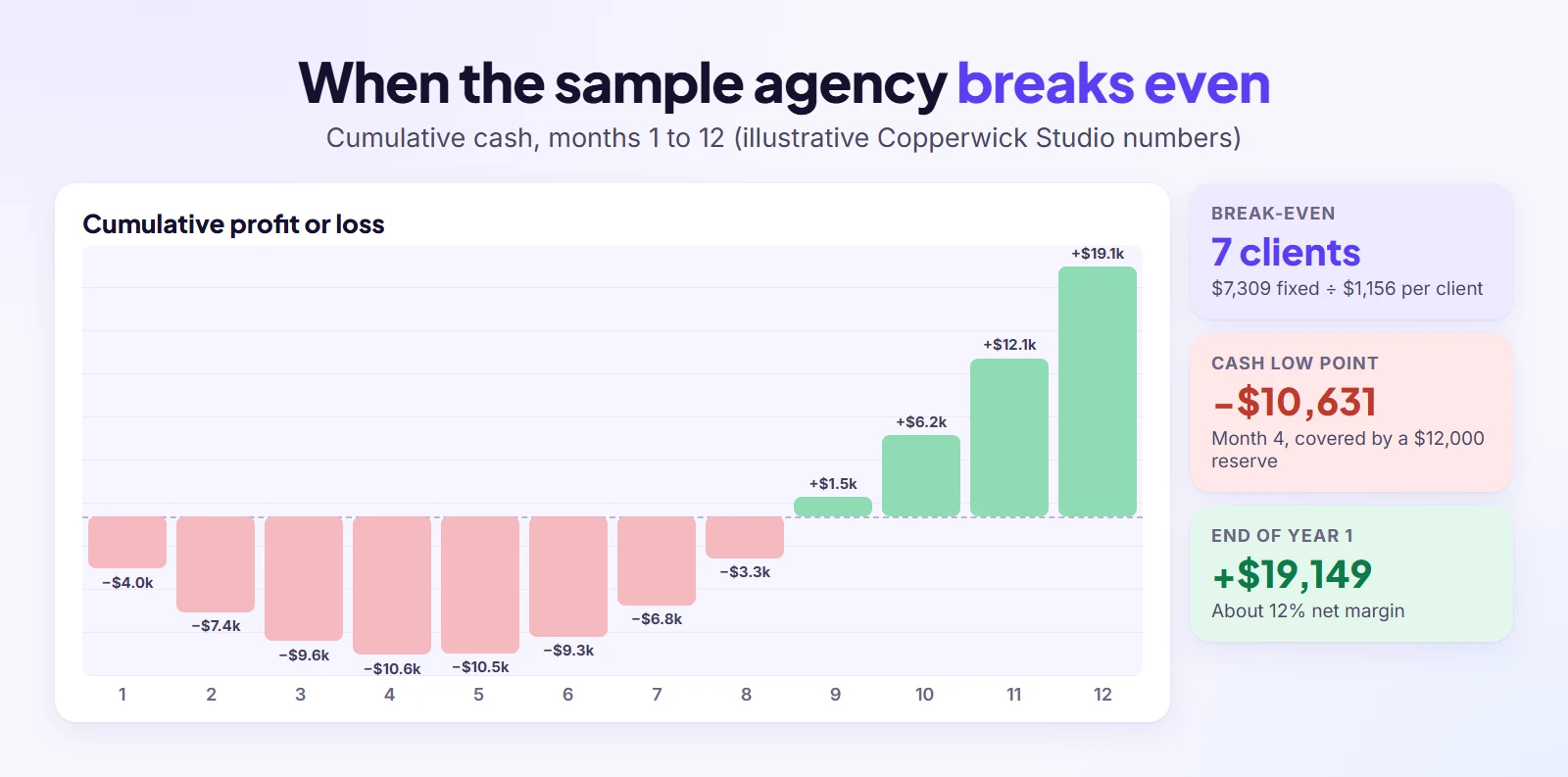
| 4 | 5 | $9,125 | $2,588 | $274 | $7,309 | −$1,046 | −$10,631 |
| 5 | 6 | $10,850 | $3,105 | $326 | $7,309 | $110 | −$10,521 |
| 6 | 7 | $12,575 | $3,622 | $377 | $7,309 | $1,267 | −$9,254 |
| 7 | 8 | $14,300 | $4,140 | $429 | $7,309 | $2,422 | −$6,832 |
| 8 | 9 | $16,025 | $4,657 | $481 | $7,309 | $3,578 | −$3,254 |
| 9 | 10 | $17,750 | $5,175 | $532 | $7,309 | $4,734 | $1,480 |
| 10 | 10 | $17,750 | $5,175 | $532 | $7,309 | $4,734 | $6,214 |
| 11 | 11 | $19,475 | $5,692 | $584 | $7,309 | $5,890 | $12,104 |
| 12 | 12 | $21,200 | $6,210 | $636 | $7,309 | $7,045 | $19,149 |
Revenue includes the $500 setup fee for each new client. Year one brings $156,575 in revenue; after contractors ($45,021) and payment fees ($4,697), gross profit is $106,857, or 68%. After $15,708 of other fixed costs and $72,000 of founder pay, the agency ends the year $19,149 ahead before tax, a net margin of about 12%. The lowest cash point is month four, at −$10,631, which is why the plan holds a $12,000 reserve.
Break-even
Each client leaves $1,156 a month after contractors and fees ($1,725 × 0.67). Fixed costs of $7,309 divided by $1,156 is 6.3, so Copperwick needs 7 clients on retainers alone to break even; with setup fees from new clients, month five is the first month in profit. In years two and three, the plan assumes an average of 16 and then 22 clients, with slightly higher prices for new clients, and a target net margin of 15% to 19%.
Risks, rules and KPIs
Copperwick’s rules: no client above 20% of monthly revenue; three revision rounds per deliverable; the first invoice paid before work starts; ad spend paid by the client directly; extra work quoted as a paid add-on. Its KPIs are pipeline value of at least three times next month’s new-revenue goal, a 50% proposal win rate, Booked Jobs at 25% or more of revenue by month 12, no invoices more than 14 days overdue, a satisfaction score of 4.5 out of 5, and a first reply to support questions within one business day.
How to Adapt the Template to Your Type of Agency
An SEO agency and a web design studio can both call themselves digital marketing agencies, yet their plans look very different on paper. The 12 sections stay the same for every agency; four things change: what your packages are built from, how you charge, your main delivery cost (covered under each type below), and the KPI you report to clients.
| Agency type | Packages built from | Usual pricing | KPI to report |
| SEO | Pages, links and audits per month | Monthly retainer | Organic leads and rankings |
| Paid ads (PPC) | Platforms and ad spend managed | Monthly fee or % of ad spend | Cost per lead, return on ad spend |
| Content | Articles or videos per month | Retainer or price per piece | Traffic and leads from content |
| Web design | Pages, features, revision rounds | Project fee plus care plan | Launch date met, enquiries |
| Email marketing | Campaigns and automated flows per month | Monthly retainer | Revenue per email sent |
| Full-service | A mix of the above | Tiered retainers | Leads and revenue overall |
Find your row, then adjust the sections below. Social media agencies have their own section after this one, because their packages, approvals and churn work differently again.
SEO agency
Build packages from monthly output: pages optimised, articles, links and audits. In the financial plan, list writers and link building as delivery costs, and SEO software as a fixed cost. Results take months, so add a minimum term to the risks section and report organic enquiries, not only rankings, so clients see value before positions settle.
Paid ads (PPC) agency
Write who pays the ad spend, because it changes your cash flow. The client can pay the platforms directly while you charge a management fee or a percentage of spend, or you can pay the platforms and bill the client back, which means you fund the spend until the invoice is paid. In the risks section, cover platform policy changes and account suspensions. Your KPIs are cost per lead and return on ad spend, and your plan should say who owns each ad account.
Content agency
Price per piece or as a monthly retainer for a set number of articles or videos, and define one unit clearly, such as word count or video length. Writers and editors are your main delivery cost, so the team section needs freelance capacity planned ahead. Report traffic and leads from content, and set an approval step so drafts do not stall in the client’s inbox.
Web design and development agency
When most of your revenue comes from one-off builds, your 12-month plan needs a pipeline of projects rather than a steady retainer count. Add a monthly care plan to smooth cash flow. In operations, list milestones and payment stages for each build, and in risks, cover scope changes and clients who delay content, because those push launch dates and your next project.
Email marketing agency
Package by campaigns and automated flows per month, with a clear limit on designs and revisions. Delivery costs are mostly copy and design. Your KPI is revenue per email or per subscriber, which needs access to the client’s store or CRM data, so write that access into the operations section and the client agreement.
Full-service agency
If you sell tiered retainers that mix several services, the plan gets complicated quickly. Give each service line its own row in the revenue table with its own delivery cost, so you can see which line makes money. Hiring triggers matter most here, because several contractors and specialists must be coordinated as the client list grows.
If You Run a Social Media Marketing Agency: What Changes?
“How many posts per week?” is the first thing a social media client asks, and it shapes the whole plan. The structure stays the same as above; the packages, approvals and risks change.
Packages by platform and volume
Social media packages are usually built from three variables: how many platforms, how many posts a week, and how many short videos a month. Put all three in the package table and in the contract, along with whether you reply to comments and messages. Ad management is priced separately, either as a monthly fee or as a percentage of ad spend, with the spend paid by the client.
An approval step before anything goes live
Social content is public the moment it is posted, so the plan needs an approval step: posts are drafted a week or more ahead, the client reviews them, and only approved content is scheduled. Set how long the client has to reply and what happens if they do not, so the calendar does not stall. Our social media retainer agreement template covers these terms with the client.
Higher churn risk and the right KPIs
Organic-only social clients can leave quickly if they do not see results, so consider a three-month minimum term in the contract. Report on enquiries and sales the social work brings in, not only followers and likes. A client who sees booked calls from Instagram stays; a client who sees a follower count often starts shopping around.
Is a Digital Marketing Agency Profitable?
“I’ve heard internet ‘gurus’ claim you can make at least a 70% margin,” one Reddit user wrote in a digital marketing forum, a claim that mixes up gross margin with what the owner keeps. Yes, a digital marketing agency can be profitable, but the realistic net figure is far lower than 70%.
What the numbers say
Industry benchmarks put typical agency net margins in the low to mid teens. Promethean Research reported an average after-tax net margin of 13% for digital agencies in 2025, and 19% for studios with fewer than ten staff. Gross margin, before overheads and owner pay, is much higher; the sample plan above shows 68% gross and about 12% net before tax in its first year, a little under those benchmarks, as you would expect while clients are still ramping up.
What moves the margin
Three things move it most: price (charging enough relative to delivery cost), utilisation (how much of the team’s paid time goes into billable work) and client fit (clients who match a package instead of needing custom work every month). Small agencies often have higher margins than large ones; the same 2025 data shows 8% for agencies with 50 or more staff, against 19% for the smallest studios.
Where the profit leaks
Underpriced first clients who never move to the current price. Scope creep that nobody charges for. Hiring before the revenue is there. Late payments that force you to fund delivery from savings. Each one is easy to fix in the plan and hard to fix once it is a habit.
How to Start a Digital Marketing Agency (and Where the Plan Fits)
One agency owner on Reddit put it bluntly: never start an agency until you have a steady list of clients as a freelancer. That is a strong opinion, but it points to the right order: prove people will pay before you build the company around them.
- Pick a niche and a core service you can deliver well, ideally one you have already been paid for.
- Win two or three clients as a freelancer or on the side, to test prices and delivery.
- Write the plan using the template above, with your real prices and costs.
- Set up the business: company registration, contracts, insurance, a simple website.
- Set up your systems: proposals, invoicing, onboarding and delivery in one place.
- Market to your niche with one main channel and an entry offer, and review every 90 days.
Starting with no experience is possible, but slower: spend the first months building proof (a few paid or low-cost projects with results you can show) before you write a plan that depends on selling to strangers. Once clients say yes, onboarding clients without email keeps the first week from turning into an inbox mess.
Business Model vs Business Plan
People often search for a “digital marketing agency business model” when they mean the plan, and the two are different. The business model is how you make money; the business plan is the full document that shows how you will make that model work.
The common agency business models are monthly retainers (steady income for ongoing work), project fees (one-off builds and audits), hourly advisory (consulting and strategy calls) and performance pricing (a share of results, which only works when you control the funnel). Most small agencies run on retainers with a few projects on the side. Choose the model first, because it decides the packages, cash flow and hiring triggers in your plan.
Running the Plan Once Clients Arrive
Picture month four: seven clients, two contractors, leads in a spreadsheet, invoices in one tool and briefs in another. The operations and KPI sections of the plan only work when you can check those numbers every month without stitching five tools together.
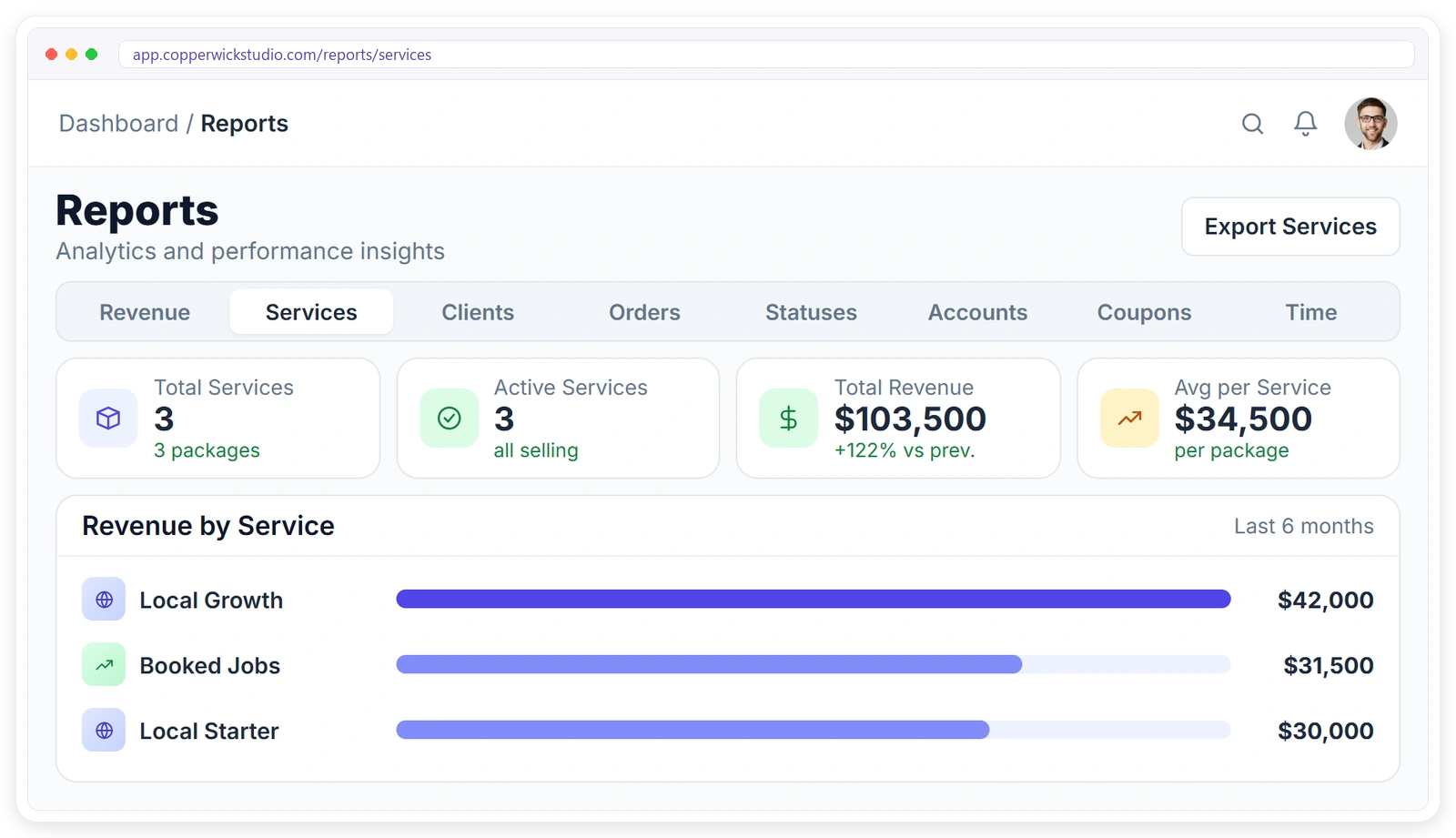
Clientish is an all-in-one client management portal for agencies, freelancers, consultants and service-based businesses: leads, proposals, a branded client portal, orders, invoices and subscriptions, support tickets and live chat in one place. In the sample plan, it is the $49 line in the tools table, the Growth plan, which includes leads and live chat. Here is how the plan’s KPIs map to it:
- Pipeline value and win rate: each lead carries an expected value, and leads move through New, Contacted, Qualified, Proposal, Won and Lost.
- Revenue by package: the Services report shows revenue by service for any date range.
- Overdue invoices and renewals: invoices show status and due date, and monthly subscriptions reopen the same invoice each cycle.
- Delivery and satisfaction: clients approve deliveries in their portal, and order ratings from 1 to 5 can be turned on.
Paid plans begin at $9.99 a month; a 14-day free trial lets you set up your packages while the plan is still a draft.
Frequently Asked Questions
Here are the questions agency founders ask while they write, check and present their first plan, whether it is for themselves, a partner or a bank.
How long should a digital marketing agency business plan be?
A lean plan for a self-funded start fits on one or two pages. A working plan you run the agency by is usually five to ten pages. A plan for a bank or investor runs fifteen to thirty pages, mostly because of the financial tables and supporting evidence they expect to see.
Do I need a business plan if I already have clients?
Yes, though a shorter one. With clients already paying, the plan’s job changes from proving demand to deciding prices, packages, hiring triggers and which clients to move on from. Agencies with clients often find their most profitable package is not the one they sell most.
Can I write the plan before I have any clients?
You can, as long as you mark every number as an assumption and set a date, usually 90 days, to replace each one with real figures. A plan written before the first sale is a set of guesses to test, not a forecast to defend.
How many clients does a small agency need to break even?
Divide your fixed monthly costs, including your own pay, by what each client leaves after delivery costs. In the sample above, $7,309 of fixed costs and $1,156 left per client means seven clients. Higher prices or lower delivery costs bring that number down quickly.
Should I put my prices in the business plan?
Yes. Prices decide your capacity, margin, break-even point and the kind of client you can serve, so a plan without them cannot answer its own questions. Put the full package table in, with what each price includes and excludes, plus any setup fee.
What startup costs do people forget?
Contract review by a lawyer, professional liability insurance, payment processing fees and, most of all, cash to live on while clients ramp up. Three to six months of reserve is a common recommendation, because a new agency often runs at a loss for its first few months, as the sample plan does.
How do I show a bank that a new agency can repay a loan?
Give them a monthly cash-flow table for the first year, the month you break even, and evidence of demand: signed contracts, letters of intent or your track record with past clients. Banks care more about the cash low point and how you cover it than about growth targets.
Can ChatGPT write my agency business plan?
It can draft sections and suggest structure, which saves typing. The numbers, niche, prices and competitors must come from your own research, because an AI tool has no idea what clients in your market will pay. Treat its draft as a starting point you check line by line.
How often should I update the plan?
Review it every 90 days against real numbers, and update it whenever you change prices, packages or your niche. Most of the value comes from those reviews, when assumptions meet reality and you decide what to change next. Put the review dates in your calendar now.
Which business model works best for a new agency?
Monthly retainers give the steadiest cash flow for ongoing work, so most new agencies build around them. Project fees suit one-off builds and audits. Performance pricing only works when you control enough of the funnel to deliver results, so leave it until you have proof.
Final Thoughts
Download the template and fill in three sections tonight: niche, packages and fixed costs. Those three give you a break-even number, and that number tells you more about whether the agency works than any market report.
Then compare your plan with the filled sample, mark your guesses, and set a date 90 days from now to check them against real sales. To run the operations section in one branded place from the first client, Signup & Try Demo.
Sources
Clientish publishes this guide. It reflects the author’s 15 years of client work at Giant Marketers and experience building client management software for agencies, plus agency business plan guides and samples, agency forum discussions on Reddit, and Google’s AI Overview and “People also ask” answers reviewed as of October 2026. Net margin benchmarks are from Promethean Research’s 2025 agency data. The 70-20-10 and 3-3-3 rules follow common versions described by marketing educators, which differ by source. Copperwick Studio is a fictional agency; its prices, costs and results are illustrative round numbers built from public price ranges, not real data. The Clientish section describes the product as documented on clientish.co in October 2026.

