

ManyRequests gives request-driven agencies a portal where clients hand over work. A client subscribes or buys a package, sends briefs through a form or by email, and the team works the queue, marks up files and bills through Stripe. A small design or video studio can run on that loop for years. The friction shows up when the team grows and when clients start sending things that are not work: each plan includes one seat, the “Powered by” credit only goes away on Pro, and support questions are handled as requests, with no reply targets.
Quick answer: For most agencies, Clientish is the ManyRequests alternative to try first. Its $29 entry plan already seats five staff and gives client questions a ticket queue with a reply deadline, and clients pay into whichever of your own Stripe, Paddle, PayPal or SSLCommerz accounts you connect. Wayfront, Zendo and Assembly are the nearest productized rivals; SuiteDash, Agiled and Plutio are broader business suites; HoneyBook, Dubsado, Bonsai and 17hats suit solo service businesses; SuperOkay, Clinked, Moxo, Accelo and FuseBase cover file sharing, guided workflows and PSA.
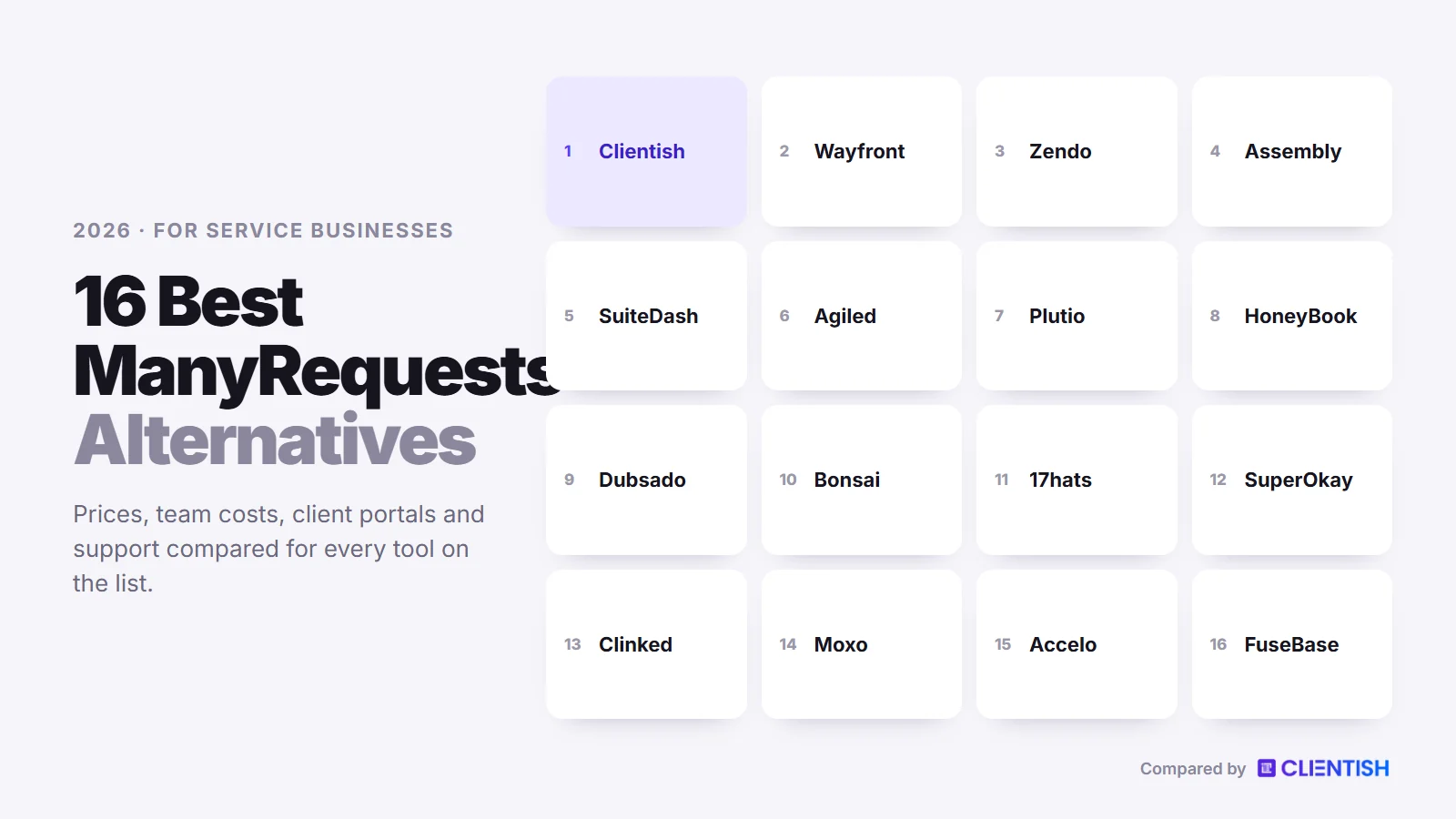
This guide explains where ManyRequests stops fitting a growing team (and where it still leads), how we chose 16 replacements, what each one costs for five or ten people as of early October 2026, and how to move clients across without charging anyone twice.
Key Takeaways
Many ManyRequests comparisons still quote its retired Starter plan and complain about storage or missing time tracking, none of which describes the product sold today. The five points below reflect what its own pricing and help pages said in October 2026.
- Every plan starts with one seat. Core lists at $59 monthly or $39 on annual terms, Pro at $99 or $79, and every added person costs $20 on Core or $30 on Pro each month ($15 or $25 when paid annually). Five people on Core come to $1,188 a year; Clientish Starter covers the same five for $276.
- Pro holds the switches agencies want. Removing “Powered by”, webhooks, the Slack app and the API all sit on Pro. Clientish also drops its credit on Pro, at the same $79 yearly sticker, but that plan seats 30 people instead of one.
- Requests double as tickets. ManyRequests offers no separate help desk, and across all 168 of its help articles we found no SLA or first-reply targets. A Clientish ticket carries a reply deadline set by its priority on every plan.
- ManyRequests leads on files and proofing. It annotates images, PDFs and video, accepts files up to 10 GB, gives every plan a custom domain and asks clients for a star rating when a request is done.
- Choose by what hurts first. Seat costs and support load point to Clientish, own domain and white-label on an entry plan point to Wayfront or SuiteDash, and a free starting tier points to Zendo.
Why Agencies Outgrow ManyRequests
ManyRequests describes itself as a “Client Portal for Agencies & Productized Services” and says more than 1,800 agencies use it. The reasons below are the ones its users and competitors raise most, each checked against ManyRequests’ own pages in October 2026 and corrected where older complaints no longer hold.
One Seat, Then a Charge for Each Colleague
Since August 2025 every ManyRequests plan has included a single team seat. The plan cards and the seat-pricing help article agree on that, although the comparison table on the yearly tab still mentions 5 and 10 seats; we followed the cards. Adding a colleague costs $20 monthly on Core or $30 on Pro, falling to $15 or $25 with annual billing, and the charge is prorated when someone joins mid-cycle. An eight-person studio on Core therefore pays $199 a month, or $144 a month billed yearly. Clients never use a seat, which keeps the cost tied to staff alone.
Storage Is Not the Weak Spot Older Reviews Describe
Third-party lists still warn about storage caps, and that warning is out of date. ManyRequests accepts files up to 10 GB each and sells another 500 GB for $25 a month. Its published allowances do conflict, though: the FAQ and help centre give 500 GB on Core and 1 TB on Pro, while the comparison table shows 1 TB and 2 TB. A video team should ask which figure applies before signing, but storage alone is rarely a reason to leave.
Billing Flexes, but Only Stripe Is Automated
Older posts claim ManyRequests can only bill subscriptions. Its help centre now answers “Is ManyRequests suitable for non-subscription agencies?” with a yes, and Core includes one-off services, invoices for a single request, hourly and credit-based billing with roll-over, and top-ups. The narrower limit is collection. Stripe is the only connected gateway (cards, Apple Pay, Google Pay, and ACH for US clients), so PayPal, Wise and bank transfers have to be marked as paid by hand, and client trials only work on accounts connected to Stripe.
Pro Holds the Branding Switch and the Developer Tools
Core already covers a lot of branding: your own subdomain, logos, favicon, colours and custom CSS. What it lacks is the option to remove “Powered by”, custom email notification text, the Slack app, webhooks (seven events), Rewardful and workload planning, all of which need Pro. The help centre places the API on Pro as well, while the Enterprise card lists “API Access”, and Enterprise itself “Starts at $1,000/m”.
Requests Doubling as Tickets
ManyRequests has no ticket module. Its help pages show how to treat a request type as a ticket, with statuses such as “Help needed” moving to “Investigation”, and there is an average-response-time report, but we found no reply targets or SLA settings, and only two automatic status rules. Review sites echo the limit: on Capterra, one agency CEO wrote of “certain moments where we outgrow some workflow limitations as our agency scales”, and a co-founder asked for “deeper integrations and more automation features”.
No Proposals and No Accounting Connection
We found no proposal, quote or contract feature in its help centre, pricing page or site; the closest thing is a terms-and-conditions checkbox on checkout forms. Its integration list also has no QuickBooks or Xero, and its own Zapier article uses “generate an invoice in Xero” as the example of what a Zap can do.
How We Chose These Alternatives
We began with the tools that appear beside ManyRequests in search results and on review sites, then added the general client-management suites that productized agencies also compare. Every candidate needed a login or link that clients use. We then read its pricing and help documentation during the first week of October 2026 and scored it on five questions:
- Seat cost: how many staff the plan includes and what each extra person adds.
- Collection: which payment gateways connect, and which only record a payment by hand.
- Client support: whether questions get a ticket queue, and whether replies have targets.
- Selling: catalogue, cart, proposals and how recurring work is billed.
- Branding and files: domain, sender address, credit removal and proofing.
Clientish publishes this guide and lists itself first because it was built for the agency model this article covers. The other fifteen entries rely on each vendor’s published pages, and they say so wherever a rival outdoes ManyRequests, Clientish or both.
ManyRequests Alternatives at a Glance
The table compares the cheapest paid plan of each tool, first on monthly billing and then per month on yearly billing, along with the points that most often decide a switch away from ManyRequests. Prices were read on vendor sites on October 4 and 5, 2026.
| Tool | From (monthly / yearly) | Team included | Own payment processor | Client tickets | Trial |
| Clientish | $29 / $23 | 5, 15, 30 or 50 | Stripe, PayPal, Paddle, SSLCommerz, manual | Every plan, reply deadlines | 14 days |
| ManyRequests | $59 / $39 | 1 seat; $15–$30 per extra | Stripe; others marked paid | Requests used as tickets | 14 days |
| Wayfront | $129 / $99 | 5 seats; $18–$20 per extra | Stripe, PayPal, manual | Helpdesk | 14 days |
| Zendo | Free; then $29 / $25 | 1 user; $8+ per extra | Stripe, bank transfer | Request types | 14 days of Pro |
| Assembly | Free; then $49 / $29 | 1 user (3 on Professional) | No; Assembly is the merchant | App template only | Free plan |
| SuiteDash | $19 / $15 | Unlimited | Stripe, Braintree, PayPal, Authorize.Net | Pinnacle plan | 14 days |
| Agiled | $29 / $24 | 1, 3, 7 or 15 seats | Stripe Connect, PayPal, Mollie | Pro and up | 14 days |
| Plutio | $19 / ~$15 | Solo on Core; 30 on Pro | Stripe, PayPal, Square | No module | 7 days |
| HoneyBook | $36 / $29 | Owner only; 3 people on Essentials | No; HoneyBook processes | No | 30 days |
| Dubsado | $35 / $335 a year | Owner + 3 free users | Dubsado Payments, Square, PayPal | Not found | 21 days |
| Bonsai | $15 / $9 per user | Charged per user | Bonsai Payments, Stripe, PayPal | Not found | 7 days |
| 17hats | $60 / $600 a year | A few users; $5 per extra | Stripe or Square | Not found | 7 days |
| SuperOkay | Free; then about $9 or $12 | 0, 3 or unlimited | None (pay link) | No | Free plan |
| Clinked | $11 per user | Per user to 25, then 100+ | None | No | 14 days |
| Moxo | $5,000 a year | Unlimited seats | Payment step in a flow | No queue found | On request |
| Accelo | Quote only | By quote | Stripe, Authorize.net, PayPal | Yes | Demo |
| FuseBase | Free; then about $32 or $39 | 1, 5 or 50 members | None | Not found | 14 days |
Assembly’s Free and Starter plans cannot add users, so a team starts on Professional at $139 a month ($99 yearly) with three users. Bonsai’s $15 Basic plan has no invoices or portal; its first plan with both is Essentials at $25 per user ($19 yearly).
What a Five- or Ten-Person Agency Pays
ManyRequests’ headline price covers one person, so the number that matters is the bill for the whole team. Each row prices a full year on the lowest plan that fits a team of five, then ten, while still offering clients a portal and, if the product bills at all, invoices.
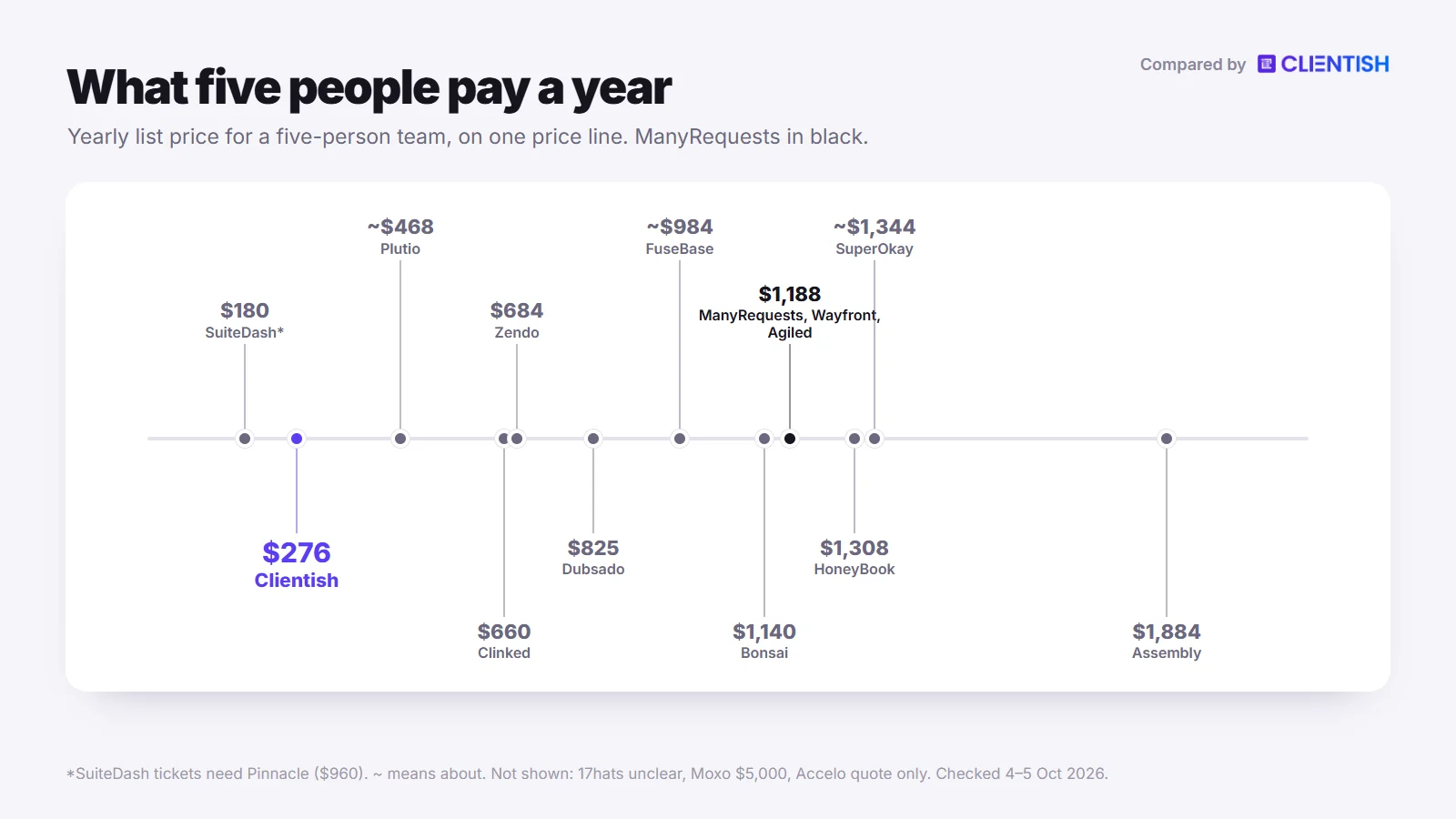
| Tool | 5 people, per year | 10 people, per year |
| Clientish | Starter: $276 | Growth: $468 |
| ManyRequests | Core + 4 seats: $1,188 | Core + 9 seats: $2,088 |
| Wayfront | Base: $1,188 | Base + 5 seats: $2,268 |
| Zendo | Core + 4 users: $684 | Core + 9 users: $1,164 |
| Assembly | Professional + 2 users: $1,884 | Professional + 7 users: $3,624 |
| SuiteDash | Start: $180 (tickets need Pinnacle, $960) | Start: $180 (tickets need Pinnacle, $960) |
| Agiled | Business: $1,188 | Business + 3 seats: $1,908 |
| Plutio | Pro: about $468 | Pro: about $468 |
| HoneyBook | Premium: $1,308 | Premium: $1,308 |
| Dubsado | Premier + user tier: $825 | Premier + user tier: $825 |
| Bonsai | Essentials × 5: $1,140 | Essentials × 10: $2,280 |
| 17hats | $600 a year plus $5 a month per extra user; the plan level with the client portal is unclear on its pages | |
| SuperOkay | Business: about $1,344 | Business: about $1,344 |
| Clinked | Start Up × 5: $660 | Start Up × 10: $1,320 |
| Moxo | Team: $5,000 | Team: $5,000 |
| Accelo | Quote only | Quote only |
| FuseBase | Essentials: about $984 | Advanced: about $3,192 |
How the figures were worked out: ManyRequests uses Core at $39 a month yearly plus $15 per extra seat; on Pro, which removes “Powered by”, the same five people cost $2,148 and ten cost $3,648, against $948 for Clientish Pro. Wayfront’s Base includes five seats and adds $18 each; Zendo adds $8 per user on Core; Assembly adds $29 per user on Professional. Agiled’s Business plan covers seven seats, with $20 for each seat beyond. HoneyBook Essentials covers the owner plus two team members, so a five-person team needs Premium. Dubsado adds a $25-a-month tier for users four to ten. The Clinked rows multiply its $11 Start Up rate by headcount on monthly terms. The SuperOkay and FuseBase figures assume the lower price on each pricing page is the yearly rate, which neither page labels.
The 16 Best ManyRequests Alternatives for Agencies
The list is grouped by how close each tool sits to ManyRequests. Tools 2 to 4 are productized-service portals that sell from a catalogue, 5 to 7 are wider business suites, 8 to 11 come from the freelancer booking-and-billing world, and 12 to 16 handle files, guided workflows or PSA. Each entry opens with how it differs from ManyRequests.
1. Clientish: Five Seats From $29 and a Help Desk on Every Plan
We built Clientish for marketing, SEO, design, web and content agencies whose staff share the work and whose clients come back to buy again. In ManyRequests, client work and support both run as requests; Clientish keeps the three jobs apart, so buying happens in a catalogue, delivery happens in an order, and questions go to a ticket.
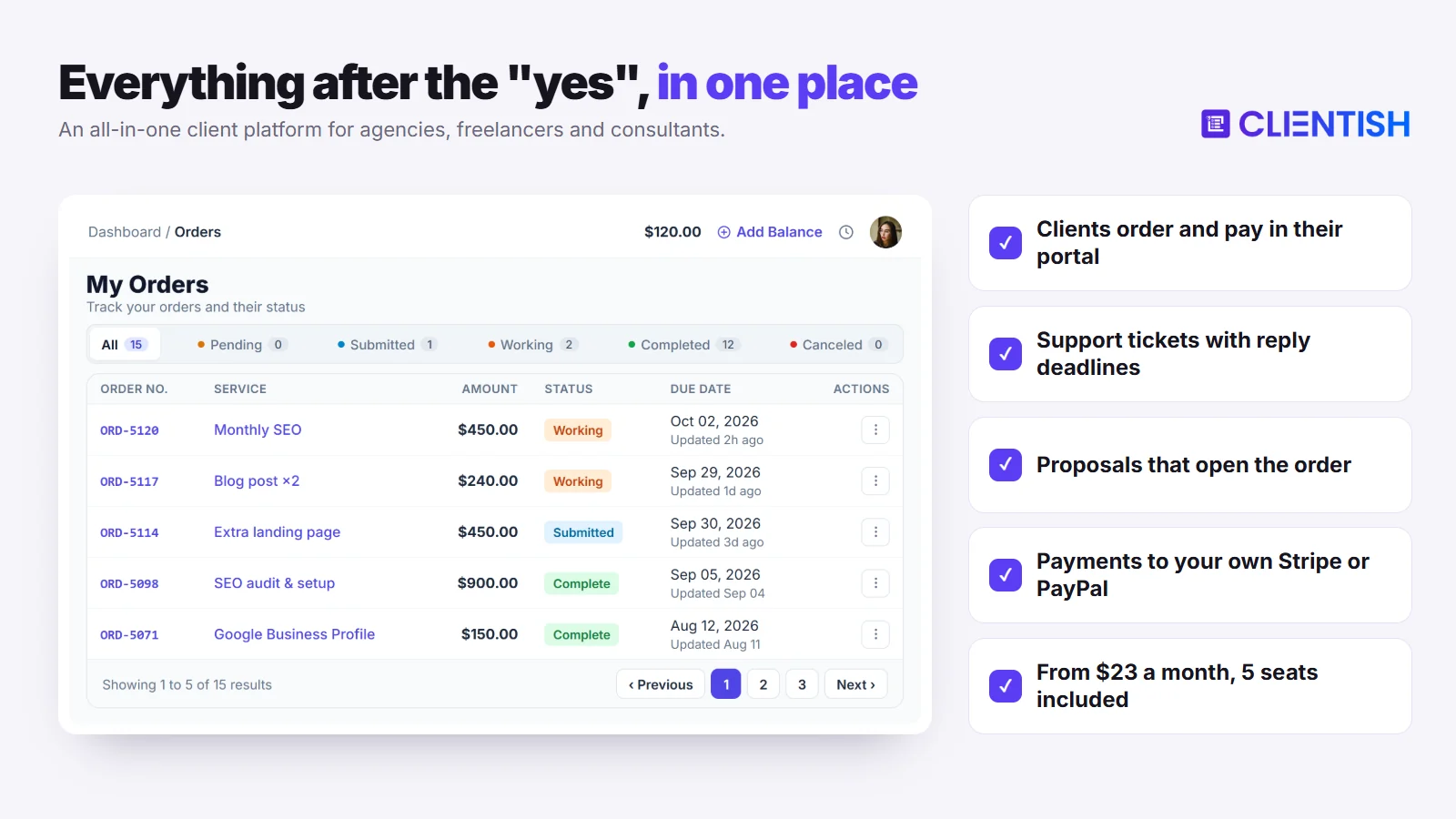
Compared with ManyRequests: five people cost $276 a year on Clientish Starter instead of $1,188 on ManyRequests Core, client questions get their own queue with reply deadlines, and PayPal, Paddle and SSLCommerz connect alongside Stripe. Both tools lift their credit only on Pro at $79 a month billed yearly, but Clientish Pro seats 30 people.
Key features (where it goes further than ManyRequests):
- Staff seats included: Starter comes with five seats, Growth with 15, Pro with 30 and Enterprise with 50; each person gets a role you configure, and extra seats are sold separately. ManyRequests bills for every colleague after the first.
- A real ticket queue: each ticket’s priority sets the deadline for your first answer; agents draw on canned responses, labels and internal-only comments; and after closing, the client rates how it went.
- Proposals that start the job: pick from eleven layouts; clients sign by typing their name, Clientish logs the IP address they signed from, and an emailed PDF copy follows. Signing creates the client account, a single invoice with the deposit (50% by default) due first, and the order.
- Gateways you already own: card and wallet money goes straight to the PayPal, Stripe, SSLCommerz or Paddle account you link, and your team marks off transfers sent by Wise, bank, Rocket, Nagad or bKash. No percentage goes to Clientish, and the markets you can bill depend on the gateway.
- Catalogue, cart and coupons: clients fill a cart, apply a coupon and check out; the invoice exists from that moment, work starts once the money arrives, and the brief comes through the service’s intake form.
- Orders with a revision allowance: each service carries its own count of included change rounds, and if a client ignores a delivery for a week it counts as approved (you can change that wait). ManyRequests caps open and monthly requests, and we found no revision limit there.
- Stored client balance: clients can settle invoices from credit held in their portal account.
- QuickBooks, Xero and webhooks: QuickBooks and Xero link in natively, while webhooks and an API hand events on to Make or Zapier. ManyRequests lists neither accounting tool.
- Hours the client signs off: freelancers you add as remote members (Growth and up) log hours for each client, and those hours reach an invoice only after the client says yes.
- Your sender, your look: whatever the plan, clients see your logo, colours and favicon, and mail to them is sent from your SMTP server.
- Selling before the sale: lead tracking and portal live chat are part of Growth and every plan above it.
Limits for agencies: Clientish never charges a renewal by itself: the subscription’s invoice reopens and must be paid, whereas ManyRequests lets Stripe take the money on the due date. Booking calendars and phone apps are absent too. Our screens exist in English alone (ManyRequests translates its portal into nine languages), and the login page your clients use lives on a clientish.io subdomain, not on an address of yours. Plans below Enterprise also cap how many new clients you add each month, and ManyRequests keeps the lead on proofing and large files.
| Pros | Cons |
| Five team members on the entry plan | Renewals wait for the client to pay |
| Tickets with first-reply deadlines | English interface only |
| Proposals that create client, invoice and order | clientish.io subdomain for the portal |
| PayPal, Paddle and SSLCommerz as well as Stripe | New clients per month capped below Enterprise |
Price: month to month, $29 (Starter), $49 (Growth), $99 (Pro) or $149 (Enterprise); on annual billing $23, $39, $79 or $119 a month. Each plan includes the portal, invoicing, tickets and proposals. Try every Clientish feature for 14 days; no card details are requested.
2. Wayfront: The Closest Productized Rival
Wayfront, called Service Provider Pro until February 2026, sells the same idea as ManyRequests (packaged services, a portal and recurring billing) but prices by a bundle of five seats rather than one. It also moves most of the white-label work down to its entry plan.
Compared with ManyRequests: at $99 a month on annual billing, the Base plan carries five seats, which puts a five-person studio at $1,188 a year, level with ManyRequests Core. Base is sold as logo-free, yet a Wayfront support article shows a modest “Powered by Wayfront” credit on order forms and in the sidebar, and the plan layers on a helpdesk where clients rate tickets, plus PayPal checkout next to Stripe.
Key features: Services with variants, add-ons and trials sell through a cart with coupons, and intake forms follow payment. Orders move through custom statuses, and a completed order can be locked so the client must press a button to ask for a revision. The helpdesk takes tickets from the portal or by email, with tags, staff-only notes, merging and ratings. Time tracking, sales pipelines, Zapier, webhooks and an MCP server are all on Base, as are your own domain, your own sending address and a portal in seven languages.
Limits for agencies: Extra seats cost $20 a month ($18 yearly). We found no proposals or quotes, only a signature field on forms. Intercom is required for live chat; client coworkers and Make wait for Pro at $249 a month on annual terms; and API access is a $300 monthly add-on sold only with Pro. PayPal subscriptions can’t be managed inside Wayfront.
| Pros | Cons |
| Five seats; white-label advertised on Base | Entry plan costs $99 a month billed yearly |
| Helpdesk with tags, notes and ratings | No proposal or quote module found |
| Time tracking and pipelines on every plan | API sold as a $300 Pro add-on |
Price: $99 a month on annual terms for Base ($129 monthly) and $249 for Pro ($299 monthly), while Plus needs a sales call. The two-week trial asks for no card and comes with an onboarding call.
3. Zendo: A Free Tier for Request-Based Teams
Zendo is the closest match to ManyRequests on structure: one internal user per plan, a storefront, subscriptions and request forms. The difference is a free plan, more portal languages and smaller per-user charges.
Compared with ManyRequests: each extra user costs $8 a month on Core rather than $15 to $20, and you can start for nothing, but the custom domain waits for Pro and the badge stays on until the $79 Agency plan.
Key features: A public service catalogue with multi-step checkout, add-ons and quantities. One-off, subscription and custom services, with subscription trials and pauses, plus quotes, invoices and percentage tax. Its nearest thing to a help desk is Request Types, which you can shape into support or onboarding forms; Free allows two, Core five and higher plans any number. Clients log in with a password or a Google or Facebook account, and the portal comes in 12 languages.
Limits for agencies: Stripe is the only connected gateway; bank transfer is manual, and PayPal and Payoneer are listed as “coming soon”. Zapier is locked until Pro, no public API has launched, and the integrations list names neither QuickBooks nor Xero. Storage runs from 1 GB on Free to 5 TB on Agency.
| Pros | Cons |
| Free plan for one user and three clients | Custom domain only from Pro |
| Cheap extra users on Core | Badge removal only on Agency |
| Portal in 12 languages | No accounting integration listed |
Price: nothing for Essential, then $25 (Core), $49 (Pro) or $79 (Agency) a month when paid annually, or $29, $59 and $99 monthly. Two weeks of Pro are free without a card.
4. Assembly: A Branded Portal Where the Vendor Takes the Payments
Assembly, formerly Copilot, is a portal for professional service firms with messaging, files, contracts, billing and a service Store. Since August 2026 it has promoted itself as an AI app builder, with templates that include a help desk, a time tracker and design approvals.
Compared with ManyRequests: Assembly acts as the merchant, so you cannot connect your own Stripe account, and platform fees sit on top of card fees. ManyRequests charges no transaction fee and uses the agency’s own Stripe.
Key features: Its Store can list four subscription offers and a dozen one-off packages, and anyone who buys becomes a portal client straight away. Recurring plans take the money from a stored card or ACH mandate. A Tasks app offers kanban boards and templates, and from Professional an automation builder can create tasks, while QuickBooks Online and Xero receive data one way. It has a SOC 2 Type II audit behind it, and people on the client side can log in with a one-use link, their Google account or a password.
Limits for agencies: Free and Starter have one user and no option to add more; Professional has three, then $29 each a month on yearly billing. Money can only be paid out to an American, British, Canadian or Australian bank account. Fees run from 0.3% to 2.0% depending on the payment type, plus 1.5% on international cards. Built-in tickets and revision handling are missing, and staff can only be Admin or Staff.
| Pros | Cons |
| Free plan and a service Store | You can’t bring your own processor |
| SOC 2 Type II and HIPAA on Advanced | Platform fees on every payment |
| QuickBooks Online and Xero sync | Help desk only as an AI-built app |
Price: a free plan, then $29 (Starter), $99 (Professional) or $499 (Advanced) a month on annual billing, or $49, $139 and $599 monthly; Enterprise is custom. No timed trial is advertised.
5. SuiteDash: One Price, No Seat Count
SuiteDash bills the account as a whole, not each user, which removes the per-seat cost that drives growing teams away from ManyRequests. It is a broad suite covering CRM, projects, invoices, portals, email marketing and courses, and it takes configuration.
Compared with ManyRequests: unlimited staff on every plan and a fully hidden brand from $19, against one seat and a Pro-only badge removal; the help desk, though, needs the $99 Pinnacle plan.
Key features: Client dashboards with magic-link login, checkout forms, estimates, invoices and subscriptions that charge automatically through Stripe, Braintree or Authorize.Net. PayPal works for one-time payments. QuickBooks Online syncs one way, and a translations toolkit and an installable app are available. File space grows from 100 GB on Start to 2 TB on Pinnacle.
Limits for agencies: Anyone wanting tickets, full automation or onboarding sequences has to buy the top tier. Learning time is a recurring complaint in reviews, and SuiteDash sells $50 setup sessions and a $299 kickstart. Xero is still on its roadmap.
| Pros | Cons |
| Staff and clients not counted | Tickets and automation on Pinnacle only |
| Own domain and hidden brand on Start | Long setup; paid onboarding sold |
| Four card gateways | No Xero connection yet |
Price: $180 a year for Start (or $19 monthly), $480 for Thrive ($49), $960 for Pinnacle ($99). A two-week Pinnacle trial needs no card.
6. Agiled: Client Work Plus HR and Expenses
Agiled, rebuilt and relaunched during 2026, gathers staff records, expenses, deals in a pipeline and the projects you run for clients behind a single sign-in. Its seats come in fixed bundles of 1, 3, 7 or 15.
Compared with ManyRequests: Mollie and PayPal connect beside Stripe, tickets arrive on Pro and QuickBooks or Xero on Business, but selling happens through one checkout link per service rather than a storefront.
Key features: Inside its portal, clients pay invoices, open tickets, chat, book meetings and work through onboarding steps. Repeat invoices go out by themselves weekly to yearly, or a Stripe or PayPal subscription can collect instead. Multi-party e-signing, HR records, leave and expenses are built in, and iOS, Android and desktop apps exist.
Limits for agencies: Seat bundles run 1, 3, 7 and 15 from Starter to Scale, with a $20 monthly charge for each person beyond the bundle. Your own branding, domain and SMTP sending arrive with Business, or separately as an add-on costing $19 a month ($15 if paid yearly). We found no reply targets or client ratings on tickets and no order or revision object. The one-time import from classic Agiled skips proposals, forms and workflows.
| Pros | Cons |
| HR, expenses and pipeline in one account | $20 per seat past the plan bundle |
| Phone and desktop apps | Accounting sync from Business |
| Stripe Connect, PayPal and Mollie | One checkout link per service, no storefront |
Price: annual billing gives $24 (Starter), $59 (Pro), $99 (Business) and $199 (Scale) a month; monthly billing is $29, $69, $129 and $249. The trial runs 14 days on Business features without a card.
7. Plutio: Every Feature on Every Plan
Plutio gives each plan the same features and limits only people, clients and automation volume. Its Pro plan includes 30 contributors for less than ManyRequests charges for one Core seat on monthly billing.
Compared with ManyRequests: a team of up to 30 fits on Pro at about $39 a month billed yearly, and Stripe, PayPal or Square all connect, yet there is no catalogue for clients to buy from and no ticket module.
Key features: Each client gets a login that shows only the projects, tasks, files, messages and invoices you share. Subscriptions can charge a saved card each cycle, invoices can be split into up to five payments, and proposals use ten built-in themes. For $9 a month extra, the portal moves to your domain, emails leave from your address and the login page carries your brand. Plutio runs in 34 languages with apps for phone and desktop.
Limits for agencies: Core is for one person and nine active clients. Plutio’s own help suggests building a support queue from a task board, QuickBooks and Xero need an automation platform, and workflow actions are metered by plan.
| Pros | Cons |
| 30 contributors on Pro | No catalogue or cart for clients |
| 34 languages and native apps | Support queue built from tasks |
| Own domain for $9 a month | Core limited to one person |
Price: $19, $49 or $199 a month for Core, Pro and Max, or roughly $15, $39 and $159 when billed annually. Trials last seven days.
8. HoneyBook: Bookings and Contracts for Owner-Led Studios
HoneyBook sells to service businesses that book clients one at a time: a proposal, contract and invoice in a single file, paid by card. It suits a different buyer than ManyRequests, though it can cover studios that sell custom projects.
Compared with ManyRequests: HoneyBook adds contracts with e-signing, a scheduler and a phone app, but it handles card payments itself instead of using your Stripe account, and there is no request queue or catalogue checkout.
Key features: Proposals, e-signed contracts and invoices on every plan, with recurring invoices charging cards automatically. The client portal and smart files can sit on your own subdomain. Expense tracking, QuickBooks Online and the removal of “Powered by HoneyBook” arrive with Essentials, and reports come in basic, standard and advanced versions by plan.
Limits for agencies: On Starter you work alone, Essentials adds room for two people beside the owner, and a bigger crew has to buy Premium. Accounts are open only to firms based in America, Canada, Britain or Australia. Client questions have no ticket desk, Xero is not on its integrations page, and the time tracker was switched off in September 2026.
| Pros | Cons |
| Contracts with e-signing built in | Payments only through HoneyBook |
| Scheduler and phone app | Four countries only |
| 30-day trial | Bigger teams need Premium |
Price: monthly billing is $36 for Starter, $59 for Essentials and $129 for Premium, falling to $29, $49 and $109 on yearly terms. 30-day trial.
9. Dubsado: Automated Client Journeys for Small Teams
Dubsado automates the path from enquiry to signed contract and paid invoice, with forms, a scheduler and a node-based builder called Flows. It is built around one business owner, though three extra users come free.
Compared with ManyRequests: three colleagues join without extra charge, and payments can go through Square or PayPal as well as Dubsado’s Stripe-based processor, but there is no request queue, proofing or catalogue checkout.
Key features: Proposals, contracts, invoices and forms in a branded portal, with a custom URL that hides the Dubsado name. Version 3.0 brought the Flows builder, board and table layouts, and a timer that runs across projects. Recurring invoices can require autopay, and Dubsado adds no fee to payments.
Limits for agencies: A fourth user triggers a $25 monthly tier that covers up to ten. Booking, Flows and the accounting links all require Premier. No ticket queue turned up in its help centre, and new sign-ups have paid higher prices since the first of December 2025.
| Pros | Cons |
| Three extra users at no cost | Automation and accounting on Premier |
| Square, PayPal or Dubsado Payments | No ticket desk found |
| 21-day trial | New-customer prices rose in 2025 |
Price: $335 a year buys Starter ($35 if paid monthly) and $525 a year buys Premier ($55 monthly). The 21-day trial unlocks Premier features.
10. Bonsai: Project Planning for Consultancies, Billed per Head
Bonsai combines proposals, contracts, invoicing and project management. Zoom acquired it in December 2025, and over 5,000 agencies and consultancies use it, according to its pricing page. Like ManyRequests, it charges for each person, though the rate depends on the plan.
Compared with ManyRequests: its Gantt timelines and task dependencies go beyond ManyRequests’ Kanban, list and queue views, yet clients reach Bonsai’s portal through emailed links instead of an account, and nothing resembles request intake or proofing.
Key features: Proposals, contracts, invoices, forms and scheduling from Essentials. Subscription invoices charge a saved card. Premium adds client messaging, automations, QuickBooks and Zapier, and removes Bonsai branding.
Limits for agencies: Every user is billed, and Elite needs three at minimum. Bonsai still lists custom portal domains as coming in 2026 rather than live. Choosing Stripe or PayPal in a country Bonsai Payments serves costs an extra 1%, and currency conversion adds 2.5%. A client ticket queue did not appear in our checks.
| Pros | Cons |
| Gantt, dependencies and workload | Each user is a paid seat |
| Saved-card subscription invoices | Portal opens by email link |
| Branding removable on Premium | Extra fees on Stripe or PayPal in some regions |
Price: each seat costs $9 (Basic), $19 (Essentials), $29 (Premium) or $49 (Elite) a month on annual billing, rising to $15, $25, $39 and $59 month to month. Trials last a week.
11. 17hats: Quotes and Bookkeeping in One App
17hats pairs quotes, contracts, questionnaires and invoices with a booking page and bookkeeping. It is sold as one plan with three ways to pay, and its client portal and per-user pricing fit a small business better than a request-driven team.
Compared with ManyRequests: it adds bookkeeping (with a $5-a-month bank feed add-on) and contracts that ManyRequests lacks, but clients cannot upload files in its portal, which rules out the brief-and-asset flow request agencies rely on.
Key features: Quotes, contracts and invoices can travel as one combined document, questionnaires support If/Then rules, and the app adds online booking and a profit-and-loss report. Payments run through Stripe or Square, autopay is a recurring billing module, and QuickBooks Online receives invoices and payments one way. iOS and Android apps are free.
Limits for agencies: The pricing grid and the multi-user page give different counts of included users, and each additional one is $5 a month. Nor do its pages say plainly which way of paying unlocks the client portal. Document links sit on a 17hats subdomain, Xero is not supported, and we found no help desk.
| Pros | Cons |
| Bookkeeping, bank feed as a $5 add-on | Clients can’t upload files in the portal |
| Free phone apps | User count unclear on its pages |
| Limited free CRM plan | One-way QuickBooks, no Xero |
Price: one plan at $600 a year, $800 for two years or $60 monthly, and on October 5, 2026 the first year was half price. Its free CRM tier stops at four invoices each quarter, and a seven-day trial is offered.
12. SuperOkay: A Project Hub Without Billing
SuperOkay builds a branded portal per project with documents, tasks, approvals and embedded apps. It has no invoicing, so it replaces the delivery side of ManyRequests but not the billing side.
Compared with ManyRequests: interactive documents and embedded Figma or Miro boards replace a request queue, and money is handled outside the tool through a pay button that links to your own gateway.
Key features: Clients sign in by magic link or password, complete interactive documents, approve them with one button and work on assigned tasks. Packaged Services pages present a service with its price and a buy button, and each project portal can take the client’s logo, colours and fonts.
Limits for agencies: No invoices, recurring billing or tickets. Nobody else can join on Free or Solo, Solo+ lets three colleagues in, and the ceiling lifts only on Business; two price columns on its pricing page also carry no labels.
| Pros | Cons |
| Free plan for a single project | No billing of any kind |
| Approvals inside documents | Teams start on Solo+ |
| Embeds for Figma, Miro and more | No support tickets |
Price: free for one project, then Solo at roughly $9 or $12 a month, Solo+ at $29 or $38 and Business at $112 or $146, with the smaller figure probably the annual rate.
13. Clinked: Secure File Exchange for Compliance-Minded Firms
Clinked sells a branded workspace for documents, tasks and chat, with industry pages for accountants, lawyers and finance firms, and one for marketing agencies. It shares ManyRequests’ strength in file review but drops billing completely.
Compared with ManyRequests: both handle file approvals and annotations, but Clinked adds ISO 27001 and an audit trail, while leaving out the catalogue, invoices and subscriptions that ManyRequests runs on.
Key features: Single files can be as large as 5 GB, outsiders can be asked to upload, and documents carry versions, comments, annotations and a sign-off button, alongside chat, tasks and shared calendars. Your own domain arrives on Standard, white-label notification emails on Premium, and iOS and Android apps come with every plan.
Limits for agencies: No invoicing, payments, catalogue or tickets are listed. Single sign-on is reserved for Enterprise. Start Up stops at 25 users, after which the price steps to $239 a month for 100 members.
| Pros | Cons |
| ISO 27001 and audit trail | No invoices or payments |
| File sign-off and versions | SSO only on Enterprise |
| Phone apps on every plan | Large jump after 25 users |
Price: Start Up runs $11 a month for each user; Standard is $239 a month, Premium $599 (or $479 on annual billing), and Enterprise is quoted. Clinked’s blog mentions a 14-day trial.
14. Moxo: Multi-Step Processes With AI Helpers
Moxo runs structured processes: each client and staff member steps through a laid-out path of forms, approvals, uploads, signatures and payments, with AI agents drafting or reviewing pieces along the way. It is priced for firms with formal processes rather than request queues.
Compared with ManyRequests: it costs $5,000 a year with unlimited seats instead of a per-seat bill, and work follows a designed sequence of steps rather than a free-form queue; we found no separate invoicing module; invoices and payments appear as steps in a flow.
Key features: The Team plan gives you flows with assigned roles, due dates and reminders. Branching, loops, portals on your own domain, single sign-on, webhooks and the audit log arrive only with Scale. Outside participants skip passwords: a magic link opens their branded view. Moxo cites SOC 3 as well as SOC 2 Type II.
Limits for agencies: Team covers 100 flows a year. Collecting money is one step type among many, with no recurring billing or support queue that we could find, and trials are assembled by Moxo staff after a request.
| Pros | Cons |
| Unlimited seats | $5,000 a year to start |
| SOC 2 Type II and SOC 3 | Branching and audit log need Scale |
| AI agents inside flows | No subscription billing found |
Price: $5,000 a year for Team; the Scale and Enterprise tiers are quoted individually. Ask Moxo for a trial.
15. Accelo: Retainers and Time for Established Firms
Quotes, delivery projects, retainers, ticketed support, logged hours and invoicing all sit inside Accelo, a PSA product now merged with Forecast. It sits at the heavy end of this list and is sold by demo and quote.
Compared with ManyRequests: it has tickets, retainer tracking and invoices built from project activity, but no catalogue or checkout for clients and no public price.
Key features: Approved quotes launch projects, retainer periods can renew and invoice automatically, and time on tickets counts against a retainer. Clients settle invoices through a payment link backed by Stripe, Authorize.net or PayPal. The portal opens from an email link, and there clients raise requests, approve sign-offs and pay. QuickBooks, Xero and many other tools connect.
Limits for agencies: No published pricing and no self-serve trial, and Accelo says most teams are running within weeks. Reviewers mention a steep learning curve.
| Pros | Cons |
| Tickets, retainers and time together | No public price |
| QuickBooks and Xero | Setup measured in weeks |
| Three card processors | No catalogue or checkout |
Price: custom quote based on team size. Demo on request.
16. FuseBase: Client Portals Inside a Shared Workspace
FuseBase, once called Nimbus, combines client portals with a document workspace and AI agents. It covers the collaboration half of what ManyRequests does and none of the selling or billing half.
Compared with ManyRequests: shared pages, e-signatures and AI agents take the place of a request queue, and there is no catalogue, invoice or subscription.
Key features: Clients arrive by magic link and find documents, to-do lists, joint action plans, a chat thread, forms, e-signature requests and meeting recordings in one place. To hide FuseBase’s name and run the portal and its mail on your own domain, you need Advanced or Unlimited.
Limits for agencies: No billing or ticket desk was found. Extra members on the five-member, 100-client Essentials plan are priced only on request, and every additional portal adds $20 a month.
| Pros | Cons |
| Workspace and portals together | No invoicing or payments |
| Built-in e-signatures | White-label from Advanced |
| Free plan and 14-day trial | Extra members by quote |
Price: a free tier, then Solo listed at $32 or $39, Essentials at $82 or $99 and Advanced at $266 or $399 a month, where the smaller number is most likely the annual rate; Unlimited is quoted. Paid plans can be tried for two weeks.
Cheapest ManyRequests Alternatives
If the ManyRequests bill is why you are looking, compare tools at the size your team will be in six months rather than at the single-seat headline. The table picks a low-cost option for each situation on yearly billing.
| Situation | Low-cost option | Cost per year |
| One person trying a request portal | Zendo Essential | $0 (three clients) |
| One person on a budget | SuiteDash Start | $180 a year |
| Five people with tickets and a portal | Clientish Starter | $276 |
| Ten people with tickets and a portal | Clientish Growth | $468 |
| Five people with the credit removed, tickets included | Clientish Pro (ManyRequests Pro: $2,148) | $948 |
| Any team size, no ticket desk needed | SuiteDash Start | $180 |
The free tiers are good for testing a workflow, not for running a studio: Zendo’s free plan stops at one user and three clients, SuperOkay’s at one project.
What Your Clients See in Each Tool
ManyRequests clients spend their time in a request list, so the portal they move to shapes how quickly they settle in. Below, for every tool, is the way a client signs in and the four things they most often try to do there.
| Tool | How clients get in | Pay invoices | Buy services | Raise tickets |
| Clientish | Own login to a branded portal | Yes, or from balance | Catalogue and cart | Yes, with deadlines |
| ManyRequests | Account created at checkout; requests by email | Yes | Catalogue and order forms | As requests |
| Wayfront | Magic link, password or Google | Yes | Cart | Yes |
| Zendo | Password, Google or Facebook | Yes | Storefront | Request types |
| Assembly | Magic link, Google or password | Yes | Store | No native desk |
| SuiteDash | Login or magic link | Yes | Checkout forms | Pinnacle |
| Agiled | Client portal | Yes | Checkout link (Business) | Pro and up |
| Plutio | Own login | Yes | Proposals | No |
| HoneyBook | Magic link, password or code | Yes | Smart files | No |
| Dubsado | Client portal | Yes | Proposals | Not found |
| Bonsai | Email link | Yes | Proposals | Not found |
| 17hats | Client portal | Yes | Quotes | Not found |
| SuperOkay | Magic link or password | Pay link only | Packaged services | No |
| Clinked | Secure login with 2FA | No | No | No |
| Moxo | Magic link or portal sign-in | Payment steps | Flow catalogue (Scale) | Flow requests |
| Accelo | Email link | Yes | No | Yes |
| FuseBase | Magic link | No | No | Not found |
Why Agencies Choose Clientish Over ManyRequests
ManyRequests is built for a small creative team working one queue. When the team passes three or four people and clients need help as well as deliverables, this is how the two compare on the points that usually decide the move.
| ManyRequests | Clientish | |
| Team members included | 1 seat on every plan | 5, 15, 30 or 50 |
| Five people, per year | Core: $1,188 | Starter: $276 |
| Credit removed, five people | Pro: $2,148 | Pro: $948 |
| Client questions | Requests set up as tickets | Tickets with first-reply deadlines and ratings |
| Automated payment gateways | Stripe | Stripe, PayPal, Paddle, SSLCommerz |
| Proposals and signatures | Terms checkbox at checkout | 11 designs; signing opens client, invoice and order |
| Accounting | No QuickBooks or Xero | QuickBooks and Xero |
| Revisions | Caps on active requests | Revision limit per service |
| Portal address | Your own subdomain | clientish.io subdomain |
| Renewals | Stripe charges the card | Client pays the reopened invoice |
ManyRequests keeps the edge on proofing, file size, its own-domain portal, nine portal languages and renewals that charge cards on their own. Clientish wins on what scales with headcount: seats, support, gateways, proposals and accounting. Open a free Clientish trial and move a single retainer client over for its two weeks.
Is ManyRequests Still Worth It in 2026?
For a design, video or 3D studio of one to three people that sells subscriptions through Stripe, it often is. Proofing on images, PDFs and video, 10 GB uploads, a custom domain on Core and automatic card renewals cover what such a team needs, and Core with three people costs $69 a month billed yearly.
The case weakens as the team grows. At five people the four extra seats alone cost $720 a year on Core, more than twice a whole Clientish Starter plan, and the agency still has no reply targets on client questions, no proposals, only Stripe for automated payment and no accounting sync. If more than one of those is already causing work, a move is worth testing.
Which ManyRequests Alternative Fits Your Agency?
Feature lists matter less than how your agency sells and supports its clients. Pick out the description that sounds most like your shop, and give the matching tool a trial run with genuine client briefs.
| If your agency… | Look at | Why |
| sells packages and retainers to many clients with a team of 3 to 50 | Clientish | Seats included, tickets with deadlines, proposals, several gateways |
| sells productized packages and wants its own domain on the entry plan | Wayfront | Five seats, cart, white-label advertised on Base |
| is one person testing a request portal on a small budget | Zendo | Free plan, cheap extra users, 12 languages |
| wants a service store and a free plan, and is happy for the vendor to process payments | Assembly | Store, SOC 2 Type II, QuickBooks and Xero |
| wants unlimited users and has time to configure | SuiteDash | One account price, white-label on every plan |
| also needs HR records and expenses | Agiled | HR, expenses and apps alongside client work |
| needs many interface languages or a phone app | Plutio | 34 languages, 30 contributors on Pro |
| books one-off projects in the US, Canada, UK or Australia | HoneyBook | Contracts, scheduler and payments in one file |
| wants automated enquiry-to-contract journeys | Dubsado | Flows builder and three free users |
| plans projects in detail and bills per consultant | Bonsai | Gantt, dependencies and workload |
| is a solo business that wants bookkeeping built in | 17hats | Bookkeeping, bank feed and quotes |
| mainly shares files and collects approvals | SuperOkay, Clinked | Project hubs; Clinked adds compliance |
| runs regulated, multi-step client processes | Moxo | Flows, AI agents, SOC 2 Type II |
| bills time against retainers at an established firm | Accelo | PSA with tickets, time and invoices |
| wants client portals inside a document workspace | FuseBase | Pages, e-signatures and AI agents |
Moving From ManyRequests Without Breaking Subscriptions
ManyRequests lets you export requests (with their URLs), clients and team members to CSV, invoices to CSV since August 2026, and a subscriptions report; we found no export for services. Saved cards live in your own Stripe account rather than with ManyRequests, which makes the billing switch easier to control.
- Download everything first. Export the client, request and invoice CSVs and the subscriptions report before your renewal. ManyRequests refunds only within 72 hours of an invoice, and a paused account keeps the portal readable and your data for at least a year.
- Import the clients. Open Clients → Import in Clientish, download its template and paste the ManyRequests contacts in; CSV, XLS and XLSX files are accepted. Nobody is emailed during the import, and each client stays inactive until you switch them on.
- Rebuild the catalogue by hand. Because no service export exists, enter each package again with its price, its intake questions and the number of change rounds it allows.
- Hand over renewals one client at a time. Cancel each Stripe subscription in ManyRequests only when its Clientish subscription is ready to start on the next billing date. Remember that Clientish reopens the invoice for the client to pay rather than charging the card.
- Tell clients where to go. Send each client the new portal address and explain that questions now go to tickets and new work to orders.
Frequently Asked Questions
Searches for ManyRequests alternatives keep raising the same questions. The answers below are written for agencies and use the prices and plan limits in force in early October 2026.
Which ManyRequests alternative do we recommend for agencies?
Clientish, if the agency has staff and a base of returning clients. Its plans bundle between five and fifty seats, questions are answered against ticket deadlines, a signed proposal opens the work, and Stripe is one of four gateways. Studios that want to keep the ManyRequests model but hide the vendor’s brand from the first day should look at Wayfront, sold as white-label from Base, although a help article describes a small “Powered by Wayfront” credit.
Is ManyRequests good for agencies that do custom project work, not just productized services?
Better than its reputation suggests. Core can sell one-time projects, bill an individual request and charge by the hour or in credits, and the help centre states plainly that agencies without subscriptions are welcome. What custom work usually needs and ManyRequests lacks is a proposal or quote step; Clientish and Accelo both have one.
What’s the main pricing difference between ManyRequests and its alternatives?
With ManyRequests, the first seat comes in the plan and every added person costs more, so the bill climbs with the team. Clientish bundles seats into each plan (five on the cheapest, fifty on the largest), Wayfront bundles five or ten, and SuiteDash and Moxo ignore headcount entirely.
What is cheaper than ManyRequests?
For one person, Zendo (free, or $25 a month yearly), SuiteDash Start ($15 a month yearly) and Plutio Core (about $15) cost less than ManyRequests Core at $39. For five people, Clientish Starter at $276 a year is the lowest-cost option on this list with tickets and a portal.
Can I white-label a client portal on every tool on this list?
Not to the same degree. A domain you own comes on every ManyRequests, Wayfront and SuiteDash plan, from Pro on Zendo, Professional on Assembly, Business (or a $19 add-on) on Agiled, with a $9 add-on on Plutio, and on higher tiers of SuperOkay, Clinked, FuseBase and Moxo. HoneyBook and Dubsado offer custom URLs; Bonsai’s custom domain is still expected; 17hats uses a subdomain. Clientish puts your logo and colours on the portal and routes its mail through your SMTP server whatever the plan, though the address stays under clientish.io.
Which tool is the best ManyRequests alternative for a design-on-demand or subscription service agency?
Wayfront and Zendo keep the productized model and add a cart; Wayfront includes five seats and Zendo starts free. Clientish suits the same agencies once support questions and team size become the pressure, though ManyRequests remains stronger on proofing.
Is Wayfront better than ManyRequests?
Five people pay $1,188 a year on either. Wayfront advertises Base as entirely unbranded, although its help centre still refers to a tiny “Powered by Wayfront” link, and Base bundles a rated helpdesk and PayPal checkout. ManyRequests offers design and video proofing and 10 GB uploads; we found no proofing tool in Wayfront’s documentation. We found a proposal tool in neither.
Why are agencies leaving ManyRequests?
The usual reasons are the per-seat bill once the team passes a few people, “Powered by” removal and the API being held for Pro, requests standing in for a support desk without reply targets, automation that reviewers call simple, and no proposals or accounting sync.
Do any of these tools have a free tier to start with?
Zendo, Assembly, SuperOkay and FuseBase have free plans, and 17hats has a free CRM plan with four invoices a quarter. Clientish skips the free tier; instead every plan can be tried for 14 days, and no card is asked for.
Is there a free ManyRequests alternative that can run a real agency?
Not for a team. Zendo’s free plan has one user and three clients, Assembly’s free plan has one user and five contacts, and SuperOkay’s covers one project with no team members. They are useful for testing a workflow before paying.
Can I take payments outside the US with these tools?
ManyRequests automates collection only through Stripe, with ACH for US clients, and PayPal or Wise payments have to be marked as paid. Clientish leaves the country list to your gateway: link SSLCommerz, Paddle, PayPal or Stripe, and record transfers made through Wise, a bank, bKash, Nagad or Rocket yourself. HoneyBook signs up businesses from four countries, and Assembly’s payouts are limited to banks in those same four.
How hard is it to migrate client data from ManyRequests to a new platform?
Client, request, team and invoice data export to CSV, and cards stay in your own Stripe account. Services must be rebuilt by hand. Clientish imports clients from a CSV, XLS or XLSX template, and they start inactive with no email sent.
Does Clientish support the same request-based intake workflow ManyRequests uses?
Not in the same form. Clientish clients buy a service from the catalogue and pay; the order then opens with its own revision allowance and the client fills in that service’s intake form; questions go to tickets. There is no single open-ended request queue like ManyRequests’.
Can clients pay invoices and manage their own accounts inside these portals?
In most of them. Accelo, Agiled, Assembly, Bonsai, Dubsado, HoneyBook, Plutio, SuiteDash, Wayfront, Zendo, 17hats, ManyRequests and Clientish all accept invoice payments inside the portal, and Clientish clients can also draw on a stored balance. SuperOkay sends people to a payment page elsewhere, while Clinked and FuseBase do no billing.
Is there a tool on this list that works well for both productized services and custom hourly/retainer work?
Clientish covers catalogue sales, subscriptions, proposals with deposits and, from Growth, client-approved hours for remote members. Accelo goes further on retainers and billable time but has no catalogue. ManyRequests itself handles hourly and credit billing on Core.
What should I look for if my agency is growing and I expect to add team members over the next year?
Price the plan for the team you expect, not the one you have. Check how many seats each plan includes, what one more person costs, and which features need a higher plan. On that measure Clientish (5 to 50 included), Plutio (30 on Pro), SuiteDash and Moxo (seats not counted) hold their price well.
Is ManyRequests still worth it in 2026?
Yes for a studio of one to three people that lives on proofing and Stripe subscriptions. Once the team grows and needs support tickets, several payment methods or proposals, the seat cost and missing help desk make a broader agency portal the better buy.
Final Thoughts
For running a request queue, ManyRequests is strong: it offers proofing with markup on images, PDFs and video, and uploads go up to 10 GB. Agencies tend to leave when the team grows past a handful of people, when clients need help as well as deliverables, and when payments, proposals and accounting have to work without extra tools.
Clientish is built for that stage: staff seats from day one, deadlines on every client ticket, proposals that turn into orders when signed, and payment accounts you already run. Bring your staff and a single subscription client into a free 14-day trial, then set seven days of its support beside the queue you run today. Our pricing page sets out each plan’s limits, while the ManyRequests vs Clientish comparison lines the two products up one feature at a time.
Sources
Clientish publishes this guide. Every ManyRequests and alternative-tool fact was checked on October 4 and 5, 2026, against each company’s own pricing and help pages; review themes come from Capterra.
ManyRequests, Wayfront, Zendo, Assembly, SuiteDash, Agiled, Plutio, HoneyBook, Dubsado, Bonsai, 17hats, SuperOkay, Clinked, Moxo, Accelo and FuseBase are trademarks of their owners. Clientish is not affiliated with any of them. See something out of date? Tell us and we’ll correct it.


