

Wayfront is what Service Provider Pro has been called since February 2026: a white-label portal for productized agencies, where packages sit in a cart, payment creates the order, and Stripe subscriptions renew by themselves. The search for something else usually starts with Wayfront’s own bill. Base runs $99 monthly when paid annually and covers five seats, each extra person adds $18 to $20, and the help centre shows no proposals, no contracts and no way for a client to approve logged hours.
Quick answer: For most agencies, Clientish is the strongest Wayfront alternative. The $29 plan ($23 billed yearly) seats five staff, one signature on a proposal produces the client login, the deposit invoice and the order together, each ticket gets a reply deadline from its priority, and payments settle in your own SSLCommerz, Paddle, PayPal or Stripe account. ManyRequests, Zendo and Assembly are the nearest like-for-like portals for packaged work. After them come three broader suites (SuiteDash, Agiled, Plutio), four tools shaped around solo and booking-led sellers (HoneyBook, Dubsado, Bonsai, 17hats), and five for file sharing, compliance, workflows and PSA (SuperOkay, Clinked, Moxo, Accelo, FuseBase).
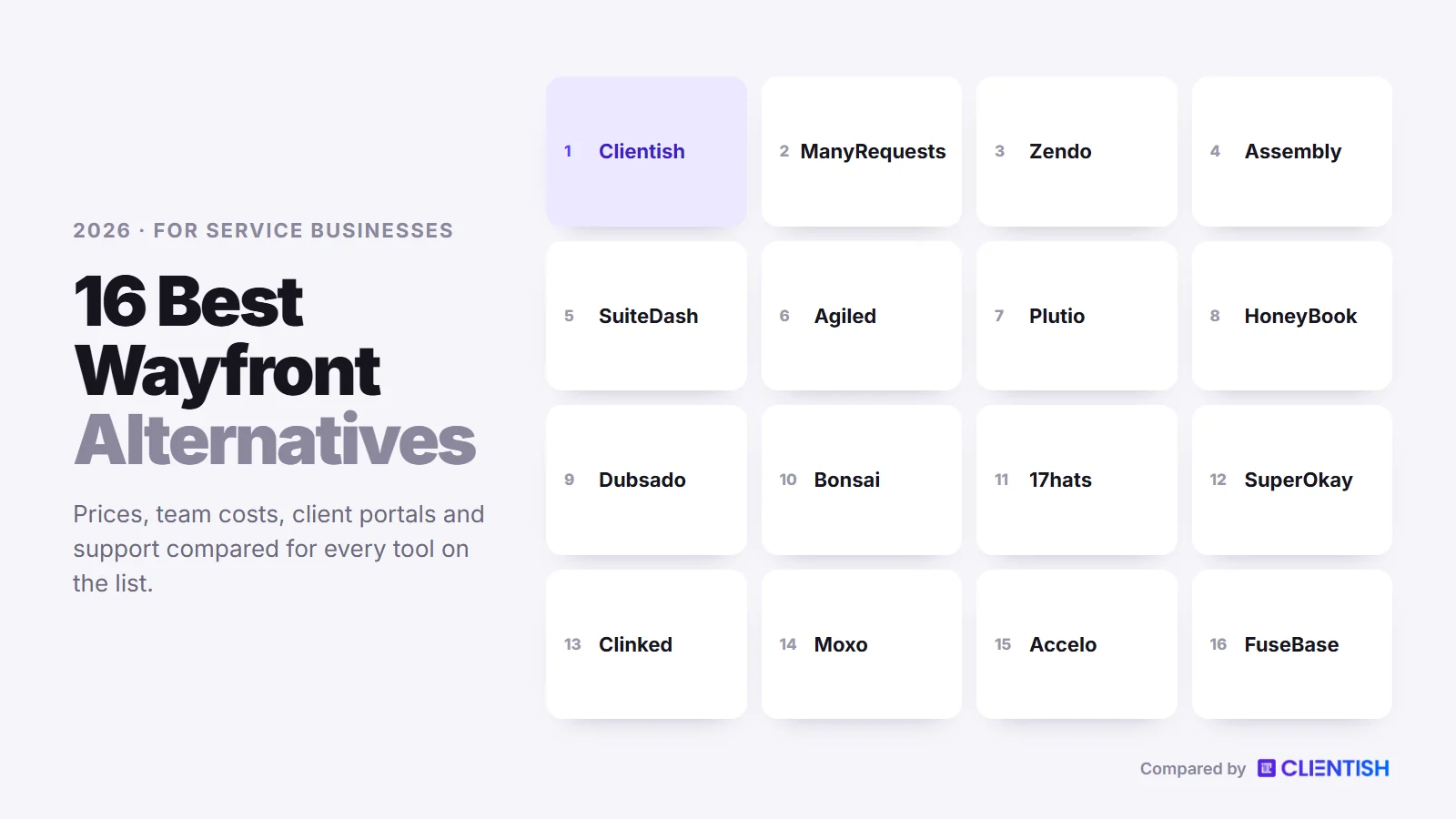
Below you will find what the SPP rename did and didn’t change, why agencies keep shopping around, the October 2026 cost of 16 alternatives for teams of five and ten, how each compares with Wayfront, and a way to switch without breaking live subscriptions.
Key Takeaways
Most pages about this product still describe the 2023 version of SPP, so they attack features that have since shipped and skip the costs that matter today. Here is where Wayfront stood when we checked it in October 2026.
- Same product, new name. Service Provider Pro took the Wayfront name in February 2026. Time tracking and Kanban sales pipelines have shipped since, so “no time tracking” and “no CRM” are out of date.
- The floor is $99 a month for five seats. Monthly billing makes it $129, and seat six onward costs $20 ($18 yearly). Ten people on Base pay $2,268 a year; Clientish Growth covers fifteen for $468.
- The gaps sit before and after the order. No proposal or contract module turned up, API access is a paid Pro add-on, client coworkers need Pro, and tracked time has no client sign-off.
- Its strengths are specific. Cart and checkout with coupons, Stripe subscriptions that charge automatically with dunning emails, a helpdesk, and a portal in seven languages.
- Choose by how you sell. Teams with many retainer clients fit Clientish, request-based design shops fit ManyRequests, and solo storefronts can start on Zendo’s free plan.
Why Agencies Look Past Wayfront
Wayfront assumes a productized agency with a proven offer, a handful of staff and clients who pay by card through Stripe. Agencies outside that profile meet the friction points below, each checked against Wayfront’s pricing page and help centre in October 2026 or labelled as a review theme.
The $99 Floor Arrives Before Any Proof
Nothing is cheaper than Base: $129 on monthly terms, or $1,188 for a year paid up front. Cost is a recurring complaint about SPP; one Trustpilot reviewer wrote in 2023 that “pricing is very high for the features they are offering”.
Every Person After the Fifth Costs Extra
Five seats come with Base, ten with Pro. Each additional login is $20 a month or $18 on yearly billing, and contractors limited to their own orders still count. Eight people on Base therefore pay $1,836 a year before any add-on.
Packaged Work Fits; Custom Work Has No Proposal Step
One-off jobs are possible: manual invoices take any line items, a deposit can be split from the balance, and credits can be sold as hours. What is missing is a proposal, quote or contract module. The closest tool is a signature field on an order or intake form, which stores the agreement text, signature, timestamp and IP with that order. Since May 2026 staff can time their work on orders, yet nothing lets the client approve those hours or turns them into an invoice.
The CRM Gap Has Mostly Closed
Older reviews say SPP has no pipeline, but company records arrived in December 2025 and Kanban sales pipelines with stage automations in May 2026, all on Base. What remains is the space between a won deal and a paid order, where a proposal would normally go. Reviewers also comment on how conversations are organised; one Capterra reviewer wrote that “Conversations are silo’d within orders”.
White-Label on Base, With One Contradiction
Base includes a custom domain, sending from your own address and editable interface text, and the pricing page promises “No Wayfront logo, ever”. Wayfront’s support documentation for the portal tells a different story: a small “Powered by Wayfront” link shows in the portal sidebar and on order forms. Deeper design work needs the HTML and CSS template editor, a Pro feature, and customisation is a recurring review theme (“Limited customization in certain views and workflows”, Capterra, May 2025).
The API and Client Teams Cost More
Zapier, webhooks and the MCP server come with every plan. Full API access, however, is sold only to Pro customers, at $300 monthly or $240 on annual terms over and above Pro itself. Client coworkers, Make and Slack notifications also require Pro.
Two Card Gateways and No Accounting Sync
Clients pay by Stripe, PayPal, a manual method or account balance. Wayfront’s PayPal module supports one subscription per order and can’t manage subscriptions, and no Paddle or regional gateway appears in its documentation. QuickBooks and Xero were absent from the roughly 70 articles in its help index, so the books depend on Zapier or exports.
How We Chose These Alternatives
We began with the tools that ranking “SPP alternatives” and “Wayfront alternatives” pages name most often, then added the client-management suites agencies weigh when the problem is cost rather than the productized model. A tool qualified if clients get some form of portal access and it covers selling, billing or delivery. Over October 4 and 5, 2026, every vendor’s own pricing and help pages were read for:
- Cost per head: people in the plan and the price of each seat beyond that.
- How clients buy: catalogue and cart, proposals, quotes or payment links.
- Who processes the money: your gateway account or the vendor’s.
- After the sale: tickets, revisions, time and recurring billing.
- Brand control: domain, sender address and removal of the vendor’s name.
This guide comes from Clientish, which puts itself at number one since it was built for agencies with a staff and returning clients, the readers this page is written for.
Wayfront Alternatives at a Glance
Here is each tool’s entry price beside the four points that most often decide a move away from Wayfront. Prices are the cheapest paid plan, monthly and on yearly billing, as each vendor listed them on October 4 or 5, 2026.
| Tool | From (monthly / yearly) | Team included | Own payment processor | Client tickets | Trial |
| Clientish | $29 / $23 | 5, 15, 30 or 50 people | Stripe, PayPal, Paddle, SSLCommerz, manual | Every plan, with reply deadlines | 14 days, no card |
| Wayfront | $129 / $99 | 5 seats; $20 each after | Stripe, PayPal, manual | Helpdesk | 14 days, no card |
| ManyRequests | $59 / $39 | 1 seat; $20 each after | Stripe; others marked paid | Requests used as tickets | 14 days, no card |
| Zendo | Free; then $29 / $25 | 1 user; $8+ each after | Stripe, bank transfer | Request types | 14 days of Pro |
| Assembly | Free; then $49 / $29 | 1 user (3 on Professional) | No, Assembly is the merchant | App template only | Free plan |
| SuiteDash | $19 / $180 a year | Unlimited staff | Stripe, Braintree, PayPal, Authorize.Net | Pinnacle plan | 14 days |
| Agiled | $29 / $24 | 1, 3, 7 or 15 seats | Stripe Connect, PayPal, Mollie | Pro and up | 14 days |
| Plutio | $19 / about $15 | Solo on Core; 30 on Pro | Stripe, PayPal, Square | Task boards only | 7 days |
| HoneyBook | $36 / $29 | Owner only, 3 people, or unlimited | No, HoneyBook only | No | 30 days |
| Dubsado | $35 / $335 a year | Owner + 3 users free | Dubsado Payments, Square, PayPal | Not found | 21 days |
| Bonsai | $15 / $9 per user | Every user is a paid seat | Bonsai Payments, Stripe, PayPal | Not found | 7 days |
| 17hats | $60 / $600 a year | Unclear; extra users $5 | Stripe or Square | Not found | 7 days |
| SuperOkay | Free; then about $12 / $9 | 0, 3 or unlimited | None (pay link only) | No | Free plan |
| Clinked | $11 per user | Per user, then 100+ members | None listed | No | 14 days |
| Moxo | $5,000 a year | Unlimited seats | Payment step in flows | Workflow requests | On request |
| Accelo | Quote only | By quote | Stripe, Authorize.net, PayPal | Yes | Demo |
| FuseBase | Free; then about $39 / $32 | 1, 5 or 50 members | None built in | Not found | 14 days |
SuperOkay and FuseBase show two prices per plan without saying which is yearly; we read the lower one as the yearly rate, so treat both as approximate.
What a Five- or Ten-Person Agency Pays
Seat rules change the ranking once a real team is counted, and Wayfront’s five-seat Base looks different beside tools that include one person or fifteen. Every row lists twelve months on the cheapest tier where the whole team gets a login and clients get a portal, using list prices recorded on October 4 and 5, 2026.
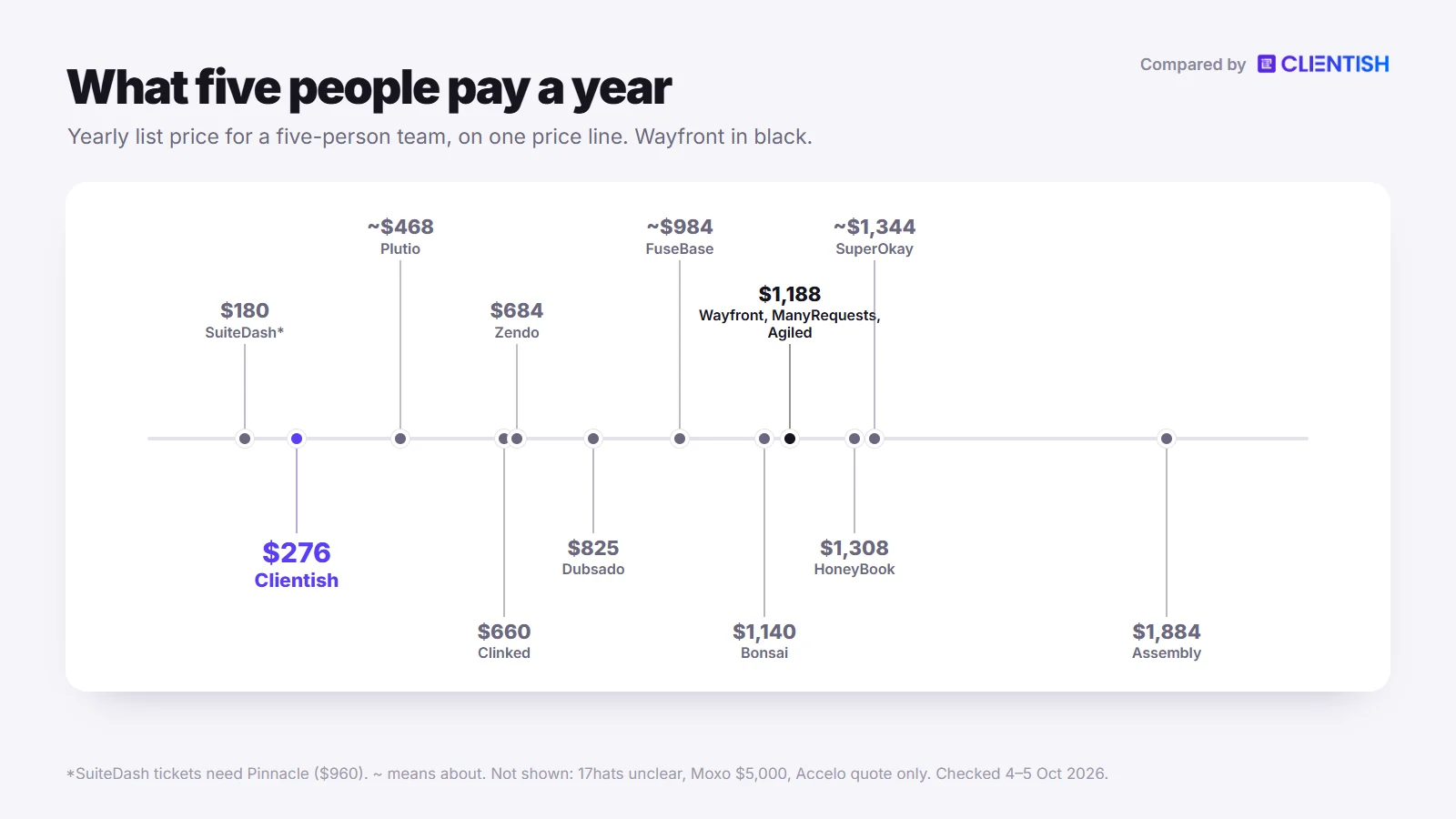
| Tool | 5 people, per year | 10 people, per year |
| Clientish | Starter: $276 | Growth: $468 |
| Wayfront | Base: $1,188 | Base + 5 seats: $2,268 |
| ManyRequests | Core + 4 seats: $1,188 | Core + 9 seats: $2,088 |
| Zendo | Core + 4 users: $684 | Core + 9 users: $1,164 |
| Assembly | Professional + 2 users: $1,884 | Professional + 7 users: $3,624 |
| SuiteDash | Start: $180 (Pinnacle with tickets: $960) | Start: $180 (Pinnacle with tickets: $960) |
| Agiled | Business: $1,188 | Business + 3 seats: about $1,908 |
| Plutio | Pro: about $468 | Pro: about $468 |
| HoneyBook | Premium: $1,308 | Premium: $1,308 |
| Dubsado | Premier + 4–10 user tier: $825 | Premier + 4–10 user tier: $825 |
| Bonsai | Essentials × 5: $1,140 | Essentials × 10: $2,280 |
| 17hats | $600 a year plus $5 a month per extra user; its pages disagree on how many users are included | |
| SuperOkay | Business: about $1,344 | Business: about $1,344 |
| Clinked | Start Up × 5: $660 | Start Up × 10: $1,320 |
| Moxo | Team: $5,000 | Team: $5,000 |
| Accelo | Quote only | Quote only |
| FuseBase | Essentials: about $984 | Advanced: about $3,192 |
The arithmetic: Wayfront is $99 a month plus $18 per extra seat on yearly terms, so ten people cost ($99 + 5 × $18) × 12. ManyRequests adds $15 a seat to Core’s $39, Zendo $8 a user to Core’s $25, and Assembly $29 a user to Professional’s $99, which already holds three. Agiled quotes its $20 seat monthly, so its ten-person figure is approximate. HoneyBook needs Premium because Essentials stops at the owner plus two, and Dubsado’s cheaper plan allows only three extra users.
The 16 Best Wayfront Alternatives for Agencies
The list falls into four loose groups. Entries 2, 3 and 4 are Wayfront’s direct rivals in packaged and request-based selling; 5, 6 and 7 are broad business suites; 8 through 11 are aimed at solo and booking-led businesses; the last five serve narrower needs in file sharing, workflows and PSA.
1. Clientish: Packages, Proposals and Support for Agencies With a Team
Clientish keeps the cart-to-order flow Wayfront users rely on and fills in the steps around it: a proposal that starts the job, tickets on a reply clock, and client sign-off on contractor hours. Its natural fit is a marketing, design, SEO, web or content shop in which a handful of staff look after a long list of returning clients.
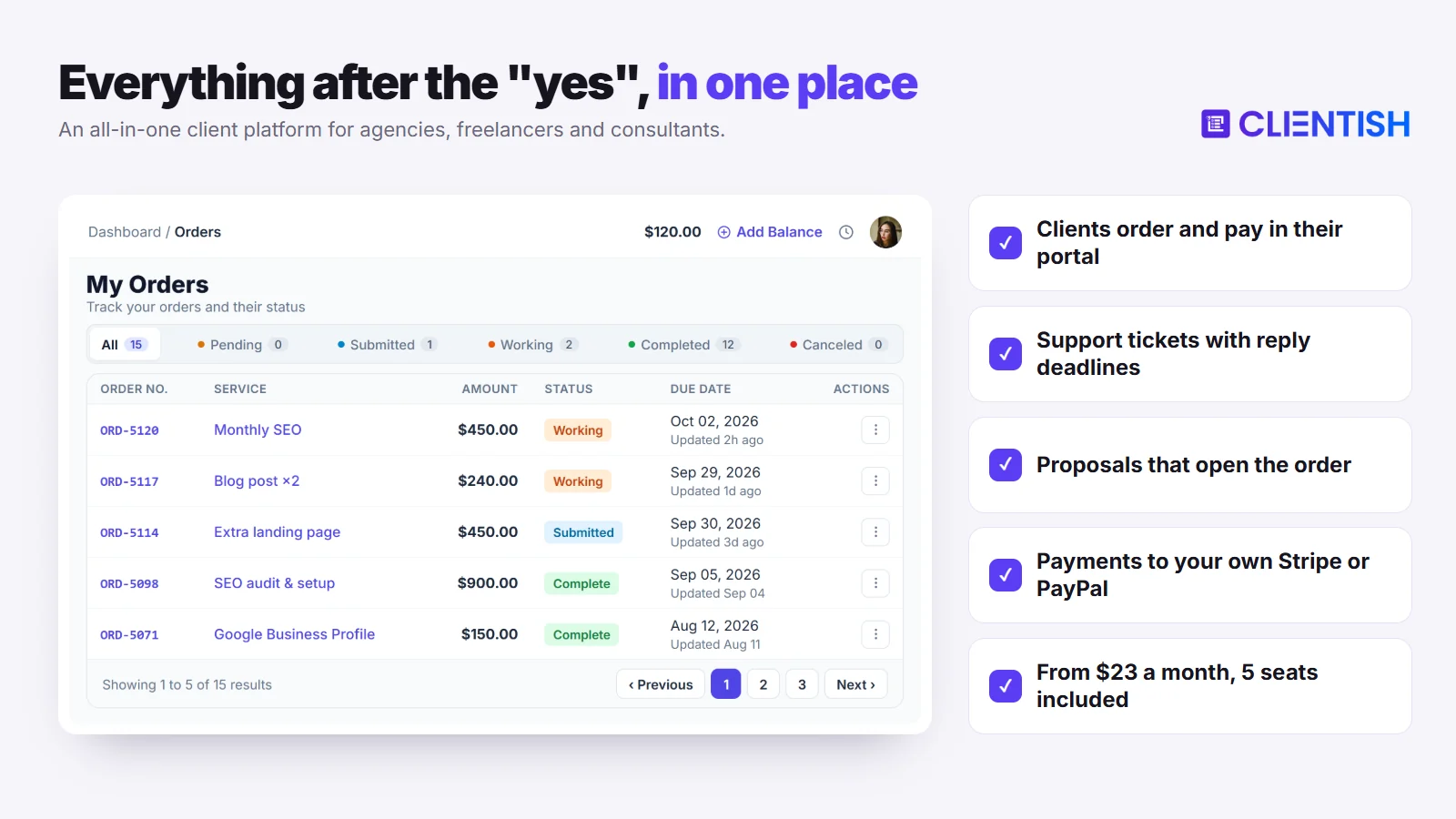
Compared with Wayfront: a five-person team pays $276 a year instead of $1,188, and a ten-person team $468 instead of $2,268. Proposals, revision limits, QuickBooks and Xero, and two more card gateways (Paddle, SSLCommerz) plus manual Wise, bKash, Nagad and Rocket payments come with it. Wayfront keeps automatic Stripe renewals, an own-domain portal and seven languages, none of which Clientish offers.
Key features (where it goes further than Wayfront):
- Seats included: the four plans hold 5, 15, 30 and 50 team members under roles you design, and a client never occupies a seat. On Wayfront, person six already adds $18 to $20 a month.
- Proposals that open the order: pick one of 11 layouts and send it; when the client types a signature, their IP is stored and the signed PDF arrives by email. The signature creates the client’s account, one invoice with the deposit (50% unless you set another share) due ahead of the balance, and the order itself.
- Catalogue, cart and coupons: the invoice exists from checkout, work opens once it is paid, and the intake form comes next, so Wayfront clients meet a familiar sequence.
- Revision rounds you can count: each package states how many rework rounds it includes, and a handover the client ignores for seven days flips to approved on its own, a timer you may lengthen or shorten. Wayfront can lock a completed order behind a revision-request button, but sets no round count.
- Tickets on a clock: on every plan a ticket’s priority decides how soon the first answer is due, and canned replies, tags, internal notes and a closing satisfaction score sit beside it. Wayfront reports response times after the fact.
- More ways to get paid: cards and wallets clear through your connected Paddle, SSLCommerz, PayPal or Stripe account, staff record Wise, bKash, Nagad, Rocket and bank transfers by hand, and clients may draw on a prepaid balance. Clientish adds no fee, and the gateway decides which countries you can bill.
- Contractor hours the client signs off: on Growth and up, a remote member’s hours are booked to one client, who must accept them before they reach an invoice.
- QuickBooks, Xero, webhooks and an API: both accounting tools connect directly, Make or Zapier hook in through webhooks, and a read-only API is available.
- Your brand on the portal and in email: every tier shows your logo, colour scheme and favicon and routes client mail through your SMTP server, and the top two tiers hide the “Powered by Clientish” credit.
- Native live chat: Growth and above add a chat window inside the portal, while Wayfront relies on an Intercom integration.
- Leads and account security: lead tracking from Growth, and 2FA by email code or authenticator app.
Limits for agencies: Renewals never pull money from a saved card; the original invoice simply reopens and waits for the client, a point where Wayfront’s Stripe billing is ahead. Clients reach the portal at a clientish.io subdomain, every screen is in English, and there is neither a booking calendar nor a phone app. Below Enterprise, each plan limits how many clients you can add in a month (Wayfront advertises no client limit), and ticket attachments come only from staff.
| Pros | Cons |
| Five to fifty staff included, from $23 a month | Renewals wait for the client to pay |
| Proposals that create the client, invoice and order | clientish.io subdomain, English only |
| Ticket reply deadlines and revision limits | Monthly new-client caps below Enterprise |
| Paddle, SSLCommerz and mobile wallets as well as Stripe and PayPal | No booking calendar or phone app |
Price: paid annually, Starter works out at $23 a month, Growth $39, Pro $79 and Enterprise $119 ($276 up to $1,428 a year); month to month the same plans are $29, $49, $99 and $149. Tickets, proposals, invoicing and the portal are in every tier, and Growth unlocks leads, live chat and remote members. Run Clientish for two weeks free, and leave your card details out.
2. ManyRequests: Wayfront’s Nearest Rival for Request-Based Creative Work
ManyRequests is a portal for agencies selling design, video or development as a stream of requests, often on an unlimited-style subscription. It overlaps with Wayfront more than anything else here: both sell through a catalogue, cap requests per period, bill subscriptions through Stripe and run the portal on your domain.
Compared with Wayfront: its $39 yearly entry covers one seat, so at five people both tools land on $1,188 a year, and beyond that its $15 seat undercuts Wayfront’s $18. File proofing and roll-over hour packages are its draws, and like Wayfront it has no proposals.
Key features: Clients order from the catalogue or a custom checkout page, then file requests by email or through per-service forms that show or hide fields by rule. Billing covers self-charging Stripe subscriptions plus hourly and credit packages that roll over. ManyRequests includes nine portal languages and your own domain on every plan, and time-entry approvals plus a Hubstaff link arrived on October 1, 2026.
Limits for agencies: Core seats beyond the first are $20 monthly ($15 yearly), and Pro seats $30 ($25). Only Stripe collects automatically; other methods are ticked off by hand. Pro is the entry point for webhooks, API access and hiding “Powered by”; there is no link to accounting software, and requests serve as tickets without any first-response goal.
| Pros | Cons |
| Proofing on images, PDFs and video | One seat included on each plan |
| Hourly and credit billing with roll-over | Only Stripe payments are automatic |
| Requests by email or conditional form | No QuickBooks, Xero or proposals |
Price: paid annually, Core is $39 a month and Pro $79; month to month they cost $59 and $99, and Enterprise begins at $1,000 a month. The 14-day trial asks for no card.
3. Zendo: A Free Storefront to Test the Model First
Like Wayfront, Zendo lets agencies sell one-off, recurring and custom work from a storefront with a multi-step checkout, yet its entry tier is free. That makes it a cheap test of catalogue selling.
Compared with Wayfront: the free tier and $25 yearly Core undercut Wayfront’s $99 floor, the portal offers twelve languages to Wayfront’s seven, and quotes are built in. One internal user per plan is the catch, and PayPal is still marked “coming soon”.
Key features: Visitors without an account can browse the catalogue and pay through checkout with add-ons and quantities. The portal holds quotes, invoices, live chat and shared files, and Request Types can be shaped into support tickets or onboarding.
Limits for agencies: Adding a teammate costs $8 a month on Core, $12.50 on Pro or $17 on Agency. Pro brings your domain and sending address, though the “Powered by Zendo” badge disappears only on Agency. Cards go through Stripe alone, Zapier needs Pro, the public API is still labelled “coming soon”, and neither QuickBooks nor Xero appears on its pricing page.
| Pros | Cons |
| Free plan with storefront and checkout | One internal user per plan |
| Twelve portal languages | Badge removal only on Agency |
| Quotes alongside invoices | Stripe only; PayPal not yet live |
Price: Essential costs nothing for a single user with up to three clients. Yearly billing puts Core at $25 a month, Pro at $49 and Agency at $79; monthly they are $29, $59 and $99. Two weeks of Pro come free with no card.
4. Assembly: Contracts and a Store, With Assembly Holding the Money
Assembly, known as Copilot until September 2025, now pitches itself to service firms as a place to build apps with AI. Beside Wayfront it adds e-signed contracts and a store for packages, but it processes every payment itself instead of through your Stripe or PayPal.
Compared with Wayfront: contracts and AI-built apps are things Wayfront lacks, yet Assembly takes a platform fee on each payment on top of card fees, where Wayfront takes none, and it caps active contacts by plan against Wayfront’s unlimited clients.
Key features: The Store holds a maximum of four subscription plans plus a dozen single-purchase packages, and each buyer becomes a client without manual setup. Recurring billing pulls from a stored card or ACH account, clients sign contracts without leaving the portal, and tasks can be templated or handed to the client. A one-way sync feeds QuickBooks Online and Xero, SOC 2 Type II audits are reported, and app templates exist for a help desk, proposals and time tracking.
Limits for agencies: Bringing a processor of your choosing is not allowed, and Assembly payouts reach banks in just four English-speaking countries: America, Britain, Canada and Australia. Fees of 0.3% to 2.0% are added to invoice, subscription and store sales depending on plan, plus 1.5% on international cards. Badge removal and your own domain start on Professional, staff roles stop at two, each client gets one message thread, and contracts allow only one signer.
| Pros | Cons |
| Contracts with e-signature on every plan | Assembly is the merchant; no own gateway |
| Store for packages and recurring plans | Platform fees on top of card fees |
| One-way QuickBooks and Xero sync | Contacts and users limited by plan |
Price: beyond the free tier, yearly billing gives Starter at $29 a month, Professional at $99 and Advanced at $499 (monthly: $49, $139 and $599), with Enterprise quoted. Testing happens on the free plan, which allows five active contacts.
5. SuiteDash: One Account Price for Any Number of Staff
With SuiteDash the price tag sits on the workspace, and headcount never moves it: unlimited staff and clients on every plan, and white-label branding with your own URL from the cheapest tier. Its toolkit spans CRM, projects, invoices, portals, e-signing, email marketing and courses.
Compared with Wayfront: Pinnacle, the tier with tickets, costs $960 a year whatever the headcount, against $1,188 for Wayfront’s five seats. It adds proposals and e-signing, though clients buy through a checkout form, not a cart.
Key features: Clients sign in with a password or a magic link to dashboards that differ per client. Checkout forms total up chosen items, add-ons and packages, and subscription plans bill on schedule without staff action. Payments can run through Braintree, Authorize.Net, Stripe or PayPal, and SuiteDash keeps no share. Proposals start on Thrive, and staff timers convert to billable hours.
Limits for agencies: Tickets, the full automation kit and onboarding flows wait for Pinnacle, and tickets showed no reply timers or client ratings in our check. PayPal can’t run subscriptions, QuickBooks Online syncs in one direction, and Xero sits on the roadmap. Setup help is sold separately, from $50 a session.
| Pros | Cons |
| Unlimited staff and clients | Tickets and automations on Pinnacle only |
| Own URL and branding from Start | Setup help costs $50 a session |
| Proposals and e-signing | Xero not live; QuickBooks one-way |
Price: yearly, Start is $180, Thrive $480 and Pinnacle $960; monthly, they cost $19, $49 and $99. Pinnacle can be tried for 14 days without a card.
6. Agiled: A Small-Business Suite With HR and Accounting Sync
Agiled puts HR, a client portal, invoicing, projects and a CRM under one login, and in 2026 it moved customers to a rebuilt platform.
Compared with Wayfront: Business matches Wayfront Base at $99 a month yearly yet includes seven seats rather than five, plus proposals, multi-party contracts and accounting sync. Public buying is limited to a checkout link per service, because the catalogue pages aren’t available yet.
Key features: Portal users can settle invoices, book appointments, chat and, from Pro, open tickets. Recurring billing either emails invoices on a schedule or runs as a Stripe or PayPal subscription, with Mollie as a third gateway. Contracts can collect signatures from several parties, one after another or at once, and HR covers leave, attendance and staff records from Pro.
Limits for agencies: Seat counts run 1, 3, 7 and 15 across the plans, with $20 a month for each one added on Pro or higher. Hosting the portal under your own web address with mail leaving via your SMTP server means Business or a $19 bolt-on ($15 if prepaid for the year); bookkeeping sync is likewise gated to Business. Tickets carry neither reply targets nor ratings, and anyone coming from the old Agiled must rebuild proposals, forms and workflows.
| Pros | Cons |
| HR, CRM and invoicing in one app | $20 a month for each extra seat |
| Multi-party contract signing | No catalogue or cart yet |
| QuickBooks and Xero on Business | Branding needs Business or an add-on |
Price: Starter, Pro, Business and Scale work out to $24, $59, $99 and $199 monthly when you commit for twelve months, against $29, $69, $129 and $249 with no commitment. A two-week trial unlocks Business features without asking for a card.
7. Plutio: Every Feature on Every Plan, in 34 Languages
Plutio’s tiers differ only in headcount, active-client limits and usage allowances; projects, proposals, contracts, invoicing, booking pages and the portal appear on all three.
Compared with Wayfront: its REST API and webhooks come with every plan, where Wayfront charges for API access on Pro, and the interface ships in 34 languages. There is no cart, so clients pick packages and add-ons inside a proposal.
Key features: Each client logs in to see the projects, files, tasks and messages shared with them, along with any linked invoice. Proposals record drawn or typed signatures with IP and timestamp, and can raise an invoice when accepted. Stripe and Square can charge saved cards each cycle, and time entries can become invoice lines. A $9 white-label add-on adds your domain and sending address.
Limits for agencies: Core is a one-person plan for up to nine active clients; Pro allows 30 contributors and is pitched by Plutio at agencies of two to ten. Support work runs on task boards with a due-date field instead of a ticket module, and accounting tools are reached only through an automation platform.
| Pros | Cons |
| API and webhooks on every plan | No catalogue or cart |
| 34 languages and native apps | No ticket module |
| Proposals with auto-invoice | Core is limited to one person |
Price: roughly $15 a month for Core, $39 for Pro and $159 for Max on annual terms, or $19, $49 and $199 if you go month by month. The trial lasts a week.
8. HoneyBook: Smart Files for Owners Who Book Clients One at a Time
HoneyBook runs a booking business through “smart files” that put a proposal, contract and invoice behind one link, paid without a client account.
Compared with Wayfront: HoneyBook has the proposals and e-signed contracts Wayfront lacks, but no cart or ticket desk, and it processes all payments itself rather than through your Stripe. Sign-up is open only to American, Canadian, British and Australian businesses.
Key features: A smart file lets the client choose, sign and pay in one sitting, and autopay is switched on for recurring invoices by default. Reports get deeper on each higher plan, Essentials adds expense tracking and a QuickBooks Online link, and phone apps exist for iOS and Android.
Limits for agencies: Starter seats nobody besides the owner, Essentials stretches to the owner and two helpers, and a crew of four or more lands on Premium at $1,308 per year. HoneyBook is the only processor, online card fees start at 2.9% + 25¢, and its terms let it hold a reserve from your funds. Xero isn’t on its integration list, and the built-in time tracker was retired on September 7, 2026.
| Pros | Cons |
| Proposal, contract and invoice in one file | HoneyBook processes all payments |
| Autopay on recurring invoices | Four countries only |
| 30-day trial and phone apps | No help desk; time tracker retired |
Price: Starter, Essentials and Premium are $29, $49 and $109 a month on annual billing, or $36, $59 and $129 monthly. A 30-day trial needs no card.
9. Dubsado: Automation-Heavy Workflows for Small Studios
Dubsado manages leads, proposals, contracts, invoices and scheduling for small service firms, steered by Flows, its node-based automation builder.
Compared with Wayfront: it has the proposals, contracts and Xero link that Wayfront lacks, and the owner plus three users costs $335 a year on Starter. Clients choose packages inside proposals, and we found no ticket system.
Key features: On Premier, Flows automate the client journey next to the scheduler, public proposals, QuickBooks and Xero. Each client’s portal gathers their invoices, forms, proposals, contracts and booked appointments under your branding, and mapping your own URL hides Dubsado from links. Dubsado Payments (on Stripe) or Square handle cards, PayPal can sit alongside, and recurring invoices can make autopay mandatory.
Limits for agencies: Past the free three, users cost $25 a month for 4 to 10, $45 for 11 to 20 and $60 for 21 to 30. Neither the portal homepage nor its login screen can be customised, and we found no ticket system in its help centre.
| Pros | Cons |
| Flows automation builder | No ticket desk found |
| Three extra users at no charge | Scheduler, Flows and accounting on Premier |
| QuickBooks and Xero on Premier | Portal homepage can’t be customised |
Price: Paid yearly, Starter totals $335 and Premier $525; paid monthly, they are $35 and $55. The 21-day trial includes Premier features.
10. Bonsai: Per-User Project and Billing Tools, Now Owned by Zoom
Bonsai joins contracts, proposals, invoicing and time tracking with Gantt and workload views, and Zoom bought the company in December 2025.
Compared with Wayfront: a five-seat Essentials account comes to $1,140 annually, a little below Wayfront Base, with proposals, contracts and Gantt charts included. Clients follow an emailed link into the portal rather than holding a login, and we found no ticket queue in its help pages.
Key features: Essentials brings invoices, payments, proposals, contracts, forms, scheduling and the client portal, where clients see invoices, upload files and, on Premium, message the team. Subscription invoices take payment from a stored card via Bonsai Payments or Stripe. Premium removes Bonsai branding and adds QuickBooks and Zapier.
Limits for agencies: Every team member, collaborators included, is billed at the full plan rate. Bonsai’s own processor is limited to American, British, Canadian and Australian accounts, and in those markets choosing Stripe or PayPal instead costs an extra one percent. Bonsai says custom portal domains should ship during 2026, and its help pages describe no ticket queue.
| Pros | Cons |
| Gantt, workload and time in one app | Every user is a full-price seat |
| Subscription invoices that charge cards | Portal through email links, no client accounts |
| Stripe available in most countries | Extra 1% fee on Stripe in Bonsai Payments countries |
Price: billed yearly, Basic, Essentials, Premium and Elite run $9, $19, $29 and $49 per seat monthly; paid month to month they rise to $15, $25, $39 and $59, and Elite sets a three-seat minimum. The trial runs seven days.
11. 17hats: Quotes, Contracts and Bookkeeping in One Plan
17hats packs quotes, contracts, questionnaires, invoices, scheduling and simple bookkeeping into one all-features subscription. Bookkeeping is the part Wayfront lacks.
Compared with Wayfront: bookkeeping and combined quote-contract-invoice documents come in a $600 yearly plan, about half Wayfront Base, with a bank feed for $5 a month more, but links run on a 17hats subdomain and we found no helpdesk, and its pages contradict each other on user numbers.
Key features: Through the portal, clients accept quotes, sign, answer questionnaires, pay and check event details, but can’t upload files. A one-way QuickBooks Online feed is offered to firms based in three countries, and free phone apps push alerts when contracts are signed or invoices paid.
Limits for agencies: One 17hats page says a subscription can add two users, while the pricing grid shows three included at its top level, with more at $5 a month each. Links run on a 17hats subdomain, Xero has no integration, and time tracking is a $5 add-on.
| Pros | Cons |
| Bookkeeping, plus a $5 bank-feed add-on | User count unclear across its pages |
| Quote, contract and invoice in one document | Clients can’t upload files |
| Free mobile apps | No Xero; QuickBooks sync one-way |
Price: just one tier, sold at $60 monthly, $600 annually or $800 per biennium; an introductory first-year markdown was on the pricing page as of October 5, 2026. Four invoices a quarter is the ceiling on the no-cost CRM, and a week-long trial is offered.
12. SuperOkay: A Branded Project Hub Without Billing
SuperOkay builds a branded space per client where files, interactive documents, task lists and sign-offs live together. It leaves out the part Wayfront is built around: no invoices, payments or subscriptions.
Compared with Wayfront: checkout becomes a “Pay Here” button pointing at your own payment page, so billing stays in a separate tool.
Key features: After signing in by magic link or password, clients complete interactive documents with text, choice, upload and rating fields, approve them with one click, and work through assigned tasks. Packaged Services pages show an offer with a buy button, and public web apps can be embedded.
Limits for agencies: Colleagues can be added from Solo+ (three of them), and only Business makes the team unlimited. Solo+ also brings your domain and full white-label, while each separate brand needs its own account. Invoicing, recurring billing, tickets and accounting links were all absent, and there is no timed trial.
| Pros | Cons |
| Free plan for one project | No invoices or payments |
| Interactive documents with approval | Teams need Solo+ or Business |
| Embeds for most web apps | No ticket queue |
Price: Business runs about $112 a month yearly or $146 monthly, Solo+ about $29 or $38, and Solo about $9 or $12, after a free tier. The page doesn’t label which figure is yearly, so read them as estimates.
13. Clinked: Compliance-First File Sharing for Firms
Clinked targets regulated sectors such as finance, legal and healthcare, plus agencies, with a locked-down portal for documents, tasks, conversations and sign-offs.
Compared with Wayfront: it holds ISO 27001 and adds file approvals and an audit trail, but has no invoicing, cart or subscriptions, so Wayfront’s selling side would need another tool.
Key features: Behind a secure login with optional 2FA, clients exchange files up to 5 GB, respond to file requests, approve and annotate documents, chat privately or in groups, and follow tasks and calendars. Standard adds your domain, Premium white-labels the email notifications, and every plan includes mobile apps.
Limits for agencies: No invoicing, payments, catalogue or tickets appear on its pages. The per-user Start Up tier ($11 a head monthly) tops out at 25 people, and Standard, the next tier, is a flat $239 a month covering 100 members. SSO waits for Enterprise, and Clinked’s own pages disagree about a QuickBooks integration.
| Pros | Cons |
| ISO 27001 and audit trail | No billing of any kind |
| File approvals and version control | SSO only on Enterprise |
| Mobile apps on every plan | Large price jump after Start Up |
Price: The Start Up tier is $11 per seat per month. Standard is a flat $239 monthly, Premium $599 (or $479 a month when billed for the year), and Enterprise is quoted. A two-week trial is available.
14. Moxo: Guided Multi-Step Processes at Enterprise Prices
Moxo strings sign-offs, forms, document requests, e-signatures and payment collection into guided sequences that employees, customers and AI agents each complete their part of.
Compared with Wayfront: the Team plan costs $5,000 a year, more than four times Wayfront Base, and sells structured processes rather than a cart of services. Seats are unlimited on all plans.
Key features: Clients open each step from a magic link without creating an account, and native e-signatures can run in sequence or in parallel. Moxo states SOC 2 Type II certification. Branching, loops, the audit log, branded portals on your domain, SAML SSO, webhooks and the REST API all sit on Scale.
Limits for agencies: The Team tier caps you at 100 flows annually, while Scale pricing comes on request. Money is collected as a payment step inside a flow, invoices included, and no recurring billing was found. Trials are by request, and Moxo’s own agency write-up admits “Overhead for very simple engagements”.
| Pros | Cons |
| Unlimited seats on every plan | $5,000 a year to start |
| Magic-link steps for clients | Branching and audit log on Scale only |
| SOC 2 Type II | No recurring billing found |
Price: the Team tier runs $5,000 annually for 100 flows, and the Scale and Enterprise tiers are priced individually. A trial has to be requested.
15. Accelo: Retainers and Time Billing for Established Firms
Accelo is professional services automation (PSA) software: one system for quoting, projects, retainers, tickets, time tracking and billing. Firms that bill by time buy it through demos and custom quotes.
Compared with Wayfront: Accelo turns project and retainer work into invoices, which Wayfront’s time tracker doesn’t, and connects to QuickBooks and Xero. There is no public price, no trial and no storefront for clients.
Key features: Approved quotes launch projects, and retainer periods renew and invoice automatically. Clients arrive by emailed link and use the portal to raise requests, give approvals, track their tickets and view or settle invoices. Each invoice can carry a pay link handled by Stripe, PayPal or Authorize.net, and staff log timers, tickets and tasks from iOS or Android apps.
Limits for agencies: Prices aren’t published, and Accelo says most teams go live within weeks. Clients have no catalogue or checkout, and a custom portal domain could not be confirmed.
| Pros | Cons |
| Retainers that renew and invoice themselves | No public pricing or trial |
| Tickets with time charged to retainers | Implementation measured in weeks |
| QuickBooks and Xero | No storefront for clients |
Price: quoted per team size after a demo.
16. FuseBase: Client Portals Inside a Document Workspace
Before it was FuseBase, this product was Nimbus; today it links client portals with an internal workspace of pages, task lists and AI agents.
Compared with Wayfront: e-signatures, forms and AI agents are included, but invoices, payments and a catalogue are not, so it would run beside a billing tool rather than replace Wayfront.
Key features: Clients reach their portal through a secure magic link and, once inside, exchange files, tick through task lists and mutual action plans, message in real time, complete forms and surveys, and sign documents. Advanced is the first tier with white-label, your domain and your email.
Limits for agencies: Five members and 100 clients fit on Essentials; FuseBase prices extra members only on enquiry, and every added portal is $20 a month. Invoicing, a catalogue and tickets were not found, and the pricing page lists two different portal limits for Advanced.
| Pros | Cons |
| Portals plus shared documents | No invoices or payments |
| E-signatures and forms built in | White-label starts on Advanced |
| Free plan and 14-day trial | Extra members priced on request |
Price: past the free tier, expect roughly $32 or $39 a month for Solo, $82 or $99 for Essentials and $266 or $399 for Advanced, the lower number apparently being the yearly rate, while Unlimited is quoted. Paid tiers can be tried for 14 days.
Cheapest Wayfront Alternatives
Wayfront’s price is what pushes most of its leavers out, so the table below matches each team situation to the least expensive tool that can handle it. Figures use annual billing wherever a vendor offers it.
| Situation | Lowest-cost option | Cost |
| Testing a storefront alone, with up to three clients | Zendo Essential | $0 |
| One person needing invoices and a portal | SuiteDash Start or Plutio Core | About $180 a year |
| Five people with a cart, tickets and own gateways | Clientish Starter | $276 a year |
| Ten to fifteen people with the same | Clientish Growth | $468 a year |
| Any team size, tickets, no cart | SuiteDash Pinnacle | $960 a year |
| Five people on a request-based model with proofing | ManyRequests Core + 4 seats | $1,188 a year |
Free tiers are for experiments only: Zendo’s holds three clients and a single seat, SuperOkay’s a single project, and FuseBase’s a single portal.
What Your Clients See in Each Tool
Wayfront clients are used to passwordless sign-in, a cart and a helpdesk, so the client side decides how much of a switch they notice. The rows show the login route for clients and the actions open to them after it.
| Tool | How clients get in | Pay invoices | Buy services | Raise tickets |
| Clientish | Own login to a branded portal | Yes, or from a balance | Catalogue, cart, coupons | Yes, with reply deadlines |
| Wayfront | Magic link or Google login | Yes, or from a balance | Cart with coupons | Yes |
| ManyRequests | Client portal | Yes | Catalogue or order form | Requests |
| Zendo | Password, Google or Facebook | Yes | Storefront | Request types |
| Assembly | Magic link, Google or password | Yes, through Assembly | Store | Help-desk app template |
| SuiteDash | Password or magic link | Yes | Checkout forms | Pinnacle only |
| Agiled | Client portal | Yes | Checkout link (Business) | Pro and up |
| Plutio | Own login | Yes | Proposals with packages | No ticket module |
| HoneyBook | Magic link, password or code | Yes | Smart files | No |
| Dubsado | Client portal | Yes | Proposals | Not found |
| Bonsai | Email link, no account | Yes | Proposals | Not found |
| 17hats | Client portal | Yes | Quotes | Not found |
| SuperOkay | Magic link or password | Pay link only | Packaged service pages | No |
| Clinked | Secure login, optional 2FA | No | No | No |
| Moxo | Magic link or portal | Payment steps | Flow catalogue (Scale) | Flow requests |
| Accelo | Email link | Yes | No | Yes |
| FuseBase | Magic link | No | No | Not found |
Why Agencies Choose Clientish Over Wayfront
Both tools sell packages through a portal, so the decision rests on team size, how deals are won and what happens after delivery. The comparison below sets Wayfront’s October 2026 pricing and help centre against Clientish’s current plans.
| Wayfront | Clientish | |
| Five people, per year | Base: $1,188 | Starter: $276 |
| Ten people, per year | Base + 5 seats: $2,268 | Growth: $468 |
| Proposals | None found; signature field on forms | Eleven designs; signing creates client, deposit invoice and order |
| Gateways | Stripe, PayPal, manual | Stripe, PayPal, Paddle, SSLCommerz, bank, Wise, bKash, Nagad, Rocket |
| Revisions | Optional lock with a request button; no count | Limit per service, auto-approval after 7 days |
| Ticket response | Response-time report | First-reply deadline by priority |
| Logged hours | Timer per order, no client approval | Client approves remote hours (Growth) |
| Accounting | No QuickBooks or Xero found | QuickBooks and Xero |
| API | Webhooks on Base; full API a Pro add-on, $240–$300 a month | Webhooks and a read-only API on every plan |
| Live chat | Through Intercom | Built in (Growth) |
| Automatic card renewals | Yes, with dunning | No; the client pays each renewal |
| Portal address and languages | Your own domain, seven languages | clientish.io subdomain, English |
Wayfront stays ahead on automatic Stripe renewals, its own-domain portal, seven languages and unlimited clients. Clientish leads on cost per head and on the work around each sale: proposals, revision counts, reply deadlines, client-approved hours and accounting sync. Start a free 14-day Clientish trial and rebuild your best-selling package to compare the two side by side.
Is Wayfront Still Worth It in 2026?
For one kind of agency it still is. A productized shop of up to five that sells fixed packages by card, wants renewals to charge without client action, serves clients in several languages and needs its own portal domain gets most of what Base charges for.
The case weakens as soon as one of these is true: the team passes five, deals begin with a proposal or contract, contractors bill hours the client ought to approve, payments need Paddle, SSLCommerz or a local method, or the books live in QuickBooks or Xero. Each means more seats, add-ons or a second tool running next to Wayfront.
Which Wayfront Alternative Fits Your Agency?
How your agency wins and delivers work matters more than any feature list, so find the row that matches your business, and trial the tools named in it first.
| If your agency… | Look at | Why |
| sells packages and retainers to many clients with a team of 3 to 50 | Clientish | Seats included, cart, proposals, revision limits, ticket deadlines, own gateways |
| runs unlimited design or video subscriptions | ManyRequests | Request queue, proofing, hourly and credit billing |
| wants to test a storefront before paying | Zendo | Free plan with catalogue and checkout |
| needs contracts and a store and is based in the US, UK, Canada or Australia | Assembly | Contracts with e-signature; Assembly handles payments |
| wants unlimited staff and will configure a large suite | SuiteDash | One account price, own URL from Start |
| also needs HR and accounting sync | Agiled | HRM from Pro, QuickBooks or Xero on Business |
| works in a language other than English, or wants a full API on every plan | Plutio | 34 languages, REST API and webhooks included |
| is a solo owner taking bookings in the US, Canada, UK or Australia | HoneyBook, Dubsado, 17hats | Proposal, contract and invoice flow for one client at a time |
| is a consultancy planning projects in detail | Bonsai | Gantt, workload and time, billed per user |
| mostly shares files and needs approvals | SuperOkay, Clinked | Branded hubs; Clinked adds compliance |
| runs regulated, multi-step client processes | Moxo | Guided flows, SOC 2 Type II |
| bills time against retainers at an established firm | Accelo | PSA with retainers, tickets and invoicing |
| wants a portal inside a shared document workspace | FuseBase | Pages, e-signatures and AI agents |
Running a hybrid offer? If a productized core sits beside bespoke retainers, favour tools that appear in more than one of your rows. Clientish handles both with packages in the cart and proposals for custom scopes, while Accelo suits firms that bill bespoke work mainly by time.
Moving From Wayfront Without Breaking Live Subscriptions
Leaving Wayfront is easier than older guides suggest, because the data comes out in bulk. Its Reports area hands over CSV files for accounts, orders, transactions and other records, and a single download bundles every invoice PDF into a ZIP. Stripe subscriptions created through Wayfront stay in your Stripe account and keep charging until you cancel them.
- Export before you cancel. Save the CSV files and invoice ZIP, and copy service descriptions, prices and intake questions by hand, since no form export turned up.
- Import your clients. Drop the completed sheet (CSV, XLS or XLSX) into Clientish’s Clients → Import screen; the new records arrive switched off, and nobody on the list hears from you until you say so.
- Rebuild services. Recreate each package with price, coupon rules, intake form and revision allowance, and move any agreement wording from signature fields into a proposal template.
- Handle subscriptions one by one. Since a Clientish renewal sits unpaid until the client settles it (no card on file gets charged), switch off every Stripe subscription that Wayfront set up only after its replacement Clientish invoice has been issued, and give the client a heads-up about the new routine.
- Announce the new address. Clients who reached Wayfront on your domain will move to a clientish.io subdomain, so send each one the new login as their account goes live.
Frequently Asked Questions
These answers cover what agencies ask most when weighing Wayfront against other portals, using prices and features the vendors listed when we checked in early October 2026.
Is Wayfront the same as Service Provider Pro?
Yes. SPP.co was renamed Wayfront on February 16, 2026, and its product and pricing stayed as they were.
Which Wayfront alternative suits most agencies?
Clientish, for any agency with staff and returning clients: five to fifty people are included, clients buy from a cart as on Wayfront, and proposals, revision limits and ticket deadlines are added.
Which Wayfront replacement fits a productized service agency?
Clientish, ManyRequests and Zendo all sell fixed services from a catalogue with checkout. ManyRequests fits creative request subscriptions, Zendo a solo seller starting free, and Clientish a team that also wants proposals and revision caps.
Is there anything cheaper than Wayfront?
Yes. Clientish Starter is $29 ($23 yearly) for five staff, where Wayfront charges $129 ($99 yearly) for the same five.
How much does Wayfront cost once seats are added?
Five seats come with Base at $129 a month, dropping to $99 on annual terms, and ten with Pro at $299 or $249. Seats beyond that are $20 ($18 yearly), and Plus is priced after a call.
Wayfront vs ManyRequests: which should I pick?
For five people both cost $1,188 a year on annual billing. ManyRequests adds design and video proofing and charges $15 per seat after the first; Wayfront bundles five seats and a fuller helpdesk.
Does Wayfront have proposals or contracts?
Its help centre and changelog show no proposal, quote or contract module. The nearest thing is a form signature field that saves the agreement, timestamp and IP address with an order.
Can any of these alternatives match Wayfront’s white-label portal?
For your own domain, yes: ManyRequests on every plan, SuiteDash from Start, Zendo from Pro, Assembly from Professional, Agiled on Business, Plutio for $9 a month, Clinked from Standard and FuseBase from Advanced. Clientish brands the portal and its email in every tier, but on a clientish.io address.
Does Clientish have time tracking?
Yes. From Growth, remote members record time against each client, and those hours wait for the client’s approval before billing.
What’s the cheapest Wayfront alternative with a real client portal?
Zendo’s free tier gives three clients and one user a storefront and portal. SuiteDash Start costs $19 a month with unlimited staff.
Do any of these tools work for agencies that bill by the hour?
Accelo is built for it. ManyRequests sells hourly and credit packages, Plutio and SuiteDash convert time entries into invoices, and Clientish bills remote hours once the client approves them.
Can I migrate my client data from Wayfront?
Yes. Expect CSV files for accounts, orders and transactions plus a PDF archive of invoices. Clientish imports clients from a CSV, XLS or XLSX sheet; check each other tool’s importer before you move. Live orders, forms and subscriptions have to be rebuilt by hand.
Is there a Wayfront alternative that handles client communication without email?
Several. Clientish offers tickets on every plan and live chat from Growth, Zendo and ManyRequests include chat, and Assembly keeps one thread per client.
What’s the main reason agencies move away from Wayfront?
Cost for small teams: nothing below $99 a month, and $18 to $20 for each seat past five.
Which alternatives work outside the US, or with other payment gateways?
Clientish adds Paddle, SSLCommerz, Wise, bKash, Nagad and Rocket to Stripe and PayPal, so reach depends on the gateway you pick. Agiled adds Mollie, and SuiteDash Braintree and Authorize.Net.
Is there a free Wayfront alternative?
Zendo, Assembly, SuperOkay and FuseBase have free plans and 17hats a limited free CRM, each tightly capped. Wayfront has no free plan; its 14-day trial and Clientish’s both skip the card.
Do I need to sign a contract with any of these tools?
Most bill monthly or yearly without a long-term contract. Moxo’s Team plan is sold per year and Accelo is quoted, so read the terms before prepaying.
Is Wayfront worth it in 2026?
For a productized team of five or fewer that depends on automatic Stripe renewals, a multilingual portal and its own domain, yes. A growing team that sells with proposals gets more from included seats.
Final Thoughts
Wayfront’s 2026 releases closed several old gaps. It still asks for a $99 floor, a charge for every person after the fifth, and separate tools for proposals, accounting and client-approved hours.
Clientish gathers all of that in one subscription from Growth up: team logins from the start, a coupon-ready cart, proposals that turn into orders, revision counts, deadline-bound tickets and your own Stripe, PayPal, Paddle or SSLCommerz account. Open a 14-day Clientish trial, invite two colleagues and push one real package through it. For plan limits, open the pricing page; for a head-to-head, read Wayfront vs Clientish.
Sources
Clientish publishes this guide. Every Wayfront and alternative-tool fact was checked on October 4 and 5, 2026, against each company’s own pricing and help pages; review themes come from Capterra, and from Trustpilot reviews of Wayfront under its old name, SPP.
Wayfront, ManyRequests, Zendo, Assembly, SuiteDash, Agiled, Plutio, HoneyBook, Dubsado, Bonsai, 17hats, SuperOkay, Clinked, Moxo, Accelo and FuseBase are trademarks of their owners. Clientish is not affiliated with any of them. See something out of date? Tell us and we’ll correct it.


