

Most service businesses reach a point where the admin starts to feel like a second job. You’re chasing a client’s project details across three apps, issuing invoices from a spreadsheet, tracking tasks in a separate tool, and somehow trying to keep your team aligned through a mix of email threads and chat messages. It works, until it doesn’t — and usually it stops working right when you’re busiest.
Quick answer: Clientish is a client management platform built for agencies, freelancers, consultants, and service teams that want to run their entire client workflow from one place. It covers leads, clients, services, orders, tasks, invoices, team management, support tickets, and a branded client portal — all connected, all in the same workspace.
This guide walks through what Clientish actually is and how each part of it works, feature by feature. By the time you finish reading, you’ll have a clear picture of what the product does, what you can do inside each section, and whether it fits the way your business operates.
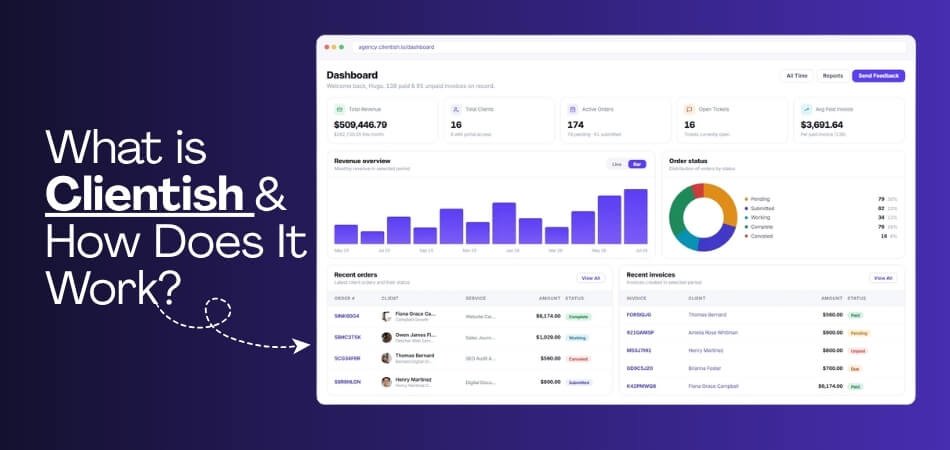
What Is Clientish?
Clientish is a client management software built for agencies and service businesses. It gives you one workspace to handle clients, orders, billing, support, and your team — without patching together a stack of separate tools.
Each business that signs up gets its own branded workspace on its own subdomain. You configure it with your logo, brand colour, and favicon, and it looks like yours to both your team and your clients. Higher plans also support a custom domain. Everyone who touches the workspace — agency admin, in-house staff, remote contractors, and clients — logs in through a separate door with their own role and permissions.
The platform covers two distinct types of work: internal operations (assigning tasks, tracking orders, managing team members, running your billing) and the client-facing side (a branded portal where clients check order status, pay invoices, submit intake forms, and open support tickets). Both sides live under the same workspace, sharing the same data.
That scope is broader than a CRM. Clientish tracks relationships, but it also manages the actual work that follows — the order, the tasks inside it, the invoice at the end, and the support conversation in between.
The sections below explain how each part of it works.
How Does Clientish Work? (The Big Picture)
Everything in Clientish connects back to a single client record. One workspace, one directory, and every order, invoice, ticket, and conversation sits underneath the right client — nothing floating loose in a separate tool.
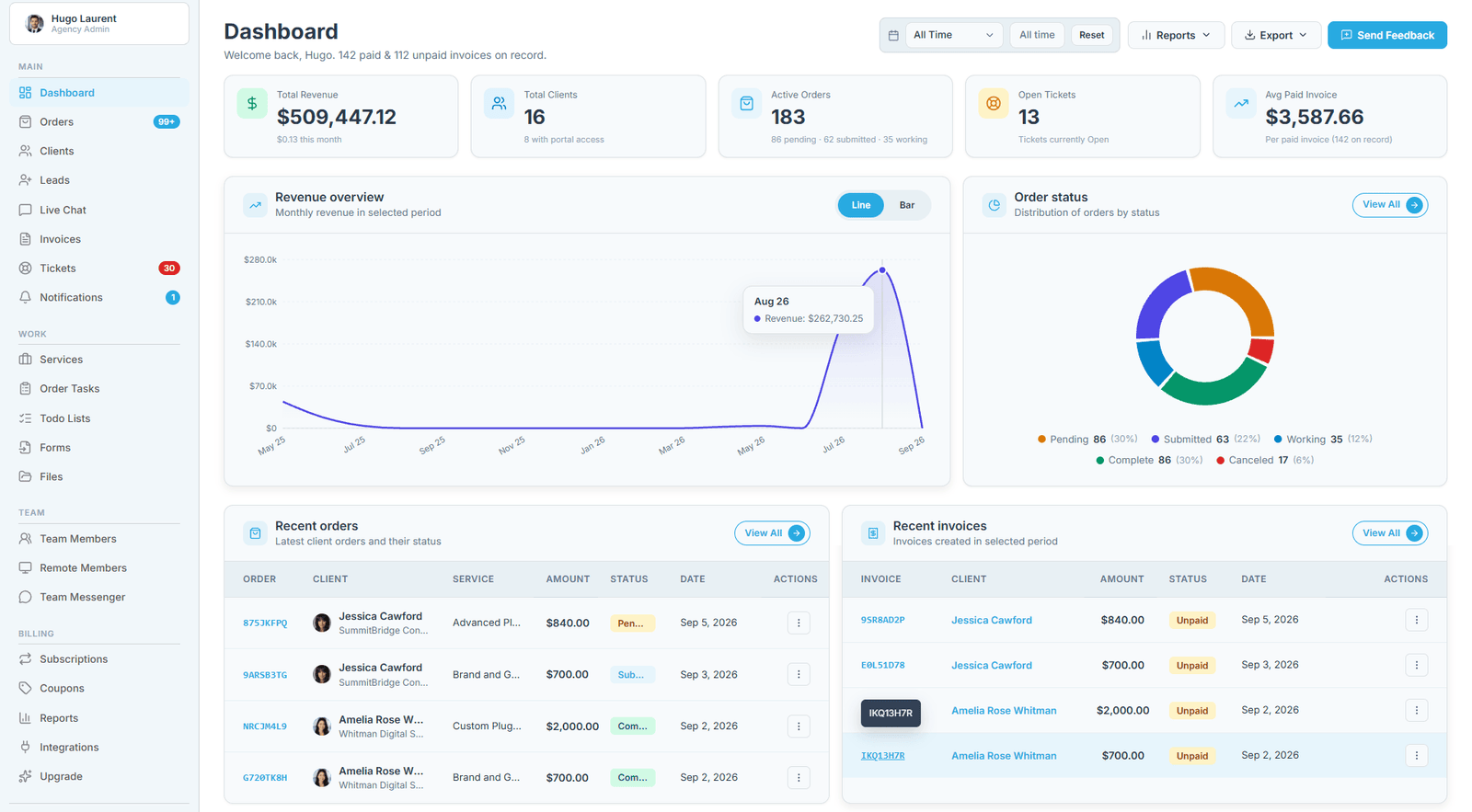
The workspace itself runs on its own subdomain with your agency’s branding. Every person who touches it — admin, team member, remote contractor, or client — signs in through a separate login path with their own permission set.
From there, the product is organized around what you actually do day to day:
- Set up — workspace branding, SMTP, security, statuses, and team roles
- Manage clients — the client directory, lead tracking, and CRM
- Sell and deliver — services catalog, orders, tasks, and to-dos
- Collect information — intake forms and the standalone form builder
- Get paid — invoices, payments, refunds, and coupons
- Communicate — client messages, team threads, lead chat, and support tickets
- Run your team — member management, permissions, and work assignment
- Track performance — the dashboard with KPI tiles and revenue reporting
- Give clients self-service — the branded client portal
- Move data in and out — import, export, and inbound integrations
Each of those areas is its own section below.
Setting Up Your Workspace
Getting a Clientish workspace ready involves more than flipping a switch. You’re configuring how your agency appears, how email flows, and who can access what — before a single client ever logs in.
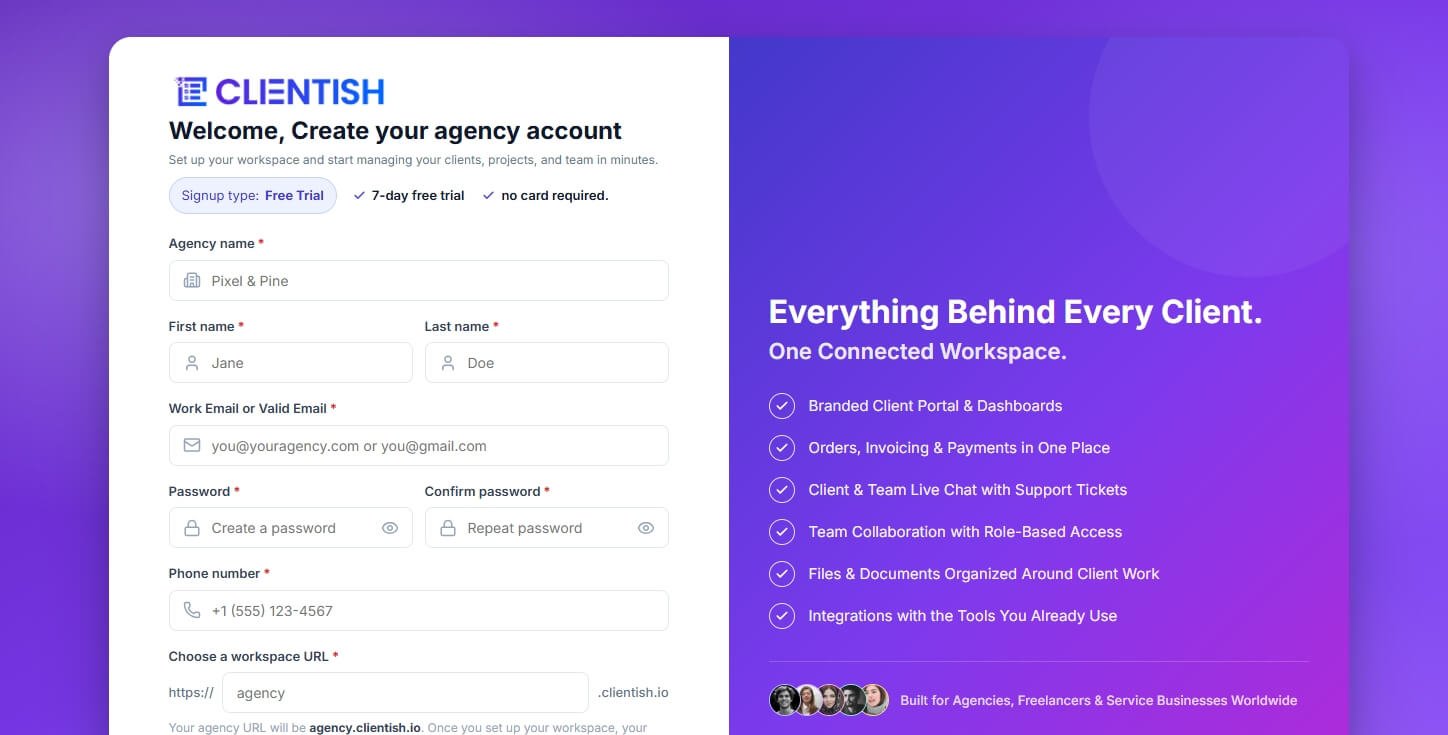
Signing Up and Onboarding
You create an account and Clientish provisions a workspace scoped entirely to your agency. Every piece of data — clients, orders, invoices, settings — lives inside that workspace and is visible only to your team and your clients.
Your Branded Workspace
Your workspace runs on its own subdomain. You can upload separate logos for light and dark mode, set a favicon, pick a brand colour, and configure your timezone. Higher plans support a custom domain, so clients see your own URL rather than a Clientish subdomain.
Your Own Email (SMTP)
Clientish lets you connect your own sending setup through inbound webhook integrations with providers like Mailgun, Postmark, SendGrid, and Amazon SES. Replies and bounces route back into the relevant lead or client record automatically.
Sign-in Security
Authentication options include email and password, Google sign-in, email verification, and two-factor authentication via either an emailed code or an authenticator app (TOTP). Failed login attempts trigger a lockout, and Google reCAPTCHA is available as an additional layer. You can also view all active sessions and sign out every device at once — a password change does that automatically.
Plans, Limits and White Label
Features are gated by both plan and role. The custom domain that removes Clientish branding from your client-facing portal is a higher-plan feature. Role-based permissions control what each team member can see or do, separate from what the plan itself unlocks.
Demo Data to Preview
If you want to see how the platform looks with real-looking records before you start, Clientish lets you seed your workspace with example data. When you’re done evaluating, you clear it in one action.
Managing Clients and Leads
Clientish separates leads from clients — you work a lead until it’s ready, then convert it with one click. Every interaction along the way is tracked inside the record.
Client Records
Each client gets a full profile: contact details, billing address, avatar, and notes. From there, tabbed views show every order, invoice, ticket, and activity connected to that client without digging through separate screens.
Clients move through four fixed lifecycle stages automatically when they pay. You can assign a team member to a client, reset their password, or sign in as them directly to see exactly what they see in the portal. Bulk import works from a spreadsheet (downloadable template), deduplicates by email, and if you end up with duplicate records, you can merge them.
Leads and CRM
Lead records hold an owner, status, source, estimated value, and notes. Clientish runs duplicate detection as leads come in, flags potential duplicates for review, and lets you deliberately dismiss a match if it’s not one.
Each lead has its own activity timeline, and you can import leads in bulk or export them. When a lead is ready to become a client, one step handles the conversion.
Lead Chat by Magic Link
Every lead gets a private chat page accessible via a unique magic link — no account or login required on the lead’s side. You can send them the link, and they open a conversation directly with your agency.
The link can be renewed if it gets stale, and it expires for security. Inside the chat, you get typing indicators, and both sides can edit or delete messages.
Emailing and Tracking Leads
You can email a lead from inside the record itself — send immediately or schedule it for later, cancel a scheduled send, or retry if delivery fails. Open tracking tells you whether the lead actually read it.
Inbound webhooks for Mailgun, Postmark, SendGrid, and Amazon SES pull replies and bounces back into the lead record, so the full email thread stays in one place. Follow-ups can be timed to the workspace timezone and will only notify active team members.
Website Lead Capture
Clientish provides a lead capture API that lets you connect a form on your own website. When someone submits it, a lead record is created in Clientish automatically, and the API hands back a magic chat link you can pass back to the visitor.
That means a prospect fills out your site form and can immediately start a conversation — no manual copy-paste into a separate CRM required.
Selling Services and Delivering Work
Once a client record exists, Clientish gives you a connected set of tools to list what you sell, take an order, break it into tasks, collect project information, and hand off files — all tied to that same client.
Services
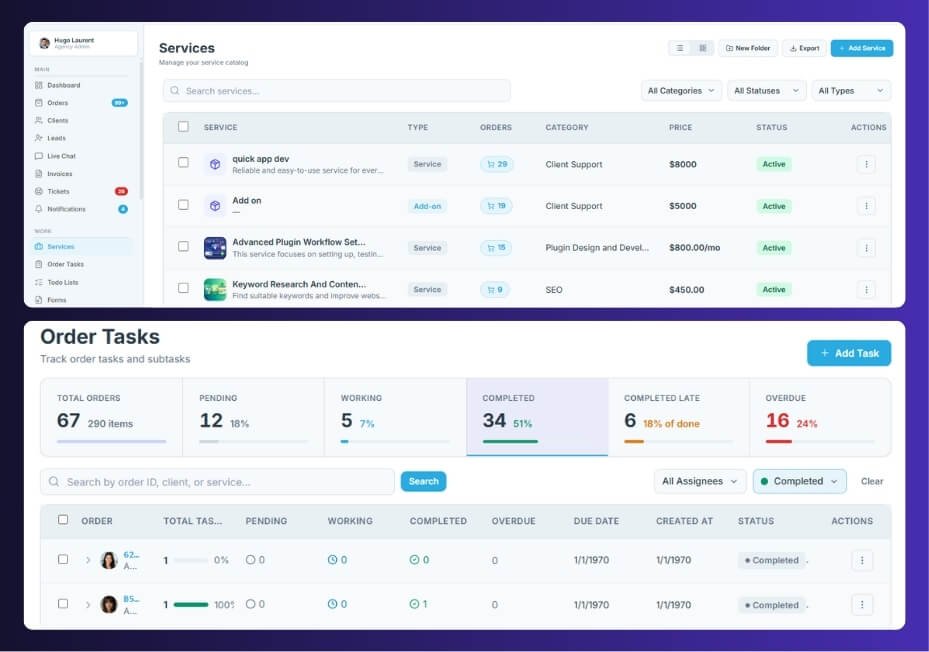
The services catalog is where you define what your agency sells before any order gets created. Each service gets a name, one-time or recurring pricing, optional add-ons, a deadline, and a default assignee. You can organise services into folders and categories, set per-service currency, control visibility (Public, Draft, or Private), and generate a shareable payment link so a client can purchase directly without you manually creating an order.
The per-service intake form is built right into the service record using a drag-and-drop editor with field types including Text, File upload, Date, and Select. Conditional show/hide rules let you surface only the fields that are relevant based on earlier answers.
Orders
An order is a client’s purchase of a specific service, and it’s the core work-item in Clientish. Each order moves through a status pipeline — with custom statuses you define per workspace — and every status change is logged in a trail so you can see exactly how the job progressed.
From an order record you can edit intake answers, download them as a PDF, add notes and tags, message the client in a shared thread, and run a separate internal team thread. You can also create an invoice or open a support ticket directly from the order without leaving the screen.
Order Tasks
Each order can have a checklist of tasks broken into individual items and sub-tasks. A dedicated Tasks screen aggregates these across every active order so you’re not opening orders one by one to check progress — you see everything in one view, filtered by assignee or status.
Task statuses include In Progress, Pending, Completed, Completed Late, and Overdue. Bulk delete and select-all are available for cleanup.
Work Assignment
Beyond order tasks, Clientish has a separate work assignment feature for team and remote members. You assign a piece of work with a written description and any relevant files, then track and review its status as it moves forward.
Per-member views show exactly which orders, tasks, tickets, and to-dos belong to each person — useful when you need a quick picture of someone’s current load without asking them.
Todo Lists
To-do lists are lightweight internal lists that exist separately from order tasks. You create a list, assign it to a team member, then add items inside it. Items can be reordered, marked complete, and given individual statuses.
Tabs filter by All, Pending, In Progress, and Completed. Permissions are split between list-level and item-level, so you can control who can manage a list versus who can just tick items off.
Forms
The standalone form builder handles public-facing forms — lead capture, order intake, questionnaires — separate from the per-service intake forms. It uses drag-and-drop with a live preview and supports a wide range of field types, including Payment, Service Select, file upload, signature, and address fields.
Conditional rules let earlier answers control what fields appear next. Submissions land in an entries inbox and can be exported as a spreadsheet. Published forms get a public link you can embed on your own site.
Files
Files in Clientish aren’t managed in a central media library — they’re attached where the work happens. Clients and team members upload files directly inside order message threads, and intake form submissions can include file fields. Work assignments also accept attached files.
This keeps project files in context rather than scattered across a shared drive, so anyone opening an order can find what they need without hunting through folders.
Communicating With Clients and Your Team
Clientish keeps conversations in their right context rather than dumping everything into one inbox. Client-facing messages stay separate from internal team threads, and support tickets have their own dedicated channel.
Order Messages
Every order has two message threads: one the client can see, and one that’s internal to your team. Both support file uploads. You can discuss delivery details with the client in the shared thread while keeping internal review notes where clients won’t stumble across them.
Client Live Chat
Clients can open a live chat from the client portal to reach the agency directly. It supports attachments, reactions, message editing, and typing indicators. If the client sends a message when nobody’s available, Clientish can fall back to email so the message doesn’t get lost.
Support Tickets
Clients raise tickets from the portal; the agency responds from its side. Both parties can edit or delete their own replies, and typing indicators show when someone’s actively responding. Clients can rate the resolution when the ticket closes, and you can create a ticket directly from an order with one click.
Team Messenger
Team Messenger is the internal side of communication — separate from anything client-facing. You can see per-member chat history from the team member’s record, and it appears on the workspace-wide status board alongside orders, tasks, and tickets.
Notifications
Notification preferences are configurable per workspace under Messaging settings. You can also review sent messages through the email log, set a retention period for that log, and configure business hours with an out-of-hours auto-reply so clients get an accurate response expectation rather than silence.
Managing Your Team
Clientish gives you a structured way to bring people into your workspace, control what they can see, and track who’s doing what across client work.
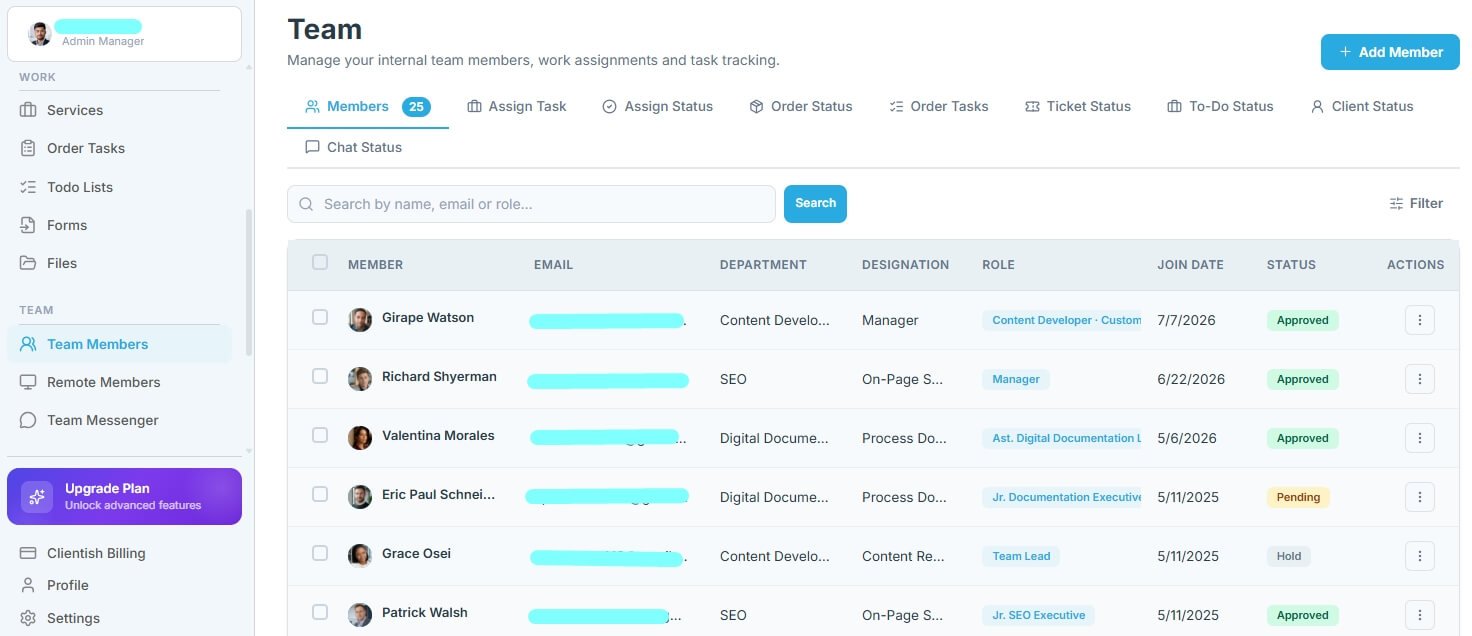
Team Members
In-house staff are added by invitation. Once a member accepts, you can edit their profile, suspend or remove them, reset their password, or sign in as them to see exactly what they see. Each member has their own view showing their assigned orders, tasks, tickets, clients, to-dos, chats, and activity log — so you can check workload without asking.
Remote Members
Remote members are a separate category from in-house team. They get their own login and permission set, which keeps contractors or outside collaborators scoped to only what they need. Settings handles their roles and statuses independently from the main team roster.
Roles and Permissions
Roles aren’t fixed system presets — you create and edit them per workspace. Each role carries its own permission set, and you can override permissions at the individual member level with a restore-to-defaults option if things get messy. Co-admin promotion is also available for members who need full access short of the account owner.
Work Assignment and Task Boards
You can assign specific pieces of work to a member with a description and supporting files, then track and review that assignment’s status from their record. Workspace-wide status boards cover orders, tasks, tickets, clients, to-dos, and chats in one view — and each board is exportable.
Billing, Payments and Money
Clientish handles the full financial side of client work — creating invoices, collecting payments through multiple gateways, running subscriptions, and managing refunds and client balances.
Invoices
You build invoices from line items drawn from your service catalog, then add discounts, coupons, tax, and a processing fee if needed. Clientish can send the invoice by email, generate a PDF, or give you a public pay link the client can open without signing in.
Invoice numbering is configurable: set a prefix, starting number, and zero padding. Each invoice has its own activity log.
Payments and Gateways
Clientish supports Stripe, PayPal, Paddle, aamarPay, SSLCommerz, and manual bank transfer. Manual transfers require the client to submit a transfer reference before the payment is accepted. You can run any gateway in test mode during setup and control which payment methods clients are allowed to use.
A per-gateway processing fee (percentage plus flat amount) can be passed on to the client with a custom label.
Subscriptions
Recurring services generate subscriptions clients can view and cancel from their portal. Payment methods can be saved, set as default, and toggled for auto-renewal.
Coupons
Coupons apply at the invoice level alongside any line-item discounts. Clients can also enter coupon codes at checkout through the portal.
Refunds and Balance
Refunds can be full, half, or a custom amount, with reason presets, initiated from either the invoice list or the invoice detail page. Separately, clients have an account balance they can top up and spend against orders — only one pending deposit at a time is allowed, and it’s cancellable.
Insights and Connections
The dashboard and reports sit at the top of the workspace — they’re where you step back from individual client records and see what’s actually happening across your whole agency. Exports, imports, and integrations handle the data flowing in and out.
Dashboard
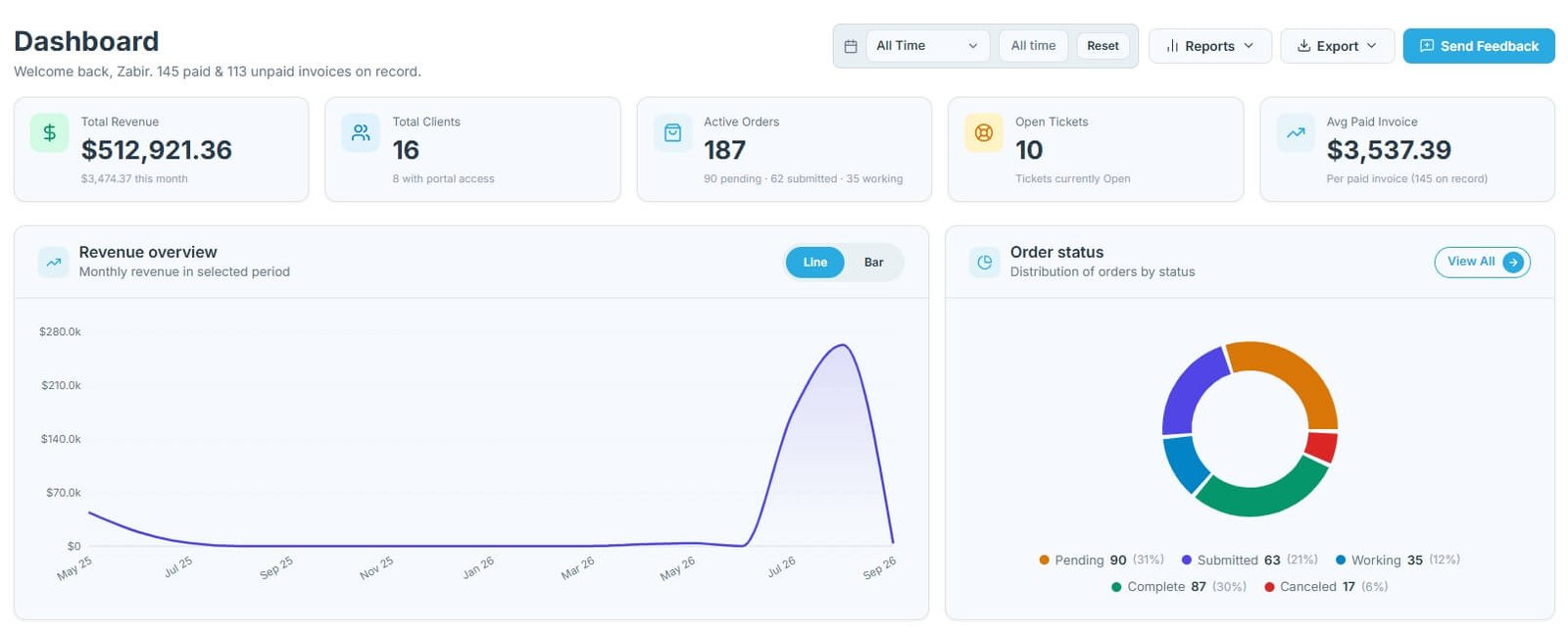
The agency dashboard opens with a date-range filter (today, 7 days, 30 days, this month, last month, custom, or all time) that controls every tile and panel on the page. KPI tiles show total revenue, total clients, active orders, open tickets, and average paid invoice. Below that, panels break down revenue over time, order-status distribution, a support tracker, and a feed of recent orders, invoices, clients, and activity.
If you’re setting up a new workspace, Clientish can seed it with demo data so the dashboard doesn’t look empty while you’re getting oriented — and you can clear all of it in one action when you’re ready to go live.
Reports
Seven dedicated report tabs go deeper than the dashboard tiles: Revenue, Services, Clients, Orders, Statuses, Accounts, and Coupons. Each tab has its own date-range filter and an export option, and access to each tab is gated by permission — so a team member can see order reports without touching revenue figures if that’s how you’ve set things up.
The Coupons report shows usage and breaks down which services a coupon was applied against, which is genuinely useful if you’re running promotional pricing across multiple services.
Search and Navigation
Clientish is structured around module-level screens — clients, orders, leads, invoices, tasks — rather than a single global search bar. Navigation is scoped to each area, with filters, saved status filters, and pagination within each module keeping records manageable as volume grows.
Exports and Imports
Most core modules support both import and export. Clients and leads can be imported from a spreadsheet using a downloadable template; the system de-duplicates by email on import. Orders, services, invoices, form entries, and ratings are all exportable. Reports export per tab. This makes it straightforward to pull data into a spreadsheet for your own analysis or to migrate records in bulk when you’re starting out.
Integrations
Clientish handles inbound email replies and bounce notifications through webhook connections with Mailgun, Postmark, SendGrid, and Amazon SES — so when you email a lead and they reply, that reply lands back inside the lead record rather than your personal inbox. Beyond that, the integrations settings are where you connect those services. There’s no listed Zapier or third-party automation connector in the current feature set.
The Client-Facing Side: Portals
Everyone who accesses your Clientish workspace gets a login door suited to their role. Clients get a branded self-service area. Your in-house team gets a focused work view. Remote members get their own equivalent. And you, as the agency admin, have your own account layer separate from all of them.
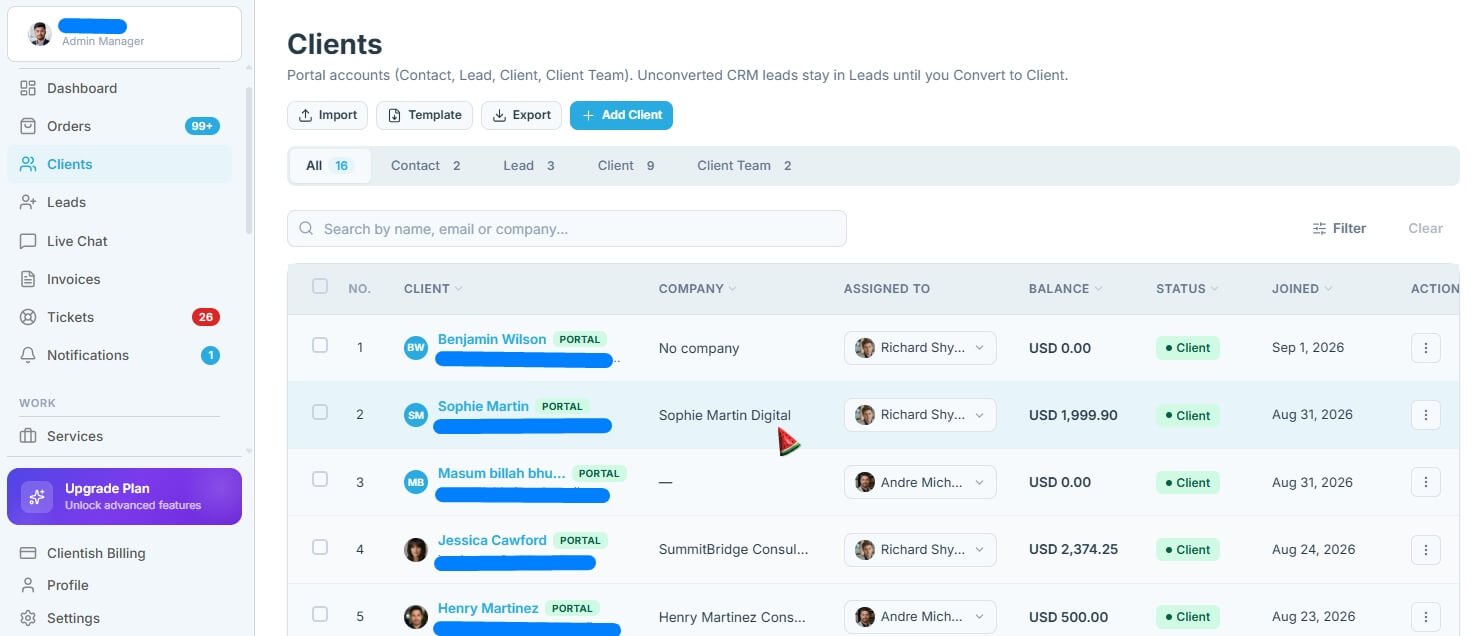
The Client Portal
When a client logs in, they land on a dashboard showing their orders, invoices, and account balance. From there they can browse your service catalogue, add services to a cart, apply coupon codes, and check out. They can view intake answers on any order, send messages with file attachments, request revisions, and rate a completed order.
On the financial side, clients can pay invoices online, download PDFs, manage saved payment methods, view payment history, and top up their balance. They can also raise and reply to support tickets, chat live with your team (with file attachments and reactions), and manage their own profile including avatar, password, and email address. The whole portal carries your agency’s logo and brand colours.
The Team Portal
In-house team members log into their own view rather than the full admin workspace. Each member sees only what their role permissions allow — their assigned orders, tasks, tickets, clients, to-dos, and chats — so the interface stays relevant to their actual workload rather than surfacing every record in the system.
The Remote Member Portal
Remote members are a distinct category from in-house staff, and they get their own equivalent portal. It works the same principle: access is scoped to what they’ve been assigned, keeping the view clean. This matters practically when you bring in contractors or outside collaborators who shouldn’t have visibility into the broader client roster or financials.
The Consumer Portal (Your Own Account)
The agency admin’s own billing account is separate from the main workspace. This is where account-level details and subscription management live, distinct from the workspace settings that control how clients and team members experience Clientish.
Public Pages
Clientish generates shareable public links at several points: individual services have a payment link you can send directly to a client, forms can be published to a public URL for embedding on your own site, and each order has a shareable portal link. Invoices also have a public pay link a client can open without signing in, which is useful when you need someone to settle a balance quickly without going through the full portal login.
Data, Security and History
Every workspace in Clientish is its own contained environment, and the platform gives you audit trails at every level so nothing disappears without a trace.
Tenant Isolation
Every database query in Clientish is scoped to the workspace that owns the row. One agency’s clients, orders, invoices, and settings are structurally inaccessible to any other workspace — there’s no shared pool where a misconfigured query could surface another account’s data.
Activity and Audit Logs
Clientish records activity logs at the workspace, client, order, invoice, ticket, lead, and team member level. Each log has a detail view, filters, and a configurable retention period you set in Settings under Other. That retention control matters: you decide how long history is kept rather than having it quietly age out.
Soft Deletes
When a record is removed, Clientish keeps its history rather than wiping it. A deleted order doesn’t leave orphaned replies pointing at nothing — the context stays intact for the audit trail.
Sign-in-as and Impersonation
Admins can sign in as a client, team member, or remote member to see their exact view. A persistent banner shows throughout the session, and one click exits back to the admin account. Nothing happens silently.
Password and Session Safety
Clientish supports two-factor authentication via emailed code or an authenticator app (TOTP), failed-attempt lockout, and Google reCAPTCHA. You can see all active sessions across devices and sign them all out at once. Changing your password automatically ends every other session.
Who Benefits From Clientish and How
Each audience gets something different from the same set of features. A freelancer cares about keeping five clients organised without hiring an assistant. An agency principal cares about what ten team members are doing across forty orders. The features are the same; the gains differ. For a deeper look at fit by audience, see the [Who Is Clientish For](#) guide — this section focuses on what each group actually gains from the features covered above.
How Agencies Benefit
Agencies with multiple services and recurring clients gain the most from the order pipeline and the connected billing. An order ties tasks, messages, intake answers, and an invoice to one place, so nothing gets reconstructed from email threads. Custom statuses mean you can map the pipeline to how your agency actually works, not a generic “open/closed” split.
Client assignment and per-member permission grids mean each account manager sees exactly what they own, and nothing they don’t.
How Freelancers Benefit
A freelancer running solo doesn’t need a team dashboard, but the client directory, invoicing, and client portal do real work. Clients can log in, check order status, pay invoices, and submit intake answers without needing to chase you by email. That alone cuts a material slice of weekly back-and-forth.
The lead chat by magic link means a prospective client can message you before they’ve created any account, which keeps early conversations from going cold.
How Consultants Benefit
Consultants typically sell time and advice rather than packaged deliverables, but the service catalog handles one-time pricing just as well as productized work. Lead follow-ups with scheduled emails and open tracking help when a proposal is sitting with a slow-moving decision-maker.
The per-client activity log means you always have a clean record of what was discussed, requested, and delivered — useful when a client’s memory of a project differs from yours.
How Service Businesses Benefit
Productized service businesses — think SEO, web design, content production — benefit most from the intake form builder and the revision workflow. Intake forms with conditional logic mean clients answer only relevant questions, and revision rounds give delivery a defined structure rather than open-ended back-and-forth.
Shareable payment links per service let you send a client straight to checkout without manually creating an order first.
How Teams and Remote Staff Benefit
In-house team members get a personal view showing their assigned orders, tasks, tickets, and to-dos in one place. Remote members get an equivalent portal scoped to what they’re actually assigned. Neither group has to ask a manager what they’re supposed to be working on today.
Work assignment with descriptions and file attachments means a team lead can brief a task properly rather than firing off a vague Slack message, and the status trail shows when the work was picked up and completed.
Is Clientish Right for You?
Clientish covers a lot of ground. That’s genuinely useful if your work is complex enough to need it — and genuinely overkill if it isn’t.
Signs Clientish Is a Fit
You’re likely a good fit if you’re selling services to multiple clients and tracking work across orders, tasks, invoices, and support at the same time. If you’ve been cobbling that together across separate tools — a spreadsheet for clients, a task app for work, an invoicing tool for billing — Clientish is built for exactly that situation.
Where Clientish Shines
Agencies running productized services get the most from the order-based workflow. When every client purchase maps to a service, moves through a status pipeline, and generates tasks and an invoice from the same record, the overhead drops noticeably. The client portal adds another layer of value if your clients expect a self-service experience rather than email back-and-forth.
Growing Into Clientish
If you’re a solo freelancer just starting out, some of the team, role, and permission features won’t apply yet. That’s fine — they’re there when you hire. You don’t have to use every module on day one, and Clientish offers a 7-day free trial with full feature access, so you can test the full scope before committing.
When Clientish Might Be More Than You Need
If you have one or two recurring clients, fixed scope, and no team, a lighter tool probably serves you better. Clientish’s depth is an asset when your client list is growing and operations are getting harder to track — less so when the whole business fits in a single spreadsheet.
Getting Started With Clientish
Sign up for an account and Clientish walks you through a multi-step onboarding wizard before you see a single client record. The wizard covers your agency type, company name, logo, brand colour, currency, and service categories — and it’s resumable, so you can stop mid-way and pick up where you left off.
Once inside, set your timezone in workspace settings so follow-ups, scheduled emails, and activity logs all reflect your actual working hours. Upload a light logo, a dark logo, and a favicon if you want the portal to look like yours. On a higher plan, point a custom domain at your workspace so clients never see the Clientish subdomain.
Before you invite anyone, connect your SMTP details under Messaging settings. That’s what Clientish uses to send invoice emails, client notifications, and lead follow-ups from your own address rather than a generic sender.
Next, build out your service catalog — add pricing, set deadlines, and attach an intake form to each service using the drag-and-drop form builder. Then configure at least one payment method under Money settings so clients can actually pay at checkout.
At that point you’re ready to add clients directly or share a service payment link and let clients arrive through checkout. Invite team members by email during setup or from the Team section later, and assign roles as you go.
If the dashboard looks thin and you want to get a feel for how everything fits together, seed the workspace with demo data. It populates orders, invoices, and client records with example content, and you can clear it all in one action when you’re done exploring.
Frequently Asked Questions
What is Clientish in simple terms?
Clientish is a platform where service agencies manage clients, sell services, deliver work, handle billing, and support clients — all from one workspace instead of several disconnected tools.
How does Clientish work?
Everything connects to a client record. You add a client (or convert a lead), create an order for a service, break that order into tasks, communicate through built-in message threads, and bill from the same screen. Each step feeds into the next.
Does Clientish send email from my own address?
Yes. You connect your own SMTP or a transactional mail provider, and Clientish sends invoice emails, client notifications, and lead follow-ups from your own address rather than a generic platform address.
Is an invoice created automatically for every order?
No. Clientish gives you a one-click option to create an invoice from an order, but it doesn’t generate one automatically. You control when the invoice goes out.
Can clients log into their own portal?
Yes. Each client gets a branded portal login where they can view orders, pay invoices, submit intake answers, request revisions, open support tickets, and chat with your team.
Does Clientish handle recurring billing?
Yes. Services can be set to recurring pricing, and clients can view and cancel their active subscriptions from the client portal.
Is Clientish only for agencies?
Clientish is designed for service businesses — agencies, freelancers, and consultants all fit the model. If you sell services to clients and need to manage the work that follows, the platform applies.
Is Clientish a project management tool?
Not primarily. Order tasks and to-do lists cover the work-tracking side, but the platform is built around the full client relationship — leads, billing, support, and delivery together — rather than project management as its core purpose.
Final Thoughts
Clientish covers the full arc of client work in one place — from capturing a lead and converting them into a client, through scoping services, taking orders, managing tasks, communicating, billing, and handling support. The reporting and team management sit on top of all of that without requiring a separate tool.
If you’ve been running those pieces across different apps, the main practical gain is that everything shares the same client record. An invoice ties back to an order, an order ties back to a service, a service ties back to a client — and you can see all of it without switching tabs.
The best way to judge whether it fits your workflow is to run a real client through it. Clientish offers a 7-day free trial with full feature access, so you can set up your services, bring in a client, and see how the order and billing flow actually behaves before committing.
